Professional container spreader solutions. We offer a comprehensive range of products, including electric, hydraulic, and tilting spreaders with lifting capacities ranging from 40 to 80 tons, designed for the efficient loading and unloading of 20-foot, 40-foot, and 45-foot containers.
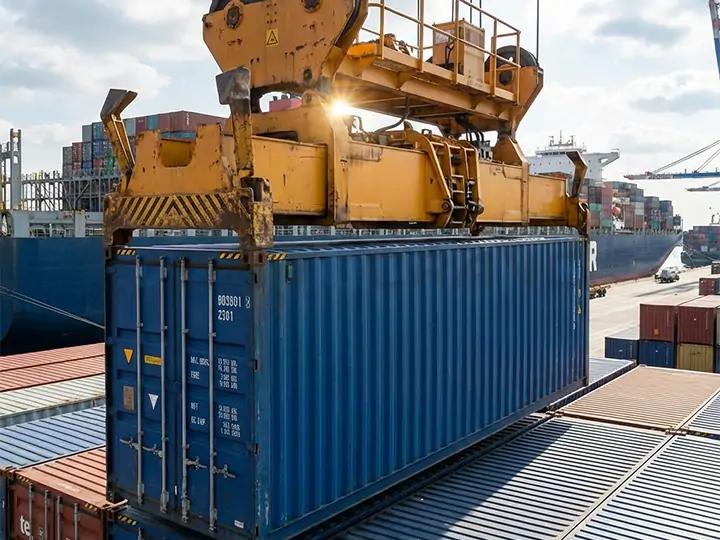
A container spreader is a specialized lifting device designed specifically for container handling operations in ports, terminals, rail yards, and logistics facilities. This equipment is mounted on STS ship-to-shore cranes, gantry cranes, Reach Stacker cranes, RTG cranes, RMG rail mounted gantry cranes, and container straddle carriers to facilitate container transshipment operations.
Our container spreaders are designed to meet diverse operational requirements, from light-duty terminal applications to heavy-duty port operations. Each model possesses unique advantages and is custom-tailored to suit specific container handling scenarios.
Electric Container Spreader
Hydraulic Container Spreader
Tilting Container Spreader
Modern container spreaders incorporate a range of advanced technologies, including automatic locking systems, load monitoring, anti-sway features, and operator assistance functions, designed to maximize loading and unloading efficiency and ensure operational safety. Our spreaders comply with all relevant international standards (including ISO 3874 and EN 13155) as well as the requirements of port authorities.
Types of Container Spreader
We offer three main configurations of container spreaders, including electric container spreaders, a hydraulic container lifting spreader, single-tilting container spreaders, and double-tilting spreaders. Below, I will introduce them.
Electric Container Spreader
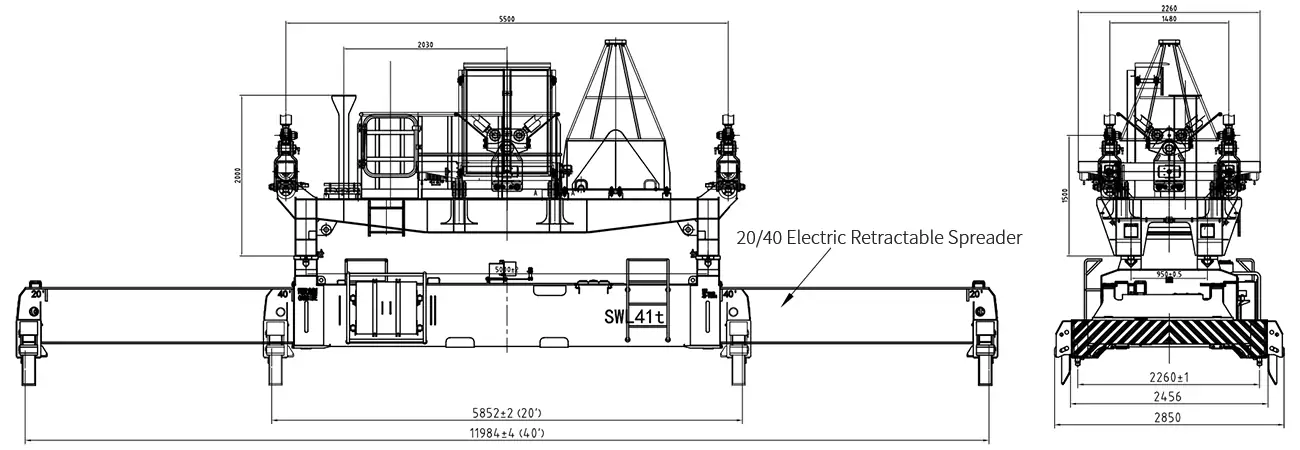
Electric container spreaders utilize an electric drive system, with an electric control system that automatically locks the container at all four corners via twist locks, enabling the gripping, lifting, and releasing of standard containers such as 20-foot and 40-foot units. Thanks to their high level of automation, operational efficiency, and safety, electric container spreaders have become the industry standard for high-throughput container terminals and automated ports.
Application
High-throughput container terminals
Automated and semi-automated container handling systems
Ports requiring high handling efficiency
Operating environments that prioritize energy efficiency and environmental performance
Facilities with well-developed electrical infrastructure
Features and Advantages
Motor control system drives all spreader functions
Powered via crane cable reel or slip ring assembly
Precise control of telescoping and container spreader twist lock
Integrates with terminal automation systems
Low operating noise
Minimal system components, resulting in low maintenance costs
Specification
Model
20ft Model
20-40ft Model
40ft Model
Twin 20ft Model
Capacity
40 tons
50 tons
65 tons
2 × 40 tons
Container Size Range
20ft fixed
20ft – 40ft telescopic
40ft fixed
Twin 20ft
Spreader Length
6,058 mm
6,058 – 12,192 mm
12,192 mm
6,058 mm (each)
Spreader Width
2,438 mm
2,438 mm
2,438 mm
2,438 mm
Overall Height
850 mm
950 mm
1,050 mm
900 mm
Self Weight
3,800 kg
5,500 kg
6,200 kg
8,500 kg
Telescoping Speed
N/A
45 m/min
N/A
N/A
Twist-Lock Type
Fully automatic
Fully automatic
Fully automatic
Fully automatic
Power Supply
380-480V, 50/60Hz
380-480V, 50/60Hz
380-480V, 50/60Hz
380-480V, 50/60Hz
Control System
PLC + HMI
PLC + HMI
PLC + HMI
PLC + HMI
Safety Features
Load monitoring, anti-collision, emergency stop
Load monitoring, anti-collision, emergency stop
Load monitoring, anti-collision, emergency stop
Load monitoring, anti-collision, emergency stop
Standards Compliance
ISO 3874, EN 13155, FEM 4.004
ISO 3874, EN 13155, FEM 4.004
ISO 3874, EN 13155, FEM 4.004
ISO 3874, EN 13155, FEM 4.004
Hydraulic Container Spreader
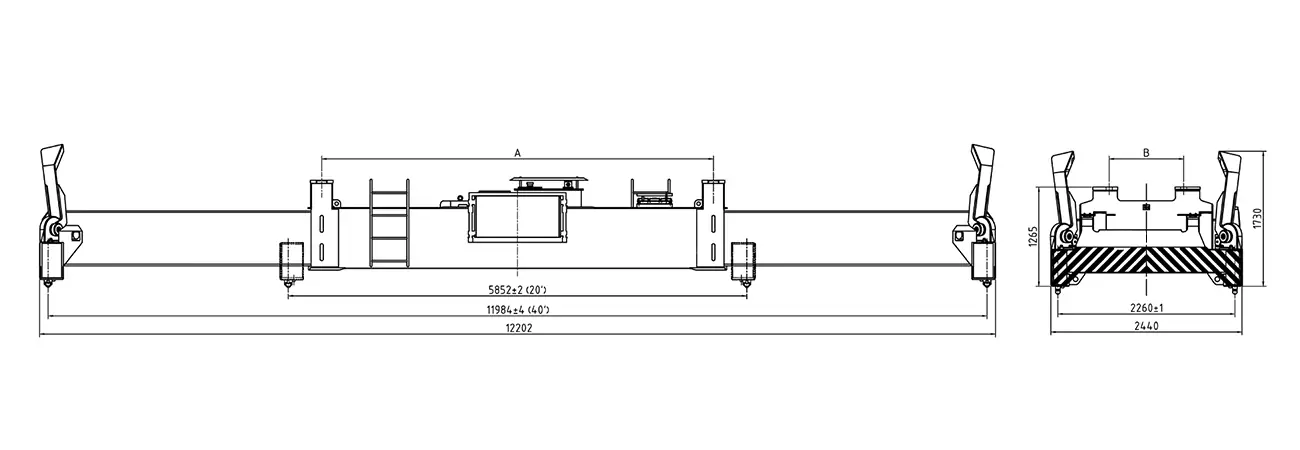
Hydraulic container spreaders are equipped with hydraulic cylinders as their drive system. Compared to electric container spreaders, they rely on hydraulic power, offering a stable structure and robust load-bearing capacity. These spreaders are specifically designed for heavy-duty operations and are well-suited for demanding and harsh working environments.
Application
Heavy-duty port operations involving frequent and high-intensity work cycles
Mobile port crane equipment
Multi-purpose terminals requiring the handling of various container conditions
Operations conducted in extreme temperature environments
Facilities with exceptionally high requirements for system robustness
Features and Advantages
Hydraulic cylinders and motors provide a powerful and reliable driving force
Users may opt for an independent hydraulic system or utilize the crane’s existing hydraulic power source
Maintains exceptional performance even under extreme temperature conditions
Operates stably in harsh marine environments
Capable of handling jammed or damaged containers
Mature and reliable technology
Specification
Model
20ft Model
20-40ft Model
40ft Model
45ft Model
Capacity
45 tons
55 tons
70 tons
75 tons
Container Size Range
20ft fixed
20ft – 40ft telescopic
40ft fixed
45ft fixed
Spreader Length
6,058 mm
6,058 – 12,192 mm
12,192 mm
13,716 mm
Spreader Width
2,438 mm
2,438 mm
2,438 mm
2,438 mm
Overall Height
880 mm
980 mm
1,080 mm
1,120 mm
Self Weight
4,200 kg
6,200 kg
6,800 kg
7,500 kg
Telescoping Speed
N/A
40 m/min
N/A
N/A
Twist-Lock Type
Semi-automatic hydraulic
Semi-automatic hydraulic
Semi-automatic hydraulic
Semi-automatic hydraulic
Hydraulic Pressure
160 bar
160 bar
160 bar
200 bar
Oil Flow Rate
45 L/min
65 L/min
55 L/min
70 L/min
Control Valves
Pilot-operated proportional
Pilot-operated proportional
Pilot-operated proportional
Pilot-operated proportional
Hydraulic System
Self-contained or crane-supplied
Self-contained or crane-supplied
Self-contained or crane-supplied
Self-contained or crane-supplied
Temperature Range
-40°C to +60°C
-40°C to +60°C
-40°C to +60°C
-40°C to +60°C
Standards Compliance
ISO 3874, EN 13155, FEM 4.004
ISO 3874, EN 13155, FEM 4.004
ISO 3874, EN 13155, FEM 4.004
ISO 3874, EN 13155, FEM 4.004
Tilting Container Spreader
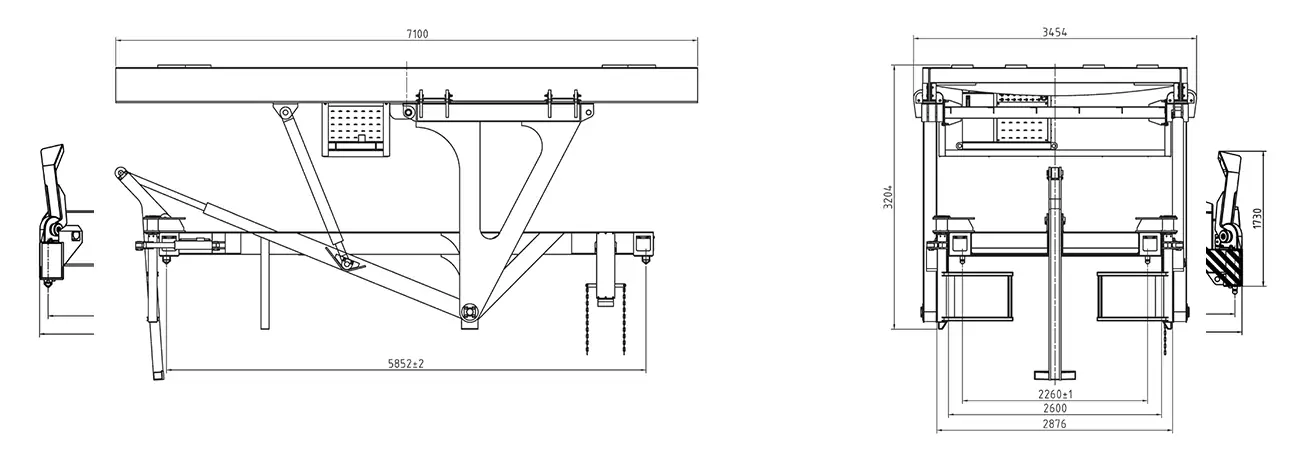
Tilting container spreaders are equipped with a hydraulic tilting mechanism, allowing users to adjust the container’s tilt angle during lifting operations. Single-tilt models can only tilt in one direction. They feature a simple design and are relatively low-cost. Dual-tilt models, on the other hand, can tilt in two directions, offering greater operational flexibility and better adaptability to complex working conditions. However, they have a relatively more complex structure and higher cost, and are commonly used in environments requiring multi-angle loading and unloading or multi-station operations.
Application
Operations involving tilting storage racks or platforms
Shipboard operations requiring the positioning of containers within tilting guide rails
Specialized cargo handling operations requiring controlled tilting and positioning
Suitable for terminal environments with complex or restricted container access geometries
Ro-Ro (Roll-on/Roll-off) operations with specific requirements for deck container storage
Features and Advantages
The hydraulic tilt system provides a tilt angle range of ±5° to ±8° (Note: Depending on the specific model)
Maintains precise control over the container during tilting operations
An integrated safety system prevents unintended tilting movements
Compatible with both electric and hydraulic base systems
Significantly improves the operator’s field of view
Frame structure specifically reinforced for tilting loads
Specification
Model
20-40ft Electric Tilting
20-40ft Hydraulic Tilting
40ft Heavy-Duty Tilting
Capacity
50 tons
60 tons
75 tons
Container Size Range
20ft – 40ft telescopic
20ft – 40ft telescopic
40ft fixed
Spreader Length
6,058 – 12,192 mm
6,058 – 12,192 mm
12,192 mm
Spreader Width
2,438 mm
2,438 mm
2,438 mm
Overall Height
1,050 mm
1,100 mm
1,150 mm
Self Weight
6,800 kg
7,500 kg
8,200 kg
Tilt Angle Range
±5°
±8°
±8°
Tilting Speed
3°/second
2.5°/second
2°/second
Tilt Drive System
Electric servo motor
Hydraulic cylinder
Hydraulic cylinder
Telescoping System
Electric motor
Hydraulic cylinder
N/A
Container Spreader Manufacturer and Supplier
As a leading manufacturer and supplier of container spreaders, VOITTO Crane leverages over two decades of engineering expertise to provide customized lifting solutions for ports, terminals, and material handling operations worldwide. We offer a comprehensive product portfolio—ranging from electric container spreaders designed for high-speed automated terminals to heavy-duty hydraulic spreaders built for demanding, heavy-load applications—enabling us to fully meet all of our customers’ container handling needs.
If you require container spreader solutions, please contact us to discuss your specific needs.
FAQ
What is a container spreader and how does it work?
Container spreaders are typically attached to port cranes. Users employ them to load and unload containers. Their operating principle involves adjusting their length—via a telescoping mechanism—to match containers of various sizes (such as 20-foot, 40-foot, or 45-foot units), and subsequently engaging the twistlocks located at the four corners to insert them into the container’s corner castings. Modern container spreaders are typically equipped with automated control systems to manage the telescoping adjustments, the locking and unlocking of the twistlocks, and safety interlock mechanisms.
How long does a container spreader last?
Container spreaders typically offer a service life of 25 to 35 years. Their actual service life depends on the intensity of their duty cycles, operating environment, maintenance quality, and the robustness of their initial design.
What maintenance does a container spreader require?
Container spreaders must undergo daily pre-operation inspections to verify the operational status of the swivel locks, the telescoping function, and the safety systems. Monthly preventive maintenance includes lubricating moving parts, inspecting wear-prone components, checking electrical connections, and (for hydraulic models) inspecting the hydraulic system. Annual comprehensive inspections cover detailed structural inspections, non-destructive testing of critical components, load testing, and the replacement of wear-prone components as needed.
What safety features are included in container spreaders?
A real-time load monitoring system featuring overload protection (typically configured to trigger an alarm at 110% load and an automatic cutoff at 125%). A container-in-position detection function prevents the inadvertent operation of twistlocks when they are not correctly engaged with the container. Additional features include an automatic twistlock position verification function, anti-collision sensors, an emergency stop system with a redundant design, and fail-safe twistlock mechanisms capable of maintaining their grip in the event of a power failure. Furthermore, the system’s operational status can be visually and audibly confirmed via dedicated indicators.
Qualification and Honor
Engineered Strength, Global Crane Supplier
service
Exclusive and Considerable, Customer First.
01
Reliable and Customized Solutions
Our pre-sale team provides consultations, tailoring solutions to your needs and environment.
Offer customization options for lifting capacity, span and lifting height etc. to meet specific needs.
02
Updated Production Process
Real-Time Progress Updates: Weekly reports and PM communication.
3-5 years warranty and free replacement for non-manufacturing defects.
24/7 online support and on-site assistance for crane issues.
FAQ
Engineered Strength, Global Crane Supplier
Can it be customized?
Yes, lifting capacity, span, height, structure type, and hoist options can be customized to match specific working conditions.
Do you ship internationally?
Yes, international shipping and export support are available for global customers.
What’s included in your after-sales service?
We offer comprehensive after-sales service, including regular maintenance, rapid technical support, and spare parts supply. The standard warranty period is 1 year, with options for extension based on your needs.
What’s the delivery time for an overseas order?
Transit time varies depending on many factors, including the destination of the goods, distance, shipping method and shipping service provider, etc. Generally speaking, international shipping may take about a month.
Get In Touch
Please feel free to leave a message. We will reply in 24 hours.
Please specify your requirement by referring to the following aspects:
Which crane product do you need?
What is the maximum lifting capacity (in tons) required for your project?
Could you specify the lifting height (in meters) needed?
Can you provide details on the working environment, such as ground conditions, space limitations, and any obstacles?
What is the expected frequency of use and the duration of the project?





 English
  Español
  Português
  العربية
  Français
  Русский