The European FEM standard gantry crane is a high-performance lifting device. Designed in accordance with advanced European FEM standards, this unit combines a lightweight structure, energy-efficient features, and precise control. The equipment is equipped with European wire rope electric hoists, variable frequency drive (VFD) technology, and an optimally designed steel structure. Compared to traditional gantry cranes, it offers lower wheel pressure, greater lifting height, smoother operation, and reduced maintenance requirements. These cranes are available in both single-girder and double-girder configurations, with lifting capacities ranging from 1 metric ton to over 320 metric tons, and can be customized to meet the needs of various industrial applications.
A FEM standard gantry crane is available in two structural configurations: single-girder systems with rated lifting capacities ranging from 1 to 32 metric tons, and double-girder models with lifting capacities ranging from 5 to 320 metric tons. Both configurations comply with FEM 1.001 and ISO 4305 standards, are equipped with redundant safety systems, and feature a hoisting speed of 2 meters per second. Typically, users operate this equipment to perform material handling tasks in the steel manufacturing, shipbuilding, and industrial assembly sectors. The equipment is CE-certified and designed for a service life of up to 25 years.
What Is a FEM Standard Gantry Crane?
The FEM-standard gantry crane is a floor-mounted lifting system. This European gantry crane features a combination of a welded box-section main girder and bolted end beams, which reduces installation time by 30% compared to riveted structures. In addition, the single-girder system has a span of 6 to 18 meters and occupies minimal horizontal space, while the double-girder configuration offers a larger span of 15 to 35 meters. Thanks to the integration of redundant load-limiting brakes, dual suspension points, and precision load cells, the FEM-certified system achieves 99.2% uptime.
Single Girder Gantry Crane
Double Girder Gantry Crane
Its modular design concept allows for lifting capacity upgrades without replacing the main structure, thereby extending the equipment’s service life to over 25 years. Therefore, when selecting the appropriate girder configuration, users must comprehensively consider the factory layout, load frequency, and production output requirements.
Types of FEM Standard Gantry Cranes
A single girder gantry crane features a single welded steel girder mounted on four legs. They have a lifting capacity of 1 to 32 metric tons, a span of 6 to 18 meters, and a lifting height of 6 to 12 meters. This compact system is ideal for spaces with limited headroom, requiring 18% less headroom than double-girder designs. In addition, the single-girder models feature a simplified hoist trolley assembly, which extends maintenance intervals and reduces spare parts inventory requirements by 25%.
Double girder gantry cranes feature two parallel main girders. This model has a lifting capacity ranging from 5 to 320 metric tons, a span of 15 to 35 meters, and a lifting height of 10 to 25 meters. This design distributes the load across two support points, thereby enhancing stability during dynamic lifting operations. As a result, the double-girder system is well-suited for handling heavy manufacturing equipment, large shipbuilding components, and continuous industrial operations.
Advantages and Features
European gantry cranes are designed in accordance with advanced European FEM standards, combining lightweight construction, energy-efficient performance, and intelligent control technology. Below, I will outline the main advantages and features of the FEM standard gantry crane.
Lightweight Design: Compared to traditional gantry cranes, its dead weight is reduced by up to 30%, effectively lowering wheel load and reducing foundation construction costs.
Greater Hook Travel: The low-headroom design maximizes lifting height.
Energy-Efficient and High-Performance: Advanced drive systems and high-efficiency motors reduce energy consumption by up to 40%.
Precise Control: Variable-frequency control ensures smooth operation, precise positioning, and minimizes load sway.
Low Maintenance Requirements: Modular components and a reliable drive system minimize maintenance needs and downtime.
Long Service Life: High-quality components and an optimized structural design ensure the equipment’s durability.
Support for Smart Automation: European gantry cranes can be integrated with PLC control, anti-sway systems, remote monitoring, and automated material handling solutions.
Application
Users operate a FEM Standard gantry crane to perform material handling tasks in the manufacturing, logistics, port, shipbuilding, wind power, and heavy industry sectors.
Manufacturing Plants: Users operate European gantry cranes in manufacturing workshops to handle the transport and assembly of large components.
Steel Structure and Metal Processing Industries: Operators use FEM standard gantry crane to lift and transport steel and large metal components, as well as to move them between welding stations.
Warehouses and Logistics Centers: European gantry cranes handle loading, unloading, stacking, and logistics operations for heavy cargo.
Ports and Terminals: Users employ European gantry cranes to perform loading, unloading, and transshipment operations at container and bulk cargo yards.
Shipbuilding and Ship Repair Yards: Shipyard operators use European FEM Standard gantry cranes to lift ship hull sections and large structural components.
Wind Power and New Energy Industries: Users operate this equipment to lift wind turbine blades, large components, tower sections, and nacelles.
Precast Components and Construction Industries: Operators use it to lift precast concrete beams, PC components, and large building modules.
Open-Air Stockyards and Heavy-Duty Material Yards: Users operate these cranes to transport steel, ore, and large equipment.
Rail Transit and Infrastructure Construction: Operators use FEM Standard gantry cranes to lift subway structural components, precast bridge sections, and large structural components for rail transit systems.
Smart Factories and Automated Workshops: European-style gantry cranes handle materials and schedule operations in smart production lines and unmanned systems.
Specification
Parameter
Single-Girder 1–5 t
Single-Girder 5–16 t
Single-Girder 16–32 t
Double-Girder 5–100 t
Double-Girder 100–320 t
Lifting Capacity
1–5 t
5–16 t
16–32 t
5–100 t
100–320 t
Span Width
4–6 m
6–12 m
8–18 m
15–25 m
25–35 m
Lifting Height
6–8 m
6–10 m
8–12 m
10–18 m
12–25 m
Hoisting Speed
2 m/s
2 m/s
2 m/s
2 m/s
2 m/s
Trolley Speed
20–30 m/min
20–30 m/min
20–40 m/min
30–50 m/min
30–50 m/min
Bridge Travel
15–20 m/min
15–20 m/min
20–25 m/min
20–30 m/min
20–30 m/min
Motor Power
2.2 kW
3.7 kW
5.5 kW
15–37 kW
45–75 kW
Duty Class (FEM)
A5
A5
A5
A5
A5
Load Cell Accuracy
±0.5%
±0.5%
±0.5%
±0.5%
±0.5%
Electrical Supply
380–480V 3ph
380–480V 3ph
380–480V 3ph
380–480V 3ph
380–480V 3ph
Standards
FEM 1.001 ISO 4305
FEM 1.001 ISO 4305
FEM 1.001 ISO 4305
FEM 1.001 ISO 4305
FEM 1.001 ISO 4305
Note: The above specifications are standard. VOITTO Crane offers customized, non-standard solutions.
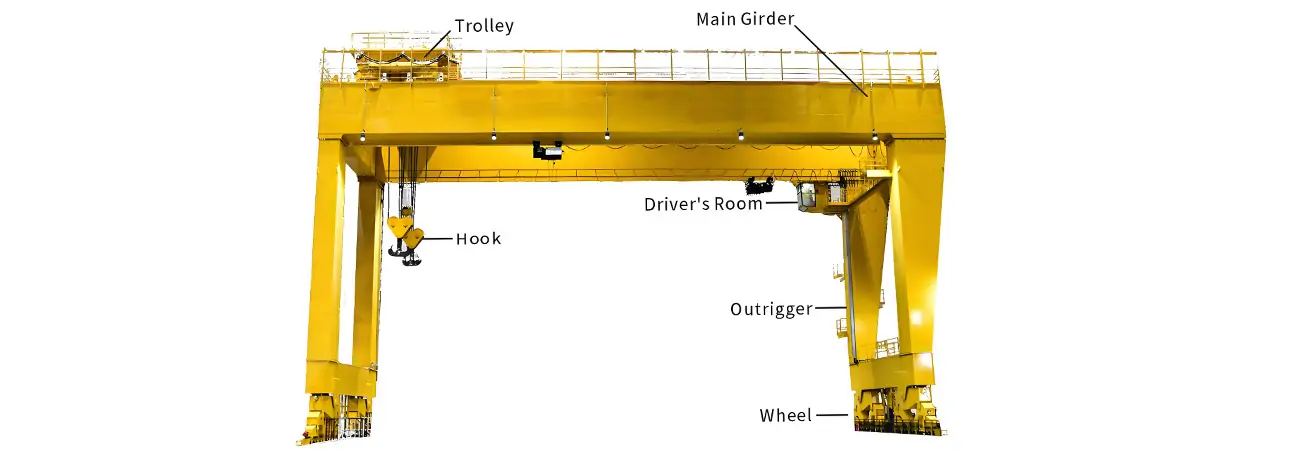
Parts of FEM Standard Gantry Crane
The FEM standard gantry crane integrates twelve major mechanical, electrical, and structural components, which are designed to work together to perform lifting tasks.
Main Beam (Single or Double Beam): Welded box-section steel beams are used as the primary load-bearing members.
End Beams: Four-wheeled trolleys mounted on the legs transfer the structural load to the foundation.
Legs and Frame: Welded structural steel columns extend from the foundation to the height of the main girder.
Trolley Assembly: An electrically powered hoisting trolley equipped with four precision-ground steel wheels, sealed tapered roller bearings, and hardened rail contact surfaces.
Hoisting Mechanism: A motor-driven drum, wire rope, or chain winding system.
Load Sensor: A precision force sensor mounted at the suspension point that transmits weight data to the control system in real time.
Braking System: Electromagnetic brakes with spring-applied, pneumatically released operation.
Motor Drive System: Three-phase AC squirrel-cage induction motor coupled to a reduction gearbox.
Variable Frequency Drive (VFD): A power conversion unit compliant with the functional safety level of EN 61800-5-1, enabling smooth acceleration and dynamic deceleration.
Electrical Control Cabinet: A PLC-based logic controller housed in a stainless steel enclosure compliant with IEC 60529 IP55 and NEMA 4X standards, integrating relays, contactors, and a wireless receiver module.
Wireless Remote Control System: A battery-powered handheld transmitter featuring dual-channel redundancy and an integrated emergency stop device.
Safety Interlocks and Limit Switches: A combination of electrical travel limit switches (covering hoisting, trolley travel, and gantry traverse) and mechanical overload shear pin devices.
European Gantry Crane Price Guide
The following comprehensive price matrix details capacity bands, dimensional parameters, and estimated investment ranges for both single-girder and double-girder systems across typical industrial applications.
Type
Capacity
Span (m)
Lifting Height (m)
Price Range (USD)
Single Girder
1–5 ton
5–18
6–12
$8,000 – $25,000
Single Girder
5–10 ton
8–22
6–15
$15,000 – $45,000
Single Girder
10–20 ton
10–25
8–18
$30,000 – $80,000
Double Girder
10–50 ton
10–30
8–20
$35,000 – $120,000
Double Girder
50–100 ton
15–35
10–25
$80,000 – $250,000
Double Girder
100–320 ton
18–45
12–35
$200,000 – $600,000
Note: The above prices are for reference only. Actual costs depend on the specific specifications.
European Gantry Crane Manufacturer and Supplier
VOITTO Crane manufactures single-girder and double-girder gantry cranes in compliance with FEM standards and has 25 years of professional experience in the industrial lifting infrastructure sector. Our business spans markets across Europe, South America, Southeast Asia, and Central Asia, and we have successfully delivered more than 480 crane systems. Customer feedback indicates that since the equipment was put into service, operational cycle efficiency has increased by 22%.
In addition, we have the capability to customize solutions for special operating conditions, including harsh environments such as cold storage facilities at -40°C, marine salt fog environments, and explosion-proof environments compliant with the ATEX Directive. Therefore, whether you need a compact single-girder solution for confined spaces or a large double-girder system for continuous heavy-duty operations, we can tailor a solution to your production plans. If you need a FEM standard gantry crane solution, please contact us.
Specialized in Overhead Crane, Gantry Crane, Jib Crane, Port Crane & EOT Crane export solutions. 10+ years helping global clients with pre-sales consultation, capacity selection and site-specific configurations.
What is the primary difference between single-girder and double-girder FEM Standard Gantry Cranes?
Single-girder systems (1–32 tons) mount a single beam on four legs, occupying minimal horizontal space in 4–18-meter spans, ideal for compact facilities. Double-girder configurations (5–320 tons) employ dual parallel beams, accommodating 15–35-meter spans with superior load stability.
How long does the installation of a FEM Standard Gantry Crane typically require?
Single-girder installation requires 6–10 working days for foundations, assembly, and FAT (Factory Acceptance Testing). Double-girder systems require 10–16 working days due to the larger structural scope. Furthermore, facility preparation—including concrete curing time—extends timelines by 5–7 days. Therefore, from order to full operation, expect 10–14 weeks for single-girder; 12–16 weeks for double-girder.
Can single-girder systems be retrofitted with double-girder capacity upgrades?
Full conversion from single to double-girder requires complete structural replacement—not practical economically. However, auxiliary beam systems can extend single-girder capacity by 10–15% without major modifications. Therefore, for anticipated capacity growth beyond 32 tons, we recommend initial double-girder installation planning. Consequently, this strategic approach prevents costly mid-life conversions.
What preventive maintenance schedule applies to FEM Standard Gantry Cranes?
Preventive maintenance includes weekly visual inspections, monthly lubrication (single-girder: 2 points, double-girder: 4 points), quarterly electrical panel audits, and annual third-party NDT (non-destructive testing) of welded joints per EN 13134 ultrasonic protocols. Therefore, adhering to this schedule extends single-girder life by 2–3 years, double-girder by 3–5 years.
Are FEM Standard Gantry Cranes suitable for outdoor or marine environments?
Yes—outdoor deployment requires hot-dip galvanized steel (EN ISO 1461 minimum 85 µm thickness) and NEMA 4X stainless-steel electrical enclosures. Moreover, wireless controls must comply with EN 60204-32 industrial electromagnetic immunity. Therefore, coastal and offshore facilities benefit from marine-duty ratings (IEC 60721-3-3C5) protecting equipment against salt spray. Both single and double-girder configurations support environmental upgrades.
Qualification and Honor
Engineered Strength, Global Crane Supplier
service
Exclusive and Considerable, Customer First.
01
Reliable and Customized Solutions
Our pre-sale team provides consultations, tailoring solutions to your needs and environment.
Offer customization options for lifting capacity, span and lifting height etc. to meet specific needs.
02
Updated Production Process
Real-Time Progress Updates: Weekly reports and PM communication.
3-5 years warranty and free replacement for non-manufacturing defects.
24/7 online support and on-site assistance for crane issues.
FAQ
Engineered Strength, Global Crane Supplier
How are large gantry cranes shipped overseas?
Large gantry cranes are typically shipped overseas through modular disassembly, where the crane is broken down into major components (beams, legs, hoists) for containerized transport. For mega-cranes, we use specialized heavy-lift vessels equipped with reinforced decks, and critical parts are protected with anti-corrosion coatings during transit.
What voltage standards do your gantry cranes support?
Our gantry cranes support global voltage standards to ensure seamless operation worldwide. Solve any concerns you have about voltage.
Can it be customized?
Yes, lifting capacity, span, height, structure type, and hoist options can be customized to match specific working conditions.
Can you design a gantry crane for extreme outdoor conditions?
Yes, our gantry cranes can be used stably in harsh environments such as strong winds or low temperatures due to their special construction and material structure.
Do you ship internationally?
Yes, international shipping and export support are available for global customers.
Get In Touch
Please feel free to leave a message. We will reply in 24 hours.
Please specify your requirement by referring to the following aspects:
Which crane product do you need?
What is the maximum lifting capacity (in tons) required for your project?
Could you specify the lifting height (in meters) needed?
Can you provide details on the working environment, such as ground conditions, space limitations, and any obstacles?
What is the expected frequency of use and the duration of the project?




 English
  Español
  Português
  العربية
  Français
  Русский