
If users select the wrong winch for crane, it will not only slow down operations but also pose serious safety hazards. Whether you are selecting equipment for bridge cranes in steel mills, gantry cranes in shipyards, or container handling cranes in ports, the winch is always the “mechanical heart” of the entire lifting system. If the wrong model is chosen, users face a range of serious consequences, including premature equipment failure, regulatory violations, and substantial costs due to repair downtime.

Hydraulic Winch

Electric Winch
This guide covers the main types of hoisting winches commonly used in various crane systems and explains how to select the appropriate hoist specifications based on actual load requirements and operating conditions. In addition, the guide highlights key factors to prioritize when selecting industrial-grade hoists for lifting applications. This guide will help users make informed decisions and ask more targeted and professional questions when communicating with suppliers.
- 1 What Is a Crane Winch and Why Does It Matter
- 2 Main Types of Winches Used on Cranes
- 3 Technical Parameters
- 4 Selecting a Winch Motor for Crane Systems
- 5 Winch Applications by Crane Type
- 6 Summary
- 7 Crane Winch for Sale
-
8
FAQ
- 8.1 What is the difference between a winch and a hoist on a crane?
- 8.2 What duty class winch do I need for a gantry crane in a fabrication yard?
- 8.3 Can I use a hydraulic winch on an indoor overhead crane?
- 8.4 How do I calculate the required pulling force for a crane winch?
- 8.5 What wire rope specification is standard for industrial crane winches?
- 8.6 How often does a crane winch need maintenance?
What Is a Crane Winch and Why Does It Matter
A crane winch is a mechanical device. This equipment lifts, lowers, or positions heavy loads by winding or unwinding steel wire ropes. In overhead cranes and gantry cranes, it serves as the core component of the lifting system. In port cranes and marine lifting equipment, however, winches operate under more demanding duty cycles and harsher environmental conditions.
Unlike standard winches used in off-road or marine recovery, industrial winches for cranes must meet strict classification standards. The most widely referenced are FEM 1.001 (European standard), ISO 4301, and GB/T 3811. These define working groups from M1 to M8 based on load spectrum and utilization class — a critical factor that separates a winch rated for occasional lifts from one built for continuous operation in a busy port terminal.
The winch motor, drum, gearbox, and braking system must all work together under rated load conditions. Weakness in any one component shortens the service life of the entire hoist assembly.
Main Types of Winches Used on Cranes
Below, I will introduce the types of winches specifically designed for lifting equipment and their advantages.
Electric Winch for Crane Applications
For overhead cranes and gantry cranes used in manufacturing, warehousing, and general industrial applications, electric winches are the most common choice. They draw power directly from the facility’s electrical supply, providing stable and consistent lifting performance.
Most industrial electric winches used in gantry cranes are powered by three-phase electricity—typically at 380V/50Hz or 460V/60Hz, depending on regional standards. Although single-phase and 12V winch models are available, their applications are limited to light-duty or portable scenarios and are not suitable for fixed crane systems.
Key advantages of electric winches:
- The winch electrical system operates in integration with a variable frequency drive, enabling precise speed control.
- Compared to hydraulic systems, this equipment offers lower operating costs.
- This unit is easily integrated with crane control systems and PLC logic.
- The electric power winch is suitable for use in indoor and climate-controlled environments.
Note: When selecting an electric winch for a gantry crane, users must pay close attention to its duty classification rating. Lifting systems rated M4 or M5 are suitable for moderate-intensity manufacturing and production applications. Conversely, environments such as port areas or high-frequency logistics operations typically require equipment rated M6 or higher.Duty class is also the single biggest variable in crane winch pricing — two units with identical rated tonnage can differ by 50% or more in cost depending on their duty rating. Our winch cost guide shows exactly how capacity and duty class interact to determine the final price.

Electric Winch Parts

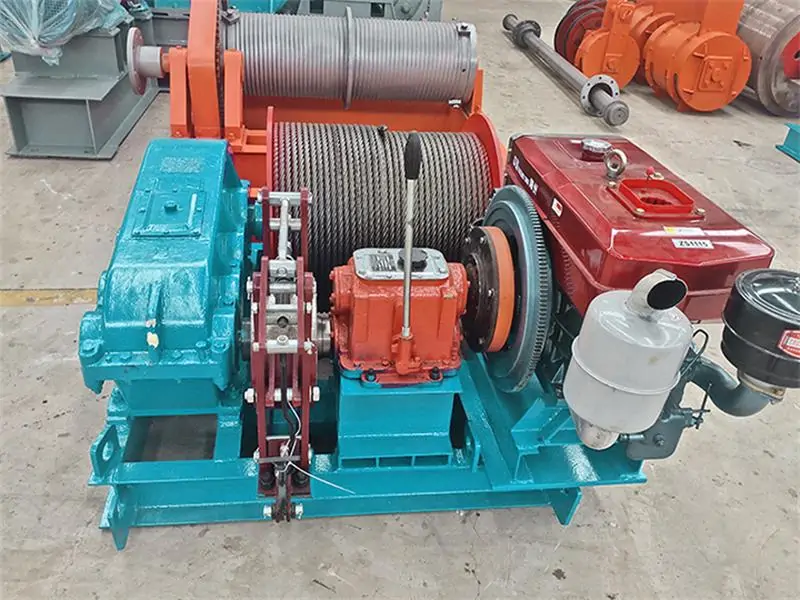
Hydraulic Winch Parts
Hydraulic Winch for Crane Applications
Thanks to their specialized performance, hydraulic winches are highly favored in port cranes, mobile port cranes, and heavy-duty marine lifting systems. Powered by hydraulic power units (HPUs), they are capable of delivering high torque at relatively low speeds.
A hydraulic winch for a crane handles shock loads better than electric alternatives. In offshore and port environments, this characteristic matters. Hydraulic systems also continue functioning in wet, corrosive, or explosive-classified zones where electric motors would require additional protective measures.
Typical applications:
- Container gantry cranes (RMG, RTG types)
- Floating crane systems and derrick barges
- Port mooring winches and anchor handling equipment
- Ship-mounted crane winches
Hydraulic systems require users to perform periodic fluid analysis, seal inspections, and pump maintenance. Over an equivalent operating cycle, their operating costs are higher than those of electrical systems.
12V and DC Winch for Crane-Adjacent Equipment
A 12V winch for crane use is generally not appropriate for industrial overhead or gantry cranes. These low-voltage winches are designed for vehicle-mounted recovery equipment or very light lifting tasks, typically under 5 tonnes. Where 12V or DC winches appear in crane contexts, it is usually in:
- Users utilize this equipment as a maintenance hoist for personnel access during crane inspection and repair.
- Portable A-frame masts or derrick assemblies for use at construction sites.
- Factories employ this equipment as part of lightweight monorail systems installed within workshops.
Note: Industrial lifting operations impose strict requirements on motor power, thermal ratings, and overload protection, and a 12V system simply cannot meet these standards.
Technical Parameters
The table below lists the standard specifications for electric vs hydraulic winches.
| Parameter | Electric Winch | Hydraulic Winch |
|---|---|---|
| Power source | 3-phase AC / single-phase | Hydraulic power unit |
| Rated capacity range | 0.5 t – 100 t | 1 t – 500 t+ |
| Speed control | VFD optional | Proportional valve |
| Duty class (ISO 4301) | M3–M7 | M4–M8 |
| Suitable environment | Indoor / dry | Outdoor / wet / hazardous |
| Maintenance interval | 500–1,000 operating hours | 250–500 operating hours |
| Typical certifications | CE, ISO 9001, GB/T | CE, DNV GL, ABS (marine) |
Selecting a Winch Motor for Crane Systems
The winch motor is often where cost-cutting creates long-term problems. Undersized motors overheat during peak demand. Motors without adequate protection ratings fail prematurely in dusty or damp environments.
For crane applications, standard motor protection ratings are:
- IP54: Suitable for most indoor industrial environments
- IP55: Preferred for outdoor or washdown environments
- IP65 or higher: Required in chemical plants, food processing, or marine environments
Motor thermal class matters for the duty cycle. Class F (155°C) is the standard for most industrial cranes. Class H (180°C) suits high-frequency operations with limited cooling time between lifts.
Winch manufacturers integrate variable frequency drives (VFDs) with winch motors to enable soft starts, controlled acceleration, and precise load positioning. This helps reduce the mechanical stress on the wire rope, drum, and gearbox, thereby extending the service life of the entire hoisting mechanism. For gantry cranes that handle precision loads, variable frequency control is no longer an option but a standard requirement for installation.


Winch Applications by Crane Type
Next, I will explain the hoisting systems and duty classes associated with various types of lifting equipment.
Overhead Bridge Cranes: Single girder and double girder overhead cranes use electric rope hoists or purpose-built hoist winch units. In single girder configurations, the winch travels along the bottom flange of the main beam. Double girder cranes allow larger winch units to be mounted between the girders, enabling higher lift heights and greater capacities. Standard working groups for bridge crane winches in manufacturing range from M4 to M6. Steel mills and foundries running continuous production require M6 or M7-rated hoist assemblies.
Gantry Cranes: An electric winch for a gantry crane must account for the outdoor operating environment in most cases. Rubber-tyred gantry cranes (RTG) at container terminals run hydraulic winch systems connected to the crane’s onboard power generation. Rail-mounted gantry cranes (RMG) typically use electric hoist winches supplied from trackside power busbars. For gantry cranes used in manufacturing workshops or construction sites, standard industrial-grade electric hoists equipped with IP55-rated motors and CE-certified components are sufficient to meet the vast majority of application requirements. In these applications, configurations with crane spans ranging from 12 meters to 35 meters and lifting capacities between 5 and 50 tons represent the most common and typical setups for gantry crane hoisting systems.
Port and Marine Cranes: Port cranes demand the highest performance from their winch systems. Container cranes at major terminals operate in 24/7 shift patterns, requiring M7 or M8 duty classification. Wire rope systems must meet DNV GL or LR certification requirements. Hydraulic winches dominate in shipyard and offshore crane applications due to their torque characteristics and tolerance for harsh environments. Specify these requirements explicitly when sourcing.
Summary
Choosing a winch for crane is a systems decision, not a parts decision. The winch motor, drum, gearbox, braking system, and control interface must all be matched to the same duty class, environmental rating, and load profile.
For most applications involving bridge cranes and workshop gantry cranes, CE-certified electric hoists equipped with variable frequency drive (VFD) control and featuring an IP55 motor protection rating typically meet operational requirements. However, in harsh environments such as ports, offshore operations, and heavy industry, hydraulic winch or heavy-duty electric winches assemblies with a rated duty class of M6 to M8 are the more suitable solutions.
Crane Winch for Sale
Before requesting a quote, review our crane winch for sale guide — it covers the four compatibility parameters (rated capacity, duty class, reeving configuration, and control system) you must confirm with any supplier before placing an order.
If you require a winch for crane solutions, please feel free to contact us at any time. VOITTO Crane will provide you with expert guidance to ensure you select the most suitable equipment.

Alan
Crane Solutions Specialist · Voitto Crane
Specialized in Overhead Crane, Gantry Crane, Jib Crane, Port Crane & EOT Crane export solutions. 10+ years helping global clients with pre-sales consultation, capacity selection and site-specific configurations.
FAQ
What is the difference between a winch and a hoist on a crane?
A hoist is a complete lifting unit that includes the winch drum, motor, gearbox, rope guide, and hook block as an integrated assembly. A winch refers specifically to the drum-and-drive mechanism. In practice, the terms are often used interchangeably in crane specifications, but a hoist implies a ready-to-install lifting unit while a winch may require integration with additional components.
What duty class winch do I need for a gantry crane in a fabrication yard?
Most fabrication yard gantry cranes operate at M4 or M5 duty class under ISO 4301. If the crane runs two or more shifts daily with frequent lifts, specify M5 or M6. Always confirm the load spectrum (proportion of lifts at rated capacity versus partial loads) with your operations team before specifying.
Can I use a hydraulic winch on an indoor overhead crane?
Yes, but it adds system complexity. You need an onboard HPU, hydraulic lines, and fluid containment measures. For most indoor applications, electric winches are simpler, cleaner, and less expensive to maintain. Hydraulic systems make more sense when the crane also drives other hydraulic functions, such as clamps or grabs.
How do I calculate the required pulling force for a crane winch?
The minimum line pull at the drum first layer must equal or exceed the rated hook load multiplied by the number of rope falls, plus an allowance for rope system efficiency (typically 90–95% per sheave). A two-fall reeving system lifting 10 t requires approximately 5.2 t–5.5 t of line pull at the drum first layer, accounting for sheave friction losses.
What wire rope specification is standard for industrial crane winches?
6×36 IWRC (independent wire rope core) construction is widely used for crane hoisting applications. Minimum breaking load should be at least 5× the maximum working load for overhead crane service. Rope diameter is determined by the drum and sheave groove dimensions specified in the winch design.
How often does a crane winch need maintenance?
Electric winch assemblies typically require inspection every 500 operating hours or 12 months, whichever comes first. This includes brake adjustment, rope inspection, gearbox oil analysis, and motor insulation testing. Hydraulic winches require more frequent fluid checks — typically every 250 hours. Follow the manufacturer’s maintenance schedule and relevant local regulations.




 English
  Español
  Português
  العربية
  Français
  Русский