
If you’re looking to buy a portable gantry crane for a facility in Mexico, the options on the market are wider than they’ve ever been—and that’s exactly where procurement decisions start going wrong. Too many buyers shortlist on price alone, receive a unit that doesn’t fit their floor clearance or duty cycle, and spend more fixing the problem than they saved on the purchase.
This guide is written for industrial procurement managers, plant maintenance engineers, and operations teams sourcing a portable gantry crane for sale in Mexico—whether for a new manufacturing plant in Nuevo León, a workshop upgrade in Querétaro, an injection molding facility in Guanajuato, or a warehouse operation near a logistics hub. It covers the spec decisions that matter most, realistic price ranges, the compliance criteria multinational buyers in Mexico now routinely require, and what separates a reliable portable gantry crane supplier from one that disappears after the invoice clears.
- 1 Why Portable Gantry Cranes Are in Strong Demand Across Mexico’s Industrial Sector
- 2 Four Application Scenarios That Drive Most Purchases in Mexico
- 3 Specifications: What to Define Before You Request a Quote
- 4 Price Ranges: What to Expect When You Buy a Portable Gantry Crane
- 5 CE and ISO Compliance: The Standard Multinational Buyers in Mexico Require
- 6 What to Look for in a Portable Gantry Crane Supplier for Mexico
- 7 Summary: Five Things to Confirm Before You Place the Order
-
8
FAQ
- 8.1 Q1: What is the typical price range for a portable gantry crane for sale in Mexico?
- 8.2 Q2: Is CE certification required when importing a portable gantry crane to Mexico?
- 8.3 Q3: What capacity portable gantry crane is right for injection molding mold changes?
- 8.4 Q4: What is the difference between a lightweight aluminum gantry crane and a steel portable gantry crane for workshop use?
- 8.5 Q5: How long does it take to receive a portable gantry crane ordered from an international supplier in Mexico?
Why Portable Gantry Cranes Are in Strong Demand Across Mexico’s Industrial Sector
Mexico’s private manufacturing sector has been expanding at pace since 2023, driven by nearshoring investment from automotive, aerospace, electronics, and healthcare companies relocating production closer to the U.S. market. The Mexican Association of Private Industrial Parks (AMPIP) projects 128 new industrial parks between 2024 and 2030, adding 20 million square meters of industrial space. Each of those facilities—and the manufacturers inside them—needs material handling capability from day one.
A portable gantry hoist system fills a specific and recurring gap: it provides overhead lifting without permanent runway infrastructure, without structural modifications, and without the installation lead time of a fixed crane. For a plant that’s still commissioning, a maintenance team that works across multiple bays, or a contractor installing heavy equipment on a construction schedule, the ability to wheel a crane into position, lift the load, and reposition in minutes is the core value proposition.
The Mexico overhead cranes market reached USD 82.23 million in 2024 and is projected to grow at a CAGR of 6.57% through 2033 (IMARC Group, 2024), driven by industrial modernization and warehouse expansion. Portable and adjustable gantry cranes are a growing segment within that market, particularly in the private industrial sector where flexibility and fast deployment matter more than rated-for-years-of-fixed-service.
Four Application Scenarios That Drive Most Purchases in Mexico
Understanding which use case applies to your facility clarifies both the capacity you need and the structural type that fits.
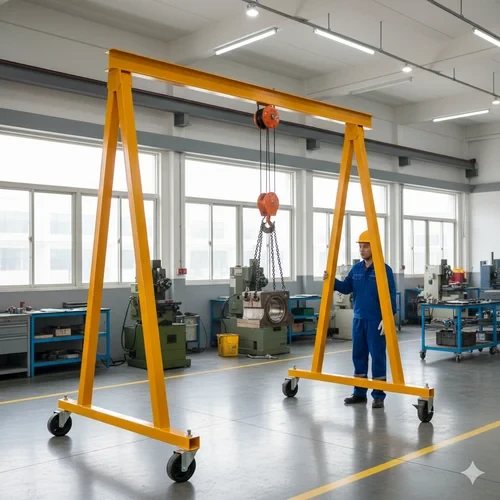
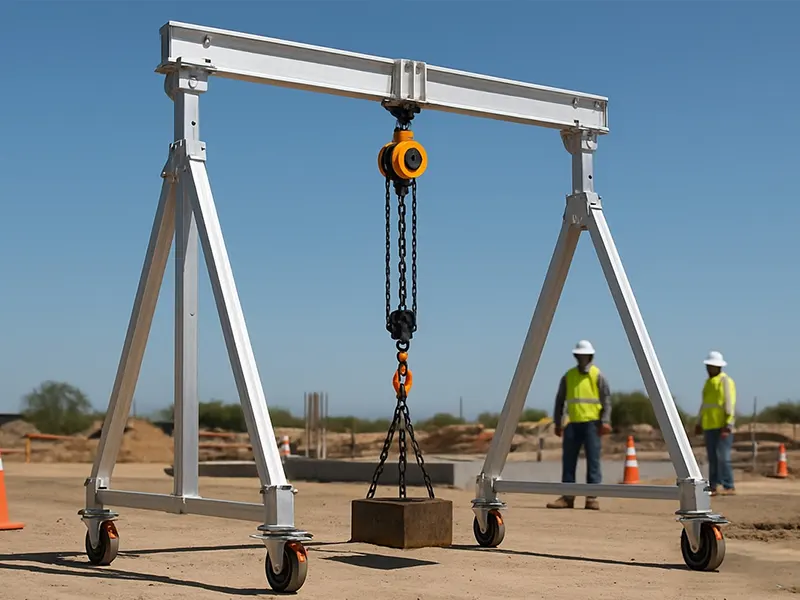
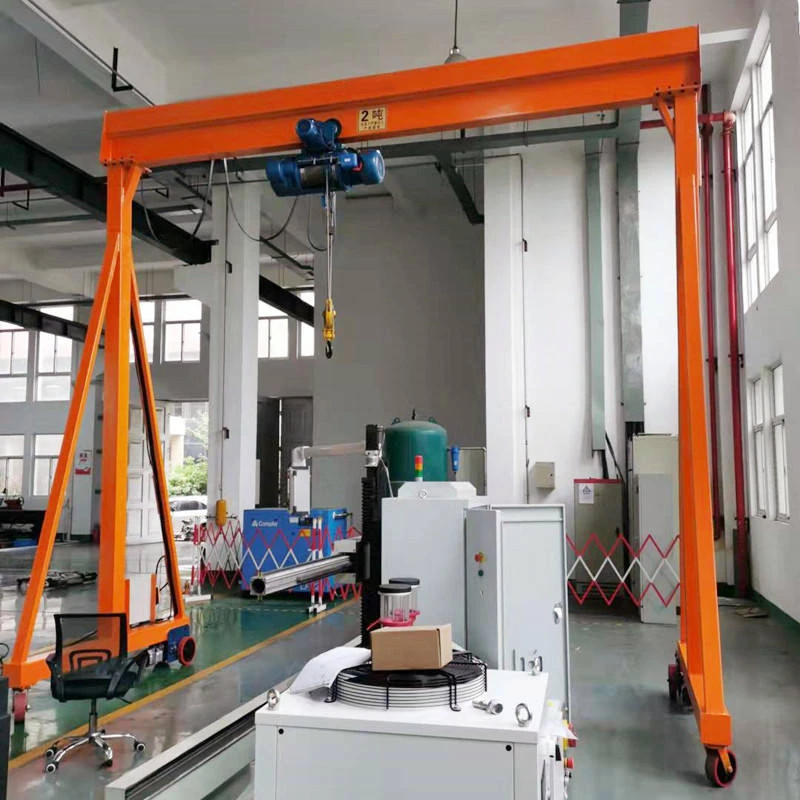
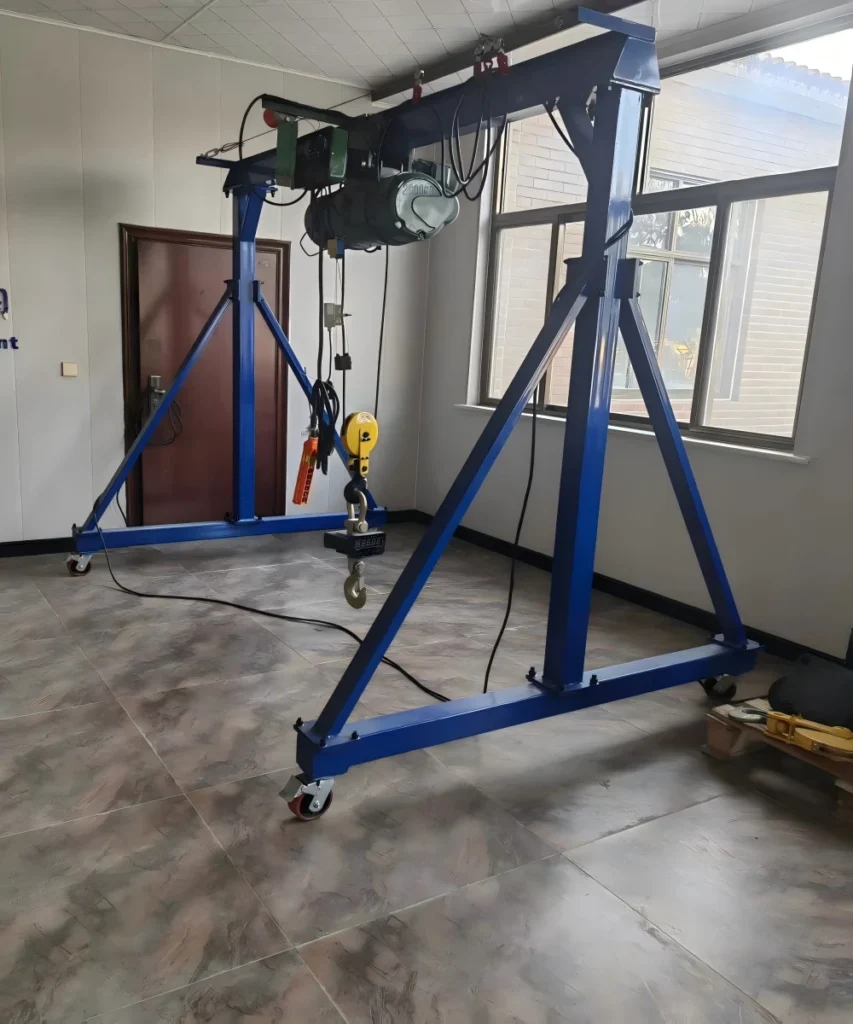
Portable Gantry Crane for Workshop and Small Manufacturing Cells
The most common entry-level application. A portable gantry crane for workshop use typically involves lifting jigs, fixtures, molds, or machine subassemblies within a defined production bay. Capacity requirements usually fall between 500 kg and 3 tons. The priority is mobility between workstations and compact footprint—not maximum tonnage. Adjustable-height models that can be lowered to pass through standard doorways (typically requiring clearance to around 2.0–2.2m lowered height) are the practical choice here when the crane needs to move between rooms or bays.
Aluminum-frame models are well-suited to this scenario. A 1-ton aluminum portable gantry typically weighs 60–100 kg complete, meaning two workers can reposition it without mechanical assistance. The tradeoff is capacity ceiling: aluminum units are generally practical up to 2–3 tons; above that, steel construction is more appropriate.
Portable Gantry Crane for Manufacturing Plant Equipment Installation
Plant setup and ongoing capital equipment maintenance are the two highest-value applications for a portable gantry crane for manufacturing plants. When a new CNC machining center, hydraulic press, or assembly robot arrives on-site, it needs to be lifted off the transport skid and positioned precisely on its mounting points. A fixed overhead crane may not yet be operational. A mobile crane truck may not fit the bay or offer the precision needed for the final placement.
An adjustable portable crane for equipment installation solves this cleanly. The crane straddles the machine footprint, the operator adjusts the under-beam height to clear the component, and a chain hoist or electric hoist provides the controlled vertical movement. For this application, specify the crane’s clear span (the inside dimension between the legs) against the widest machine footprint you regularly handle—this is a more critical dimension than nominal capacity for many installation tasks.
Gantry Crane for Injection Molding and Plastic Factory Operations
Mold changes in injection molding are one of the most repetitive and physically demanding lift cycles in plastics manufacturing. A production injection mold for automotive components can weigh anywhere from 500 kg to several tons depending on part size. Changing molds manually or with inadequate lifting equipment is a leading cause of workshop injuries and production downtime.
A gantry crane for injection molding or plastic factory use needs to meet three specific requirements: capacity rated to the heaviest mold in the facility (with a margin—never specify the crane at its rated maximum for a regular production lift), under-beam height sufficient to clear the mold height when the platens are open, and a hoist with dual-speed or variable speed control for the final alignment phase when the mold must be lowered precisely onto the platen locating ring. For this application, a portable gantry hoist system with an electric chain hoist providing slow-speed creep (typically 0.8–1.5 m/min) is the right choice over a manual chain block.
Mobile Gantry Crane for Warehouse Maintenance and Logistics
A mobile gantry crane for warehouse use serves a different function than production applications. In distribution centers and logistics facilities—a segment growing rapidly in Mexico with the expansion of e-commerce infrastructure—the crane is used for conveyor maintenance, dock equipment servicing, and the occasional heavy equipment positioning task, rather than production lifting cycles. Duty cycle requirements are typically lower (FEM M3 or M4), but floor mobility across large concrete slabs is critical.
For warehouse use, steel-frame adjustable models on 360° swivel casters with brakes are the standard configuration. Confirm the caster diameter and floor load rating against your slab specification—modern Class A industrial warehouses in Mexico’s industrial corridors typically carry 5–6 tonne/m² slab ratings, sufficient for most portable gantry configurations when properly spread through outrigger pads or the crane’s base footprint.
Specifications: What to Define Before You Request a Quote
Requesting a quote without defined specifications is the single most common cause of mismatched equipment and pricing surprises. The following parameters should be documented before any supplier conversation.


Portable Gantry Crane Specification Reference Table
| Parameter | Light Duty | Medium Duty | Heavy Duty |
|---|---|---|---|
| Rated Capacity | 0.5 – 1 ton | 1 – 3 ton | 3 – 10 ton |
| Under-Beam Height (adj.) | 1.8 – 3.0 m | 2.0 – 4.5 m | 2.5 – 6.0 m |
| Clear Span | 1.5 – 3.0 m | 2.0 – 5.0 m | 3.0 – 8.0 m |
| Frame Material | Aluminum or light steel | Steel or aluminum | Steel |
| Duty Class (ISO 4301-1) | M2 – M3 | M3 – M4 | M4 – M5 |
| Hoist Type | Manual chain block | Electric chain hoist | Electric chain / wire rope hoist |
| Caster Type | Polyurethane swivel | Polyurethane / nylon swivel with brake | Heavy-duty steel swivel with brake |
| Typical Application | Workshop, light maintenance | Mold handling, equipment installation | Machinery maintenance, plant install |
Duty class per ISO 4301-1:2021. Capacity ratings apply at the specified span—verify load-span curve for adjustable span models.
Three Specifications Buyers Commonly Underestimate
Clear span vs. nominal span. The nominal span is the outside dimension between the legs. The clear span—the usable working width inside the legs—is typically 200–400mm less. For a load that needs to pass between the legs, always specify the minimum clear span required, not the load footprint alone.
Adjustable height range. A crane advertised as “adjustable height 2–4m” means the under-beam height adjusts across that range. The total height at the highest setting plus the hoist body and hook can add another 600–900mm above the beam. Confirm the total height at maximum setting against your lowest overhead obstruction—a beam, sprinkler line, or duct—before ordering.
Capacity at maximum span. On adjustable-span models, rated capacity may be derated at wider span settings due to increased bending moment on the main beam. Always request the load-span table from the supplier and confirm rated capacity at your specific working span, not just the headline tonnage.
Price Ranges: What to Expect When You Buy a Portable Gantry Crane
Portable gantry crane prices vary significantly based on capacity, material, adjustability, and hoist configuration. The following ranges reflect market pricing for new equipment as of 2025, based on published supplier data.
Indicative Price Reference Table (USD, FOB)
| Configuration | Capacity | Price Range (USD) | Notes |
|---|---|---|---|
| Aluminum, fixed height, manual hoist | 0.5 – 1 ton | $800 – $2,500 | Light workshop, occasional use |
| Aluminum, adjustable height/span, manual hoist | 1 – 2 ton | $1,500 – $4,500 | Workshop, maintenance, cleanroom |
| Steel, adjustable height, electric hoist | 1 – 3 ton | $3,000 – $8,000 | Manufacturing, mold handling |
| Steel, adjustable height, electric hoist | 3 – 5 ton | $6,000 – $15,000 | Plant maintenance, heavy production |
| Steel, heavy-duty, electric hoist | 5 – 10 ton | $12,000 – $28,000 | Machinery install, heavy industrial |
CE and ISO Compliance: The Standard Multinational Buyers in Mexico Require
Mexico does not mandate CE marking for lifting equipment under national regulation. However, multinational manufacturers—automotive OEMs, aerospace primes, major logistics operators—operating facilities in Mexico increasingly apply their global EHS procurement standards domestically, which typically require CE-compliant lifting equipment regardless of local rules.
EN 13157 is the CE standard for hand-powered lifting equipment including portable gantry cranes used with manual hoists. For portable gantry hoist systems with electric chain hoists, EN 14492-2 (Power driven chain hoists) covers the hoist component. A CE-marked portable gantry crane system should come with a Declaration of Conformity (DoC) identifying the specific standards assessed.
ISO 4301-1:2021 (Cranes — Classification) provides the duty class framework (M1–M8) used to define the crane’s design for estimated use frequency and load spectrum. For any portable gantry crane supplier quoting into Mexico’s industrial market, duty class documentation per ISO 4301-1 should be a standard deliverable with the technical offer.
ISO 9927-1 (Cranes — Inspections) specifies periodic inspection requirements. For production-critical applications, buyers should request the manufacturer’s recommended inspection schedule and confirm it is compatible with their maintenance program.
When evaluating suppliers, request the CE Declaration of Conformity, the ISO 4301-1 duty class, and the load-span chart as a package. A supplier who cannot provide these documents in response to a formal enquiry is not positioned to serve multinational industrial buyers in Mexico.
What to Look for in a Portable Gantry Crane Supplier for Mexico
The supplier decision matters as much as the product specification, particularly for buyers who need reliable after-sales support in a market where the nearest factory may be in China or Europe.
Documentation and Technical Support
A credible portable gantry crane supplier for Mexico should provide, as standard with any quotation: full technical datasheet with all specified parameters, CE Declaration of Conformity (for CE-marked units), ISO 4301-1 duty class, load-span chart for adjustable configurations, and installation and maintenance manual in Spanish or English. If any of these are unavailable or require special requests, treat it as a supplier capability signal.
Spare Parts and Lead Times
For a lightweight gantry crane for maintenance applications where the crane itself is a production tool, spare parts availability matters. The hoist chain, caster wheels, and brake components are the highest-wear items. Ask the supplier: what is the lead time for a replacement load chain for this model, and is it stocked regionally? A six-week lead time from a factory in China is operationally acceptable for planned maintenance;
Freight and Customs Experience for Mexico
Importing a portable gantry crane to Mexico involves documentation requirements beyond the equipment datasheet: commercial invoice, packing list, bill of lading, certificate of origin, and technical specification sheet for customs classification. Suppliers experienced in exporting to Mexico will have this process documented. First-time exporters frequently cause delays at Mexican customs through incomplete documentation—delays that fall on the buyer, not the seller.
Summary: Five Things to Confirm Before You Place the Order
Sourcing a portable gantry crane for sale in Mexico comes down to five decisions made before you sign anything:
- Define your real lift parameters: maximum suspended load including rigging, required clear span at your specific working configuration, and minimum/maximum under-beam height for your facility.
- Match the duty class to your actual use cycle: ISO 4301-1 M3 for light maintenance, M4 for regular production support, M5 for high-frequency industrial applications—get this confirmed in writing.
- Specify steel or aluminum based on your environment: aluminum for mobility, corrosion resistance, and light duty; steel for capacities above 2–3 tons or sustained production cycles.
- Require CE documentation: Declaration of Conformity referencing EN 13157 (or EN 14492-2 for the electric hoist), load-span chart, and duty class per ISO 4301-1.
- Confirm landed cost, not FOB price: add freight to Mexico, import tariff under HS 8426, IVA (16%), and local handling to get the real procurement cost before comparing supplier quotes.
The portable gantry crane market in Mexico serves buyers across a wide range from a small workshop needing a basic aluminum unit for occasional lifts, to a large automotive supplier needing a 5-ton steel crane for daily mold changes. The right specification and the right supplier look very different at each end of that range—but the procurement process for getting there is the same.

Alan
Crane Solutions Specialist · Voitto Crane
Specialized in Overhead Crane, Gantry Crane, Jib Crane, Port Crane & EOT Crane export solutions. 10+ years helping global clients with pre-sales consultation, capacity selection and site-specific configurations.
FAQ
Q1: What is the typical price range for a portable gantry crane for sale in Mexico?
Landed price in Mexico depends on the specification and origin. A 1-ton aluminum adjustable-height model from an international supplier typically costs USD $1,500–$4,500 FOB, with freight, import duties under HS 8426, and IVA (16%) adding 25–40% to the total depending on origin and incoterm. A 3-ton steel adjustable model with electric hoist runs USD $5,000–$10,000 FOB before Mexican import costs. For accurate landed cost, always request a formal quotation from the supplier with declared HS code and work with a licensed Mexican customs broker to calculate the final all-in cost before comparing bids.
Q2: Is CE certification required when importing a portable gantry crane to Mexico?
Mexico does not mandate CE marking under national regulation for lifting equipment. However, CE compliance is increasingly required by multinational manufacturers operating plants in Mexico as part of their global EHS procurement standards—particularly in the automotive and aerospace sectors. For any facility supplying to tier-1 or OEM customers with international EHS programs, specifying CE-marked equipment avoids supplier audit findings and compliance disputes. Request the CE Declaration of Conformity referencing EN 13157 (for the crane structure) and EN 14492-2 (for any electric hoist component) from your supplier.
Q3: What capacity portable gantry crane is right for injection molding mold changes?
Specify the crane’s rated capacity at a minimum of 125% of the heaviest mold you regularly handle, including all rigging hardware (below-hook devices, shackles, lifting eyes). For example, if your heaviest mold is 2,400 kg, a 3-ton rated crane provides adequate margin. More important than the tonnage is the under-beam height: the crane’s clear lifting height must accommodate the mold height when suspended, plus the hoist body, plus sufficient clearance to swing the mold clear of the machine platen. Measure this dimension at your specific press before specifying crane height. An adjustable-height model gives flexibility across multiple press sizes in the same facility.
Q4: What is the difference between a lightweight aluminum gantry crane and a steel portable gantry crane for workshop use?
Aluminum and steel portable gantry cranes serve different primary use cases. An aluminum unit—typically 60–120 kg complete for a 1-ton model—is easy to reposition by one or two workers and resists corrosion in humid or chemically active environments. It’s the right choice for aerospace manufacturing, electronics assembly, cleanrooms, and any application where the crane needs to move frequently. Steel units are heavier (180–350 kg for an equivalent 1-ton model), harder to reposition without mechanical assistance, but handle sustained production lift cycles better and are practical up to 10 tons. Steel is the appropriate choice for mold handling, machinery installation, and any application involving daily production lifting at capacities above 2–3 tons.
Q5: How long does it take to receive a portable gantry crane ordered from an international supplier in Mexico?
Lead time depends on whether you’re ordering a standard catalog model or a custom configuration. Standard aluminum models and fixed-height steel cranes in common capacities (0.5–3 ton) are often available from stock with 2–4 weeks sea freight transit time from China or 1–2 weeks from U.S. suppliers. Adjustable-height and heavy-duty steel models frequently require production lead time of 3–6 weeks before shipping. Add 1–2 weeks for Mexican customs clearance and inland delivery. Total elapsed time from confirmed order to crane operational in your facility is typically 6–12 weeks for international suppliers—plan accordingly when scheduling equipment installation or plant commissioning timelines.




 English
  Español
  Português
  العربية
  Français
  Русский