A diesel winch is a type of traction and lifting equipment. This equipment operates normally without the need for an external power supply. Powered by a diesel engine, the unit possesses robust independent operational capabilities, making it particularly well-suited for field construction, mining operations, road and bridge construction, and emergency rescue missions.
A diesel winch is a type of mechanical lifting equipment. An internal combustion engine drives this device. It features a lifting capacity ranging from 1 to 100 tons, accommodates wire ropes with diameters between 8 mm and 60 mm, and offers a drum rope capacity ranging from 20 to 500 meters. Typically, users employ this equipment to perform towing and lifting tasks in the construction, mining, and marine sectors. It is particularly well-suited for field operations and work environments where no external power source is available.
Product Description
The diesel powered winch is a robust and durable mechanical lifting and traction system. The winch manufacturer has specifically designed this equipment for operating environments where power supply is scarce or unstable. Utilizing a mechanical transmission mechanism involving a drum and steel wire rope, this equipment converts the rotational kinetic energy generated by its engine into linear traction force, offering a lifting capacity range spanning from 1 to 100 tons. Its core design features include a planetary gearbox, a fail-safe braking system, and a steel wire rope drum. Based on the user’s duty class, the configuration of this drum is designed to meet the M3 through M8 classifications defined in the ISO 4301-1:2016 standard.
Unlike electric winches, diesel winches can operate independently of grid infrastructure. Consequently, they constitute the ideal solution of choice for remote construction sites, offshore platforms, and emergency response scenarios.
Types of Diesel Winch
The configuration of diesel-powered winches is classified into single-drum and double-drum types, based on the drum structure and operational application.
Single-drum diesel winches are equipped with a cylindrical drum with a diameter ranging from 200 mm to 1,200 mm. Users employ them to perform simple lifting and towing operations. These units can accommodate steel wire ropes ranging from 20 meters to 500 meters in length.
A twin-drum diesel winch integrates two synchronized drums, capable of handling complex applications such as trolley traction in a double-rope system or performing synchronized lifting operations. Each drum can be configured for independent or synchronized rotation.
Parts of Diesel Winch
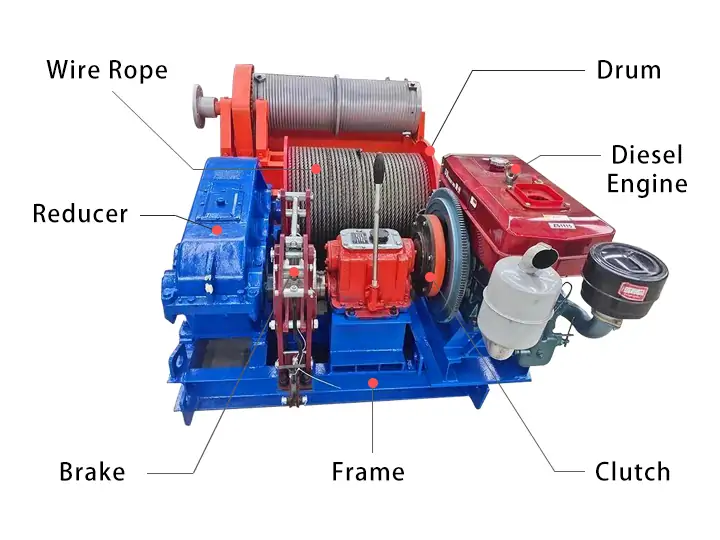
A diesel winch primarily consists of a diesel engine, a clutch, a reducer, a drum, a wire rope, a brake, a frame, and a control system. Next, I will introduce each of the components.
Diesel Engine: This component provides power to the entire unit.
Clutch: This component controls the transmission and disconnection of power.
Reducer: This component reduces rotational speed and increases torque.
Drum: This component winds the steel wire rope to perform operations.
Steel Wire Rope: Supports the load.
Brake: This component ensures safe stopping.
Frame/Base: Supports the entire machine structure.
Key Features and Technical Advantages
This device delivers a high torque output ranging from 5,000 Nm to 200,000 Nm, ensuring continuous operation even under heavy-load conditions.
Power Independence: Driven by a diesel engine, eliminating the need for an external power supply.
High Traction Force: The diesel winch delivers high torque output, meeting the traction and lifting requirements for medium-to-heavy—and even ultra-heavy—loads.
High Mobility: The equipment can be easily relocated or configured as a trailer-mounted unit.
Environmental Adaptability: The device operates stably and reliably in extreme conditions, including high or low temperatures, muddy terrain, and complex outdoor environments.
Independent Operating Capability: The diesel winch operates independently of power grids or hydraulic stations, offering flexible deployment and allowing users to put it into service rapidly.
Wide Range of Applications: The equipment is widely utilized across various sectors, including mining, construction, ports, roadworks, and emergency rescue operations.
Applications and Industry Sectors
Diesel winch systems play a critical role in heavy industry, particularly in environments where electrical infrastructure is scarce or nonexistent.
Construction and Infrastructure: Bridge construction projects utilize diesel-powered winches to hoist concrete formwork, assist in the installation of steel structures, and execute high-altitude material lifting tasks.
Mining and Extraction: Underground and open-pit mining operations utilize diesel winches for ore transport, equipment positioning, and shaft sinking.
Maritime and Offshore Engineering: Shipboard applications include anchoring operations, mooring procedures, and towing assistance.
Forestry and Recovery: Users employ diesel winches to carry out timber harvesting operations and the recovery of off-road vehicles.
Equipment Installation and Large-Scale Projects: Users utilize diesel-powered winches to assist in the traction, positioning, and installation of large-scale mechanical equipment.
Specifications
Parameter
Specification Range
Lifting Capacity
1 – 100 ton
Rope Diameter
8 mm – 60 mm
Rope Capacity
20 m – 500 m (single drum)
Drum Diameter
200 mm – 1200 mm
Drum Type
Single drum / Double drum
Engine Power
7.5 kW – 160 kW
Line Speed
8 – 16 m/min (adjustable)
Duty Classification
M3 – M8
Operating Temperature
-20°C to +42°C
Protection Class
IP55 (electrical components)
Braking Torque
Up to 1,700 Nm
Gearbox Type
Planetary / Worm reducer
Diesel Winch for Sale
VOITTO Crane offers diesel winch solutions designed to ensure consistent reliability, even in the most demanding operating environments. Our diesel winch systems undergo rigorous testing and certification to ensure full compliance with global market requirements and guarantee operational safety.
If you require solutions for diesel-powered winches, please feel free to contact us.
FAQ
What is the maximum lifting capacity of a VOITTO diesel winch?
VOITTO diesel winches accommodate lifting capacities from 1 ton to 100 tons, with custom-engineered solutions available for specialized heavy-lift applications beyond standard ranges.
How does the duty classification system work for diesel winches?
The duty cycle ratings range from M1 (light duty) to M8 (extremely heavy-duty continuous operation). The specific selection depends on the load profile, the number of operating cycles per hour, and the required total service life.
Can diesel winches operate in extreme weather conditions?
CE-compliant winches must include rated capacity limiters for loads over 1,000 kg, emergency stop functions with priority override, fail-safe brakes, and mechanical safety locks per EN 14492-1:2006.
Is remote control available for diesel winch operations?
Yes. VOITTO offers radio remote control systems with operational ranges up to 100 meters, enabling safe operation from distance in hazardous environments.
Qualification and Honor
Engineered Strength, Global Crane Supplier
service
Exclusive and Considerable, Customer First.
01
Reliable and Customized Solutions
Our pre-sale team provides consultations, tailoring solutions to your needs and environment.
Offer customization options for lifting capacity, span and lifting height etc. to meet specific needs.
02
Updated Production Process
Real-Time Progress Updates: Weekly reports and PM communication.




 English
  Español
  Português
  العربية
  Français
  Русский