The crane trolley is mounted on the main girder and is responsible for supporting the lifting mechanism. It moves horizontally along the main girder rails, thereby enabling the lateral movement and lifting of heavy loads. This equipment features a compact design and can be equipped with various types of hoisting mechanisms.
A crane trolley is the load-carrying mobile component in an overhead crane or gantry crane system. The crane travel trolley runs along the rails on the main girder and supports the hoisting mechanism responsible for lifting and lowering loads. By moving the trolley horizontally, the load can be positioned at a specified location. This dual-axis motion mode enables load positioning capabilities in three-dimensional space.
Each crane electric trolley features welded steel frame construction with precision-machined wheel assemblies. Hardened steel wheels distribute loads evenly while sealed bearing assemblies reduce maintenance. Electric crane lifting trolley models integrate VFD technology for smooth acceleration and precise speed control. Safety systems include overload protection (90% warning, 110% shutdown), emergency stop functionality, and anti-collision systems.
Crane Trolley Types
Crane trolleys come in various types, including European crane electric trolleys, hoist crane trolleys, and winch crane trolleys. Each crane lifting trolley type has distinct application scenarios and structural designs. The following section provides a detailed overview of each type of crane travel trolley.
Hoist Crane Trolley
European Crane Trolley
Winch Crane Trolley
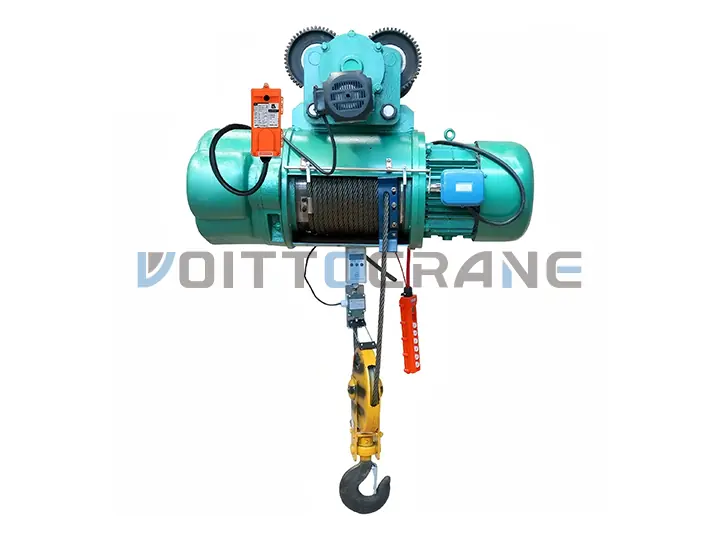
Hoist Crane Trolley: A hoist crane trolley is a system that integrates an electric hoist with a traveling mechanism. It lifts heavy loads using the electric hoist while simultaneously traversing laterally along the main beam rail via the trolley, thereby facilitating the spatial handling of materials. This system features a simple structure, low cost, and ease of installation and maintenance. Typically, the rated lifting capacity range of a crane trolley is 5 to 32 tons.
European electric Crane Trolley: European crane lifting trolleys minimize the distance between hook and bridge girder, maximizing available lifting height in facilities with limited vertical clearance. The European crane trolley is equipped for use on the QDXX type double-girder overhead crane. This European crane trolley features a lightweight design and high precision, making it suitable for medium to heavy loads. Its lifting capacity typically ranges from 10 to 50 tons. Furthermore, specially customized models can achieve a maximum lifting capacity of up to 80 tons.
Winch Crane Trolley: Winch crane electric trolleys are specifically designed for use in extreme operating conditions. They feature a reinforced structure, oversized components, and higher safety margins. With load capacities up to 200 tons, they are suitable for use in steel mills, foundries, and heavy manufacturing facilities.
Parts of Crane Trolley
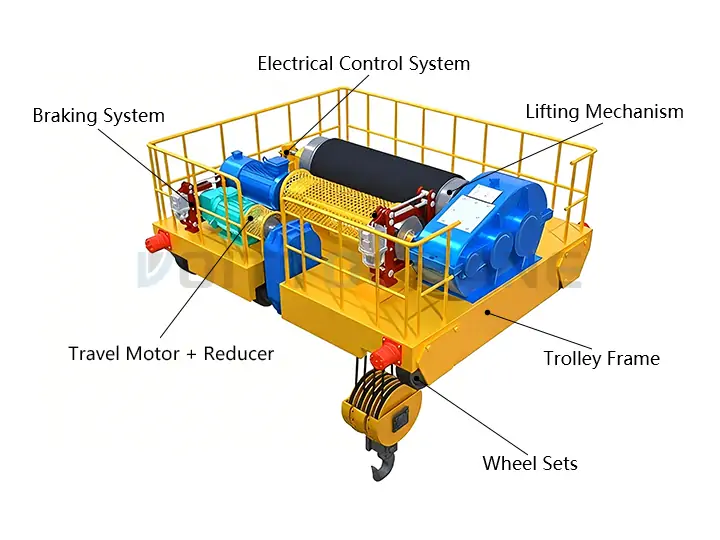
The crane electric trolley primarily consists of a lifting mechanism, a trolley frame, wheel assemblies, a braking device, and an electrical control system. Below, I will explain each component and its function.
Lifting Mechanism: Responsible for lifting and lowering the load.
Trolley Frame: Serves as the primary load-bearing structure, used to mount and support the various mechanisms while transmitting the load to the main girder.
Braking Device: Provides rapid braking during stops or in emergencies.
Electrical Control System: Responsible for controlling the starting, stopping, speed regulation, and safety protection functions of each mechanism.
Electric Motor: Provides the driving force for the trolley, converting electrical energy into mechanical energy to propel the trolley along the rails.
Reducer: Converts the high-speed rotation of the motor into a low-speed, high-torque output.
Wheel Set: Makes direct contact with the rails to facilitate rolling movement; it supports the weight of the trolley and the hoisted load while converting motive power into actual linear motion.
Crane Trolley Manufacturer and Supplier
Whether you need a standard crane electric trolley or a custom-designed solution, we can provide you with expert guidance and high-quality equipment to help you achieve efficient material handling. If you are interested in crane trolley systems, please contact us for detailed technical specifications, performance data, and highly competitive quotes.
FAQ
What is a crane trolley and how does it work?
A crane travel trolley is the movable component of a crane that travels along the bridge main girder rails, supporting the hoisting mechanism. It moves horizontally across the bridge while the hoist provides vertical motion, enabling precise three-dimensional load positioning.
What maintenance does a crane trolley require?
Daily visual inspections, monthly lubrication, quarterly electrical checks, and annual comprehensive examination, including load testing. Typical maintenance costs run 2-3% of the purchase price annually.
What capacity crane trolley do I need?
When selecting a capacity, users are advised to choose a rating that is 25% to 50% higher than the maximum lifting weight. For occasional lifting operations with known loads, a 25% safety margin is sufficient. In production environments where loads vary significantly, a 50% margin is required to accommodate dynamic loads.
Qualification and Honor
Engineered Strength, Global Crane Supplier
service
Exclusive and Considerable, Customer First.
01
Reliable and Customized Solutions
Our pre-sale team provides consultations, tailoring solutions to your needs and environment.
Offer customization options for lifting capacity, span and lifting height etc. to meet specific needs.
02
Updated Production Process
Real-Time Progress Updates: Weekly reports and PM communication.






 English
  Español
  Português
  العربية
  Français
  Русский