


An explosion proof hoist is a type of lifting equipment specifically designed for use in flammable, explosive, and dusty environments. It is widely used in the petroleum and chemical industry, coal mines, the military industry, the pharmaceutical industry, warehousing, and other places where flammable gas, steam, or dust exists.
Below you will find the complete technical specifications, working duties, and hazardous-zone selection criteria for VOITTO’s three explosion-proof lifting series—Explosion-proof Wire Rope Hoists (1–35T), European Low-Headroom Explosion-Proof Hoists, and Spark-Resistant Electric Chain Hoists (0.5–35T). We also break down the differences between Ex d IIB T4 (gas), Ex d IIC T4 (hydrogen/acetylene), and Ex tD A21 (combustible dust) standards so you can configure a fully compliant lifting solution for your chemical, oil & gas, or dust-heavy workshop.
Get QuoteVOITTO Explosion Proof Hoist (also known as a flameproof hoist or spark-resistant electric hoist) is heavy-duty lifting equipment engineered specifically for hazardous, flammable, explosive gas (Zone 1 & Zone 2) and combustible dust (Zone 21 & Zone 22) environments. Built strictly in compliance with ATEX, IECEx, and GB3836 standards, our explosion-proof lifting solutions eliminate electrical arcs and mechanical friction sparks to ensure 100% operational safety in chemical plants, oil refineries, coal mines, paint booths, and grain silos.
Explosion Proof Hoist
European Explosion-proof Hoist
Explosion-proof hoists are usually used as lifting mechanisms and are installed on overhead cranes, gantry cranes, electric EOT Cranes, and cantilever cranes for supporting use. It is widely used in the petroleum, chemical industry, coal mine, military industry, pharmaceutical industry, warehousing, and other places where flammable gas, steam, or dust exists.
An Explosion proof hoist is divided into different types, including explosion proof wire rope hoist, European explosion proof hoist, and explosion proof chain hoist. Different types of explosion-proof hoists use scenarios and structures that are also very different. The following sections will introduce you to the different types of explosion-proof hoists and their definitions, applications, and specifications.
Designed for medium-to-heavy lifting in hazardous locations, the HB/BCD explosion-proof wire rope hoist features an integral flameproof enclosure (Ex d). All exposed rotating parts—including the trolley wheels and hook assembly—are available with spark-resistant bronze alloys or stainless steel cladding to prevent mechanical impact sparks. It can be mounted on a fixed frame, monorail I-beam, or integrated into an LB Explosion Proof Single Girder Overhead Crane.
Application: Explosion-proof wire rope hoists are suitable for use in explosive environments such as petroleum, chemical, coal mining, natural gas, and pharmaceuticals, and require large-tonnage lifting work.
Features: An explosion-proof wire rope hoist has the advantages of large load capacity, high lifting height, economy, and practicality. Its load capacity ranges from 1 ton to 32 tons, and the lifting height can reach 30 meters.
Get Quote| Type | HB Type Explosion Proof Wire Rope Hoist |
|---|---|
| Lifting Capacity | 1-32 ton |
| Lifting Height | 6-30 M |
| Hoisting Speed | 5/0.8 M/MIN |
| Working Class | M3 |
| Ambient Temperature | -25℃ to 80℃ |
| Explosion-proof grade | ExdⅡBT4、ExdⅡCT4 |
Engineered for modern workshops with limited ceiling height, the European explosion-proof electric hoist adopts a compact, C-type modular structure that maximizes hook approach and lifting height. Equipped with explosion-proof variable frequency drives (VFDs) for smooth dual-speed or stepless travel, it minimizes load swing when handling volatile chemical containers or precision machinery in Zone 1 and Zone 2 areas.
Application: European explosion-proof hoists are suitable for high-risk, high-cleanliness, high-efficiency scenarios, and limited space, such as petrochemical, natural gas, pharmaceutical, military, port, and new energy industries.
Features: European explosion-proof hoists have advantages such as a compact structure, high load capacity, stable operation, and maintenance-free operation. They are the preferred solution for high-frequency use scenarios.
Get Quote| Type | European Explosion Proof Hoist |
|---|---|
| Lifting Capacity | 3-32 ton |
| Lifting Height | 5-18 M |
| Hoisting Speed | 1-10 M/MIN |
| Working Class | M5 |
| Ambient Temperature | -20℃ to 80℃ |
| Explosion-proof grade | ExdⅡBT4、ExdⅡCT4 |

For compact workstations, maintenance platforms, and chemical dosing rooms, VOITTO explosion-proof electric chain hoist offers exceptional flexibility and durability. It comes equipped with a copper-plated or stainless steel spark-resistant load chain, a heavy-duty dustproof/flameproof motor brake, and an ergonomic explosion-proof pendant controller (IP65/IP66).
Application: Explosion-proof chain hoists are primarily used in flammable and explosive environments, such as the petroleum, chemical, and coal mining industries. It is particularly suitable for places with limited space, small and medium tonnage, frequent operations, and flammable and explosive dust.
Features: It has the characteristics of high safety, light weight, easy operation, and high load capacity. It has a lifting height and load capacity that support non-standard customization.
Get Quote| Type | HBS Type Explosion-Proof Chain Hoist |
|---|---|
| Load capacity | 1-35 ton |
| Lifting height | 3-12 m |
| Lifting speed | 1.8-8 m/min |
| Ambient Temperature | -20℃ to 40℃ |
| Work duty | M4,M5 |
| Explosion-proof grade | ExdⅡBT4、ExdⅡCT4 |
Choosing the right explosion-proof classification is critical for site compliance and safety inspections. VOITTO customizes hoists according to the specific explosive gas mixtures or combustible dust present in your facility:
| Ex Grade Marking | Applicable Hazardous Zone | Typical Explosive Medium / Gas | Typical Industry Applications |
|---|---|---|---|
| Ex d IIB T4 Gb | Zone 1 & Zone 2 (Gas) | Propane, Ethylene, Methane, Coal Gas, Petroleum Vapors | Oil & gas refineries, petrochemical plants, wastewater treatment, liquefied gas stations |
| Ex d IIC T4 Gb | Zone 1 & Zone 2 (High-Risk Gas) | Hydrogen (H2), Acetylene (C2H2), Carbon Disulfide | Hydrogen energy plants, battery manufacturing, fine chemical synthesis, aerospace fuel workshops |
| Ex tD A21 IP65 T135°C | Zone 21 & Zone 22 (Dust) | Coal dust, grain/flour dust, aluminum/magnesium powder, plastic dust | Grain silos, flour mills, coal handling plants, pharmaceutical & powder coating workshops |
As a direct factory manufacturer, VOITTO provides tailor-made explosion-proof lifting systems. To get an accurate quotation and technical drawing within 24 hours, simply share the details you have (our engineers will help you determine the rest):


Alan
Crane Solutions Specialist · Voitto Crane
Specialized in Overhead Crane, Gantry Crane, Jib Crane, Port Crane & EOT Crane export solutions. 10+ years helping global clients with pre-sales consultation, capacity selection and site-specific configurations.
Both are designed for Zone 1 and Zone 2 explosive gas environments with a maximum surface temperature below 135°C (T4). However, Ex d IIC T4 offers a higher safety level specifically required for extremely volatile gases with low ignition energy, such as hydrogen (H2) and acetylene (C2H2), whereas Ex d IIB T4 covers standard petrochemical gases like propane, ethylene, and natural gas.
Every explosion-proof hoist comes with an official Explosion-Proof Conformity Certificate, factory load test report, CE certification, and ISO9001 quality documentation. We also support third-party inspection and ATEX/IECEx-compliant configurations for European, Middle Eastern, and global projects.
In addition to flameproof electrical enclosures, we prevent mechanical sparks by using bronze alloy (aluminum bronze / beryllium bronze) or stainless steel for high-friction parts, including trolley wheels, hook safety latches, rope guides, and copper-plated load chains.
For standard Ex d IIB T4 models (1–10 Ton), our factory lead time is 15–25 working days. For customized Ex d IIC T4, European low-headroom models, or special voltage specifications, production takes 20–35 working days.

Our pre-sale team provides consultations, tailoring solutions to your needs and environment.
Offer customization options for lifting capacity, span and lifting height etc. to meet specific needs.

Real-Time Progress Updates: Weekly reports and PM communication.
Pre-Delivery Testing: 100% load & safety checks, detailed reports.

3-5 years warranty and free replacement for non-manufacturing defects.
24/7 online support and on-site assistance for crane issues.
Transit time varies depending on many factors, including the destination of the goods, distance, shipping method and shipping service provider, etc. Generally speaking, international shipping may take about a month.
We offer comprehensive after-sales service, including regular maintenance, rapid technical support, and spare parts supply. The standard warranty period is 1 year, with options for extension based on your needs.
Yes, international shipping and export support are available for global customers.

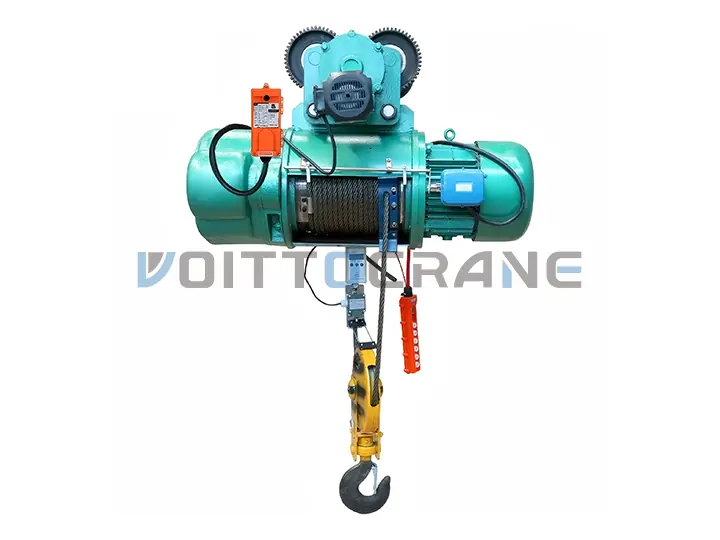

An electric hoist is a small lifting device that uses a reduction gear and a drum system to lift and horizontally move materials. Among them, there are many types of electric hoists, such as wire rope hoists, chain hoists, and European standard hoists, and electric hoist manufacturers can customize them according to different working environments. Next, we will introduce what is electric hoist, their applications, and prices to help you choose the right lifting solution. Usually, electric hoists as lifting mechanisms are equipped on overhead bridge cranes, gantry cranes, EOT cranes, jib cranes, KBK crane systems, and other equipment, and they work together to complete the lifting task. What is a Hoists? The electric hoist is primarily composed of a motor, reducer, drum, wire rope or chain, hook assembly, and electronic control system. The entire device features a compact structure, stable operation, and a strong load-bearing capacity, making it suitable for frequent lifting and large-tonnage material handling operations. Typically, electric hoists have a load capacity range of 1 to 32 tons. European electric hoists can reach 80 tons. What is…
An electric hoist works by using an electric motor and a transmission mechanism to move a wire rope or load chain, which raises or lowers the hook and the load attached to it. The motor produces rotation. A gearbox slows that rotation and increases its turning force. A rope drum or chain sprocket then converts it into straight-line movement of the rope or chain. Other parts keep that movement under control. A brake holds the load when the hoist stops, limit switches restrict hook travel, and many hoists add overload protection. This guide shows how an electric hoist works in the order it happens, from motor to hook. If you want a broader product overview first, read our overview of electric hoist types and uses. How Does an Electric Hoist Work? The easiest way to understand an electric hoist is to follow the path of power transmission from the power source to the load. Electrical Power → Electric Motor → Gearbox → Rope Drum or Chain Sprocket → Wire rope or Load Chain → Hook and Load The above represents…
Every week, maintenance managers and equipment buyers order chain hoists based on a single number: the rated capacity. That number feels like enough information. It usually isn’t. A 1/4 ton chain hoist handles very different workloads than a 1/2 ton or 1 ton model — not just in raw lifting weight, but in duty cycle, chain size, headroom requirement, and long-term maintenance cost. Scale that gap up to 10-ton or 20-ton industrial chain hoists, and a misjudged specification can create safety risks, premature equipment failure, or unnecessary capital spending. This guide answers one question: given your actual load, frequency, and environment — what chain hoist do you actually need? You will find: Whether you are sourcing a light-duty 500 lb chain hoist for a workshop or specifying a 20-ton heavy duty chain hoist for a steel fabrication facility, the logic in this guide applies directly. Chain Hoist Capacity Explained Rated Capacity Is Not Your Working Load The rated capacity printed on any chain hoist — whether it is a 1/4 ton chain hoist or a 5 ton chain hoist —…
An electric hoist is only as safe as the person operating it. The equipment itself — motor, brake, wire rope or chain, and control system — is engineered to handle rated loads reliably, but most lifting incidents stem from skipped inspections, overloading, or abrupt operation rather than equipment failure. This guide walks through a complete lifting operation, from pre-use checks to shutdown, so operators can operate a hoist correctly and consistently, whether it’s mounted on a single-girder overhead crane, a jib crane, or a standalone beam. What Is an Electric Hoist? An electric hoist is a motor-driven lifting device that raises and lowers heavy loads using a wire rope or lifting chain wound around a drum or sprocket. It is typically mounted on an overhead crane, jib crane, gantry crane, or a fixed I-beam and is operated via a handheld control box or a wireless remote control. This guide focuses on how to properly operate an electric hoist, rather than its construction or selection. For detailed information on its components, please refer to the article “What Is Electric Hoist?” What…
A chain hoist that hasn’t been properly inspected is not just a compliance risk — it’s a potential catastrophe waiting to happen. Whether you manage a manufacturing floor, a construction site, or a warehouse, skipping or shortcutting your chain hoist inspection program is one of the fastest ways to face equipment failure, regulatory fines, or worse, a serious workplace injury. Here’s the reality most procurement and safety managers face: they know inspections matter, but they’re uncertain about what to check, how often, and who is qualified to sign off. Add in the complexity of sourcing chain hoist replacement parts, scheduling electric chain hoist brake service, or finding a reliable chain hoist repair service, and the whole process can feel overwhelming. This guide cuts through the noise. You’ll get a complete, practical inspection checklist, a clear explanation of certification requirements, a maintenance schedule framework, and answers to the most common questions about chain hoist upkeep. Whether you’re managing a fleet of electric chain hoists or a single manual unit, this article gives you a working framework you can implement immediately. Why…
Procurement teams face the same challenge every time: too many chain hoists for sale, not enough clarity on which one actually fits the job. Choose the wrong capacity and you create a safety liability. Overpay on a unit that ships from three countries away and your project budget takes an unnecessary hit. Get the specs wrong and the hoist sits in a corner, unusable. Here’s the bottom line upfront: the right chain hoist depends on three factors — your lift capacity, duty cycle, and operating environment. Get those three right, and the rest of the decision falls into place. This guide is built for industrial buyers: factory procurement managers, equipment supervisors, and sourcing teams who need to move fast, spend smart, and avoid costly returns. Quick price reference — FOB factory, CE-certified: Type Capacity Indicative Price (USD) Manual chain hoist 0.5T – 3T $30 – $180 Manual chain hoist 5T – 20T $150 – $600 Electric chain hoist 0.5T – 3T $150 – $700 Electric chain hoist 5T – 10T $500 – $2,000 Prices are indicative and vary by specification.…

 English English
 Español
 Português
 العربية
 Français
 Русский