The hydraulic winch utilizes a hydraulic system as its core power source. Users employ it for lifting or towing operations. The device drives a drum via a hydraulic motor to wind and unwind a steel wire rope, thereby accomplishing the lifting, towing, and positioning of heavy loads. Compared to traditional electric winches, hydraulic winches offer higher torque output, smoother stepless speed control capabilities, and superior environmental adaptability. This equipment is capable of operating stably under heavy loads, during continuous duty cycles, and in harsh working conditions.
A hydraulic winch is a high-capacity traction device that uses hydraulic power to drive the drum, thereby winding and unwinding steel wire ropes or cables. Unlike electric winches, hydraulic winches convert hydraulic energy into mechanical energy, providing high pulling capacity and the ability to operate continuously. For this reason, a hydraulic winch has become the preferred solution for demanding applications, particularly in environments where heavy loads must be sustained continuously, harsh environmental conditions are present, or there is no access to electrical power.
A Hydraulic winch operates via a closed-loop hydraulic system, using pressurized fluid to drive a hydraulic motor. This design offers several advantages, including variable speed control, automatic load holding without the need for a brake, smooth and seamless start-up and shutdown, and the ability to withstand stalling under load without damage.
Hydraulic Winch Parts
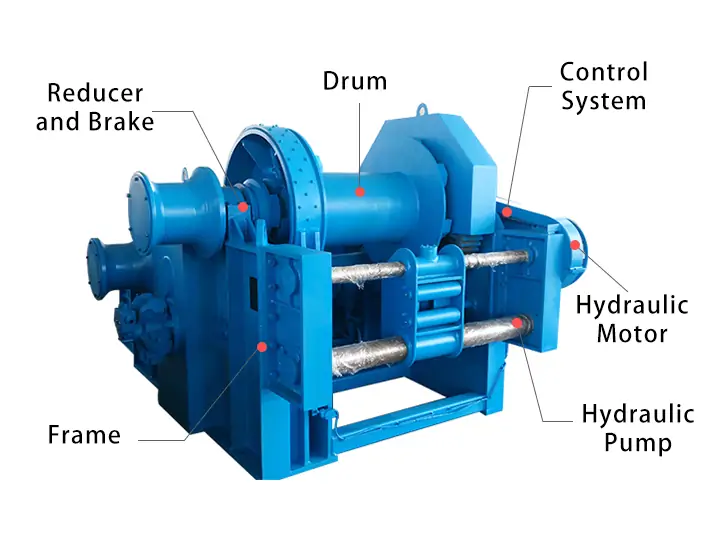
A hydraulic winch primarily consists of a hydraulic motor, a drum, a steel wire rope, an electrical control system, a frame structure, a reducer, a brake, and a hydraulic system. Below, I will introduce each component and its function.
Hydraulic Motor: Converts the pressure energy of the hydraulic fluid into rotational mechanical energy, driving the drum’s rotation.
Drum: Responsible for winding the steel wire rope.
Steel Wire Rope: Connects the winch to the load and transmits the traction or lifting force.
Reducer: Reduces rotational speed while increasing torque.
Brake: Locks the drum when the unit stops or in the event of a power failure.
Hydraulic Pump: Supplies high-pressure hydraulic fluid to the hydraulic system.
Hydraulic Valve Block: Controls the direction, pressure, and flow rate of the hydraulic fluid to facilitate starting, stopping, reversing, and speed regulation.
Oil Tank: Stores the hydraulic fluid and serves to dissipate heat and allow for the sedimentation of impurities.
Filter: Removes impurities from the hydraulic fluid, thereby protecting the hydraulic system.
Piping System: Connects the various hydraulic components and conveys the hydraulic fluid.
Control System: Controls the solenoid valves via electrical signals.
Frame: Supports and secures all components.
Types of Hydraulic Winch
1. According to the Reel Structure
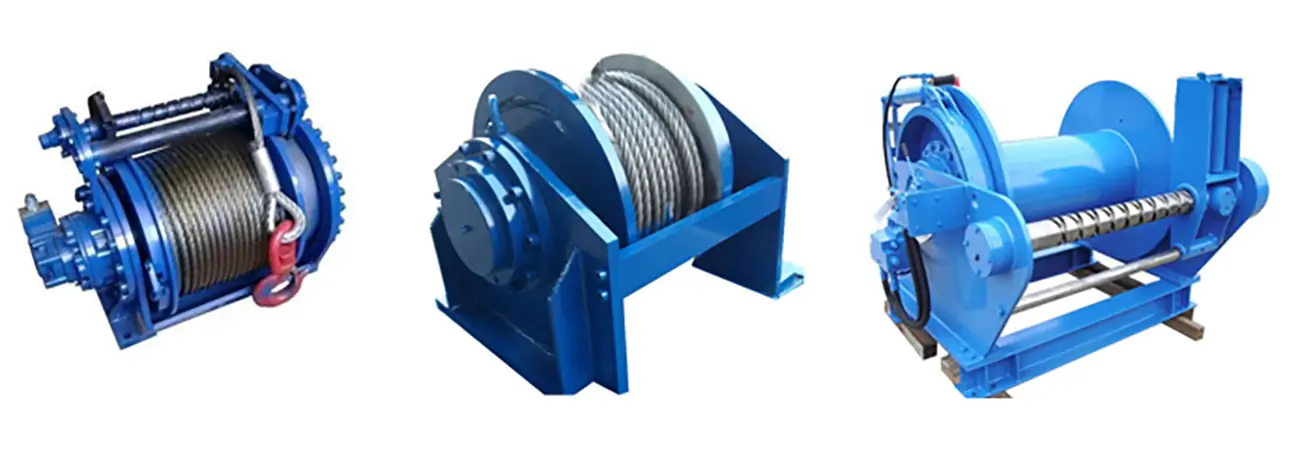
Single-drum Structure: Hydraulic winch suppliers utilize a single-drum design, employing a hydraulic motor to drive the steel wire rope for single-path lifting or pulling operations. The entire unit features a simple structure and convenient controls, making it suitable for general construction, marine anchor handling, and light-duty gantry crane applications.
Dual-drumStructure: A dual-drum hydraulic winch is equipped with two independent or interlinked drum systems, enabling either synchronized lifting or separate control of different loads. Compared to a single-drum configuration, it offers greater lifting capacity and effectively ensures load balancing and precise control.
2. Installation Method
Vertical Type: The vertical hydraulic winch features a drum structure arranged vertically, occupying minimal floor space. It is particularly well-suited for vertical lifting operations, enabling efficient hoisting within confined areas. Users employ this winch for hoisting materials in mines as well as for integration into tower cranes.
Horizontal Type: The horizontal hydraulic winch features a horizontal configuration, offering a compact structure and flexible installation options. It is suitable for horizontal traction or short-distance lifting operations. Typically, crane manufacturers integrate this type of winch into mobile lifting equipment, construction machinery, and operational environments requiring flexible spatial arrangements.
3. According to the Purpose
Lifting Applications: Hydraulic winches designed for lifting purposes primarily serve as the core hoisting mechanism for overhead cranes, gantry cranes, or tower cranes. This equipment features high torque output and stable operational performance, enabling it to meet the industrial demands associated with frequent lifting operations and the handling of heavy loads.
Towing Application: Designed for horizontal dragging and towing operations, this device delivers a powerful pulling force and is shock-resistant. It is widely utilized in scenarios such as vehicle recovery, marine towing, field construction, and port operations.
4. According to the Driving Method
Hydraulic Pump Directly Drives the Drum: This type of hydraulic winch uses a hydraulic pump to directly drive the drum’s rotation. The entire unit features a compact design and rapid response, making it suitable for applications involving small to medium-sized loads, as well as conditions requiring high control sensitivity.
Hydraulic Motor + Gear Reducer-Driven Drum: This type uses a hydraulic motor in conjunction with a gear reducer to drive the drum. Users employ it to perform lifting tasks under conditions involving heavy tonnage, high loads, and continuous operation.
Advantages
High Traction Capacity: The hydraulic system features an excellent power-to-weight ratio, delivering massive torque despite its compact size.
Precise Control: The equipment supports stepless speed regulation, ensuring smooth operation, and is capable of stopping under load.
Suitable for Harsh Environments: The equipment can operate in high-temperature, humid, dusty, and corrosive environments.
High Reliability and Durability: The entire unit has a simple structure with few potential failure points, requiring minimal maintenance and offering a long service life.
System Integration: The hydraulic winch can be directly integrated into hydraulic systems without requiring additional electrical infrastructure.
High Shock Resistance: The hydraulic system effectively absorbs shock loads, reducing equipment damage.
Excellent Low-Speed Stability: It maintains smooth operation even at low speeds, with minimal vibration or crawling.
High Safety: Overload protection is achieved through pressure control, and when combined with a braking system, it effectively prevents hook slippage or loss of control.
Flexible Layout: The hydraulic system can transmit power over long distances via piping, allowing for more flexible equipment placement.
Automated Control: The hydraulic winch can be integrated with PLCs or remote control systems to meet automated operation requirements.
Specifications
Capacity (Ton)
Line Pull (kN)
Rope Diameter (mm)
Drum Capacity (m)
Working Pressure (bar)
Line Speed (m/min)
1-2
10-20
12-16
50-100
140-160
15-25
3-5
30-50
16-22
80-150
160-180
12-20
8-10
80-100
24-28
100-200
180-200
10-18
15-20
150-200
28-36
150-300
200-250
8-15
30-50
300-500
40-52
200-400
250-280
6-12
60-100
600-1000
56-76
300-600
280-315
5-10
Custom Hydraulic Winch
VOITTO Crane offers custom-designed hydraulic winches tailored to meet unique application requirements not covered by our standard product line. Customers can specify custom pulling capacities, drum sizes, mounting configurations, and control systems.
Whether you need explosion-proof designs, food-grade hydraulic systems, or components rated for arctic-grade cold resistance, our custom configuration solutions ensure that the equipment perfectly matches your specific needs. Please feel free to contact us.
Hydraulic Winch Suppliers
Selecting the right hydraulic winch hinges on matching the equipment’s load capacity, operating speed, installation method, and control requirements to your specific application. VOITTO Crane engineers will provide expert guidance to ensure you choose the most suitable equipment.
Please feel free to contact our technical team to discuss your specific application requirements and learn more about our available hydraulic winch products, so you can find the ideal solution that best meets your needs.
FAQ
What is a Hydraulic Winch?
A hydraulic winch is a device that utilizes a hydraulic system to drive the rotation of a drum, thereby enabling the lifting or towing of heavy loads. Users typically deploy this equipment in heavy-duty applications and complex operating environments.
What advantages do hydraulic winches offer compared to electric winches?
Hydraulic winches feature higher torque output, superior stability at low speeds, and greater adaptability to varying environmental conditions. They are particularly well-suited for heavy-duty loads, continuous operation, and harsh environments.
Which industries utilize hydraulic winches?
They are primarily employed in ports and terminals, marine and offshore engineering, mining, oilfields, construction, and the field of heavy machinery.
How do I choose the right hydraulic winch?
When selecting a model, users must consider the rated pulling force, wire rope length and diameter, drum capacity, operating speed, and available installation space.
Can a hydraulic winch operate continuously?
Yes. Hydraulic systems feature excellent heat dissipation capabilities, making them suitable for prolonged, continuous operation; however, it is essential to ensure that the oil temperature remains within a safe and reasonable range.
What maintenance does a hydraulic winch require?
Maintenance tasks primarily include the periodic replacement of hydraulic fluid, inspection of seals, cleaning of filters, and checking pipelines and connections for leaks.
Can a hydraulic winch be used for precision positioning?
Yes. Its stepless speed control capability enables smooth and steady operation at low speeds.
Can a hydraulic winch be integrated into existing equipment?
Yes. If the equipment already possesses a hydraulic system, the winch can be connected directly, thereby simplifying installation and reducing costs.
What is the service life of a hydraulic winch?
With proper usage and maintenance, a hydraulic winch can typically operate reliably for over 20 years.
Are hydraulic winches safe?
Yes, hydraulic winches are equipped with braking systems and overload protection functions, allowing for safe stopping under load.
Qualification and Honor
Engineered Strength, Global Crane Supplier
service
Exclusive and Considerable, Customer First.
01
Reliable and Customized Solutions
Our pre-sale team provides consultations, tailoring solutions to your needs and environment.
Offer customization options for lifting capacity, span and lifting height etc. to meet specific needs.
02
Updated Production Process
Real-Time Progress Updates: Weekly reports and PM communication.





 English
  Español
  Português
  العربية
  Français
  Русский