
- 1 How Does an Electric Winch Work: The Core Principle
- 2 Components of an Electric Winch
- 3 How Does Electric Winch Brake Work?
- 4 Safety Considerations and Best Practices
- 5 How to Choose the Right Electric Winch
- 6 Conclusion
-
7
FAQ
- 7.1 What is the rated line pull of an electric winch, and how is it measured?
- 7.2 Can an electric winch be used for continuous lifting operations?
- 7.3 What maintenance does an electric winch require?
- 7.4 How do I know if I need a 12V or 24V electric winch?
- 7.5 Are there international standards I should check before purchasing an electric winch for industrial use?
An electric winch is a mechanical load-handling device. Typically, users use this device for lifting and towing operations in industrial, marine, and off-road environments. However, for procurement teams and end users, its internal mechanics often remain a “black box” filled with unknowns.


Next, this guide will explain how an electric winch works. I will provide a detailed breakdown of each major component and offer a practical decision-making framework to help you make the right purchasing choice. Whether you are selecting equipment for engineering, lifting, industrial, shipping logistics, or vehicle recovery applications, the information in this guide will serve as a valuable reference.
How Does an Electric Winch Work: The Core Principle
Understanding how an electric winch works starts with one straightforward idea: it converts electrical energy into mechanical pulling force. When the winch is activated, an electric motor draws current from a power source — typically a 12V or 24V DC battery, or a 110V or 220V AC supply for industrial-grade units. The motor drives the internal gears, which amplify torque through the gear train and transmit the rotational motion to the drum. The drum then winds or unwinds the steel wire rope, thereby providing the required pulling or lifting force.
A control system controls the entire operation of an electric winch. Typically, users employ a handheld remote control or an integrated control panel to regulate the motor’s direction, speed, and braking. In addition, modern electric winches are equipped with an electromagnetic switch that automatically cuts off the power supply when the current draw exceeds a safety threshold, thereby protecting the motor from overload damage.
The key advantage of this system is precision: because motor speed is electrically controllable, operators can manage load movement with a degree of accuracy that purely mechanical systems rarely offer.
Components of an Electric Winch
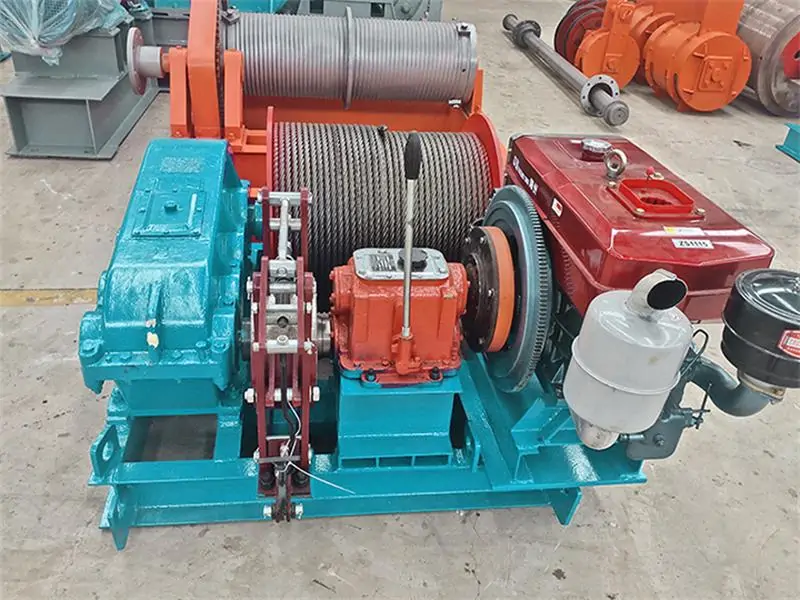
Below, I will describe the various parts of the electric winch. Understanding the functions of each component of an electric winch helps the procurement team assess the product’s quality, maintenance requirements, and long-term reliability.
Electric Motor
The motor is the heart of the system. Most industrial electric winches use series-wound DC motors, valued for their high starting torque and tolerance for short, high-load cycles. Motor output is rated in horsepower (HP) or kilowatts (kW), and this rating directly influences the winch’s line pull capacity.
For continuous-duty applications — such as anchoring systems or conveyor assists — buyers should look for motors rated for a higher duty cycle (expressed as a percentage of on-time per hour). A motor rated for 10% duty cycle is designed for short bursts, not sustained operation.
Drum
The drum is the cylindrical spool that stores and deploys the wire rope or synthetic line. Drum diameter and width determine line capacity. A critical but often overlooked factor is layer effect: as rope builds up in multiple layers on the drum, the effective drum radius increases, which reduces line pull at the drum. Manufacturers typically rate pulling capacity at the first layer — real-world performance at full drum may be 20–30% lower.
Gearbox
The gearbox is located between the motor and the drum. Its function is to convert the high-speed, low-torque power output from the motor into the low-speed, high-torque rotational power required to drive heavy loads. Most electric winches utilize a planetary gear transmission system, which offers advantages such as a compact design, high transmission efficiency, and even distribution of forces across the gears. The choice of gear ratio affects both the winch’s winding speed and pulling force—a higher gear ratio results in greater output torque, but the cable winds more slowly.
Brake
When the motor is de-energized, the braking system is responsible for preventing the load from descending uncontrollably or the cable from accidentally unwinding. Most electric winches employ an automatic mechanical braking mechanism—typically a worm brake or a cone brake—integrated directly into the gear train. This mechanism engages automatically and immediately the moment power to the motor is cut off. This serves as a passive safety feature requiring no intervention whatsoever from the operator. Furthermore, certain industrial-grade models incorporate a dynamic braking function utilizing the motor itself, thereby enabling smoother and more precise control over the load.


How Does Electric Winch Brake Work?
An electric winch brake works by automatically engaging when power to the motor is cut, using a spring-loaded mechanism to lock the drive shaft or gearbox and hold the load in place. While the winch is operating, electromagnetic or mechanical force keeps the brake released. Once the operator stops the winch or power is lost, the spring force immediately applies the brake, preventing the drum from rotating and stopping the load from slipping. This automatic load-holding function is critical for safety, ensuring the load remains secure without requiring manual intervention.
Safety Considerations and Best Practices
Before using this device, users must ensure they have a winch shock-absorbing pad and a pulley set storage bag. In the event of a cable break, the shock-absorbing pad absorbs the energy, thereby preventing dangerous “rebound” of the cable and effectively avoiding injury to personnel.
When handling steel cables, users must wear gloves. Even brand-new steel cables may have tiny broken strands protruding like needle tips. Older cables are prone to developing burrs, which can easily cut hands and cause deep wounds if proper protection is not worn.
When operating a winch, ensure that all bystanders maintain a sufficient safety distance from the steel cable and vehicles. Potential danger zones extend not only along the direction of the wire rope but may also extend beyond the anchor point.
Before each use, be sure to inspect the wire rope or rope for kinks, wear, rust, or other damage. Also, check hooks, shackles, and mounting hardware for wear or deformation.
Finally, ensure the cable is wound properly: always leave at least five turns of cable on the drum to prevent the fixed end (anchor point) from bearing the load directly. Additionally, maintain even tension when winding the cable to prevent it from becoming trapped between the lower layers during subsequent use.
How to Choose the Right Electric Winch
When selecting an electric winch, operators must do more than simply match the rated load capacity to the actual load weight. When determining specific specifications, the following factors should be taken into account:
- Calculate the actual traction force required. When performing this calculation, it is essential to fully account for friction, slope, and the weight of the load itself.
- Users must verify the duty cycle. If the application involves frequent repetitive towing or prolonged continuous towing operations, it is essential to verify the motor’s rated duty cycle.
- Users must confirm the power supply. Verify the available on-site voltage (e.g., 12V, 24V, or 48V DC, or AC mains power) and ensure the electrical system can withstand peak current surges.
- Determine the type of rope. Steel wire ropes offer superior wear and heat resistance. Synthetic ultra-high molecular weight polyethylene ropes, on the other hand, are lighter, float on water, and provide greater safety in the event of a snap-back accident.
- Evaluate the IP protection rating and the operating environment. If the winch will be used in a marine environment, subjected to washdown operations, or in an open-air outdoor setting, it is essential to verify the IP (Ingress Protection) rating of the motor and control enclosure.
- Verify relevant certifications. In markets requiring CE marking, electric winches used as lifting equipment must comply with the relevant provisions of the Machinery Directive 2006/42/EC and the corresponding harmonized standards.
Conclusion
An electric winch is capable of converting electrical energy into controllable mechanical traction. This equipment is ideally suited for industrial lifting, marine towing, construction, and vehicle recovery operations. When making a purchasing decision, users should prioritize the following factors: calculated pulling force, duty cycle, power source compatibility, wire rope type, protection rating, and relevant applicable certifications. VOITTO Crane is dedicated to providing our customers with valuable reference information.
If you wish to discuss specific technical specifications for a particular application scenario, or if you require a customized electric winch solution tailored to your specific load requirements, please do not hesitate to contact us.

Alan
Crane Solutions Specialist · Voitto Crane
Specialized in Overhead Crane, Gantry Crane, Jib Crane, Port Crane & EOT Crane export solutions. 10+ years helping global clients with pre-sales consultation, capacity selection and site-specific configurations.
FAQ
What is the rated line pull of an electric winch, and how is it measured?
Rated line pull refers to the maximum pulling force a winch can develop, typically expressed in pounds-force (lbf) or kilonewtons (kN). Manufacturers measure this at the first layer of rope on the drum under controlled test conditions, following standards such as SAE J706 or equivalent.
Can an electric winch be used for continuous lifting operations?
Most electric winches are designed for intermittent duty cycles — typically 10% to 30% on-time per hour.
What maintenance does an electric winch require?
Routine maintenance of electric winches includes: regularly inspecting and lubricating the drum bearings and gear drive system, checking the steel wire rope or synthetic rope for wear, kinks, or broken strands, and testing the functionality of the braking mechanism under load. In addition, electrical connections and electromagnetic contacts should be inspected for corrosion, particularly in marine or outdoor environments. Establishing and properly maintaining maintenance records and strictly adhering to the manufacturer’s maintenance schedule help ensure the validity of warranty coverage and support regulatory compliance inspections.
How do I know if I need a 12V or 24V electric winch?
The choice between 12V and 24V depends on your vehicle or power system. Most light-duty trucks, SUVs, and off-road vehicles use 12V electrical systems, making 12V winches the standard choice for capacities up to approximately 17,500 lbf. For larger capacities or commercial vehicles with 24V systems, 24V winches are appropriate.
Are there international standards I should check before purchasing an electric winch for industrial use?
Yes. For industrial applications in CE-marked markets, electric winches used as lifting appliances must comply with the Machinery Directive 2006/42/EC, and relevant harmonized standards include EN 14492-1 (powered winches) and EN 13135 (equipment for cranes).



 English
  Español
  Português
  العربية
  Français
  Русский