Hydraulic gantry lifting systems use hydraulics as their primary power source. These systems feature a multi-stage hydraulic telescoping beam-and-column structure designed to lift, move, and precisely position heavy-duty equipment. Typically, hydraulic gantry crane systems are used across a wide range of industries, including energy, infrastructure, transportation, and manufacturing.
Hydraulic gantry lifting systems are heavy-duty lifting equipment. The equipment features a modular design, with a simple layout and hydraulic synchronized lifting capability. Its rated lifting capacity ranges from 5 to 800 tons, with spans of 6 to 18 meters and lifting heights of 5 to 12 meters. The system is certified to CE and ISO 9001 standards. Users employ it for lifting operations in the power, petrochemical, and heavy manufacturing sectors, providing lifting solutions specifically designed for environments where conventional cranes cannot operate.
Product Overview
Hydraulic gantry lifting systems use hydraulics as their primary power source. The equipment features a multi-stage hydraulic telescopic column and beam structure for lifting, moving, and precisely positioning large-tonnage equipment. Unlike traditional overhead and gantry cranes, they do not require a permanent track structure. Instead, two to four hydraulic outriggers move along steel tracks or guide rails, allowing them to be deployed directly on the shop floor or at outdoor job sites.
The user-operated hydraulic gantry lift system keeps all legs at the same height, allowing the equipment to hoist, relocate, and install large equipment in narrow spaces and low-headroom environments. Hydraulic gantry lifting systems are characterized by their compact structure, high load-bearing capacity, convenient installation, and high site adaptability. Users widely apply it to scenarios such as power, petrochemicals, manufacturing, bridge construction, and large equipment maintenance.
Parts of Hydraulic Gantry Lifting Systems
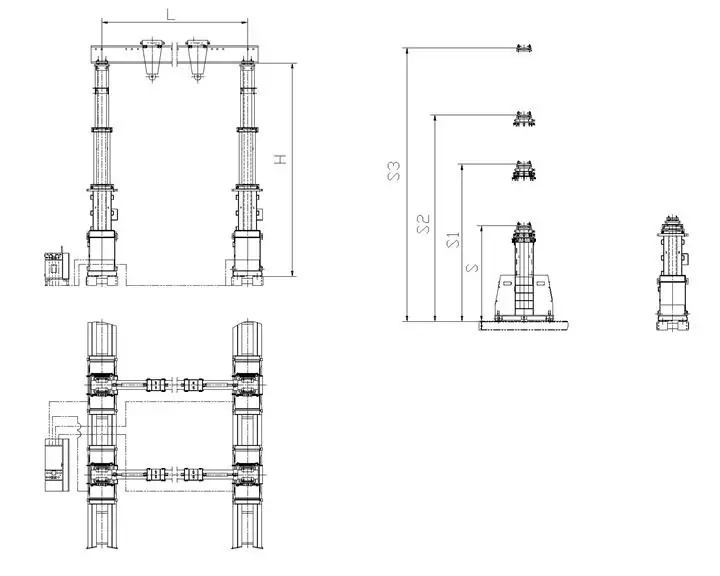
Hydraulic gantry lifting systems mainly consist of hydraulic gantry legs, upper header beam, base frame, lifting system, travelling mechanism, track, and a hydraulic system. The following is an introduction to each component of the hydraulic gantry crane:
Hydraulic Gantry Legs: The core load-bearing structure of the machine, utilizing multi-stage telescoping cylinders to achieve vertical movement.
Upper Header Beam: This component connects to the hydraulic mast legs and bears the load at the lifting point.
Base Frame: This assembly provides overall support and serves as a power transmission channel, ensuring the equipment’s overall stability during lifting and movement.
Lifting System: This mechanism consists of hydraulic cylinders, lifting points, load distribution devices, and a synchronization control system.
Travel Mechanism: This mechanism drives the hydraulic mast outriggers to move.
Track System: This component ensures stability and directional consistency during the equipment’s longitudinal movement.
Hydraulic System: The power source for the entire machine, responsible for providing power to the lifting, travel, and synchronization control functions.
Features and Advantages
The hydraulic gantry crane has many features and advantages, mainly including the following aspects:
Telescopic Column Structure: Users can flexibly adjust the equipment height according to hoisting needs. Its columns are strong and stable, allowing for use in low-ceiling or height-restricted environments.
High-precision Control System: Hydraulic gantry crane manufacturers equip their cranes with electronic proportional control, hydraulic synchronous valve groups, or PLC monitoring systems, ensuring that the height error at each point is within millimeters.
High-strength Steel Frame: The manufacturer of this hydraulic gantry crane uses Q345B/S355 structural steel to construct the equipment. The welds are inspected in accordance with ISO 5817 Class B standards, ensuring exceptional rigidity even under eccentric loads.
Modular Design: The hydraulic gantry lifting systems adopt a modular design to facilitate user transportation, installation, and disassembly.
Diverse Travel Options: Users can choose between rail-mounted or trackless travel for the hydraulic gantry crane. Rail-mounted travel is suitable for linear working conditions, while trackless travel is suitable for free movement, adapting to different working environments.
High Safety: The crane manufacturer equips the equipment with wireless remote control and micro-motion control functions, which effectively improve installation accuracy and safety.
High Equipment Adaptability: A hydraulic gantry crane has a compact structure and small footprint, making them very suitable for space-constrained environments.
Integrated Load Sensing System: Equipped with pressure sensors and a PLC controller to continuously monitor the actual load in real time.
CE / ISO 9001 / EAC Certification: Each unit is shipped with a Declaration of Conformity. Structural strength calculations strictly comply with the FEM 1.001 and EN 13001 crane design standards.
Application
Hydraulic gantry lifting systems cover a wide range, including industry, energy, infrastructure, transportation, and manufacturing. Below are some common application scenarios for a hydraulic gantry crane.
Transformer Hoisting: Users use it to lift, move, and maintain transformer equipment.
Power Generation Equipment: Users use it to lift, transport, and precisely position large generator units.
Manufacturing Industry: Assisting with the relocation, replacement, and maintenance of large production equipment within the workshop.
Petrochemical Industry: Users control it for the replacement, maintenance, and installation of large reactors, heat exchangers, tanks, and other equipment.
Paper, Steel, and Metallurgical Industries: Operators use it to install and maintain large equipment.
Bridge Construction and Precast Component Hoisting: Users use it to hoist concrete beams, steel box girders, and other components.
Shipbuilding and Shipyard Maintenance: Users use it to lift, assemble, and maintain large ship sections, power modules, and mechanical components.
Railway Equipment: Operators use it to install, maintain, and repair tunnel boring machines, rail vehicles, and other equipment.
Logistics and Warehousing: Users use it to move and position large pallets, equipment, or heavy containers over short distances.
Mining and Metallurgy Industry: In high-temperature environments, users employ this equipment for ladle turntable maintenance, electric furnace transformer replacement, and rolling mill roll replacement operations.
Specification
Type
Hydraulic Gantry Lifting Systems
Load Capacity
5 ~ 800 tons
Span
6 ~ 18 m
Lifting Height
5 ~ 12 m
Column Number
Level 2/Level 3/Level 4 telescopic posts
Gantry Legs Number
2 legs / 4 legs (common)
Travelling Method
Track / Trackless
Travelling Speed
3–8 m/min (load)
Control Methods
Wired Control or Wireless Remote Control
Operating Pressure
250 ~ 350 bar
Structural Steel Grade
Q345B / S355 (welds per ISO 5817 Level B)
Working Class
A3 ~ A5 per FEM 1.001
Power Supply
AC380V/50Hz
Working Temperature
-20℃~50℃
Warranty Period
18 months
Hydraulic Gantry Crane for Sale
VOITTO Crane is an ISO 9001-certified hydraulic gantry lifting systems manufacturer with more than 15 years of experience designing and delivering hydraulic gantry lifting systems to clients in over 60 countries. We are committed to providing customers with customized hydraulic gantry crane solutions. We can design fully customized hydraulic gantry lifting systems solutions tailored to your specific application needs, including lifting capacity, span, and work class.
If you have any requests or need further assistance, please feel free to contact us.
Specialized in Overhead Crane, Gantry Crane, Jib Crane, Port Crane & EOT Crane export solutions. 10+ years helping global clients with pre-sales consultation, capacity selection and site-specific configurations.
What is the maximum load capacity of a hydraulic gantry lifting system?
Standard hydraulic gantry lifting systems are rated from 5 to 800 tons per unit. However, tandem multi-unit configurations controlled by a single synchronous PLC can exceed this limit, enabling lifts well above 1,000 tons in special projects such as offshore topside installation.
How does synchronous control work in hydraulic gantry systems?
The synchronous control technology for the hydraulic gantry crane system utilizes proportional directional control valves and pressure sensors, which are connected to a central PLC. The controller continuously monitors and compares the actual heights of each outrigger, adjusting the hydraulic flow in real time to maintain the maximum height deviation within ±1 mm, in accordance with ISO 4413.
Can hydraulic gantry cranes operate in low-headroom environments?
Yes. Hydraulic gantry lifting systems are specifically designed for low-headroom applications. The minimum structural depth of approximately 300 mm — far less than conventional crane runways — allows operation inside existing buildings, substation bays, and underground facilities where overhead space is at a premium.
Is a permanent runway or foundation required for a hydraulic gantry crane?
No permanent structure is required. Hydraulic gantry cranes travel on temporary steel runways or skid tracks laid directly on a prepared concrete slab with adequate bearing capacity — typically 20 t/m² or greater.
Qualification and Honor
Engineered Strength, Global Crane Supplier
service
Exclusive and Considerable, Customer First.
01
Reliable and Customized Solutions
Our pre-sale team provides consultations, tailoring solutions to your needs and environment.
Offer customization options for lifting capacity, span and lifting height etc. to meet specific needs.
02
Updated Production Process
Real-Time Progress Updates: Weekly reports and PM communication.
3-5 years warranty and free replacement for non-manufacturing defects.
24/7 online support and on-site assistance for crane issues.
FAQ
Engineered Strength, Global Crane Supplier
Have your gantry cranes been used in major infrastructure projects?
Yes, our gantry cranes have participated in large-scale bridge construction projects and railroad construction in Brazil, Pakistan, Indonesia, Malaysia, Egypt, and other countries, in which we have played a particularly key role and contributed to these construction projects!
How are large gantry cranes shipped overseas?
Large gantry cranes are typically shipped overseas through modular disassembly, where the crane is broken down into major components (beams, legs, hoists) for containerized transport. For mega-cranes, we use specialized heavy-lift vessels equipped with reinforced decks, and critical parts are protected with anti-corrosion coatings during transit.
What voltage standards do your gantry cranes support?
Our gantry cranes support global voltage standards to ensure seamless operation worldwide. Solve any concerns you have about voltage.
Can you design a gantry crane for extreme outdoor conditions?
Yes, our gantry cranes can be used stably in harsh environments such as strong winds or low temperatures due to their special construction and material structure.
What is the price range of a standard gantry crane?
The price of a gantry crane ranges from $1300 to $1900875. Usually, the price is determined by the specific parameters. Contact us now to get a more professional quote!
Get In Touch
Please feel free to leave a message. We will reply in 24 hours.
Please specify your requirement by referring to the following aspects:
Which crane product do you need?
What is the maximum lifting capacity (in tons) required for your project?
Could you specify the lifting height (in meters) needed?
Can you provide details on the working environment, such as ground conditions, space limitations, and any obstacles?
What is the expected frequency of use and the duration of the project?




 English
  Español
  Português
  العربية
  Français
  Русский