
A guindaste de pórtico for sale from Chinese manufacturers is priced between $3,800 and $150,000+ FOB factory, depending on lifting capacity, span, and configuration. A 5-ton single girder unit at 12 m span starts around $7,000; a 10-ton double girder at 20 m span typically falls in the $20,000–$30,000 range; a 50-ton rail-mounted gantry crane runs $70,000–$110,000. These are real transaction prices from factories, not catalog estimates.Before diving into specific configurations, it helps to understand what drives those price differences — duty class, span, structural type, control system, and environment all affect the final number significantly. Our gantry crane cost guide breaks down each cost factor in detail so you can benchmark any quote you receive against realistic market expectations.
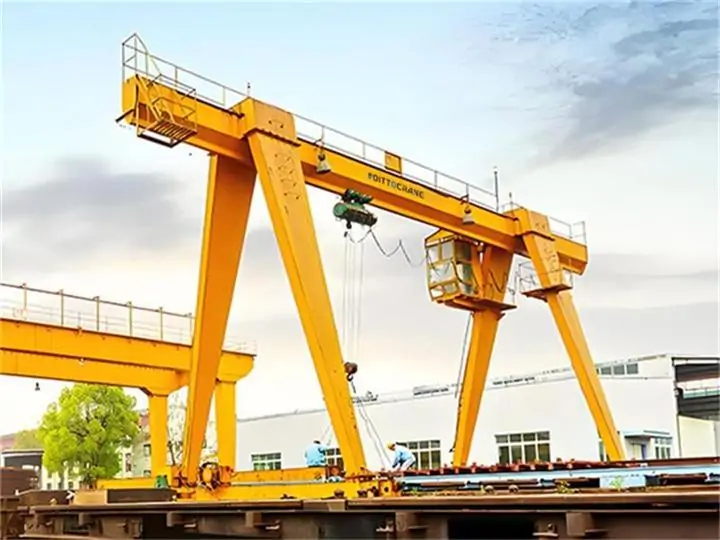
Guindaste pórtico de viga única
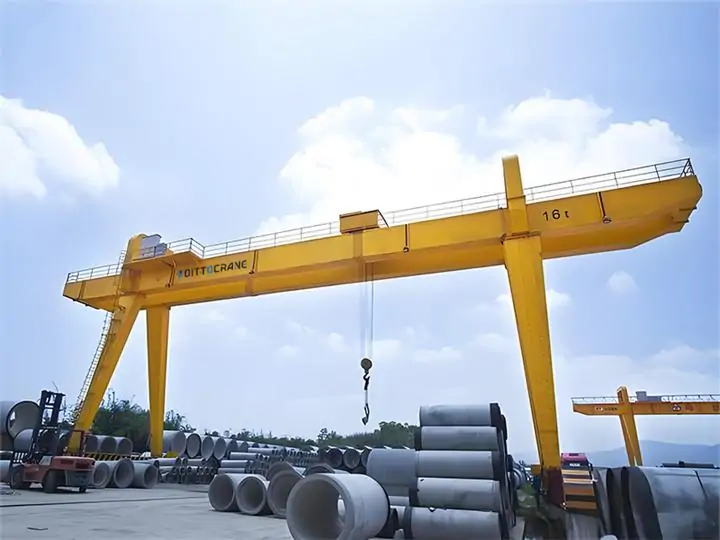
Full Gantry Crane
Many buyers tend to fall into a common misconception during the quotation phase: they view gantry cranes as standardized catalog items. This is not the case. The equipment’s span, lifting height, track gauge, duty cycle, and outdoor environmental conditions all influence the structural design. Making changes to any of these factors once manufacturing has begun can result in project delays of several weeks and increased costs. In the following sections, this article will clarify the key parameters that must be determined before contacting suppliers, guide you in choosing between single-girder and double-girder configurations, and list the certification documents that should be required as part of the procurement terms.
- 1 Gantry Crane Types Available for Sale: How Configuration Determines Price
- 2 Five parameters that procurement personnel must determine before issuing a Request for Quotation (RFQ)
- 3 Single Girder vs Double Girder Gantry Crane: Decision Table
- 4 Certifications and Documents Required When Buying a Gantry Crane
- 5 VOITTO Crane: Gantry Crane Manufacturer & Supplier
-
6
FAQ
- 6.1 Q1: What is the price range for a gantry crane from a Chinese factory?
- 6.2 How do I confirm the right duty class for my application?
- 6.3 Can an outdoor gantry crane for sale be configured for coastal or port environments?
- 6.4 What is the standard delivery time for gantry cranes for sale from China?
- 6.5 What maintenance inspections are required after a gantry crane is installed?
Gantry Crane Types Available for Sale: How Configuration Determines Price
The most meaningful variable in gantry crane pricing is not capacity — it is the combination of span, lifting height, capacity, and duty class. Two cranes with identical 10-ton rated capacity but different spans and duty classes can differ in price by 80%. The table below gives transaction-level price ranges across the main configurations currently available for direct factory purchase.
| Tipo | Capacidade | Span | China FOB Price | Duty Class / Application |
|---|---|---|---|---|
| Single Girder — Fixed Leg | 1–5 t | 6–16 m | $3,800–$9,500 | M3/M4 · Storage, light assembly |
| Single Girder — Fixed Leg | 5–10 t | 10–22 m | $7,500–$18,000 | M4/M5 · General manufacturing |
| Double Girder — Fixed Leg | 5–10 t | 10–22 m | $11,000–$22,000 | M5 · Medium-heavy production |
| Double Girder — Fixed Leg | 10–20 t | 13–30 m | $18,000–$45,000 | M5/M6 · Steel fab, precast |
| Double Girder — Fixed Leg | 20–50 t | 16–35 m | $38,000–$90,000 | M6 · Shipyards, heavy yards |
| Heavy-duty Double Girder Gantry Crane | 32-320 t | 18-35M | $78,000-$385,000 | A5/A6, Steel plants, hydroelectric projects, and large-scale manufacturing |
| Guindaste de pórtico montado sobre trilhos | 50–100 t | 20–40 m | $70,000–$150,000+ | M6/M7 · Port, container ops |
| Guindaste de pórtico com pneus de borracha | 30–80 t | 18–35 m | $58,000–$130,000+ | M5/M6 · Mobile outdoor yards |
Five parameters that procurement personnel must determine before issuing a Request for Quotation (RFQ)
Incomplete specifications during the quotation phase are the primary cause of cost changes after an order is placed. Suppliers base their production on the information they receive. If your request for quotation is missing these five parameters, the quote you receive will be only a provisional price, and changes are inevitable down the line.
1. Lifting Capacity — Include Rigging Weight
The lifting capacity specified by the user in the inquiry must reflect the maximum total lifting weight, which is the sum of the payload and the weight of all lifting accessories (such as hooks, lifting beams, electromagnetic clamps, or grabs). The SWL (Safe Working Load) indicated on the crane’s nameplate refers to the net load limit. For example, if your operation involves using a 600-kilogram steel coil grab to lift an 8-ton steel coil, the crane’s SWL must be 10 tons, not just 8 tons. Mistaking the net load for the crane’s rated lifting capacity is one of the most common misconceptions in the procurement of such products.
2. Duty Class
Most Chinese manufacturers default to M4/A4 (FEM 1.001 / ISO 4301-1) unless the buyer specifies otherwise. M4 is engineered for approximately 10–20 lift cycles per hour with a design life of 6,300 hours. A precast concrete yard running 50 lifts per shift requires M5 or M6 — a crane built to M4 for that duty cycle will show structural fatigue at the end-carriage and girder-to-leg connections within two to three years. Specify duty class explicitly; the structural cost difference between M4 and M6 on a 10-ton crane is typically 25–35%.
3. Span and Rail Gauge — Measure on Site
Span is the centre-to-centre distance between the two ground rails the gantry travels on. Rail gauge is the same measurement. Both must be verified on site with a tape measure — not taken from an existing equipment drawing that may reflect a previous installation. A 200 mm error in span results in a leg geometry that cannot be corrected after fabrication. Provide the dimension in millimetres, not a rounded metre figure.
4. Lift Height — Measure from Rail Surface
The lifting height refers to the distance between the top of the rail and the center point of the hook when it is in its lowest position. This height is neither the main girder height nor the overall crane height, nor is it the distance from the hook to the ground. Measurement errors in this area can affect the diameter of the hoist drum.
5. Outdoor Gantry Crane for Sale: Site Environment
For any outdoor gantry crane application, the Request for Quote (RFQ) must include the following information: Maximum operating wind speed (used to calculate wind loads in accordance with GB/T 3811-2008 or EN 13001-3-5 for CE-certified equipment), ambient temperature range (motor and brake specifications vary when temperatures fall below -10°C or rise above 45°C), and ground type. Rubber-tyred gantry cranes generate concentrated wheel loads that often exceed the bearing capacity of unpaved or inadequately compacted yard surfaces—it is essential to verify the ground bearing capacity before ordering (rather than after delivery).

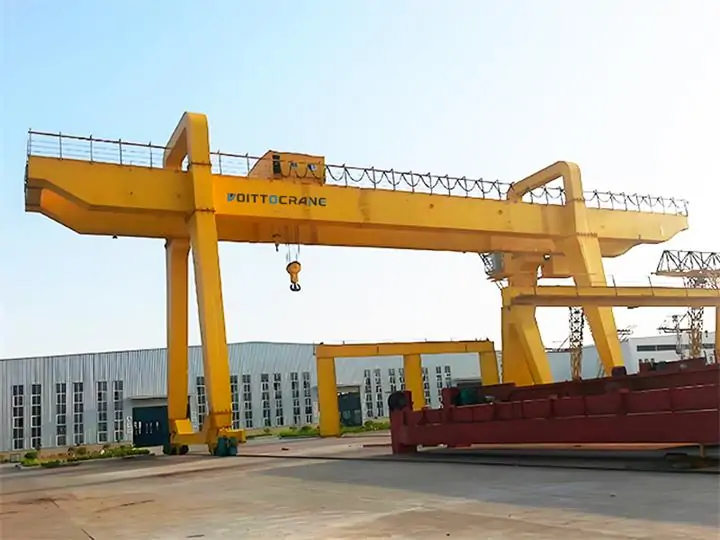
Single Girder vs Double Girder Gantry Crane: Decision Table
Choosing the wrong girder configuration is the most common source of over-specification (buying a double girder crane that adds 60% cost with no operational benefit) or under-specification (ordering a single girder unit that fails ahead of its design life under actual operating conditions). Use the table below as the primary decision filter.
| Decision Criterion | Pórtico rolante de uma viga | Pórtico rolante de dupla viga |
|---|---|---|
| Capacity ceiling | 32 t | 500 t (standard to 100 t) |
| Span ceiling | 22 m | 40 m (engineered beyond) |
| Outdoor use | ✓ With a weatherproof package | ✓ Standard configuration |
| Hook end-approach | Limited (hoist below girder) | Full (hoist on top rail) |
| Auxiliary hoist | Not available | ✓ Available |
| Maintenance walkway | Not included | ✓ Standard |
| Recommended max duty | M5 | M8 |
| CE / ISO certification | ✓ | ✓ |
| Delivery (FOB factory) | 15–25 working days | 20–40 working days |
When Single Girder Is the Right Choice
Single girder gantry cranes are correct for capacities at or below 32 tonnes, spans under 22 metres, and duty classes at or below M5. The lower structural self-weight reduces ground rail loading — a practical advantage when the crane is installed on an existing concrete surface not originally designed for crane wheel loads. Single girder units also carry a shorter lead time (15–25 working days vs. 20–40 for double girder) and lower maintenance complexity, since the hoist runs on the bottom flange of a single girder and is accessible from ground level or a short ladder.
A common mistake users should avoid is selecting a single-girder crane to reduce initial purchase costs when the duty class is M6 or higher. The lower-flange trolleys of single-girder cranes are not designed for high-frequency continuous operation. Under M6 duty conditions, wear on the trolley wheels and flanges increases significantly. Furthermore, under repeated loading, deflection of the main girder often begins to affect the alignment accuracy of the hoist within 18 to 24 months.
When Double Girder Is Required
Users should select a double-girder gantry crane in any of the following situations: when the lifting capacity exceeds 32 tons, the span exceeds 22 meters, the duty class is M6 or higher, the application requires an auxiliary hoisting mechanism for secondary lifting, or a maintenance walkway must be installed at the operating height to ensure safe maintenance of the hoisting mechanism. For gantry cranes used in ports, shipyards, and heavy prefabricated component manufacturing, a double-girder structure is standard for lifting capacities exceeding 20 tons, regardless of span.
Double-girder cranes also support “full hook end-approach”—where the hoist trolley runs on rails at the top of both main girders, allowing the hook to reach within 300–600 millimeters of the rail end. In contrast, this distance is typically 600–1,200 millimeters for single-girder cranes.
Certifications and Documents Required When Buying a Gantry Crane
A gantry crane operating over personnel and equipment for 15–20 years must be verifiably certified. The documents listed below are purchase conditions, not items to negotiate away for a lower price.
| Padrão | Scope | Market |
|---|---|---|
| CE / 2006/42/EC | Machinery safety conformity — unit-specific Declaration required | EU, Middle East, Africa |
| ISO 4301-1:1986 | Crane and hoist classification by duty cycle | Global |
| EN 13001-1:2015 | Structural safety — general principles for crane design | EU / International |
| FEM 1.001 | Duty class calculation — default standard for Henan manufacturers | Global (widely cited) |
| GB/T 14406-2011 | Chinese national standard for general-purpose gantry cranes | China domestic |
| IEC 60204-32:2023 | Electrical equipment requirements for hoisting machinery | Global |
| ISO 9927-1:2013 | Inspections and load testing — periodic and after major repairs | Global |
CE Certification: The Critical Distinction
CE marking under EU Machinery Directive 2006/42/EC requires that the Declaration of Conformity be issued for the specific serial-numbered unit you receive, supported by a Technical Construction File (TCF). For high-capacity or high-duty-cycle orders (above 20 tonnes or M6+), consider appointing a third-party notified body for a pre-shipment inspection. Cost is typically $800–$2,500 and reduces compliance risk substantially on arrival at the destination port.
Load Test Documentation
Before shipment, the gantry crane manufacturer must provide a complete full-load test report: First, conduct a static load test at 110% of the safe working load (SWL) and maintain this load for at least 10 minutes. This is followed by a dynamic load test at 100% SWL, covering the full travel range. The report must include time-stamped photographs, the actual test weights used, the ambient temperature, and the identification details of the inspectors. In accordance with ISO 9927-1:2013, the same test procedure must be performed whenever major structural repairs are carried out or the hoisting mechanism is replaced during the crane’s service life.
VOITTO Crane: Gantry Crane Manufacturer & Supplier
VOITTO Crane manufactures and exports single-girder and double-girder gantry cranes with lifting capacities ranging from 1 to 500 tons, selling directly to more than 50 countries worldwide. Standard models in the 1- to 32-ton range have a delivery time of 15 to 25 business days. For requirements involving special spans, non-standard duty cycles, explosion-proof specifications, and rail-mounted or rubber-tired configurations, we offer customized design and manufacturing services.
Each order includes a general arrangement (GA) drawing for customer approval before manufacturing, an individual CE Declaration of Conformity in accordance with Directive 2006/42/EC, a comprehensive pre-shipment load test report with photographic documentation, and post-delivery technical support services. The products comply with the requirements of standards such as CE, ISO 9001:2015, FEM 1.001, and GB/T 14406-2011.

Alan
Especialista em soluções para guindastes · Voitto Crane
Especializada em soluções de exportação de pontes rolantes, pórticos, gruas, pórticos portuários e pontes rolantes EOT. Mais de 10 anos a ajudar clientes globais com consultoria pré-venda, seleção de capacidade e configurações específicas do local.
To receive a direct manufacturer quote, please provide the lifting capacity (t), span (m), lifting height (m), duty cycle, and information about the on-site environment. We will provide you with a solution, along with configuration recommendations and a delivery schedule.
FAQ
Q1: What is the price range for a gantry crane from a Chinese factory?
Transaction prices from Henan-region factories run from approximately $3,800 for a 1–3 t single girder unit at 6–10 m span, to $150,000+ for a 50–100 t double girder rail-mounted crane. A 10-ton double girder at 20 m span is typically $22,000–$35,000 FOB. The most significant price driver after capacity and span is duty class: upgrading from M4 to M6 on a 10-ton crane adds 25–35% to structural cost. Electrical specification (voltage, frequency, control type) and hoist brand are the next largest variables.
How do I confirm the right duty class for my application?
Duty class under FEM 1.001 / ISO 4301-1 is determined by two parameters: load spectrum (the ratio of actual lifted loads to the SWL, across all lifts over the crane’s life) and total number of working cycles over the design life. In practice, the fastest path to the correct duty class is to specify your average lift frequency (cycles per hour) and shift pattern (hours per day, days per year). Most Henan manufacturers can map those inputs to a duty class within one RFQ exchange.
Can an outdoor gantry crane for sale be configured for coastal or port environments?
Yes. Outdoor and coastal configurations add three specification layers to the standard build: wind load design per GB/T 3811-2008 or EN 13001-3-5 (for CE-marked units), corrosion protection (hot-dip galvanized structural members plus multi-layer epoxy or marine-grade topcoat), and weatherproof electrical enclosures rated IP55 or IP65 per IEC 60529.
What is the standard delivery time for gantry cranes for sale from China?
Single girder units (1–10 t, standard spans) are ready for shipment in 15–25 working days from deposit payment and GA drawing approval. Double girder units above 16 tonnes, or any crane with a non-standard span or duty class, take 25–40 working days. Sea freight adds 18–28 days to most destinations. Confirm the production slot and lead time in the purchase order — not via email — and build a 10-day buffer into your project plan for customs clearance and inland transport at the destination port.
What maintenance inspections are required after a gantry crane is installed?
Mandatory inspection intervals are specified by applicable national standards and service categories. According to EN 13001 and FEM 1.001, the interval for formal structural inspections of M3–M5 class cranes must not exceed 10 years, and for M6–M8 class cranes, it must not exceed 5 years. Following any major structural repairs or replacement of the hoisting mechanism, a full-load test at 110% of the safe working load (SWL) must be conducted in accordance with ISO 9927-1:2013. For details on the maintenance, please visit this page: Lista de verificação para inspeção de guindastes de pórtico


 English
  Español
  Português
  العربية
  Français
  Русский