
Selecting the right overhead crane for a steel mill is not a catalog decision — it is an engineering decision with direct consequences for production continuity and worker safety. A ladle crane transporting 200 tons of molten steel at 800°C and a coil-handling crane moving finished product share the same name but almost nothing else: different work grades, different structural standards, different safety systems, and a price difference that can exceed $300,000.
Steel mills present five simultaneous challenges that standard industrial cranes are not designed for: radiant heat from furnaces and ladles, airborne metallic dust, corrosive atmospheres, continuous multi-shift operation, and catastrophic consequences if a load is dropped. Each of those factors drives a specific design requirement, and every requirement narrows your crane specification further.
This guide gives plant engineers and equipment managers a complete, bay-by-bay selection framework — crane type, capacity range, duty class, key technical features, and indicative price — so you can frame an accurate specification before you talk to any supplier.
- 1 Quick Reference: Overhead Crane Types for Steel Mill
-
2
Types of Overhead Crane for Steel Mill
- 2.1 Ladle Crane — The Most Safety-Critical Unit in Your Plant
- 2.2 Foundry and Casting Crane — Heat Resistance Is the Design Driver
- 2.3 Electromagnetic Crane — Scrap Yard to Finishing Line
- 2.4 Grab Bucket Crane — Bulk Raw Materials and Slag
- 2.5 Double Girder Overhead Crane — Rolling Mill and General Service
- 3 Duty Class: The Specification Factor Most Buyers Get Wrong
- 4 Key Technical Specifications for an Overhead Crane for Steel Mill
- 5 How to Match Crane Type to Your Steel Mill Bay
- 6 Conclusão
-
7
FAQ
- 7.1 Q1: What duty class does an overhead crane for a steel mill need?
- 7.2 Q2: How much does an overhead crane for a steel mill cost?
- 7.3 Q3: What is the difference between a ladle crane and a foundry crane?
- 7.4 Q4: What safety features are mandatory on a steel mill overhead crane?
- 7.5 Q5: Can a standard double-girder overhead crane be used in a steel mill?
Quick Reference: Overhead Crane Types for Steel Mill
The table below summarizes every overhead crane for steel mill application by type, capacity, duty class, and indicative price.
| Tipo de grua | Gama de capacidades | Duty Class (FEM/GB) | Typical Bay | Indicative Price (FOB) |
|---|---|---|---|---|
| Ladle Crane (YZ) | 75–400T | A7–A8 | Steelmaking / Converter | $120,000–$350,000+ |
| Foundry / Casting Crane | 50–320T | A7–A8 | Continuous casting / Pouring | $80,000–$280,000 |
| Electromagnetic Crane (QC) | 5–64T | A5–A8 | Scrap yard / Finishing | $25,000–$95,000 |
| Grab Bucket Crane (QZ) | 5–60T | A6 | Raw material yard / Slag | $18,000–$65,000 |
| Double Girder Crane (QD) | 5–800T | A3–A6 | Rolling mill / Maintenance | $18,000–$180,000 |
Prices are indicative market reference. Final pricing depends on span, lifting height, under-hook attachments, and control system.
Obter cotaçãoTypes of Overhead Crane for Steel Mill
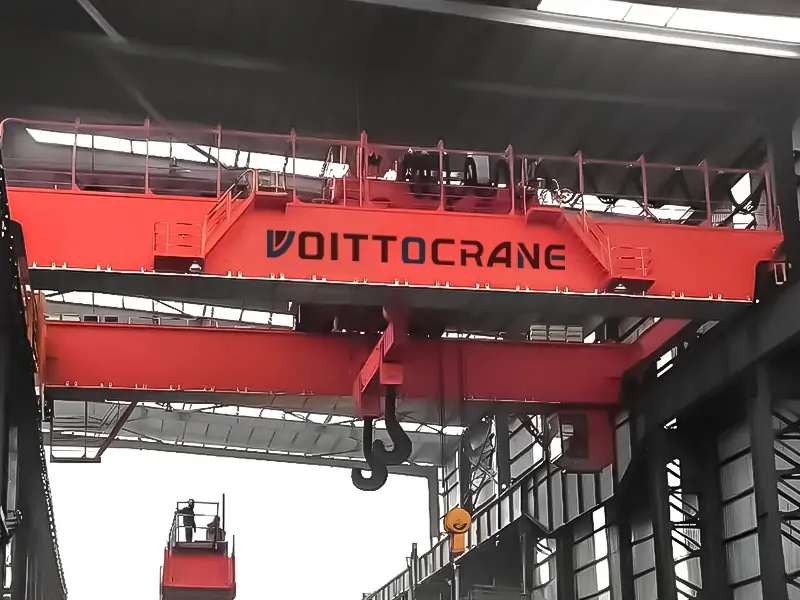
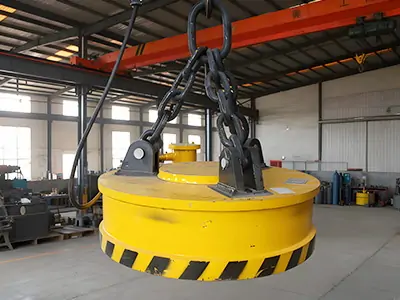
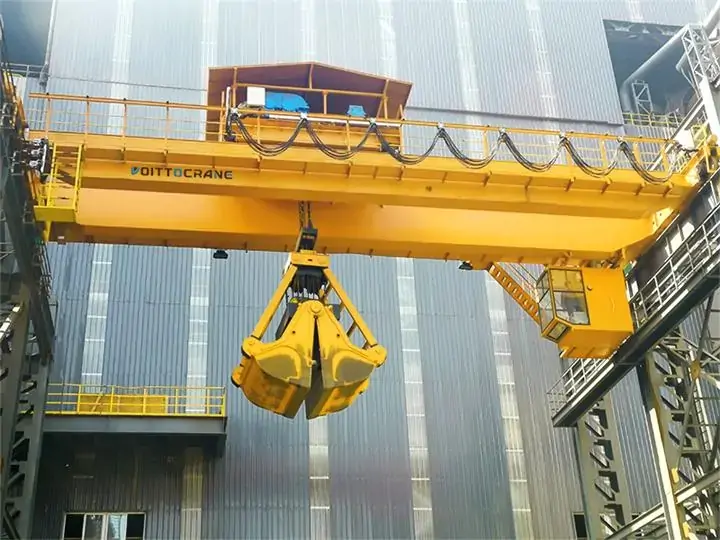

Ladle Crane — The Most Safety-Critical Unit in Your Plant
A ladle crane is the highest-risk, highest-specification overhead crane for steel mill applications, designed exclusively to transport ladles containing molten steel between furnaces, refining stations, and continuous casting machines. At rated capacity, a ladle may hold 150–300 tonnes of steel at temperatures exceeding 1,550°C. A structural failure is not a maintenance event — it is a life-safety emergency.
The defining technical requirements: work grade A7–A8 per FEM 1.001 (or GB/T 3811 equivalent), dual independent hoisting mechanisms (main hook + auxiliary hook), redundant braking systems on each hoist (minimum two independent brakes per mechanism), and heat shields on the bridge and trolley structure. Anti-sway control is standard on modern ladle cranes to prevent oscillation during high-precision positioning over casting molds.
Spans typically run 18–32 m; lifting heights 12–28 m depending on converter/EAF bay geometry. Capacity 75–400T depending on heat size.
Foundry and Casting Crane — Heat Resistance Is the Design Driver
Foundry cranes (YZ type) handle molten metal transport in casting bays — moving ladles to tundishes, positioning tundish cars, and supporting maintenance operations around active casting lines. The structural distinction from a standard double-girder crane is substantial: heat-resistant structural steel (typically Q345B or equivalent), high-temperature-rated wire rope, thermal insulation on trolley and bridge components, and class F4 insulation on motor windings to sustain continuous operation at ambient temperatures up to 40–60°C at hook level.
Work grade A7–A8. Lifting capacity 50–400T. These cranes almost always feature a secondary hoist (auxiliary hook, typically 20–30% of main hook capacity) for mold handling and maintenance tasks that would otherwise require a separate crane.
Electromagnetic Crane — Scrap Yard to Finishing Line
An electromagnetic crane (QC type) replaces manual and mechanical gripping with a disc electromagnet or rectangular lifting magnet, making it the correct choice wherever ferromagnetic material is handled in irregular shapes — scrap bundles, steel billets, cut plate, and coils. The electromagnet is energized through slip rings on the hoist, and power loss protection (maintained field on emergency power) is a mandatory safety feature for any above-floor application.
Work grade A5–A8 depending on cycle intensity. In a high-throughput scrap yard running continuous charging cycles, A7–A8 is appropriate. Lifting capacity 5–64T (electromagnet size is the practical limit, not structural capacity). This type is also common in the finishing bay for fast, tool-free product handling.
Grab Bucket Crane — Bulk Raw Materials and Slag
A grab bucket crane (QZ type) handles the loose, high-volume material flows that move through a steel plant before and after the furnace: iron ore, coke, coal, limestone in the raw materials yard; furnace slag and dust in waste handling areas. The grab bucket — hydraulic, mechanical, or electro-hydraulic — opens and closes independently of hoist travel, enabling continuous cycling without manual rigging.
Work grade A6 (continuous bulk handling). Lifting capacity 5–60T, grab volume 1–8 m³ depending on material density. Because the grab operates through constant opening/closing impacts, the bridge and trolley structure must be rated for impact loads per GB/T 14405 Group A6 or higher.
Double Girder Overhead Crane — Rolling Mill and General Service
The standard double-girder bridge crane (QD type) is the workhorse of the rolling mill, billet storage, and maintenance bays — areas where temperatures are lower, load profiles are more predictable, and cycle rates are moderate. Capacity range 5–800T; work grade A3–A6 depending on application. In a rolling mill handling billets and slabs, A5–A6 is typical. For equipment maintenance bays with infrequent lifts, A3–A4 is appropriate and considerably less expensive.
This is the only crane type in a steel plant where a single-girder configuration is sometimes acceptable — for maintenance areas with loads below 20T and infrequent use cycles.
Duty Class: The Specification Factor Most Buyers Get Wrong
Duty class is the most consequential — and most commonly misread — specification in an overhead crane for steel mill procurement. It determines structural design, motor sizing, gearbox selection, brake specification, and ultimately the crane’s fatigue life under actual operating loads.
Classe de serviço (also called work grade or service class) classifies a crane by its expected total number of load cycles and average load ratio over its design life, as defined under FEM 1.001 (European standard), ISO 4301-1, or China’s GB/T 3811.
The practical error pattern in steel mill procurement: a buyer specifies capacity correctly (e.g., 100T ladle crane) but defaults to A6 because it is “heavy duty.” In a converter bay running three shifts with 40+ lifts per shift, a ladle crane operates under A7–A8 conditions. An A6 crane will reach fatigue-life limits in 3–5 years instead of the expected 15–20 years, requiring full structural recertification or replacement at a cost exceeding the original purchase price.
Bay-by-bay duty class reference:
| Bay / Process Zone | Tipo de grua | Minimum Duty Class | Notas |
|---|---|---|---|
| Converter / EAF bay | Ladle crane | A7–A8 | Continuous high-cycle, high-load |
| Continuous casting | Foundry crane | A7–A8 | Tundish handling = near-rated loads, every cast |
| Scrap yard (high throughput) | Electromagnetic / Grab | A7–A8 | 40–80 cycles/hr common |
| Raw material yard | Grab bucket crane | A6 | Intermittent bulk cycling |
| Rolling mill | Viga dupla | A5–A6 | Billets/slabs: heavy but predictable cycles |
| Equipment maintenance bay | Viga dupla | A3–A4 | Infrequent lifts, low average load |
| Finished product storage | Electromagnetic / DG | A5–A6 | Regular cycling, moderate loads |
Key Technical Specifications for an Overhead Crane for Steel Mill
Safety Systems That Are Non-Negotiable
Every overhead crane for steel mill service above A6 duty class must include a defined set of safety systems beyond what is standard on general-purpose industrial cranes. The following are not optional add-ons — they are baseline requirements under GB 6067.1 (Safety Rules for Lifting Appliances) and the equivalent EN 13001 series for CE-marked equipment:
Dual independent hoisting brakes: Each hoist mechanism on a ladle or foundry crane must have a minimum of two independent braking systems, either both mechanical or one mechanical plus one hydraulic thruster brake. This directly addresses the failure mode of a single brake releasing while the hoist is loaded.
Proteção contra sobrecarga: Load limiter set at 100–110% of rated SWL, with automatic cut-out. In high-cycle applications, overload events accumulate structural fatigue faster than any other single factor.
Anti-sway control: Standard on ladle cranes for positioning accuracy over casting molds (±10 mm). Variable-frequency drives (VFD) on all motion axes with electronic speed regulation replace legacy contactor-based control.
Heat shielding and high-temperature wire rope: For foundry and ladle cranes, the hoist rope must be heat-resistant wire rope (per GB/T 9944 Class B or equivalent), and structural components within 3 m of the ladle travel zone require thermal insulation.
Electrical and Control Requirements
Steel mill cranes operate in Category C3 electromagnetic environments (heavy industrial, per IEC 61000). All electrical cabinets require IP54 minimum, motor windings F-class insulation (155°C), and contactors/controls rated for the expected ambient temperature at installation level. Festoon cable or conductor rail systems replace trailing cable runs over spans greater than 20 m.
Obter cotação
How to Match Crane Type to Your Steel Mill Bay
Selecting the right overhead crane for a steel mill starts with the bay, not the catalog.
A Practical Selection Sequence
The correct way to specify an overhead crane for a steel mill is to work from the process outward, not from a capacity number inward. The sequence:
Start with the bay and the operation — which production zone, what material is being lifted, what is the transfer distance, and what is the cycle frequency? Next, determine maximum lift capacity including the weight of the hook block, lifting beam, electromagnet, or ladle (empty weight can be 30–50% of the load total). Then establish the duty class based on lifts per hour and average load ratio. Finally, specify span, lifting height, and any special environmental requirements (temperature, corrosion, explosion risk).
Specifying by crane capacity alone and ignoring duty class is the single most common and most expensive mistake in steel mill crane procurement. A 100T ladle crane specified at A6 instead of A7 may save $30,000–$50,000 at purchase. In a converter bay running continuous shifts, the fatigue life calculation under FEM 1.001 shows that A6 structural members will reach their design cycle limit within 4–6 years of operation — at which point a structural recertification test (typically 15–25% of new crane cost) is required before the crane can continue operating. Over a 20-year service life, the total cost of an underspecified crane exceeds the correct specification by a factor of 2–3x.
The correct approach: provide your crane supplier with operating hours per year, average lifts per shift, and average % of rated load per lift. Any competent manufacturer will calculate the duty class from these inputs rather than asking you to specify it directly.
Conclusão
Choosing the right overhead crane for a steel mill requires matching crane type, capacity, and duty class to each specific bay and process — not selecting a generic “heavy duty” unit and hoping it survives. For molten metal bays (converter, EAF, continuous casting), A7–A8 ladle or foundry cranes with dual braking and anti-sway control are non-negotiable. For material handling in scrap yards and raw material areas, electromagnetic and grab bucket cranes at A6–A7 offer the best cycle efficiency. Rolling mills and maintenance bays are typically well served by standard double-girder QD cranes at A5–A6.
Before issuing a specification, define your operating profile: tons per lift, lifts per shift, ambient temperature, and span. Share those inputs with your supplier and ask them to validate the duty class — if they can’t, that tells you something important about the quality of engineering support you’ll receive after the crane ships.
Voitto Crane provides full custom engineering for overhead cranes for steel mills across all bay types, from 5T maintenance cranes to 400T ladle cranes. Our engineers review your process parameters and return a duty-class-validated specification, typically within 48 hours.

Alan
Especialista em soluções para guindastes · Voitto Crane
Especializada em soluções de exportação de pontes rolantes, pórticos, gruas, pórticos portuários e pontes rolantes EOT. Mais de 10 anos a ajudar clientes globais com consultoria pré-venda, seleção de capacidade e configurações específicas do local.
FAQ
Q1: What duty class does an overhead crane for a steel mill need?
Ladle cranes and foundry cranes require duty class A7–A8 (FEM 1.001 / GB/T 3811) due to continuous high-load cycling in hot metal bays. Grab and electromagnetic cranes in scrap yards typically need A6–A7 depending on cycle rate. Rolling mill and maintenance bay cranes can be specified at A5–A6. Underspecifying duty class is the most common procurement error in steel mills — an A6 ladle crane in a converter bay will exhaust its structural fatigue life 3–4x faster than a correctly specified A7–A8 unit, triggering recertification or replacement within 4–6 years.
Q2: How much does an overhead crane for a steel mill cost?
Indicative pricing (FOB, market reference): standard double-girder QD cranes for rolling mill or maintenance bays start around $18,000–$25,000 for 5–10T units and rise to $120,000–$180,000 at 100–200T. Electromagnetic cranes (QC type) run $25,000–$95,000. Ladle cranes and heavy-duty foundry cranes range from $80,000 to $350,000+ depending on capacity, span, and control sophistication. Custom under-hook attachments (ladle hooks, coil tongs, slab lifters) are priced separately and can add $15,000–$80,000.
Q3: What is the difference between a ladle crane and a foundry crane?
Both are high-temperature, A7–A8 duty class cranes for molten metal handling, but their function differs. A ladle crane is purpose-built to transport steel ladles between steelmaking furnaces, refining stations, and casters — it must sustain near-rated loads at near-continuous cycle rates, and always has dual independent hoisting systems. A foundry crane (also called a casting crane) operates in continuous casting and pouring bays, handling the tundish, mold positioning, and maintenance tasks — it may have a wider speed range and more flexibility in configuration. In practice, the terms overlap at smaller capacities; for units above 100T in an EAF or BOF steelmaking bay, “ladle crane” implies the stricter A7–A8 dual-brake specification.
Q4: What safety features are mandatory on a steel mill overhead crane?
For A7–A8 duty class cranes in hot metal service (ladle and foundry cranes), mandatory features under GB 6067.1 include: dual independent hoisting brakes on each hoist mechanism, overload limiting device (cut-out at 100–110% SWL), emergency power-off braking, load display with overload alarm, anti-sway control (VFD on all travel motions), heat shielding on bridge and trolley structure, and high-temperature-rated wire rope per GB/T 9944. Cranes for export to the EU must additionally comply with EN 13001-1/-2/-3 and carry CE marking per Machinery Directive 2006/42/EC.
Q5: Can a standard double-girder overhead crane be used in a steel mill?
A standard double-girder crane (QD type, A3–A6) is appropriate for rolling mill bays, billet and slab storage, finished product handling, and equipment maintenance areas — wherever loads are predictable, temperatures are below 40°C at hook level, and cycle rates are moderate. It must not be used for molten metal transport (ladle, tundish, or any vessel containing liquid steel) regardless of its rated capacity. The structural and safety requirements for hot metal handling are categorically different and cannot be met by a standard-grade crane, regardless of how conservatively the load is applied.


 English
  Español
  Português
  العربية
  Français
  Русский