The 2 ton bridge crane is a type of light-duty lifting equipment. It is widely used in light material handling applications, such as industrial production, warehousing and logistics, and equipment maintenance. This equipment is capable of safely and efficiently lifting, transporting, and positioning cargo. It features a compact design, smooth operation, ease of use, and low maintenance costs. Users can select from the LD Standard Type, HD European Type, LDP Low Headroom Type, LX Underhung Type, Explosion-Proof Type, and grab attachments based on their specific needs.
The 2 ton bridge crane is a rail-mounted overhead lifting system. It has a rated lifting capacity of 2,000 kilograms (2 tons), with a design span ranging from 7.5 meters to 31.5 meters and a lifting height ranging from 6 meters to 12 meters. This equipment is suitable for various operational environments, including manufacturing, warehousing, and workshops. All equipment bears the CE mark and is manufactured in strict accordance with the ISO 9001 quality management system standard, making it fully capable of meeting the operational demands of high-intensity industrial environments.
Product Description
A 2 ton bridge crane—also known as a 2 ton EOT crane—is an electric material-handling system. The equipment runs along two parallel overhead rails, and operators can control it to lift and move loads weighing up to 2,000 kilograms within a specified working range. Unlike mobile equipment, electric overhead travelling cranes operate on a fixed track structure supported by columns or suspended from the ceiling, thereby eliminating floor obstructions and maximising available floor space. As a result, various facilities can maintain an uninterrupted workflow beneath the crane’s travel path. The crane’s main girder spans the entire width of the bay, while the hoisting mechanism moves laterally along the main girder, enabling three-axis load positioning with repeatable precision.
LD Type Overhead Crane
HD Type European Bridge Crane
LX Type Underhung Crane
LB Explosion-proof Overhead Crane
LZ Grab Overhead Bridge Crane
LDP Low-headroom EOT Crane
Types of 2 Ton Overhead Crane Configurations
The 2 ton overhead bridge crane series includes a variety of structural configurations, each optimized for specific headroom heights or operating conditions. Understanding these differences helps users select the most suitable configuration for their facilities.
2 Ton LD Type Single Girder Overhead Crane
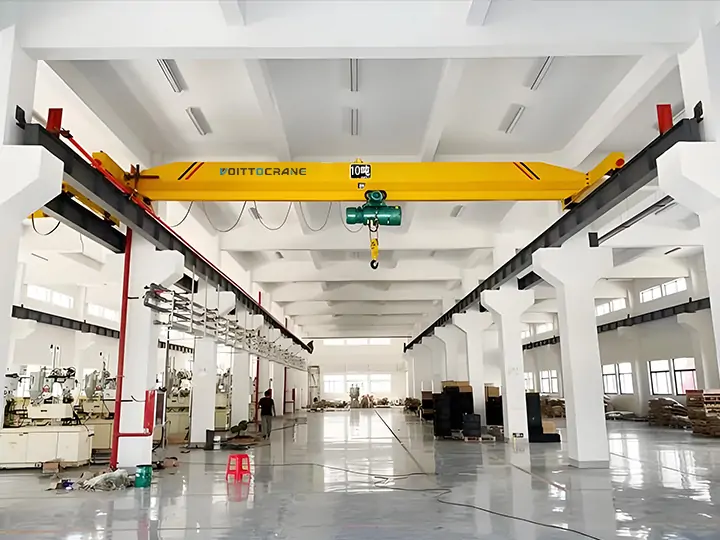
The single-girder design features a single main girder, thereby reducing dead weight and lowering installation costs. This design is suitable for light-duty lifting applications. It is equipped with a CD/MD wire rope hoist as the lifting mechanism, which operates suspended beneath the main girder.
Application: Users employ the 2-ton LD-type single-girder overhead crane to perform material handling tasks in mechanical manufacturing, equipment maintenance, warehousing and logistics, metal processing, and industrial workshops.
Features and Advantages: The device features a simple overall structure, is cost-effective, and is easy to maintain. It stands as one of the most cost-effective lifting solutions for material handling in factories and warehouses.
2 Ton LD Single Girder Bridge Crane Specifications
Type
2 Ton LD Single Girder Bridge Crane
Load Capacity
2 Ton
Span
7.5–31.5 m
Lifting Height
6 m、9 m、12 m、18 m、24 m(Customizable)
Lifting Speed
8 m/min(Single Speed)或 0.8/8 m/min(Double Speed)
Trolley Travelling Speed
20 m/min
Crane Travelling Speed
20 m/min or 30 m/min
Work Duty
A3–A4
2 Ton HD Type European Overhead Crane
The 2 ton HD Type European overhead crane is designed and manufactured in accordance with European FEM and DIN standards. The entire unit features an optimized box-type main girder structure and FEM Standard electric hoists. Compared to traditional LD overhead cranes, the European bridge crane effectively improves factory space utilization while reducing both construction and equipment maintenance costs.
Application: Users widely employ HD type overhead cranes in mechanical manufacturing, the automotive industry, warehousing and logistics, metal processing, and other industrial settings where high operational efficiency and space utilization are essential.
Features and Advantages: This equipment features lightweight, low wheel pressure, smooth operation, precise positioning, and low energy consumption.
0.8/5 m/min or 0.8/8 m/min (Variable Frequency Dual Speed)
Trolley Travelling Speed
2–20 m/min(VFD Variable Frequency Drive)
Crane Travelling Speed
3–30 m/min(VFD Variable Frequency Drive)
Work Duty
A5
2 Ton Underslung Crane
Under-slung cranes are mounted directly on the lower flange of an existing building’s steel structure, eliminating the need for dedicated track columns and occupying no floor space. As a result, they offer the quickest retrofitting solution for older buildings with limited ceiling heights.
Application: Underslung cranes are widely used in light manufacturing workshops, assembly lines, warehousing and logistics centers, and material handling applications where headroom is limited.
Features and Advantages: The underhung suspension crane hangs directly from overhead tracks within the facility, requiring no additional support columns. It maximizes floor space utilization and reduces structural investment in the building.
Explosion-proof overhead cranes are lifting devices specifically designed for flammable and explosive environments. The entire unit incorporates explosion-proof motors, explosion-proof electrical components, and an explosion-proof control system.
Application: Users operate explosion-proof overhead cranes to perform lifting tasks in petrochemical, natural gas storage and transportation, pharmaceutical, paint manufacturing, oil depots, and other industrial settings where explosive gases or dust are present.
Features and Advantages: The explosion-proof overhead crane is equipped with an explosion-proof electrical system and a spark-proof design, enabling safe, stable, and efficient material handling operations in flammable and explosive environments.
2 Ton Explosion-proof Overhead Crane Specifications
Type
2 Ton Explosion-proof Overhead Crane
Load Capacity
2 t
Span
7.5–28.5 m
Lifting Height
6–18 m
Lifting Speed
0.8/8 m/min
Trolley Travelling Speed
20 m/min
Crane Travelling Speed
20 m/min 或 30 m/min
Work Duty
A3–A4
Explosion-Proof Class
Ex d IIB T4 / Ex d IIC T4
Control Method
Pendant Control / Wireless Remote Control
Ambient Temperature
-20°C ~ +40°C
2 Ton Grab Overhead Crane
The grab overhead crane is equipped with a mechanical or hydraulic grab as its material-handling device. Users can choose between a multi-flap and a clamshell grab bucket, depending on their operational requirements.
Application: Users widely apply it in ports and terminals, power plants, mines, steelworks, cement plants, and waste treatment facilities.
Features and Advantages: Grab bridge cranes can automate the loading, handling, and unloading of bulk materials, significantly improving loading and unloading efficiency while reducing labor costs.
The LDP-type low-headroom overhead crane is specifically designed for applications where factory ceiling height is limited. Compared to the traditional LD-type single-girder overhead crane, it offers a larger effective working space.
Application: The LDP low-headroom bridge crane is widely utilized in workshops and warehouses with limited headroom, as well as in renovation projects for existing facilities.
Features and Advantages: LDP low-headroom bridge cranes can effectively improve the utilization of the hoisting system’s lifting height and increase operational efficiency.
2 Ton LDP Type Low-headroom Bridge Crane Specifications
Type
2 Ton LDP Type Low-headroom Bridge Crane
Load Capacity
2 t
Span
7.5–28.5 m
Lifting Height
6–18 m(Compared to the LD model, the effective lifting height can be increased by approximately 0.3–1 m.)
Lifting Speed
0.8/8 m/min
Trolley Travelling Speed
20 m/min
Crane Travelling Speed
20–30 m/min
Work Duty
A3–A4
Power Supply
380V/50Hz/3Ph (Customizable)
Hoist Type
Low Headroom Electric Wire Rope Hoist
2 Ton Bridge Crane Parts and Components
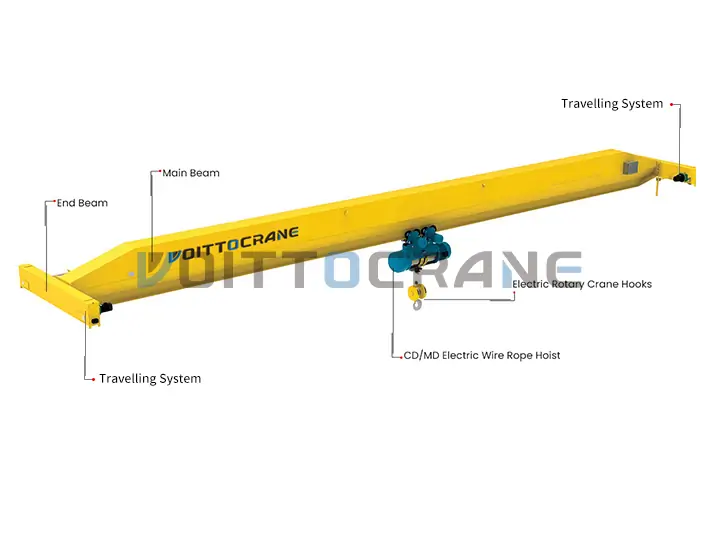
The 2 ton bridge crane consists of a main girder, end beams, a crane travel system, a hoisting mechanism, an electrical system, and safety devices. Below, I will provide an overview of each component.
Main Girder: This component bears the entire load.
End Girder: This component is mounted at both ends of the main girder.
Travel Mechanism: Located at the bottom of the end girder, this mechanism enables the crane to move longitudinally.
Hoisting Mechanism: This mechanism comes into direct contact with the load and is responsible for lifting or lowering materials.
Control System: Users can choose to control the entire crane from the operator’s cab or via a remote control.
Electrical System: Provides power to the entire crane.
Safety Devices: Equipped with travel limit switches, load limiters, and emergency stop buttons.
Buffer Protection Device: This device absorbs the impact force when the crane collides with the end of the track.
2 Ton Bridge Crane Price
Below is a table showing the reference price range for a 2-ton overhead bridge crane. Actual prices may vary depending on components, span, and lifting height. The price is subject to the actual specifications.
Model
Capacity
Span
Price Range (USD)
LD Single Girder Bridge Crane
2 t
7.5–31.5 m
$3,000 – $8,000
HD Type FEM Standard Overhead Crane
7.5–28.5 m
$6,000 – $15,000
LX Underslung Crane
3–16.5 m
$2,800 – $7,000
LB Explosion-proof Overhead Crane
7.5–28.5 m
$8,000 – $25,000
LDZ Grab Overhead Crane
7.5–22.5 m
$12,000 – $35,000
LDP Type Low-headroom Bridge Crane
7.5–28.5 m
$5,000 – $12,000
Note: The above prices are for reference only. Actual costs depend on the specific specifications.
Custom 2 Ton Electric Overhead Travelling Crane
The VOITTO crane can provide customized 2-ton overhead bridge crane solutions based on the width and height of a customer’s factory.
Load Capacity: 2 tons
Span: Adjustable to fit your facility (typically 7.5 m~31.5m)
Lifting Height: Customizable (6 m~18 m)
Control Options: Remote / Cabin control
Lifting Speed: Customizable
Power Supply: 3 Phase A.C. 50Hz 380V
Spreader: Hook or Crane Grab
If you require bridge crane solutions, please feel free to contact us.
2 Ton Bridge Crane for Sale
VOITTO Crane is a professional manufacturer of bridge cranes. We are committed to providing single-girder, double-girder, gantry, and jib crane systems to industrial customers worldwide. With our ISO 9001:2015-certified manufacturing system and a global network of installation and service partners, we are able to offer comprehensive, customized lifting solutions.
Please feel free to contact us at any time for project solutions.
Specialized in Overhead Crane, Gantry Crane, Jib Crane, Port Crane & EOT Crane export solutions. 10+ years helping global clients with pre-sales consultation, capacity selection and site-specific configurations.
What is the maximum span available for a 2 ton bridge crane?
The standard 2 ton overhead bridge crane range supports spans up to 31.5 m in double girder configuration. However, spans beyond 31.5 m require project-specific structural analysis under EN 13001-2.
How long does the installation of a 2 ton overhead crane typically take?
A standard single-girder 2 ton bridge crane with a span of up to 19.5 m typically installs within two to three working days, assuming the runway structure is already in place.
Can the crane operate in an outdoor or high-humidity environment?
Yes. Units configured for outdoor or coastal environments receive an ISO 12944-C4/C5 corrosion protection system, stainless-steel fasteners, and IP65-rated electrical enclosures. Specify the exposure category at the time of enquiry so the engineering team can apply the correct protection standard from the outset.
Which control option is recommended for high-cycle warehouse operations?
Wireless radio remote control (2.4 GHz, EN 60204-32 Cat. 3 PLd) is strongly recommended for high-cycle operations exceeding 50 lifts per shift. It eliminates pendant cable wear, reduces operator fatigue, and allows the operator to maintain line-of-sight positioning for safer load control.
Is a load test certificate included with delivery?
Yes. Every unit undergoes a static load test at 125 % of rated capacity and a dynamic test at 110 % before shipment, in accordance with EN 13001-1 and FEM 1.001. The original signed test certificate and Declaration of Conformity accompany every delivery.
Qualification and Honor
Engineered Strength, Global Crane Supplier
service
Exclusive and Considerable, Customer First.
01
Reliable and Customized Solutions
Our pre-sale team provides consultations, tailoring solutions to your needs and environment.
Offer customization options for lifting capacity, span and lifting height etc. to meet specific needs.
02
Updated Production Process
Real-Time Progress Updates: Weekly reports and PM communication.
3-5 years warranty and free replacement for non-manufacturing defects.
24/7 online support and on-site assistance for crane issues.
FAQ
Engineered Strength, Global Crane Supplier
How do I choose the right overhead crane for my facility?
A: Consider these factors:
Load Capacity (Max weight to lift, including rigging).
Span Width (Distance between runways).
Lifting Height (Hook path elevation).
Duty Cycle (Frequency of use: light, moderate, or severe service).
Power Supply (Electric, manual, or hybrid options).
For more detailed answers, please contact our engineers as soon as possible. Our engineers will be based on your use of the scene to give you the most professional program for you to choose!
Are you a manufacturer or supplier?
VIOTTO is a heavy duty lifting scissor platform manufacturer and supplier, providing factory-direct solutions and custom options.
Can it be customized?
Yes, lifting capacity, span, height, structure type, and hoist options can be customized to match specific working conditions.
Can it be used indoors?
Yes, most Warehouse Lift Platform models are designed for indoor warehouse and industrial environments.
Do you ship internationally?
Yes, international shipping and export support are available for global customers.
Get In Touch
Please feel free to leave a message. We will reply in 24 hours.
Please specify your requirement by referring to the following aspects:
Which crane product do you need?
What is the maximum lifting capacity (in tons) required for your project?
Could you specify the lifting height (in meters) needed?
Can you provide details on the working environment, such as ground conditions, space limitations, and any obstacles?
What is the expected frequency of use and the duration of the project?






 English
  Español
  Português
  العربية
  Français
  Русский