
Full gantry cranes are two-legged structures that run on ground rails. They are capable of handling large spans and high lifting capacities, and are used in outdoor and large industrial environments such as shipyards, ports, steel mills, bridge construction projects, and precast concrete yards.
This article will systematically introduce the structural characteristics, type classifications, key technical parameters, main application industries,components and working principle of full gantry cranes, and analyze the core factors affecting selection and pricing.
What is a Full Gantry Crane?
A full gantry crane is a freestanding lifting device consisting of a bridge and two ground-traveling outriggers. It is independent of factory building structures and suitable for large-span, open-air operations. Standard lifting capacities range from 10 to 200 tons, but larger tonnages can be customized to meet specific requirements. Compared to workshop cranes, full gantry cranes offer wider coverage, greater stability, and are better suited for heavy-duty continuous operations.
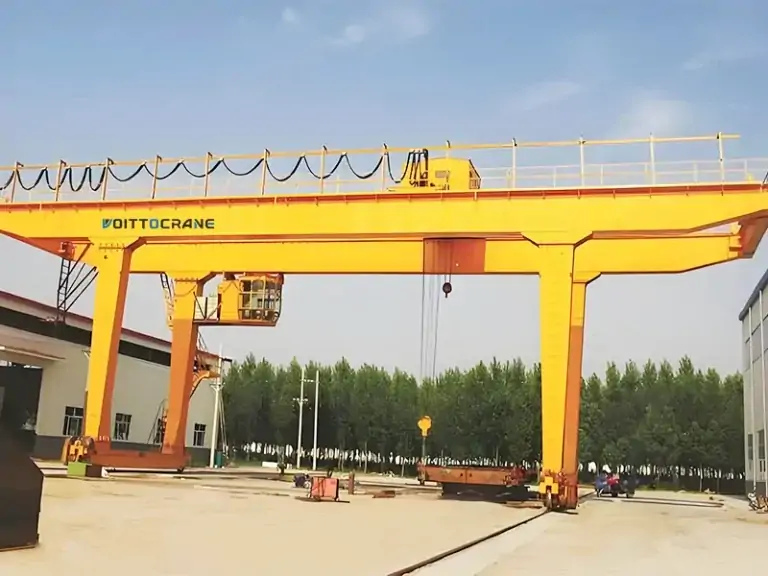
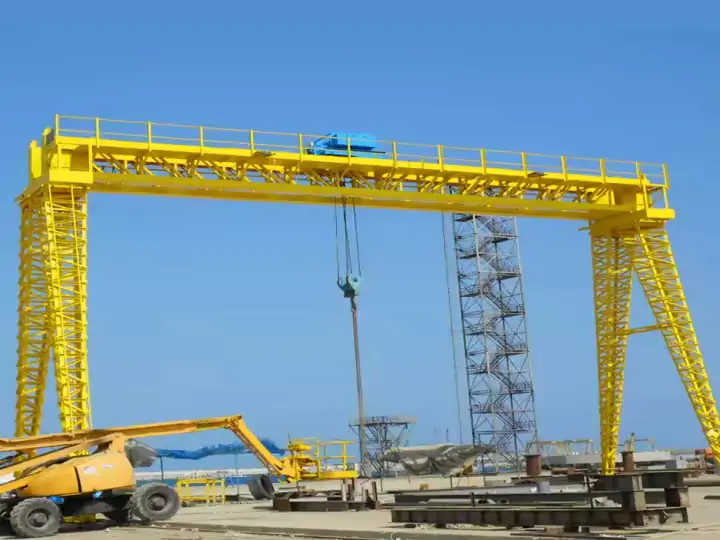
Types of Full Gantry Cranes
Depending on their lifting capacity, structural form, and application scenario, full-gantry cranes can be divided into several types. Different structural designs have their own advantages in terms of load-bearing capacity, span, cost control, and applicable environment. The following are some common types of full-gantry cranes:
Single girder gantry crane
The Single Girder Gantry Crane is used for light to medium-duty material handling. It features a simple structure, low cost, and easy installation and maintenance, and is commonly used in workshops and small to medium-sized sites.
- Lifting Capacity: 5–50 tons
- Span: 10–30 meters
- Lifting Height: 6–18 meters
- Working Class: A3–A5

Double girder gantry crane
Double Girder Gantry Cranes offer high load-bearing capacity, suitable for large spans and heavy loads, and operate stably. They are widely used in shipyards, steel mills, and large-scale construction projects.
- Lifting Capacity: 50–200 tons
- Span: 18–40 meters
- Lifting Height: 10–30 meters
- Working Class: A5–A7

Portable gantry crane
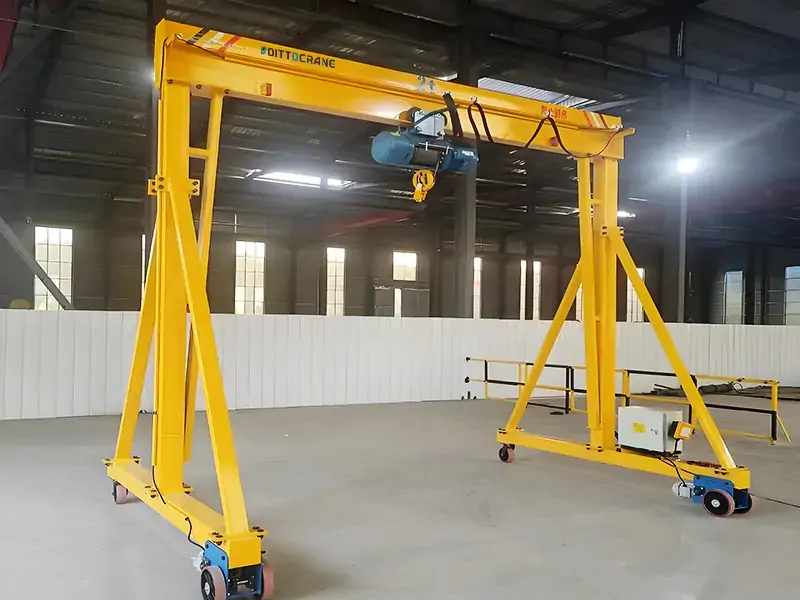
Portable Gantry Cranes are lightweight, mobile, and detachable, making them suitable for equipment installation, maintenance, and temporary hoisting operations.
- Lifting capacity: 0.5–10 tons
- Span: 3–10 meters
- Lifting height: 3–6 meters
- Traction method: Caster-mounted or rail-mounted
Truss gantry crane
The Truss Gantry Crane features a truss beam structure, is lightweight, and has good wind resistance, making it suitable for outdoor operations and bridge construction sites.
- Lifting capacity: 10–100 tons
- Span: 20–50 meters
- Lifting height: 8–25 meters
- Suitable environment: Outdoor high-wind areas
Components of a Full Gantry Crane
A complete gantry crane consists of multiple components that work together to enable the crane to lift and transport heavy objects. These components include:

- Main beam: Bears the main load and supports the hoisting trolley.
- Outriggers: Connect the main beam to the ground rails, ensuring overall stability.
- Hoisting mechanism: Includes an electric hoist or winch system to raise and lower the load.
- Trolley traveling mechanism: Moves the hook laterally along the main beam.
- Gantry traveling mechanism: Drives the entire machine longitudinally along the ground rails.
- Electrical control system: Controls hoisting, travel, and safety protection devices.
How Does a Full Gantry Crane Work?
A full-gantry crane achieves vertical lifting and lowering of heavy objects through a hoisting mechanism. The trolley moves laterally along the main beam, while the main trolley runs longitudinally along ground tracks. These three movements work together to enable the lifting, transfer, and precise positioning of heavy objects within the work area.
Key Specifications to Consider
When selecting a full gantry crane, pay close attention to the following key parameters:
- Lifting capacity (10–500 tons): Determine the rated load based on actual lifting requirements to avoid overloading or selecting an oversized model.
- Span: Determines the operational coverage area and should be designed in conjunction with site dimensions and track layout.
- Lifting height: Determined based on the height of the object being lifted and stacking requirements.
- Working class: Reflects usage frequency and load intensity, commonly A3–A7.
- Outdoor protection rating: Includes windproof, rainproof, and corrosion-resistant design, suitable for outdoor operating environments.
Main Applications of Full Gantry Crane
Gantry cranes are used in large open-air work sites, primarily including:
- Shipyards: Used for the hoisting and assembly of ship sections.
- Port terminals: Used for the handling of heavy equipment and large components.
- Steel mills: Used for the transfer of steel structures, steel plates, and heavy materials.
- Bridge construction: Used for the hoisting and on-site installation of bridge beams.
- Precast component yards: Used for the production and storage/transfer of concrete components.
Advantages of Heavy Duty Full Gantry Crane
Advantages of full-gantry cranes in large industrial projects:
- High stability: Double-leg structure provides strong load-bearing capacity and smooth operation.
- Large span: Large span design covers a wider working area.
- Suitable for outdoor use: Equipped with windproof, rainproof, and corrosion-resistant design, suitable for open-air environments.
- Customizable: Can be specially designed according to tonnage, span, and working condition requirements.
How Much Does a Full Gantry Crane Cost?
The price of a full-gantry crane is influenced by a variety of factors, making a standardized price impossible.
Key influencing factors include:
- Lifting capacity and span
- Lifting height and working class
- Structural form (single-girder or double-girder)
- Outdoor protection and wind resistance requirements
- Electrical configuration and intelligent control system
- Transportation, installation, and site conditions
How to Choose a Reliable Full Gantry Crane Manufacturer?
When choosing a reliable gantry crane manufacturer, pay close attention to the following aspects:
- Certifications: Does the manufacturer possess relevant certifications such as ISO and CE? Do their products meet industry standards?
- Project Experience: Does the manufacturer have experience with large-scale projects in shipyards, steel mills, bridges, etc.?
- Technical Support Capabilities: Does the manufacturer possess capabilities in design, selection, non-standard customization, and on-site technical services?
- Global Delivery Capabilities: Does the manufacturer have export experience and can provide transportation, installation guidance, and after-sales support?
Why Choose Our Full Gantry Crane Solution?
When selecting a full gantry crane supplier, in addition to focusing on product specifications, it is even more important to consider the overall solution capabilities. Below are the core advantages of our full gantry crane solutions.
- Customization Capabilities: We provide customized designs based on lifting capacity, span, operating environment, and working conditions, offering single-beam, double-beam, and non-standard structural solutions.
- Overseas Project Experience: Serving multiple countries and regions, we possess experience delivering projects to ports, shipyards, and large-scale industrial sites.
- Stable Delivery Times: Our comprehensive production system and quality control processes ensure on-time delivery.
- Technical Support: We provide solution design, installation guidance, commissioning training, and after-sales service support.
Conclusion
Full-span gantry cranes are suitable for large-span, heavy-load, and open-air operating environments, and are used in shipyards, ports, steel mills, and bridge construction.
During the selection process, lifting capacity, span, working class, and operating environment should be comprehensively considered. Choose a manufacturer with relevant certifications and project experience to obtain a customized solution.
Contact us for customized full gantry crane solutions.
FAQ
What is the maximum capacity of a full gantry crane?
Standard capacities range from 10 to 200 tons. Custom designs can reach 500 tons or more.
Can full gantry cranes be used outdoors?
Yes. They are designed for outdoor use and can be equipped with wind protection, rain covers, and anti-corrosion systems.
What is the difference between full and semi gantry crane?
A full gantry crane has two ground-supported legs, while a semi gantry crane has one leg and one side supported by a building runway beam.
How long does manufacturing take?
Production typically takes 30–60 days, depending on capacity, span, and customization requirements.
Do you provide global installation?
Yes. We offer international shipping, installation guidance, and technical support.


 English
  Español
  Português
  العربية
  Français
  Русский