
A grue à flèche pour assemblage automobile Il s'agit d'un dispositif de levage localisé, installé au niveau d'un poste de travail (au sol, mural ou articulé), qui manipule des charges de 0,25 à 10 tonnes sur des postes fixes le long d'une chaîne de production. Les usines automobiles thaïlandaises de Rayong, Chonburi et Ayutthaya les utilisent dans les cellules d'assemblage des moteurs, les stations de soudage de la carrosserie, les lignes de finition et les ateliers de maintenance, où un système de pont roulant partagé engendrerait des goulots d'étranglement dans la planification et ralentirait les objectifs de cadence de production.
Le problème pratique auquel la plupart des responsables d'équipement sont confrontés n'est pas de savoir s'il faut utiliser des grues à flèche, mais quel type convient à chaque poste et quelle capacité spécifier. Un mauvais choix de type peut entraîner soit une limitation de charge trop faible pour la manutention de moules lourds, soit un surdimensionnement excessif d'une simple application de découpe, avec à la clé un coût deux fois supérieur au nécessaire. Un mauvais choix de type d'installation – fixation murale lorsque la colonne ne peut supporter le moment de flexion, ou fixation au sol en présence d'une tranchée technique enterrée – peut engendrer des modifications coûteuses avant même le début de la production.
Ce guide associe chaque type de grue à flèche à son application d'assemblage automobile correcte, vous indique les plages de capacité de charge utilisées dans les principales usines des équipementiers et fournisseurs de rang 1 de Thaïlande, et vous explique les documents de conformité CE et ISO que vous devriez demander à tout fournisseur avant de signer un bon de commande.
Guide rapide : Sélection d’une grue à flèche par étape d’assemblage
| Étape d'assemblage | Type recommandé | Plage de charge typique | Rotation | Prix de référence direct usine |
|---|---|---|---|---|
| Atelier d'estampage / de matrices | Grue à flèche montée sur pied (sur pilier) | 3-10 tonnes | 270°–360° | $3 500–$12 000 |
| Cellule d'assemblage moteur | grue à flèche articulée | 0,5–2 tonnes | 180°–270° | $1 800–$5 500 |
| Poste de soudage de carrosserie | Grue à flèche murale | 0,5–2 tonnes | 180° | $1 200–$4 000 |
| Finition et assemblage final | Fixation murale ou au plafond | 0,25-1 tonne | 180°–270° | $800–$2500 |
| Atelier de maintenance | grue à flèche portable / mobile | 0,5–2 tonnes | 180°-360° | $900–$3000 |
Les prix indiqués sont des fourchettes de prix de référence pour une livraison directe d'usine depuis la Chine (certification CE, FOB). Le prix final dépend de la capacité, de la longueur de la flèche, de la classe de service et du type de palan.
Vous prévoyez une nouvelle ligne ou le remplacement de grues existantes ? Adressez votre demande à Voitto Crane
Obtenir un devisPourquoi les usines automobiles thaïlandaises choisissent-elles des grues à flèche à niveau de station ?
Le cadencement est le véritable facteur déterminant, et non le poids de la charge.
La raison principale pour laquelle les usines d'assemblage des équipementiers et des fournisseurs de premier rang en Thaïlande standardisent l'utilisation de ponts roulants à flèche sur chaque poste de travail est la maîtrise du temps de cycle, et non la charge utile. Lorsqu'un pont roulant partagé couvre toute une travée, chaque levage non planifié engendre une attente. Sur une ligne fonctionnant avec un temps de cycle de 60 à 90 secondes — typique des usines des équipementiers de Rayong et Chonburi — une attente de 30 secondes due au pont roulant se répercute sur tous les postes en aval. Un pont roulant à flèche dédié élimine cette attente : l'opérateur lance le levage dès l'arrivée du composant, sans aucune coordination en amont.
Le calcul est simple. Dans une usine de 20 postes d'assemblage partageant deux ponts roulants, on observe en moyenne une attente de pont roulant par poste et par heure en conditions de production moyennes. L'installation de grues à flèche sur les 12 postes de levage les plus sollicités réduit généralement les temps d'arrêt liés aux ponts roulants à un niveau quasi nul sur ces postes, tandis que le pont roulant prend en charge les transferts inter-baies lourds pour lesquels il est plus adapté.
L'expansion de la CEE en Thaïlande stimule les spécifications des nouvelles constructions
Le corridor économique oriental de la Thaïlande, qui s'étend de Chachoengsao à Rayong en passant par Chonburi, s'est imposé comme le principal pôle régional d'assemblage de véhicules électriques à batterie (VEB) et de véhicules hybrides rechargeables (VHR). La production a progressé de 10 321 milliards de tonnes (TP3 T) en mai 2025 par rapport à l'année précédente, soit la première hausse en 21 mois, principalement grâce à l'accélération de la production de VEB et de VHR. Les nouvelles usines, dont la production débutera entre 2025 et 2027, intègrent désormais des ponts roulants dès leur conception, au lieu de les adapter a posteriori. Cette approche modifie la logique de spécification : les concepteurs peuvent dimensionner les fondations et les structures de colonnes pour les ponts roulants au sol et muraux dès le départ, sans avoir à composer avec l'infrastructure existante.
Cet avantage en matière de planification est déterminant pour le choix du type de pont roulant. Une usine qui intègre dès le départ des ponts roulants à colonne au cahier des charges de sa dalle peut exploiter pleinement leur rotation à 360° sans se soucier des réseaux souterrains. En revanche, la modernisation d'une installation existante nécessite une étude des réseaux avant tout forage d'ancrage au sol.
Les quatre types de grues à flèche utilisés dans l'assemblage automobile — et leur domaine d'application
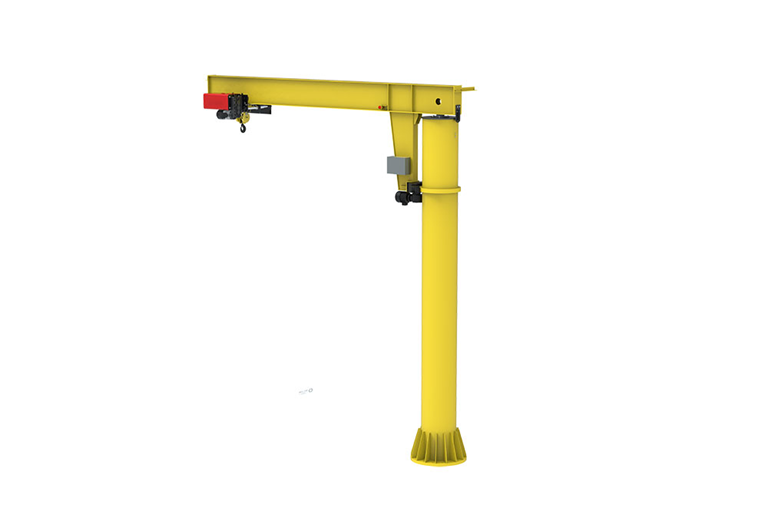

Grue à flèche sur colonne (au sol) : estampage, manutention de matrices et fabrication lourde
Une grue à flèche sur pied est la solution idéale lorsque les charges les plus lourdes par poste dépassent 2 tonnes, ou lorsqu'une rotation à 360° autour d'un îlot central est nécessaire. Dans les ateliers d'emboutissage automobile, où les matrices peuvent peser de 3 à 8 tonnes et doivent être transférées avec précision entre les tables de presse et les chariots de stockage, une grue à flèche pivotante sur pied d'une capacité de 5 à 10 tonnes est la norme. Le pilier s'ancre directement dans une dalle de béton armé, nécessitant généralement une épaisseur de dalle d'au moins 300 mm et des boulons d'ancrage chimique conformément aux plans de fondation du fabricant.
La capacité de levage des grues sur pied Voitto varie de 0,5 à 10 tonnes, avec des flèches de 3 à 8 mètres. Pour les ateliers d'outillage, une grue de 5 tonnes avec une flèche de 5 mètres et une rotation de 270° permet d'effectuer la plupart des transferts entre la table de presse et le chariot de stockage sans que l'opérateur ait besoin de se repositionner. La rotation est limitée à 270° au lieu de 360° lorsque des colonnes ou des bâtis de presse bloquent l'arc de rotation complet, ce qui est fréquent dans les ateliers d'emboutissage à forte densité.
Les ponts roulants à flèche au sol présentent des limitations : ils nécessitent un accès dégagé à la dalle pour les travaux de fondation. Si votre installation comporte une tranchée de refroidissement, une canalisation encastrée ou une fosse d'inspection souterraine dans la zone d'installation prévue, il convient d'envisager une solution alternative avec un pont roulant mural ou suspendu. De plus, pour des charges supérieures à 10 tonnes, la rentabilité structurelle justifie l'utilisation d'un pont roulant dédié à cette section de l'étage.
Grue à flèche murale : postes de soudage de carrosserie et lignes d’assemblage périmétriques
Une grue à flèche murale fixée à une colonne porteuse ou à un mur en béton armé est la solution idéale pour les postes de travail périphériques sur les chaînes de soudage de carrosserie et d'assemblage de garnitures, où l'espace au sol sous la grue doit rester dégagé pour les chariots à outils, les dispositifs de soudage et les déplacements des opérateurs. Le support mural transmet le moment de flexion à la structure du bâtiment ; il est donc impératif de vérifier la résistance de la colonne ou du mur à la charge en porte-à-faux. Cette vérification, effectuée par un ingénieur structurel, doit être réalisée avant la commande, et non après la livraison.
Les grues à flèche murales Voitto couvrent une capacité de 0,25 à 5 tonnes et offrent une rotation jusqu'à 180°. Pour un poste de soudage de carrosserie standard traitant des panneaux de porte, des flancs et des sous-ensembles de soubassement pesant entre 200 et 800 kg, une grue murale d'une tonne, équipée d'une flèche de 4 mètres et d'une rotation de 180°, est la configuration la plus courante dans les usines de premier rang en Thaïlande. L'arc de 180° est suffisant car la pièce arrive et part du même côté du poste : la grue pivote de la position du convoyeur d'entrée vers le dispositif de fixation, puis revient à sa position initiale. Si la configuration de votre poste exige une réception d'un côté et une expédition du côté opposé, une grue au sol avec une rotation de 270° est alors plus appropriée.
Une erreur fréquente lors des achats en usine en Thaïlande : spécifier une grue à flèche murale pour un bâtiment à ossature métallique avec des panneaux de remplissage légers, puis constater que les points d'ancrage ne peuvent supporter la charge. Il est impératif de toujours vérifier la section des poteaux et les spécifications des ancrages avec un ingénieur structure avant de finaliser le choix du type de grue.


Grue à flèche articulée : cellules d'assemblage du moteur et de la transmission
Une grue à flèche articulée possède deux segments de flèche reliés par une articulation pivotante, ce qui lui permet de contourner les obstacles, d'accéder aux zones d'assemblage exiguës et de positionner des charges dans des endroits inaccessibles à une grue à flèche droite. Dans le montage de moteurs, où l'espace de travail autour d'un support moteur rotatif est encombré d'outillage, de conduites pneumatiques et de plateformes d'accès pour opérateurs, le modèle articulé est la norme.
Pour une application typique d'assemblage de moteur essence ou hybride 4 cylindres, la plage de charge est de 300 à 900 kg en tenant compte du poids du bloc-moteur (180 à 350 kg selon la cylindrée), du dispositif de levage, du palan et d'une marge dynamique de 10 à 151 TP3T, conformément aux recommandations de Voitto pour la sélection des capacités de sa gamme de grues à flèche. Le choix d'une grue à flèche articulée d'une tonne couvre cette plage de charge avec une marge suffisante. Les stations d'assemblage de transmissions manipulant des boîtes de vitesses automatiques d'un poids compris entre 90 et 180 kg utilisent généralement des grues de 500 kg ou d'une tonne.
Le modèle articulé coûte 20 à 351 TP3T de plus qu'une grue à flèche droite au sol équivalente, de capacité égale, en raison du mécanisme de pivotement supplémentaire et de l'analyse structurelle plus complexe qu'il requiert. Pour l'assemblage des moteurs et des transmissions, ce surcoût se justifie par la géométrie d'accès : une grue à flèche droite au même poste obligerait l'opérateur à repositionner manuellement les charges autour des obstacles, ce qui irait à l'encontre de l'objectif ergonomique de la présence d'une grue sur le poste.
Grue à flèche mobile : baies de maintenance et postes de retouche flexibles
Une grue à flèche mobile sur châssis à roues ou lesté est la solution idéale pour les baies de maintenance, les postes de réparation et tout point de levage dont l'emplacement est modifié plus d'une fois par mois. Pour la plupart des ateliers automobiles, une capacité de 250 kg à 1 000 kg permet la dépose des moteurs, la dépose des boîtes de vitesses et le positionnement des composants lors de la maintenance des équipements.
Le principal compromis réside dans l'équilibre entre la capacité nominale et la stabilité au sol. La base lestée d'une grue mobile limite sa capacité pratique à environ 2 tonnes ; au-delà, le poids de la base nécessaire pour éviter le basculement devient difficile à déplacer. Pour les postes de production dédiés, avec des tâches de levage fixes et répétitives, une grue mobile n'est pas le choix idéal : l'instabilité d'une base mobile introduit une variabilité de positionnement qui ralentit les opérations d'assemblage de précision. Les grues à flèche mobiles sont destinées aux zones de maintenance et de retouche ; les modèles fixes, aux lignes de production.
Prêt à préciser ? Partagez votre étape d'assemblage, le poids maximal des composants et l'agencement de votre espace avec l'équipe d'ingénierie de Voitto. Nous vous ferons parvenir une proposition de configuration (type, capacité, longueur de flèche, classe de service) sous 48 heures.

Alan
Spécialiste des solutions de grue · Voitto Crane
10+Années d'exp.5,000+Clients50+PaysSpécialisés dans les solutions d'exportation de ponts roulants, portiques, grues à flèche, grues portuaires et ponts roulants. Plus de 10 ans d'expérience dans l'accompagnement de clients internationaux : conseils avant-vente, choix de la capacité et configurations sur mesure.
Sélection de la capacité de charge : bien dimensionner votre grue à flèche
La formule de capacité correcte ne se base pas uniquement sur le poids des composants.
Choisir une grue à flèche en fonction du poids de la pièce à soulever est une erreur fréquente lors des achats dans les usines automobiles. La capacité nominale de la grue doit couvrir le poids total de la pièce, du dispositif de levage, du mécanisme de levage et d'un coefficient dynamique tenant compte des forces d'accélération pendant le levage. En règle générale : capacité nominale totale = poids maximal de la pièce × 1,25, puis arrondir à la catégorie de capacité supérieure.
Pour un bloc moteur de 600 kg équipé d'un dispositif de levage de 45 kg et d'un palan électrique à chaîne de 35 kg, la charge réelle sur la grue est de 680 kg avant application du coefficient dynamique, et de 850 kg après application de 1,25. La spécification correcte est donc une grue d'une tonne, et non de 750 kg. Dans la gamme Voitto, les capacités standard sont de 250 kg, 500 kg, 1 tonne, 2 tonnes, 3 tonnes, 5 tonnes et 10 tonnes ; l'arrondi à 1 tonne à partir de 850 kg est donc une étape de sélection standard.
L'expérience montre que négliger le poids du palan et celui de l'outillage entraîne une sous-estimation de la charge totale de 5 à 121 tonnes. Sur une chaîne de montage à haute fréquence (400 à 600 levages par poste), cette sous-estimation systématique accélère l'usure du mécanisme de rotation et du palan, raccourcit les intervalles d'entretien et augmente le risque de surcharge.
Longueur de flèche et angle de rotation : dimensionnez-les en fonction de l’emprise au sol de la station, et non de celle du bâtiment.
La longueur de la flèche et l'angle de rotation sont définis par l'espace de travail du poste de travail, et non par les dimensions générales du bâtiment. La méthode consiste à dessiner l'emprise au sol du poste : marquer l'emplacement de la pièce entrante, le dispositif d'assemblage ou la surface de travail, et le point de départ ; puis déterminer le rayon et l'arc nécessaires pour relier ces trois points sans que l'opérateur ait à contourner la colonne de la grue.
Dans la plupart des usines de fabrication de pièces détachées et de carrosseries en Thaïlande, une flèche télescopique de 3 à 4 mètres avec une rotation de 180° couvre la zone de travail. Les cellules d'assemblage de moteurs, avec des agencements d'outillage compacts, nécessitent généralement des flèches télescopiques de 4 à 6 mètres avec une rotation de 270° pour une portée optimale. Les applications de manutention de matrices sur les presses d'emboutissage requièrent généralement des flèches télescopiques de 5 à 6 mètres, d'une capacité de 5 à 10 tonnes.
Certification CE et conformité des grues à flèche dans les usines automobiles thaïlandaises
Quelles certifications sont applicables et pourquoi sont-elles importantes pour les achats en Thaïlande ?
Les principales usines d'assemblage de constructeurs automobiles en Thaïlande — notamment celles des marques japonaises, américaines et, de plus en plus, chinoises implantées dans la zone CEE — exigent des fournisseurs qu'ils présentent des équipements de levage portant le marquage CE pour toutes les grues installées de façon permanente. Le marquage CE, conformément à la directive européenne Machines 2006/42/CE, atteste que l'équipement répond aux exigences européennes en matière de sécurité mécanique ; il est devenu la norme internationale de facto pour les achats d'équipements de levage industriels dans le secteur automobile thaïlandais, fortement tourné vers l'exportation, même si la Thaïlande ne dispose pas d'une certification locale obligatoire équivalente pour les grues.
Au-delà du marquage CE, la classe de service (classification FEM 1.001) constitue un critère de sélection interne pour les achats dans la plupart des usines de premier rang. Les classes de service M3 et M4, selon la norme FEM 1.001, couvrent les applications typiques d'assemblage automobile : la classe M3 pour les stations de maintenance et de retouche à usage léger (jusqu'à environ 63 000 cycles de charge sur la durée de vie), et la classe M4 pour les applications sur les chaînes d'assemblage à usage moyen. Spécifier les classes M5 ou M6 est approprié pour les ateliers d'emboutissage avec des opérations de levage à haute fréquence, où le pont roulant peut effectuer plus de 200 cycles par poste. Sous-spécifier la classe de service pour réaliser des économies entraîne une défaillance prématurée par fatigue du mécanisme de rotation, ce qui engendre des coûts d'arrêt de production et de remplacement bien supérieurs à la différence de prix initiale.
La certification ISO 9001:2015 du système de management de la qualité du fabricant est le troisième document normatif exigé par la plupart des services d'approvisionnement des usines automobiles. Il s'agit d'une exigence de qualification des fournisseurs, et non d'une spécification produit ; pourtant, la plupart des équipes d'approvisionnement des usines thaïlandaises considèrent son absence comme un motif de disqualification automatique.
Comment vérifier les certifications avant de s'engager auprès d'un fournisseur
Trois documents sont indispensables pour toute grue à flèche destinée à une usine d'assemblage automobile thaïlandaise. Premièrement, la déclaration de conformité CE : une déclaration signée par le fabricant identifiant les dispositions spécifiques de la directive Machines respectées, l'organisme notifié CE (le cas échéant) et la personne autorisée à constituer le dossier technique. Exigez ce document pour le modèle et la capacité précis que vous achetez, et non un certificat générique d'entreprise.
Deuxièmement, un certificat d'essai de surcharge attestant que l'unité a été testée à 1 251 TP3T de sa capacité nominale (soit 1 250 kg pour une grue d'une tonne) avant expédition. Il s'agit de l'exigence standard d'essai de charge selon la norme EN 13852 et les normes connexes ; son absence signifie que les marges structurelles n'ont pas été vérifiées par un essai physique.
Troisièmement, un certificat ISO 9001:2015 en cours de validité, dont la date de validité est postérieure à la date de livraison prévue. Les certificats ont une date d'expiration et doivent être renouvelés par le biais d'audits de surveillance annuels ; un certificat expiré depuis six mois ne constitue pas une preuve de la conformité du système de management de la qualité.
Une pratique courante des fournisseurs consiste à fournir des pages de couverture scannées des certificats, sans mention lisible de l'organisme notifié ni possibilité de traçabilité du numéro de série jusqu'à l'unité commandée. Exigez des copies complètes des documents mentionnant le titulaire du certificat, son champ d'application, sa date d'émission, sa date d'expiration et le numéro d'accréditation de l'organisme de certification.
Conclusion
Spécifier un grue à flèche pour assemblage automobile Dans le cluster EEC thaïlandais, le choix d'une grue dépend de trois décisions prises dans le bon ordre : premièrement, adapter le type de grue à l'étape d'assemblage (sur pied pour les travaux d'outillage lourds, murale pour le soudage périphérique et les lignes de découpe, articulée pour les cellules de moteur, portable pour les baies de maintenance) ; deuxièmement, calculer la capacité en fonction de la charge combinée réelle — composant plus dispositif de fixation plus palan plus marge dynamique 25% — et ne jamais dimensionner uniquement en fonction du poids du composant ; troisièmement, vérifier le marquage CE, la classe de service FEM, le certificat de charge d'épreuve 125% et la norme ISO 9001 avant de s'engager auprès d'un fournisseur.
L'expansion continue du CEE en Thaïlande, avec une accélération de la production de véhicules électriques et hybrides rechargeables prévue jusqu'en 2026-2027, offre aux nouvelles usines la possibilité d'intégrer les fondations des ponts roulants dès la conception de leurs dalles – une solution bien plus économique que l'installation de ponts roulants fixes dans une usine existante. Si votre usine est actuellement en phase de planification, c'est le moment de définir le type, la capacité et les spécifications des fondations, et non après le coulage de la dalle.

Alan
Spécialiste des solutions de grue · Voitto Crane
Spécialisés dans les solutions d'exportation de ponts roulants, portiques, grues à flèche, grues portuaires et ponts roulants. Plus de 10 ans d'expérience dans l'accompagnement de clients internationaux : conseils avant-vente, choix de la capacité et configurations sur mesure.
FAQ
Q1 : Quel type de grue à flèche est le mieux adapté à l'assemblage de moteurs dans une usine automobile ?
Une grue à flèche articulée d'une capacité de 0,5 à 2 tonnes est le choix standard pour les cellules d'assemblage de moteurs. Sa flèche à deux pivots lui permet de contourner les supports d'outillage, les plateformes opérateur et les conduites pneumatiques qui gênent l'accès à une grue à flèche droite. Pour un bloc-moteur 4 cylindres standard avec dispositif de levage, une grue articulée d'une tonne offre la capacité adéquate et l'accessibilité géométrique requise par les cellules de moteurs. Spécifiez la classe de service M4 selon la norme FEM pour une fréquence d'utilisation sur une chaîne d'assemblage.
Q2 : Une grue à flèche peut-elle remplacer un pont roulant sur une chaîne de montage automobile ?
Non, les grues à flèche et les ponts roulants ont des rôles différents et doivent fonctionner ensemble, et non se substituer les uns aux autres. Une grue à flèche effectue des levages répétitifs au niveau d'un poste dans un rayon défini ; un pont roulant assure les transferts entre travées et les manutentions lourdes traversant plusieurs postes. Remplacer un pont roulant par une grue à flèche à chaque poste créerait des lacunes dans la couverture pour les déplacements de composants entre travées. La configuration optimale consiste en des ponts roulants pour la couverture au niveau des travées et des grues à flèche aux postes individuels à haute fréquence.
Q3 : De quelle capacité de charge ai-je besoin pour une grue à flèche de station de soudage de carrosserie ?
Pour les composants typiques d'une station de soudage de carrosserie (panneaux de porte, flancs, sous-ensembles de soubassement), une grue à flèche murale d'une tonne convient à la plupart des applications. Calcul : poids du composant le plus lourd (généralement 300 à 600 kg pour les pièces embouties de carrosserie), plus le poids du dispositif de levage (20 à 50 kg), plus celui du palan à chaîne (15 à 35 kg), multiplié par 1,25 pour le coefficient dynamique. Dans la plupart des cas, le résultat se situe entre 500 et 850 kg, ce qui fait d'une grue d'une tonne la spécification standard appropriée avec une marge suffisante.
Q4 : Quelle documentation CE dois-je demander à un fournisseur de grues à flèche en Chine ?
Veuillez demander trois documents : (1) une déclaration de conformité CE attestant du respect des dispositions de la directive Machines 2006/42/CE, spécifique au modèle et à la capacité commandés ; (2) un certificat d’essai de surcharge 125% pour l’unité concernée ; (3) un certificat ISO 9001:2015 en cours de validité, dont la date de validité est postérieure à la date de livraison. Exigez des copies intégrales des documents – et non seulement les pages de couverture – avec les coordonnées de l’organisme de certification et les numéros d’accréditation clairement identifiables pour l’unité concernée.
Q5 : Quel est le prix d'une grue à flèche pour l'assemblage automobile auprès d'un fabricant chinois ?
Prix direct usine (certifié CE, FOB) : généralement de $800 à $2 500 pour les unités murales légères de 0,25 à 1 tonne utilisées pour l’ébavurage et l’assemblage final ; de $1 800 à $5 500 pour les modèles articulés de 0,5 à 2 tonnes utilisés dans les cellules moteurs ; et de $3 500 à $12 000 pour les unités au sol de 3 à 10 tonnes destinées aux ateliers d’outillage et à la fabrication lourde. Les prix varient en fonction de la longueur du bras, de la classe de service, du type de palan (à chaîne électrique ou à câble) et des exigences de personnalisation. Pour l’approbation de votre budget, demandez un devis personnalisé plutôt que de vous fier aux fourchettes de prix indiquées.




 English
  Español
  Português
  العربية
  Français
  Русский