
An overhead crane for steel and aluminum industry applications in Oman typically runs $10,000 to $130,000+ in market reference pricing, with the wide range driven almost entirely by one factor: whether the crane handles molten metal or finished product. A ladle-duty double girder crane rated for continuous high-temperature service costs several times more than a standard workshop crane of the same tonnage, because the structural and safety requirements are fundamentally different.
Oman’s steel and aluminum sector has scaled fast — Jindal Steel Sohar alone runs a 2.4-million-ton integrated DRI-EAF steel plant in the Sohar Free Zone, and Sohar hosts one of the region’s largest aluminum smelters alongside a titanium processing complex nearing full completion. Procurement teams sourcing overhead cranes for these facilities face a problem that generic “cranes for Oman” listings don’t solve: a crane spec that works for a finishing bay will fail — or be dangerously under-engineered — in a melt shop or potroom.
This guide breaks down which overhead crane configuration fits which stage of steel and aluminum production, how duty class and heat protection should be specified for continuous high-temperature operation, what certification documentation to require from your supplier, and what a factory-direct quote should actually include.
- 1 Quick Reference: Overhead Crane Types for Oman’s Steel & Aluminum Plants
- 2 Overhead Crane Types by Production Stage in Steel & Aluminum Plants
- 3 Selecting Duty Class and Heat Protection for High-Temperature, Corrosive Environments
- 4 Certification, Standards & Supplier Verification in Oman
- 5 Conclusion
- 6 FAQ
Quick Reference: Overhead Crane Types for Oman’s Steel & Aluminum Plants
| Type | Capacité | La portée | Fourchette de prix (USD) | Meilleur ajustement |
|---|---|---|---|---|
| Single Girder EOT | 1–10 t | 7.5–22.5 m | $2,800–$15,000 | Finishing bays, spare parts stores, light workshop |
| Double Girder EOT | 5-20 t | 10–28 m | $10,000–$35,000 | Billet/coil handling, general fabrication |
| Double Girder EOT | 20–50 t | 16–35 m | $30,000–$80,000 | Rolling mill, heavy fabrication, foundry-adjacent bays |
| Double Girder with Operator Cab | 30–100 t | 18–40 m | $55,000–$130,000+ | Ladle handling, EAF/DRI melt shop, continuous high-temp duty |
Prices are market-reference FOB factory figures, not catalog list prices — final pricing depends on duty class, heat shielding, and control configuration. Confirm capacity, span, and process stage before requesting a quote.
Have your capacity, span, and process stage ready?
Obtenir un devisOverhead Crane Types by Production Stage in Steel & Aluminum Plants


Melt Shop & Ladle-Duty Cranes
A crane handling molten steel or aluminum in a melt shop or potroom must be specified at M6–M8 duty class with heat-resistant design features, not simply sized to the load. The reason is operational, not just structural: a facility like Jindal Steel Sohar’s DRI-EAF melt shop runs ladle and charging cranes on a near-continuous cycle, and radiant heat from molten metal at 700–800°C degrades standard-grade wire ropes, electrical components, and hoist seals far faster than in a cool workshop — a crane correctly rated for tonnage but not for thermal exposure will show premature rope and bearing failure within a fraction of its expected service life. Double girder cranes with an operator cab, priced $55,000–$130,000+ for the 30–100 ton range, are the standard configuration here because the elevated cab gives the operator a direct sightline to the ladle or charge bucket — a genuine safety requirement, not a comfort feature, when the load is molten metal.
Billet, Coil & Ingot Handling
A double girder EOT crane in the 20–50 ton range, running $30,000–$80,000, is typically the right fit for moving billets, coils, or aluminum ingots between process stages, because these loads are heavy but the crane isn’t exposed to direct radiant heat the way a ladle crane is. The selection driver here is cycle frequency rather than raw tonnage: a rolling mill or casting line moving product every few minutes needs M6 duty class or above, while a slower-cycling storage yard can run comfortably at M4–M5 and save meaningfully on structural cost. Getting this wrong in either direction is a common and expensive mistake — underspecifying duty class on a high-cycle line accelerates wheel and bearing wear well ahead of schedule, while overspecifying duty class on a low-cycle yard adds cost with no corresponding benefit.
Finishing & Warehouse Cranes
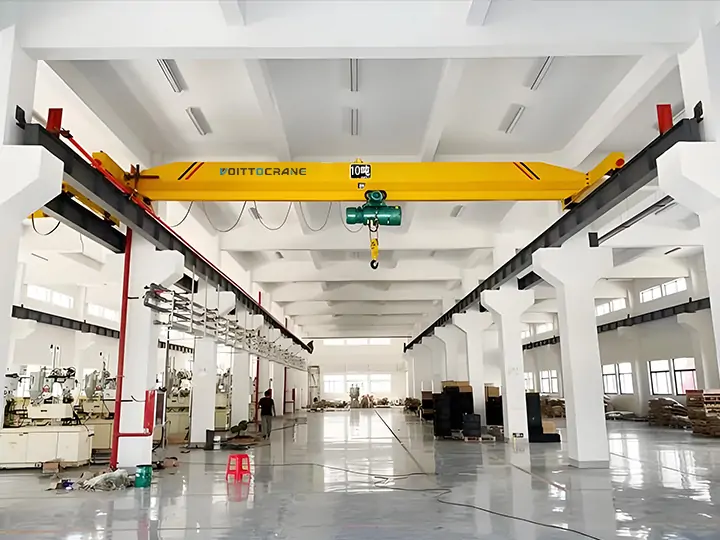
A single girder EOT crane, priced $2,800–$15,000 for 1–10 ton capacity, covers finishing bays, quality-control areas, spare parts stores, and general warehouse handling — the parts of a steel or aluminum plant that don’t involve direct exposure to molten metal or continuous heavy cycling. This is the largest cost saving available in a plant-wide crane specification: pricing a finishing-bay crane like a melt-shop crane wastes capital that’s better spent on the higher-duty equipment where it actually matters. The trade-off is headroom — single girder cranes need somewhat more vertical clearance for a given hook height than double girder units, which matters in retrofit buildings with fixed roof structures.
Selecting Duty Class and Heat Protection for High-Temperature, Corrosive Environments


Heat & Particulate Exposure
Steel melt shops and aluminum smelters present two different environmental stresses that both push against a generic capacity-only specification. In a steel EAF/DRI environment like Jindal Steel Sohar’s Sohar Free Zone facility, radiant heat and metallic dust are the primary concerns, calling for heat-shielded control panels, high-temperature-rated cable and rope, and enclosed motor housings; in an aluminum smelting potroom, the concern shifts to corrosive fume exposure, which accelerates degradation of unprotected steel and standard electrical components. A crane bought without specifying these environmental factors at the RFQ stage typically arrives correctly rated for tonnage but under-protected for the actual operating environment — the fix after delivery (retrofitting heat shielding or corrosion protection) costs substantially more than specifying it correctly the first time.
Duty Class by Cycle Frequency
The most common procurement mistake in heavy industry crane sourcing is defaulting to a mid-range duty class without checking actual cycles per hour against the manufacturer’s duty class table. FEM 1.001 and ISO 4301 classify cranes from M3 (light, intermittent use, under 10 cycles/hour) up through M8 (severe duty, over 160 cycles/hour, for steel mills and continuous-process operations) — a melt shop ladle crane running near-continuous cycles belongs at M7–M8, while a finishing-bay crane used a handful of times per shift is correctly specified at M3–M4. Buying a mid-range M5 crane for a melt shop application because it “seems heavy enough” on paper is a common way plants end up with unplanned downtime during the highest-value production periods.
Certification, Standards & Supplier Verification in Oman
ISO 9001 & ISO 4301 Documentation
Confirming a supplier’s quality management and duty classification documentation is the baseline verification step before placing an order, because it establishes whether the factory operates under a consistent, auditable production process across a multi-unit order. Request the ISO 9001 quality management certificate and ask the supplier which ISO 4301 or FEM 1.001 duty class each component — structure, mechanism, and hoist — is rated to individually, not just the crane as a whole; this level of detail matters more in high-temperature applications where structural and mechanism duty class can reasonably differ.
CE Marking: Optional, Not Standard
Oman is not an EU market, so CE marking under the EU Machinery Directive (2006/42/EC) is not a mandatory import requirement here — it functions as an optional international benchmark that some multinational EPC contractors or project financing partners request contractually, particularly on projects with European engineering oversight. If your project specifically requires Marquage CE, confirm with your supplier upfront whether it’s available as an add-on for your order and what it adds to cost and lead time, rather than assuming it’s included in standard factory-direct pricing.
Verify with documents, not verbal assurance
Request the actual ISO 9001 certificate, load/overload test report (both static and dynamic), and — for melt-shop or high-duty units — documentation of the specific duty class rating for each major component before final payment. Also confirm safety devices (overload protection, anti-collision limits, load display) are itemized as standard or optional in the quotation, since these are frequently the line items quietly omitted from a low headline price.
Conclusion
Selecting an overhead crane for steel and aluminum industry applications in Oman comes down to matching duty class and environmental protection to the actual process stage — continuous high-temperature ladle duty, mid-cycle billet and coil handling, or standard finishing-bay use — rather than sizing by tonnage alone. Before requesting quotes, identify which process stage the crane serves, confirm capacity, span, and duty class, and ask your supplier for ISO 9001 and ISO 4301 documentation upfront, confirming CE availability separately if your project specifically requires it.

Alan
Spécialiste des solutions de grue · Voitto Crane
Spécialisé dans les solutions d'exportation de ponts roulants, de portiques, de grues à flèche, de grues portuaires et de grues EOT. Plus de 10 ans d'aide aux clients internationaux en matière de consultation avant la vente, de sélection de la capacité et de configurations spécifiques au site.
FAQ
How much does an overhead crane cost for a steel plant in Oman?
An overhead crane for steel industry use in Oman typically costs $10,000 to $130,000+, depending on process stage and duty class. Finishing-bay and warehouse cranes run $2,800–$15,000, mid-range billet/coil handling cranes run $30,000–$80,000, and heavy-duty ladle cranes with an operator cab for melt-shop service run $55,000–$130,000+.
What duty class does a melt shop crane need?
A melt shop or ladle-handling crane running near-continuous cycles typically needs FEM/ISO duty class M7–M8, while a finishing-bay or warehouse crane used a few times per shift is correctly specified at M3–M4. Duty class should be set by actual cycles per hour, not assumed from tonnage alone.
Does an overhead crane for Oman need CE certification?
CE marking is not a legal requirement for import into Oman since it isn’t an EU market, though some EPC contractors or project financiers request it contractually. Confirm with your supplier whether CE is available as an optional add-on before assuming it’s included in standard pricing.
What’s the difference between a crane for aluminum smelting and one for steel handling?
An aluminum smelting environment primarily requires corrosion-resistant protection against fume exposure, while a steel melt shop primarily requires heat-shielded components to withstand radiant heat from molten metal. Both should be specified explicitly at the RFQ stage rather than assumed from standard tonnage-based specs.




 English
  Español
  Português
  العربية
  Français
  Русский