


A 10 ton hoist has a rated lifting capacity of 10,000 kg and uses wire rope or lifting chains to lift heavy loads. This equipment is mounted on a crane and is used to lift and move materials weighing less than 10 tons within industrial facilities.
VOITTO’s 10 ton hoist series includes a variety of configurations, such as wire rope, European standard, chain, explosion-proof, and low-headroom models, all with a rated load of 10 tons. These hoists can be installed on overhead cranes, gantry cranes, jib cranes, and electric overhead travelers (EOT), and are widely used for material handling operations in sectors such as machinery manufacturing, mining, warehousing, automotive production, precision assembly, equipment maintenance, and petrochemicals. The lifting height, lifting speed, and control methods of this equipment can be customized to meet specific requirements.
The 10 ton electric hoist is driven by an electric motor and uses a wire rope or lifting chain to move the hook for lifting and lowering materials. When mounted on a crane, the electric hoist can travel along the main girder via its travel mechanism, with the crane’s main structure bearing the load and providing the operational span. This equipment offers two lifting options—wire rope or chain—and is manufactured in strict accordance with FEM standards. It features an explosion-proof design and a low-headroom configuration, allowing for flexible configuration based on specific material handling requirements and structural conditions.
10 Ton Wire Rope Hoist
FEM Standard 10 Ton Hoist
VOITTO cranes can customize a 10-ton electric hoist with various configurations to meet customers’ lifting needs.
VOITTO Crane offers five configurations of 10 ton electric hoists. The specific choice depends on the load being lifted, the working environment, and the building’s headroom. The following section describes each type and its typical applications.
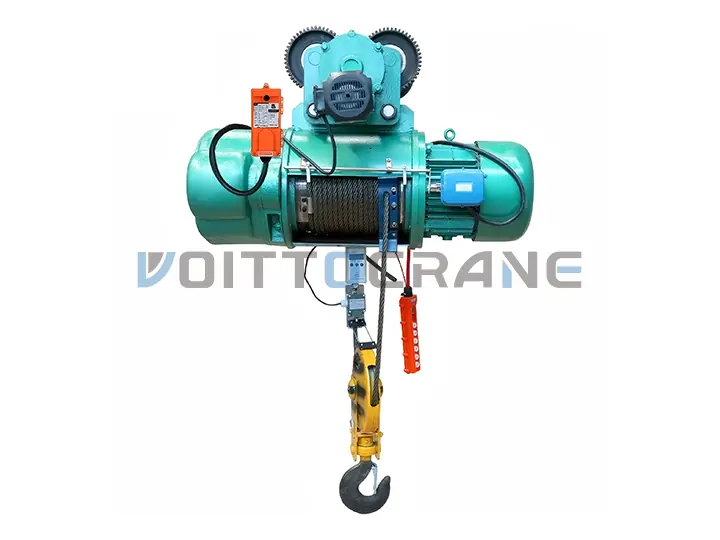
A 10 ton wire rope hoist uses a wire rope wound on a drum as its lifting medium. The motor turns the drum to raise and lower the hook, and a travelling mechanism moves the hoist horizontally along the main beam. The CD/MD type offers single-speed or dual-speed control, so the lifting speed can be matched to the working conditions.
Application: Users utilize it for vertical lifting and horizontal transportation of materials in places such as mechanical manufacturing facilities, mines, warehouses, and factories.
Features and Advantages: This 10 ton hoist has the advantages of small size, light weight, easy operation, and supports double-speed control.
Get QuoteThe FEM standard 10 ton hoist, also called a European-style electric hoist, has a more compact structure and lower weight than the CD/MD wire rope hoist above. Variable frequency speed control, a precision reducer, and a braking system support accurate load positioning, and the low-maintenance design helps reduce operating costs.
Application: Used for material handling in manufacturing, the automotive industry, precision assembly, and warehousing and logistics.
Features and Advantages: Compact structure with a small footprint, precise positioning, and low maintenance requirements.
Get QuoteA 10 ton chain hoist uses a load chain as its lifting medium and is available with electric or manual operation. In the electric version, a motor drives a sprocket through a reduction mechanism, and the sprocket moves the load chain to lift and lower the load.
Application: Operators use this 10 ton chain hoist for assembly lines, equipment maintenance, mold changes, and warehousing and logistics.
Features and Advantages: Easy maintenance and strong adaptability to different working conditions.
Get QuoteThe explosion-proof 10 ton hoist is specifically designed for environments containing flammable and explosive gases and combustible dust. Its motor, control system, and key electrical components are all designed with explosion-proof structures and protection ratings. The specific explosion-proof rating and certification requirements depend on the hazardous area classification at the installation site and relevant standards; please be sure to confirm these details with our engineers before placing an order.
Application: Users operate this equipment to perform material-handling tasks in the petrochemical, pharmaceutical, hazardous materials storage, dust-prone, and battery manufacturing industries.
Features and Advantages: Explosion-proof structure for the motor and electrical components, smooth operation, and suitability for hazardous working conditions.
Get QuoteThe low-headroom 10 ton hoist is designed for workshops where building height or lifting space is limited. The motor, gearbox, and drum are arranged to reduce the overall height of the hoist, which leaves more usable lifting height within the same building height.
Application: Used in renovation projects for older factory buildings, in warehouses, and in workshops with limited headroom.
Features and Advantages: Compact structure and low overall height for buildings with limited headroom.
Get QuoteThe table below lists the specifications for the standard 10-metric-ton FEM hoist. Specifications for other configurations depend on the specific model. Please contact VOITTO Crane for more information.

| Type | FEM Standard 10 Ton Hoist |
|---|---|
| Load Capacity | 10 ton |
| Lifting Height | 9-24 m |
| Lifting Speed | 5/0.8 m/min |
| Travelling Speed | 2 ~ 20 m/min |
| Hoist Length | 798 ~ 1668 mm |
| Work Duty | M5 |
The prices below are reference ranges for each 10 ton hoist configuration. The final quotation depends on lifting height, work duty, control type, working environment, and any customization required.
| Type | Lifting Height | Price Range |
|---|---|---|
| 10 Ton Wire Rope Hoist | 9-30 m | $1350 ~ $1900, depending on specifications |
| FEM Standard 10 Ton Hoist | 9-24 m | $5950 ~ $7350, depending on specifications |
| 10 Ton Chain Hoist | 6-30 m | $1950 ~ $2500, depending on specifications |
| Explosion-proof 10 Ton Hoist | 6.5-26.5 m | $3450 ~ $4650, depending on specifications |
| Low-headroom Type 10 Ton Hoist | 9-24 m | $3100 ~ $4250, depending on specifications |
VOITTO Crane is a 10 ton hoist manufacturer in China, supplying wire rope, FEM standard, chain, explosion-proof, and low-headroom configurations for overhead, gantry, jib, and EOT cranes. Lifting height, lifting speed, control, and other parameters can be customized to the application. To request a quotation, send your lifting height, working environment, duty requirements, and crane type through our contact page, and our engineers will recommend a suitable configuration.

Alan
Crane Solutions Specialist · Voitto Crane
Specialized in Overhead Crane, Gantry Crane, Jib Crane, Port Crane & EOT Crane export solutions. 10+ years helping global clients with pre-sales consultation, capacity selection and site-specific configurations.
A 10 ton hoist is a lifting device with a rated capacity of 10,000 kg. It raises and lowers loads using a wire rope or load chain and is usually mounted on an overhead, gantry, jib, or EOT crane.
We offer five configurations: wire rope hoist (CD/MD type), FEM standard hoist, chain hoist, explosion-proof hoist, and low-headroom hoist. Each suits a different lifting medium, working environment, or building height.
Reference prices on this page range from $1,350 to $7,350, depending on the configuration. Lifting height, work duty, control type, and working environment affect the final quotation, so send your requirements for an exact price.
First, users should consider the lifting height, duty cycle, and crane type, and then select the appropriate equipment based on the operating environment: for general applications, chain or wire rope hoists can be used; in flammable or explosive environments, explosion-proof models must be selected; and when building height is limited, low-headroom models should be chosen.
Yes. The specifications shown on this page can be customized (including lifting height and other parameters) to suit your crane and operating conditions. Please send us your requirements so we can provide you with a suitable configuration and a quote.

Our pre-sale team provides consultations, tailoring solutions to your needs and environment.
Offer customization options for lifting capacity, span and lifting height etc. to meet specific needs.

Real-Time Progress Updates: Weekly reports and PM communication.
Pre-Delivery Testing: 100% load & safety checks, detailed reports.

3-5 years warranty and free replacement for non-manufacturing defects.
24/7 online support and on-site assistance for crane issues.
We offer comprehensive after-sales service, including regular maintenance, rapid technical support, and spare parts supply. The standard warranty period is 1 year, with options for extension based on your needs.
Transit time varies depending on many factors, including the destination of the goods, distance, shipping method and shipping service provider, etc. Generally speaking, international shipping may take about a month.
Yes, international shipping and export support are available for global customers.


A wire rope electric hoist is a light and small lifting equipment, usually equipped on overhead cranes, gantry cranes, jib cranes, and EOT cranes as a lifting mechanism to complete the lifting work. It uses a wire rope as the lifting medium, and a motor and reducer drive the drum to achieve vertical lifting of materials. Compared with the chain electric hoist, the wire rope electric hoist has the advantages of fast lifting speed, higher lifting height, economy, and practicality. This page provides a comprehensive overview of wire rope electric hoist types, prices, features, and the VOITTO export projects case. If you are considering upgrading your Lifting mechanism, it is crucial to understand its configuration and actual project costs. Explore our detailed insights to help guide your procurement decisions effectively. Different Types of Wire Rope Electric Hoist Wire rope electric hoists are divided into many types according to their structural form and use environment, as follows: CD/MD Type Wire Rope Electric Hoist CD/MD type wire rope electric hoists are available in single or double speed configurations. The CD model is…
An electric hoist is a small lifting device that uses a reduction gear and a drum system to lift and horizontally move materials. Among them, there are many types of electric hoists, such as wire rope hoists, chain hoists, and European standard hoists, and electric hoist manufacturers can customize them according to different working environments. Next, we will introduce what is electric hoist, their applications, and prices to help you choose the right lifting solution. Usually, electric hoists as lifting mechanisms are equipped on overhead bridge cranes, gantry cranes, EOT cranes, jib cranes, KBK crane systems, and other equipment, and they work together to complete the lifting task. What is a Hoists? The electric hoist is primarily composed of a motor, reducer, drum, wire rope or chain, hook assembly, and electronic control system. The entire device features a compact structure, stable operation, and a strong load-bearing capacity, making it suitable for frequent lifting and large-tonnage material handling operations. Typically, electric hoists have a load capacity range of 1 to 32 tons. European electric hoists can reach 80 tons. What is…
Procurement teams face the same challenge every time: too many chain hoists for sale, not enough clarity on which one actually fits the job. Choose the wrong capacity and you create a safety liability. Overpay on a unit that ships from three countries away and your project budget takes an unnecessary hit. Get the specs wrong and the hoist sits in a corner, unusable. Here’s the bottom line upfront: the right chain hoist depends on three factors — your lift capacity, duty cycle, and operating environment. Get those three right, and the rest of the decision falls into place. This guide is built for industrial buyers: factory procurement managers, equipment supervisors, and sourcing teams who need to move fast, spend smart, and avoid costly returns. Quick price reference — FOB factory, CE-certified: Type Capacity Indicative Price (USD) Manual chain hoist 0.5T – 3T $30 – $180 Manual chain hoist 5T – 20T $150 – $600 Electric chain hoist 0.5T – 3T $150 – $700 Electric chain hoist 5T – 10T $500 – $2,000 Prices are indicative and vary by specification.…
If your team regularly lifts heavy loads — on a factory floor, at a construction site, or inside a maintenance facility — a chain hoist is likely one of the most important tools in your operation. Yet many procurement managers struggle to choose the right type, understand how it functions, or explain what separates a reliable unit from a problematic one. This article cuts through the confusion. You’ll learn exactly what a chain hoist is, how it works step by step, what its core components do, and which type fits which application. By the end, you’ll have the practical knowledge to make a smarter buying decision — or to ask the right questions when evaluating suppliers. What Is a Chain Hoist? A chain hoist is a mechanical device used to lift, lower, and position heavy loads using a chain as the primary load-bearing element. It converts input force — whether manual or electric — into lifting power through a system of gears, hooks, and chain links. Chain hoists are used across industries including manufacturing, warehousing, construction, shipbuilding, and automotive assembly.…
An electric hoist is only as safe as the person operating it. The equipment itself — motor, brake, wire rope or chain, and control system — is engineered to handle rated loads reliably, but most lifting incidents stem from skipped inspections, overloading, or abrupt operation rather than equipment failure. This guide walks through a complete lifting operation, from pre-use checks to shutdown, so operators can operate a hoist correctly and consistently, whether it’s mounted on a single-girder overhead crane, a jib crane, or a standalone beam. What Is an Electric Hoist? An electric hoist is a motor-driven lifting device that raises and lowers heavy loads using a wire rope or lifting chain wound around a drum or sprocket. It is typically mounted on an overhead crane, jib crane, gantry crane, or a fixed I-beam and is operated via a handheld control box or a wireless remote control. This guide focuses on how to properly operate an electric hoist, rather than its construction or selection. For detailed information on its components, please refer to the article “What Is Electric Hoist?” What…
If your lifting application meets the following criteria: a lifting capacity of less than 32 tons, a lifting height of 30 meters or less, and a duty class at or below FEM 3m (ISO M6). Then an electric wire rope hoist is almost always the ideal choice, offering greater cost-effectiveness and shorter lead times. Once these thresholds are exceeded, or when the crane is custom-designed for specific operating conditions such as those found in ports, shipyards, or the metallurgical industry, an industrial winch becomes the only viable option. When choosing between a winch vs hoist, the key to making this decision does not lie in which type of equipment is capable of lifting heavy loads (since both are equally capable), but rather depends on four key parameters that are often misunderstood during the procurement process: maximum working load rating, wire rope drum flexibility, lifting height, and the equipment’s long-term maintainability. This article will provide an in-depth analysis of the structural differences between these two drive systems, comparing them across eight key parameters critical to procurement decisions. It will also highlight…

 English English
 Español
 Português
 العربية
 Français
 Русский