
If your lifting application meets the following criteria: a lifting capacity of less than 32 tons, a lifting height of 30 meters or less, and a duty class at or below FEM 3m (ISO M6). Then an electric wire rope hoist is almost always the ideal choice, offering greater cost-effectiveness and shorter lead times. Once these thresholds are exceeded, or when the crane is custom-designed for specific operating conditions such as those found in ports, shipyards, or the metallurgical industry, an industrial winch becomes the only viable option.

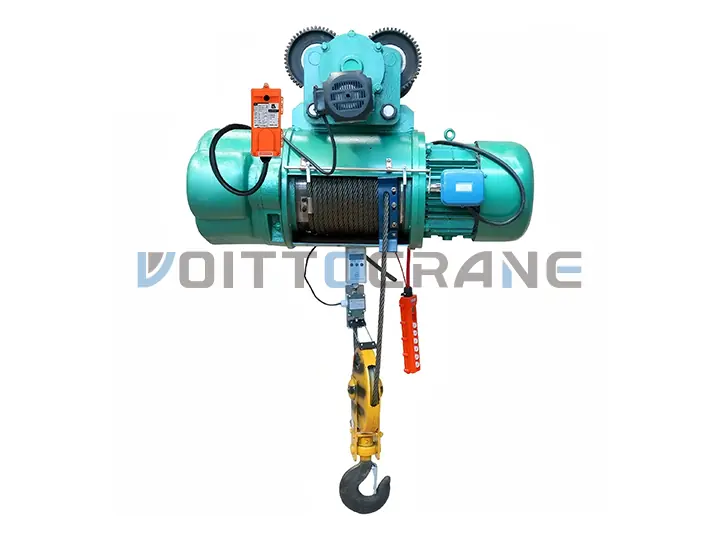
Wire Rope Hoist

Electric Winch
When choosing between a winch vs hoist, the key to making this decision does not lie in which type of equipment is capable of lifting heavy loads (since both are equally capable), but rather depends on four key parameters that are often misunderstood during the procurement process: maximum working load rating, wire rope drum flexibility, lifting height, and the equipment’s long-term maintainability.
This article will provide an in-depth analysis of the structural differences between these two drive systems, comparing them across eight key parameters critical to procurement decisions. It will also highlight four common pitfalls in equipment selection and explain in detail under what conditions replacing one system with the other constitutes a reasonable and feasible engineering decision.
- 1 Winch vs Hoist Difference: What Each Device Actually Is
- 2 What is an Electric Hoist
- 3 Winch vs Hoist: Parameter Comparison for Crane Selection
- 4 Duty Class: The Parameter That Most Often Drives the Winch Decision
- 5 Reeving Configuration and Lift Height: Where Winches Have No Equivalent
- 6 Four Specification Parameters That Fail as Sole Decision Criteria
- 7 Can You Use a Winch as a Hoist on a Standard Overhead Crane?
- 8 Can You Use an Electric Wire Rope Hoist as a Winch on a Crane?
- 9 Winch vs Hoist Manufacturer and Supplier
-
10
FAQ
- 10.1 What is the functional difference between an industrial winch and an electric wire rope hoist on a crane?
- 10.2 At what capacity or duty class does a wire rope hoist stop being the right choice?
- 10.3 Can a wire rope hoist replace an existing crane winch?
- 10.4 How do I verify the duty class of a wire rope hoist for my application?
- 10.5 What is the typical maintenance interval difference between a crane winch and a wire rope hoist?
Winch vs Hoist Difference: What Each Device Actually Is
Users employ two types of lifting equipment, a winch vs a hoist, to perform vertical material lifting operations. Although their purposes are similar, they differ in appearance and application scenarios. Next, I will explain these two types of equipment—hoist vs winch—separately.
What is a Crane Winch?
An industrial lifting winch is an open-frame drive system consisting of a motor, a multi-stage gearbox, a drum, and a braking assembly. Each component of this equipment is specifically selected (and sometimes even procured separately) and then integrated into the crane’s overall structure by the original equipment manufacturer (OEM) or the crane manufacturer.


This drum supports multi-layer wire rope winding, and winch manufacturers can flexibly configure the pulley block ratio to meet users’ lifting requirements. Depending on the specific load and speed requirements, a single winch drum can be configured for a 2:1, 4:1, or even higher lifting ratio. This high degree of configurability is precisely the core engineering advantage that winches offer over traditional electric hoists. However, this advantage comes with a corresponding trade-off: the complexity of the integration process. A winch is not a standalone unit that can be simply “plugged in and used.” It requires specialized mounting brackets, engineered wire rope guidance systems, and a control system tailored to the specific crane.
This equipment has become the standard lifting drive system widely used in shipyard cranes, gantry cranes, container cranes, heavy-duty overhead cranes in steel mills, and smelters. It offers a wide range of lifting capacities: for light industrial applications, lifting capacities typically start at around 5 tons. In the marine engineering and port machinery sectors, lifting capacities can reach 500 tons or more.
What is an Electric Hoist
An electric wire rope hoist is an integrated unit consisting of a motor, gearbox, drum, rope guide, and hook. The equipment is fully assembled and tested as a single unit before leaving the factory. It features a standard bolt hole pattern, allowing for direct installation on the end beam or lower girder of an overhead crane.


Compared to a winch, installation takes very little time and requires minimal engineering effort. Commercially available wire rope hoists cover a lifting capacity range from 0.5 tons to 32 tons. Standard models typically have a lifting height of up to 30 meters, while custom models equipped with extended drums can reach 60 meters. In the standard product range, the maximum duty class is FEM 3m (corresponding to ISO M6). For equipment meeting the FEM 4m (corresponding to ISO M7) standard, a special order must be placed with specific manufacturers.
In manufacturing, warehousing, and general industrial facilities, wire rope hoists have become the standard lifting drive system for bridge cranes primarily because they shorten the crane procurement cycle and simplify maintenance. Their limitations lie not in their lifting capacity but in their configuration flexibility and the upper limit of their duty rating.
Winch vs Hoist: Parameter Comparison for Crane Selection
The table below lists the key parameters for these two devices. The “Decision Signal” column indicates the conditions under which each parameter favors the selection of one specific device over the other.
| Parameter | Industrial Lifting Winch | Electric Wire Rope Hoist | Decision Signal |
|---|---|---|---|
| Parameter | Industrial Lifting Winch | Electric Wire Rope Hoist | Decision Signal |
| Typical capacity range | 5 t – 500 t+ | 0.5 t – 32 t | Winch for >32 t or >20 m lift height |
| Rope reeving | Multi-layer, multi-fall; reeving ratio up to 8:1 or higher | Single or double fall; fixed reeving per model | Winch when variable reeving is needed |
| Lift height | Virtually unlimited (drum depth determines rope layers) | Typically ≤30 m; extended models to 60 m | Winch for long-travel applications (port, shipyard) |
| Integration | Custom-engineered into crane structure; separate motor, gearbox, drum | Self-contained unit; bolts to crane end-truck or beam | Hoist for retrofit / standard crane; winch for OEM build |
| Duty class ceiling | FEM 4m / ISO M8 achievable with correct motor sizing | Commercially available to FEM 3m / ISO M6 (special orders: M7) | Winch for metallurgical, continuous-cycle duty |
| Speed control | Variable frequency drive standard; micro-speed to full speed | VFD available; 2-speed motor common on standard units | Equivalent if VFD-equipped; check motor thermal rating at low speed |
| Maintenance access | Gearbox and drum serviceable in-situ; component-level repair | Unit swap typical; on-site repair limited by enclosed housing | Hoist where downtime tolerance is low and spares are local |
| Capital cost | Higher; custom engineering, separate components | Lower at equivalent rated capacity up to ~20 t | Hoist below 20 t if duty class and lift height allow |
Duty Class: The Parameter That Most Often Drives the Winch Decision

European Electric Hoist

Low-headroom Hoist
Why Duty Class Overrides Capacity in the Selection
The rated lifting capacity merely confirms that the equipment is capable of lifting a specified load in a single operation, whereas the duty class confirms that the equipment can reliably perform the expected number of lifting cycles per shift and per year throughout its entire service life. The FEM 1.001 standard classifies hoisting mechanisms into different categories ranging from Class M1 (very light duty, infrequent use) to Class M8 (continuous heavy duty). This classification depends primarily on the load spectrum and actual operating hours—not merely on the maximum lifting capacity.
A 10-ton electric wire rope hoist rated at FEM 3m (ISO M6) has a design service life of approximately 3,200 operating hours when subjected to a full load spectrum. In contrast, a charging crane at a steel mill operating on a three-shift schedule with extremely high load utilization may require an FEM 4m (ISO M8) rating—a classification typically not found in the catalogs of commercially available general-purpose wire rope hoists.
If a hoist with a rated class of only 3m is forcibly used in an M8-class application, the result will be predictable failures: issues such as burned-out motor windings, gear fatigue damage, or drum bearing failure will occur within the first maintenance cycle. During the procurement process, if selection is based solely on lifting capacity and price, this pattern of improper selection becomes the most common mistake.
When a Winch Is the Only Compliant Option
If the duty class requirement is FEM 4m (ISO M7) or higher, be sure to verify whether any electric wire rope hoist manufacturers can provide products of the appropriate class that meet your required lifting capacity before finalizing your choice of hoist. For applications with lifting capacities exceeding approximately 20 tons under M7 duty conditions, electric hoist manufacturers must provide customized solutions tailored to the specific duty class.


Reeving Configuration and Lift Height: Where Winches Have No Equivalent
Reeving Flexibility
The rope-over-drum ratio determines the relationship between the drum’s pulling force and the load on the hook, as well as between the drum’s rotational speed and the hook’s lifting speed. The drums of industrial winches are specially designed to support a variety of rope-over-drum configurations, typically ranging from a 2:1 ratio to an 8:1 ratio (or even higher on large port cranes).
This allows the equipment to be re-rigged using the same drive system when operational requirements change. In contrast, the rope configuration of electric wire rope hoists is fixed and determined at the factory. If the rope ratio of an electric hoist needs to be changed, it usually requires replacing the unit with a different model or returning it to the manufacturer for modification.
For applications with significant fluctuations in load ranges. For example, on gantry cranes in shipyards, which must lift both lightweight outfitting components and heavy hull sections, the flexibility of a winch’s rope configuration offers significant operational value—a capability that electric hoists cannot match. However, for manufacturing cranes operating under fixed conditions with consistent load characteristics, a fixed rope configuration does not present a disadvantage.
Lift Height Limits
The depth of a wire rope hoist drum limits its practical lifting height. Standard models typically have a lifting height ranging from 20 to 30 meters. Models equipped with extended drums can increase this height to approximately 60 meters, but the cost will be relatively higher. In contrast, from a drum design perspective, industrial-grade winches have virtually no practical upper limit on lifting height. For winches, wire rope lay management, deflection control, and wire rope fatigue at the drum are all considered key design factors. Therefore, for port cranes, marine cranes, and tower cranes requiring lifting heights exceeding 60 meters, winches are the preferred solution.
Four Specification Parameters That Fail as Sole Decision Criteria
The table below lists the parameters that procurement teams typically use as primary screening criteria, as well as the specific circumstances under which each parameter can lead to errors in equipment selection.
| Parameter | Condition Where It Fails as a Decision Criterion | Correct Action |
|---|---|---|
| Rated capacity | A 20 t hoist and a 20 t winch are not equivalent if the duty class or reeving differs. Capacity alone does not define the machine. | Compare capacity + duty class + reeving configuration together. |
| Price | A hoist appears cheaper at 10 t, but if the application is M6 duty and the commercial hoist is rated M5, the real cost includes premature motor replacement. | Request the duty class documentation before comparing prices. |
| crane compatibility | Wire rope hoists fit standard end-trucks but have a fixed wheelbase. | Confirm end-truck gauge and crane rail span before ordering. |
| Lift speed specification | Hoist lift speed is rated at single-fall. If the application uses double-fall reeving, the actual hook speed is half the nameplate value. | Specify the required hook speed at the reeving ratio you will use. |
Can You Use a Winch as a Hoist on a Standard Overhead Crane?
Yes. This is provided that the winch has been explicitly specified and certified for vertical lifting operations, and all industrial-grade lifting winches used in crane applications meet this requirement. Questions regarding interchangeability arise when plant engineers consider replacing existing crane winches with wire rope hoists. In many cases, such a replacement is mechanically feasible, but before proceeding, the following three conditions should be considered as a reference:
- The replacement unit’s duty class must meet or exceed the original specification. Downgrading the duty class to reduce cost is the single most common error in hoist-for-winch substitutions.
- The reeving ratio must be preserved. If the existing winch runs 4-fall and the replacement hoist is fixed at 2-fall, hook speed doubles and hook pull force halves — changing the crane’s operating characteristics entirely.
- The structural interface must be confirmed. Winches mount to crane girders via custom frames. Wire rope hoists mount to end-trucks via standard bolt patterns. These are not the same interface. Structural modification is required for substitution in either direction.
Can You Use an Electric Wire Rope Hoist as a Winch on a Crane?
Within their rated parameters, wire rope electric hoists serve precisely this purpose as the lifting mechanism for cranes. However, when application requirements exceed the capacity of an electric hoist, the issue becomes critical—for example, in cases involving heavy-duty lifting (Class M6 or higher), lifting heights exceeding 60 meters, variable wire rope winding configurations, or integration into custom crane structures lacking standard end-carriage interfaces.
In these situations, an electric hoist cannot replace a winch. If an electric hoist is selected that exceeds its upper limit—even if its technical specifications meet the requirements—its actual dimensions will be too small, which can easily lead to increased equipment wear and shorter maintenance intervals.
Winch vs Hoist Manufacturer and Supplier
Selecting the correct equipment type is the first decision. Selecting a manufacturer that can deliver it to the right duty class, with the right certifications, and with the engineering documentation to prove both is the second decision, and the one that determines whether the specified equipment performs in the field.
VOITTO Crane has over 30 years of experience manufacturing industrial hoists and electric wire rope hoists. Its product range spans both ends of the spectrum when it comes to choosing between a “winch” and a “hoist”: it offers wire rope hoists suitable for standard overhead crane applications, as well as lifting winches custom-engineered for overhead cranes, gantry cranes, and port machinery. If you need a winch vs hoist customizable solution, please feel free to contact us at any time.

Alan
Crane Solutions Specialist · Voitto Crane
Specialized in Overhead Crane, Gantry Crane, Jib Crane, Port Crane & EOT Crane export solutions. 10+ years helping global clients with pre-sales consultation, capacity selection and site-specific configurations.
FAQ
What is the functional difference between an industrial winch and an electric wire rope hoist on a crane?
A winch is an open-architecture drive — motor, gearbox, drum, and brake are separate components integrated into the crane structure, supporting variable reeving and virtually unlimited lift height. A wire rope hoist is a self-contained unit with fixed reeving and catalog-defined lift height limits. Both perform vertical lifting; the difference is configurability, duty ceiling, and integration complexity.
At what capacity or duty class does a wire rope hoist stop being the right choice?
Generally speaking, wire rope electric hoists are no longer the preferred choice when the rated lifting capacity exceeds 32 tons, the lifting height exceeds 60 meters, or the duty class exceeds FEM 3m (ISO M6). However, for lifting capacities of 20 tons or less, a duty class of FEM 3m, and lifting heights below 30 meters, wire rope electric hoists are a suitable solution.
Can a wire rope hoist replace an existing crane winch?
Mechanically possible in many cases, but three parameters must match: duty class must be preserved or exceeded, reeving ratio must be replicated (or the crane’s speed and pull force characteristics will change), and the structural interface must be compatible. Winch-to-hoist substitution almost always requires structural modification to the crane girder or end-truck. Confirm all three with engineering documentation before proceeding.
How do I verify the duty class of a wire rope hoist for my application?
Please request a service factor calculation sheet from the manufacturer. This sheet should clearly indicate the corresponding FEM or ISO M service class based on your specific load spectrum coefficient (Kp) and annual operating hours. The service class indicated on the nameplate represents only the maximum rating listed in the catalog. You may also contact VOITTO Crane. Our engineering team will provide customized solutions tailored to your specific operating conditions and lifting requirements.
What is the typical maintenance interval difference between a crane winch and a wire rope hoist?
Crane winches generally require more frequent maintenance than electric wire rope hoists because winches are often used for heavy-duty, long-distance hauling and continuous operation. The multiple layers of wire rope winding, impact loads, and wear are more severe, so the wire rope, brakes, and gear reducers often require weekly or monthly inspection and maintenance. In contrast, wire rope electric hoists feature a more standardized design and operate more smoothly. Typically, monthly inspections and annual maintenance are sufficient to meet the needs of most industrial workshops, resulting in longer overall maintenance intervals and lower maintenance costs.




 English
  Español
  Português
  العربية
  Français
  Русский