Electric Transfer Cart | Rail Transfer Cart, Trackless, AGV & RGV
VOITTO electric transfer carts are engineered for heavy-duty industrial material handling, covering load capacities from 0.5 to 500 tons across four drive configurations: rail transfer cart, trackless transfer cart, AGV, and RGV.
An Electric transfer cart is also commonly known as an electric rail transfer cart, a trackless transfer cart, or industrial transfer carts. It is a ground-level material handling solution for transporting heavy loads across factory floors, workshops, and warehouses. VOITTO crane manufactures four core types of rail transfer cart, trackless transfer cart, AGV automated guided vehicle, and RGV rail guided vehicle, covering capacities from 0.5 to 500 tons.
Whether you need a fixed-route rail transfer cart for a steel mill, a flexible trackless cart for mold handling, or an unmanned AGV/RGV system for smart factory automation, VOITTO provides fully customized solutions to match your production layout and load requirements.
Trackless Transfer Cart
Rail Transfer Cart
An Electric transfer cart is powered by batteries, commonly lead-acid, maintenance-free gel, or lithium iron phosphate. The batteries power the motor and control system, enabling the battery transfer cart to transport heavy materials within the factory. Lead-acid and gel batteries are low-cost and have mature structures, making them suitable for low-level operation, while lithium batteries are lightweight, have a long lifespan, and support fast charging, making them more suitable for high-frequency, long-term operation scenarios. Users can flexibly choose different battery configurations according to their own usage environment and load requirements.
Types of Electric Transfer Cart
Electric transfer carts are categorized into various types and configurations, with each type suited to specific lifting requirements and application scenarios. Below are some of the common types:
Rail Transfer Cart
A rail transfer cart operates along pre-installed steel rails, relying on the guidance provided by steel wheels on fixed tracks to achieve precise and repeatable material transport. Thanks to their high load-carrying capacity, smooth operation, and low long-term maintenance costs, they have become one of the most widely used types of electric trucks in heavy industrial environments.
To accommodate different workshop conditions, electric transfer carts manufacturers offer three primary power supply options for rail-guided transfer carts: low-voltage rail power supply (36V/48V DC), suitable for scenarios requiring continuous, uninterrupted operation, cable reel power supply, suitable for enclosed, fixed-route layouts, and battery power supply, suitable for scenarios that do not require fixed infrastructure and call for flexible deployment. Based on the factory floor plan, track layouts can be configured as straight, L-shaped, or S-shaped curves.
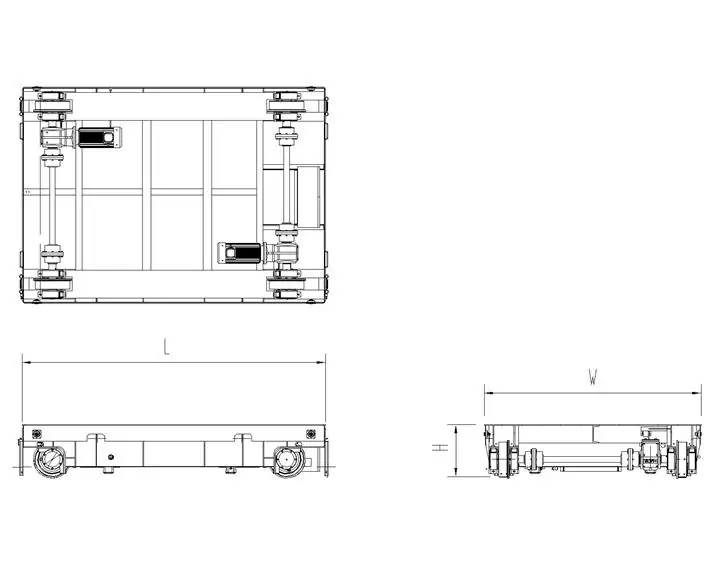
The frame of this transfer car is constructed from welded steel box sections, with dimensions and specifications designed to meet the required load capacity. The selection of the drive motor, gear reducer, and wheel sets is determined based on the load capacity and duty class (M3–M7). Safety devices include buffers, limit switches, and emergency stop buttons, with derailment prevention devices available as an option. Rail-mounted transfer trolleys are the preferred transport solution when the transport route is fixed, the load capacity exceeds 150 tons, and the operating frequency is high. These trolleys are widely used in steel mills, foundries, heavy machinery workshops, and precast concrete facilities for the transfer of steel billets, coils, molds, and large assemblies.
Specification
Model
Rail Transfer Cart
Load Capacity (ton)
0.5 – 500 ton
Cart Length (m)
2.2 – 13.5 m
Cart Width (m)
1.3 – 5 m
Cart Height (m)
0.7 – 1.1 m
Running Speed (m/min) Heavy Load
0 – 20 m/min
Running Speed (m/min) Standard
20 – 50 m/min
Duty Class
M3 – M7
Operation Method
Remote Control or Wireless Remote Control
Trackless Transfer Cart
The trackless transfer cart is equipped with polyurethane rubber wheels and requires no tracks to be laid. This highly flexible equipment is particularly suitable for production environments where transport routes need to be frequently changed or where workshop floor space must accommodate multiple functional uses. Operators can control the vehicle using a handheld control panel or a wireless remote control. Depending on the steering configuration, the vehicle fully supports a variety of movement modes, including forward, reverse, lateral shifting, and 360-degree on-the-spot rotation.
As they require no tracks, trackless transfer carts can shuttle between multiple workstations, transition seamlessly between indoor and outdoor environments, and easily traverse workshop aisles, assembly stations, and loading docks. The ground surface on which the trackless transfer carts operate must be hard, level, and possess sufficient load-bearing capacity to support the weight of the cart when fully loaded.
These battery-powered, trackless transfer carts can be equipped with lead-acid, gel, or lithium iron phosphate batteries, depending on shift duration and charging frequency requirements. These transfer vehicles are widely used in mold and tooling manufacturing plants, automotive assembly plants, machining workshops, and any other facilities requiring multi-directional, cross-station material handling without the constraints of fixed track infrastructure.
Specification
Model
Trackless Transfer Cart
Load Capacity (ton)
0.5 – 300 ton
Cart Length (m)
2.2 – 12.5 m
Cart Width (m)
1.5 – 4 m
Cart Height (m)
0.7 – 1.1 m
Running Speed (m/min) Heavy Load
0 – 15 m/min
Running Speed (m/min) Standard
15 – 45 m/min
Climbing Ability
5 – 8%
Steering Methods
90° Lateral Movement or Stationary Rotation, or Normal turn
Operation Method
Remote Control or Wireless Remote Control
AGV Automated Guided Vehicle Transfer Carts
AGV automated guided vehicle transfer carts operate without human intervention, navigating autonomously along pre-programmed routes or in response to real-time dispatch instructions from the warehouse management system (WMS) and factory control systems. This AGV transfer cart is capable of transporting materials around the clock (24/7) without interruption.
AGV supports a variety of navigation technologies to accommodate different operating conditions. Laser SLAM is suitable for dynamic, flexible path planning in complex environments, magnetic strip navigation is the ideal choice for cost-effective fixed-path deployments, QR code positioning is suitable for high-precision docking scenarios, and vision-based navigation is suitable for facility environments requiring map-free adaptive capabilities. The vehicle is equipped with LiDAR sensors at both the front and rear for obstacle detection, enabling the AGV to automatically slow down and stop, thereby effectively ensuring the safety of personnel and equipment.
AGV transfer vehicles are suitable for factories or warehouses requiring automation, continuous operations, and precise timing. Such as e-commerce logistics centers, automotive parts assembly facilities, electronics manufacturing plants, and pharmaceutical logistics hubs.
Specification
Model
AGV Automated Guided Vehicle Transfer Carts
Load Capacity (ton)
0.1 – 100 ton
Cart Length (m)
0.7 – 3 m
Cart Width (m)
0.5–1.8 m
Cart Height (m)
0.3–1.1 m
Running Speed (m/min)
0–25 m/min
Climbing Ability
5 – 8%
Positioning Accuracy
±10 mm (Laser) / ±15 mm (Magnetic Strip)
Battery Types
Lithium Iron Phosphate or Ternary Lithium or Gel Battery or Lead-acid Battery
RGV Rail Guided Vehicle Transfer Cart
RGV rail-guided vehicle transfer cart travels back and forth along dedicated tracks in response to system commands, requiring no manual operation and relying on neither laser nor magnetic navigation technology.
RGV shuttles can be integrated with automated warehouse infrastructure, including automated storage and retrieval systems (AS/RS), conveyor lines, lifts, and AGV transfer stations. When a transport task is triggered by a WMS, MES, or manual command, the RGV rapidly accelerates to the target location, then decelerates precisely to dock with the receiving station. After completing the cargo transfer, it automatically returns to its original position or proceeds to the next task. Its positioning accuracy is as high as ±5 mm.
Typically, users utilize the RGV rail guided vehicle transfer cart to transport pallets, turnover boxes, material bins, and semi-finished components along production lines.
Specification
Model
RGV Rail Guided Vehicle Transfer Cart
Load Capacity (ton)
5 – 100 ton
Overall dimensions L*W*H(m)
6*2.1*0.65 m
Lifting Height (mm)
0.25 mm
Climbing Ability
≥3 %
Running Speed (m/min)
0–35 m/min
Positioning Accuracy
<±5 mm
Active Obstacle Avoidance
Front and rear laser obstacle avoidance
Advantages
Selecting the right type of material handling vehicle depends on your specific load requirements, route planning needs, floor conditions, and the level of automation required for your facility. The table below provides a concise overview of various types of electric transfer carts, their key features, and advantages for your reference.
Type
Best For
Load Capacity
Navigation
Key Advantage
Rail Transfer Cart
Fixed-route factory lines
0.5 – 500 T
Steel rail track
Highest load capacity, stable, low cost
Trackless Transfer Cart
Flexible multi-area movement
0.5 – 300 T
Rubber tires, free path
No track installation, 360° steering
AGV Transfer Cart
Automated smart factories
0.1 – 100 T
Laser / magnetic / SLAM
Unmanned, MES/WMS integration
RGV Transfer Cart
Automated warehouse systems
5 – 100 T
Fixed rail + PLC control
High speed, ±5 mm positioning accuracy
Custom Electric Transfer Cart
VOITTO Cranes is a professional supplier and manufacturer of an electric transfer cart in China. We focus on providing efficient and safe material transfer carts for factories or warehouses. We can provide customized industrial transfer carts solutions based on the layout of your factory or warehouse, ensuring a perfect match with your production line, warehouse, or logistics system.
Load Capacity: 0.5 – 500 tons (Customised)
Power Supply Configuration: Lithium-ion battery, lead-acid battery, low-voltage track power supply, Cable Reel Power Supply
Navigation and control: Remote Control or Wireless Remote Control, Magnetic tape, laser SLAM, QR code
navigation, PLC, and wireless remote control
Travelling and Steering: 360° full-range mobility, differential drive/mechanical steering.
Safety Devices: Include Obstacle detection (lidar/sensors), emergency stop, collision avoidance system, and more.
Electric Transfer Cart Manufacturer and Supplier in China
VOITTO Cranes has been deeply involved in the electric transfer cart industry for over 20 years, possessing a complete R&D system from structural design and electrical control to non-standard customization. With mature production capabilities, strict quality control, and extensive project experience, we have provided over 3,000 transfer cart solutions to industries such as steel mills, mold factories, and machinery manufacturing.
Choose VOITTO for safer and more efficient handling every time. For related solutions, please feel free to contact us.
FAQ
What is the difference between a rail transfer cart and a trackless transfer cart?
Rail transfer carts operate on fixed rails laid on the ground, offering extremely high load-carrying capacity (up to 500 tons) and enabling precise positioning along fixed routes. In contrast, trackless transport vehicles use rubber or polyurethane wheels, allowing them to move freely on any level surface without the need for rails. Their maximum load capacity is typically slightly lower than that of rail-guided transport vehicles.
What power supply options are available for rail transfer carts?
Rail transfer carts can be powered by a battery (lead-acid, gel, or lithium-iron-phosphate), a low-voltage rail supply (36V/48V DC conductors embedded in the track), a cable reel, or a tow cable (festoon).
Can electric transfer carts be used outdoors?
Yes. Our trackless transfer carts and rail transfer carts can be configured for outdoor use with weather-resistant enclosures, sealed drive systems, and appropriate wheel materials.
How long does a battery last on a battery-powered transfer cart?
Battery life depends on load weight, travel distance, speed, and duty cycle. Typical lithium iron phosphate battery packs provide 8–12 hours of operation per charge under normal duty. Fast-charging options can replenish charge during shift breaks.
What is the delivery time for a custom electric transfer cart?
Standard models typically ship within 25–35 days from order confirmation. Custom-engineered or large-capacity units (100 tons and above) generally require 45–60 days, depending on the complexity of the specifications. International shipping transit varies by destination, typically adding 20–35 days.
Qualification and Honor
Engineered Strength, Global Crane Supplier
service
Exclusive and Considerable, Customer First.
01
Reliable and Customized Solutions
Our pre-sale team provides consultations, tailoring solutions to your needs and environment.
Offer customization options for lifting capacity, span and lifting height etc. to meet specific needs.
02
Updated Production Process
Real-Time Progress Updates: Weekly reports and PM communication.
3-5 years warranty and free replacement for non-manufacturing defects.
24/7 online support and on-site assistance for crane issues.
FAQ
Engineered Strength, Global Crane Supplier
What’s included in your after-sales service?
We offer comprehensive after-sales service, including regular maintenance, rapid technical support, and spare parts supply. The standard warranty period is 1 year, with options for extension based on your needs.
What’s the delivery time for an overseas order?
Transit time varies depending on many factors, including the destination of the goods, distance, shipping method and shipping service provider, etc. Generally speaking, international shipping may take about a month.
Get In Touch
Please feel free to leave a message. We will reply in 24 hours.
Please specify your requirement by referring to the following aspects:
Which crane product do you need?
What is the maximum lifting capacity (in tons) required for your project?
Could you specify the lifting height (in meters) needed?
Can you provide details on the working environment, such as ground conditions, space limitations, and any obstacles?
What is the expected frequency of use and the duration of the project?




 English
  Español
  Português
  العربية
  Français
  Русский