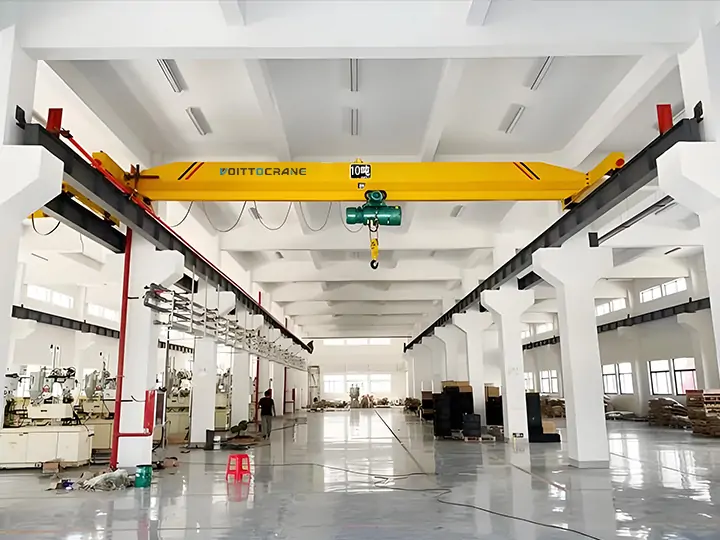
Low-headroom overhead cranes are lifting solutions specifically designed for locations with limited headroom, aimed at maximizing lifting height. Crane manufacturers equip these units with a compact hoist layout and an optimized main girder structure, significantly reducing the distance between the hook and the crane’s main girder. This allows users to achieve greater effective lifting headroom without the need to modify existing buildings. Low-headroom overhead cranes are widely used in manufacturing plants, warehouses, workshops, equipment maintenance facilities, and production lines where ceiling heights are limited.
A low headroom crane is a compact overhead crane system. This equipment is specifically designed for locations with limited vertical clearance and is intended to maximize the hook’s effective travel. The equipment has a rated lifting capacity of 1 to 20 tons and a span range of 7.5 to 31.5 meters. It is powered by a three-phase power supply of 220V–660V/50–60Hz and complies with duty classes A3–A4 (FEM 1.001). VOITTO Crane’s low headroom overhead crane products have obtained CE, ISO 9001, FEM 1.001, and GB/T 14405 certifications and are widely used in automotive assembly, steel processing, and factory production.
Product Description
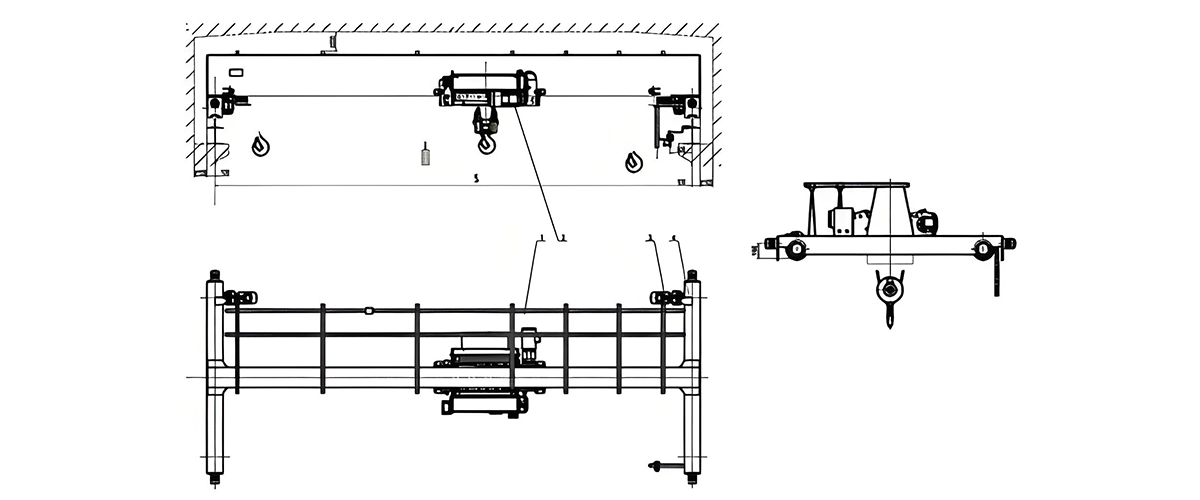
A low-headroom crane is a lifting system specifically designed to minimize the distance between the top of the hook and the main girder. Compared to traditional overhead cranes, this design can increase the effective hook height by as much as 30%–40%. The low-headroom design integrates the hoisting mechanism directly into the side of the main girder, thereby eliminating previously wasted headroom.
This design principle applies to both single-girder and double-girder configurations. In single-girder models, the hoisting mechanism is mounted on the side of the main girder, whereas in double-girder structures, it is positioned between the two main girders, thereby further maximizing hook height. As a result, practical lifting operations can be performed even in facilities with a ceiling height of just 5 meters, without the need for costly structural modifications.
This low-headroom overhead crane retains all the operational advantages of a traditional overhead crane. The equipment features precise three-axis load positioning and a high duty cycle, and supports either wireless remote control or cab operation. As a result, this model is the preferred solution when using a standard crane would require costly factory expansions or raising the roof.
Types of Low Headroom Overhead Cranes
Low headroom overhead crane designs fall into three primary categories, each suited to a distinct structural and operational context.
Single Girder Low-headroom Crane
Double Girder Low-headroom Bridge Crane
Explosion-proof Low-headroom Crane
Single-girder Low-headroom Crane: This model is suitable for loads ranging from 1 to 10 tons and spans of up to 22.5 meters. It requires the least amount of headroom, making it the most cost-effective choice for light- to medium-duty applications.
Double-girder Low-headroom Bridge Crane: A specialized low-headroom hoisting mechanism is supported and mounted between two parallel main girders. This configuration supports lifting capacities of 5 to 20 tons and spans of up to 31.5 meters. Its rigid double-girder structure provides excellent lateral stability under dynamic loads, making it ideal for continuous production operations.
Explosion-proof Low-headroom Cranes: This optional model combines a low-headroom design with electrical components compliant with ATEX certification (IEC 60079 standard). This equipment is primarily used in environments where flammable, explosive, or dusty conditions are present.
When selecting a low-headroom overhead crane, users primarily consider lifting capacity, factory span, required duty class, and environmental conditions.
Key Features and Technical Advantages of the Low Headroom Crane
Compared to traditional lifting equipment, low-headroom cranes offer significant performance advantages in the following six key areas:
Maximized Hook Travel: Crane manufacturers integrate the hoist body into the beam profile, a design that increases effective lifting height by up to 40%.
Compact End-beam Assembly: This design incorporates precision-machined wheels and an integrated drive unit, reducing the overall structural dimensions.
Variable Frequency Drive (VFD) Control: Equipped with a VFD, the equipment reduces mechanical shock during hoist startup, extends the service life of the gearbox and wire rope, and enables stepless speed regulation within the range of 10% to 100% of the rated speed.
Multiple Control Modes: Users can select from various control options based on actual operating conditions, including a floor-mounted pendant controller, a wireless remote control (with an effective range of up to 100 meters), and an enclosed operator cab.
High Adaptability: The electrical control box has an IP54 (IEC 60529) protection rating, making it suitable for ambient temperatures ranging from -20°C to +40°C and relative humidity up to 85%.
Low Maintenance Costs: The drum and trolley wheels use sealed bearings, extending the lubrication interval to 2,000 operating hours.
Applications
Typically, users employ low-headroom cranes to perform lifting tasks in the following scenarios.
Automotive Final Assembly: Operators use this equipment in automotive production workshops to lift pallets and tooling fixtures.
Steel Mills: Users employ low-headroom overhead cranes to handle steel coils and stack steel plates.
Shipbuilding and Offshore Engineering: Shipyard personnel use this equipment to perform lifting tasks in hull sections and prefabrication workshops.
Manufacturing: In heavy-duty CNC machining centers, operators control this equipment to perform material lifting tasks.
Renovation Projects for Older Factory Buildings: Without altering the building layout, users install low-headroom lifting equipment to effectively increase lifting height.
Electronics and Precision Manufacturing Industries: This equipment is suitable for scenarios with high requirements for operational stability and space utilization.
Technical Specifications
The table below summarizes the standard design parameters. For configurations outside this range, VOITTO can provide customized solutions.
Parameter
Specification
Lifting Capacity
1 – 20 tons
Span Length
7.5 – 31.5 m
Work Duty Class
A3, A4 (per FEM 1.001 / ISO 4301-1)
Power Supply
220 V – 660 V, 50–60 Hz, 3-phase AC
Operating Temperature
-20 °C to +40 °C
Relative Humidity
≤ 85 % (non-condensing)
Control Modes
Floor pendant / Radio remote / Cabin
Hoist Enclosure Rating
IP54 (IEC 60529)
Structural Standard
GB/T 14405, FEM 1.001
Electrical Standard
IEC 60204-32, EN 13557
Certification
CE, ISO 9001:2015
Low-headroom Crane for Sale
VOITTO Cranen is a specialist manufacturer of overhead lifting equipment serving automotive, steel, shipbuilding, and logistics industries worldwide. The product range covers single-girder and double-girder bridge cranes, gantry cranes, jib cranes, and custom-engineered lifting systems, all manufactured under ISO 9001:2015 and CE-certified quality processes.
Before our sales team provides a quote, our engineering team calculates the headroom for each span to confirm that the specified hook height can be achieved within the customer’s facility without modifying the track beams. In addition, our standard services include on-site installation guidance and load testing to ensure full compliance with local safety regulations upon delivery. Please feel free to contact us for low headroom crane solutions.
Specialized in Overhead Crane, Gantry Crane, Jib Crane, Port Crane & EOT Crane export solutions. 10+ years helping global clients with pre-sales consultation, capacity selection and site-specific configurations.
What is the minimum building height required for a low headroom crane?
The minimum clear height required for a factory building depends on the span and lifting capacity. Taking a common 5-ton single-girder low-headroom crane as an example, the height from the floor to the bottom of the rail girder is approximately 4.8–5.2 meters, whereas a standard crane with the same lifting capacity requires 6.0–6.5 meters.
How does a low headroom crane differ from a standard overhead crane?
The primary difference lies in hoist integration: a low headroom design recesses the drum and gearbox within the beam depth, reducing the distance between the rail top and the hook at the highest position by 400–800 mm.
Can a low headroom overhead crane operate in cold storage facilities?
Yes. The standard operating temperature range is -20 °C to +40 °C, which covers most cold-chain distribution and food-processing environments. Cold-grade lubricants and low-temperature-rated motors are fitted as standard rather than as an option, eliminating the need for a separate specification.
Which control mode is recommended for high-cycle automotive applications?
Radio remote control is preferred because it allows the operator to position alongside the load rather than at a fixed pendant station, improving cycle times by 10–15 %. Moreover, the radio system complies with EN 13557 safety category 3, meeting the functional safety requirements of modern automotive production standards.
Qualification and Honor
Engineered Strength, Global Crane Supplier
service
Exclusive and Considerable, Customer First.
01
Reliable and Customized Solutions
Our pre-sale team provides consultations, tailoring solutions to your needs and environment.
Offer customization options for lifting capacity, span and lifting height etc. to meet specific needs.
02
Updated Production Process
Real-Time Progress Updates: Weekly reports and PM communication.
3-5 years warranty and free replacement for non-manufacturing defects.
24/7 online support and on-site assistance for crane issues.
FAQ
Engineered Strength, Global Crane Supplier
How do I choose the right overhead crane for my facility?
A: Consider these factors:
Load Capacity (Max weight to lift, including rigging).
Span Width (Distance between runways).
Lifting Height (Hook path elevation).
Duty Cycle (Frequency of use: light, moderate, or severe service).
Power Supply (Electric, manual, or hybrid options).
For more detailed answers, please contact our engineers as soon as possible. Our engineers will be based on your use of the scene to give you the most professional program for you to choose!
Can it be customized?
Yes, lifting capacity, span, height, structure type, and hoist options can be customized to match specific working conditions.
Do you ship internationally?
Yes, international shipping and export support are available for global customers.
Can you customize an overhead crane to my specific needs?
Yes, we can customize an overhead crane to meet your specific business needs. We can design and manufacture complete crane systems or upgrade existing systems.
What industries are your EOT cranes suitable for?
Our overhead cranes are suitable for use in a variety of industries, including manufacturing, construction, metallurgy, logistics, and transportation etc. We specialize in providing customized solutions to multiple industries.
Get In Touch
Please feel free to leave a message. We will reply in 24 hours.
Please specify your requirement by referring to the following aspects:
Which crane product do you need?
What is the maximum lifting capacity (in tons) required for your project?
Could you specify the lifting height (in meters) needed?
Can you provide details on the working environment, such as ground conditions, space limitations, and any obstacles?
What is the expected frequency of use and the duration of the project?






 English
  Español
  Português
  العربية
  Français
  Русский