
Introduction
A small overhead crane is a compact lifting system designed to handle light to medium loads within limited workspace environments such as workshops, warehouses, and small manufacturing plants. Installed on ceiling-mounted or freestanding runway beams, it enables efficient material handling, improves workflow, and reduces manual labor. Compared with larger industrial cranes, small overhead cranes are more cost-effective, easier to install, and highly adaptable to various operational needs.
In this guide, we’ll explore what defines a small overhead crane, its key components, common types, and how to choose the right solution for your facility, helping you maximize efficiency while keeping investment under control.
Main Components
The structure of a small overhead crane is similar to that of a standard overhead bridge crane, but it is more lightweight and modular. Its main components include:

- Main Girder: A structure used to horizontally install the lifting mechanism and determine the span.
- End Girder: Equipped with traveling mechanisms to enable longitudinal movement of the crane.
- Hoisting Mechanism: A device used to move the hook up and down. It consists of a motor, gearbox, brake, drum, wire rope, hook, and pulley block.
- Remote Controller: A device used to control crane operations.
- Electrical System: Provides power for crane operation.
- Safety Devices: Protective devices to prevent overload lifting.
Main Types of Small Overhead Crane
With the diversification of application demands, different industries have higher requirements for the structure, capacity, and installation methods of small overhead bridge cranes, resulting in various types to suit different working conditions. Taking the Chinese crane manufacturer VOITTO as an example, its product line includes single girder, KBK, suspended, and freestanding systems to meet various needs.
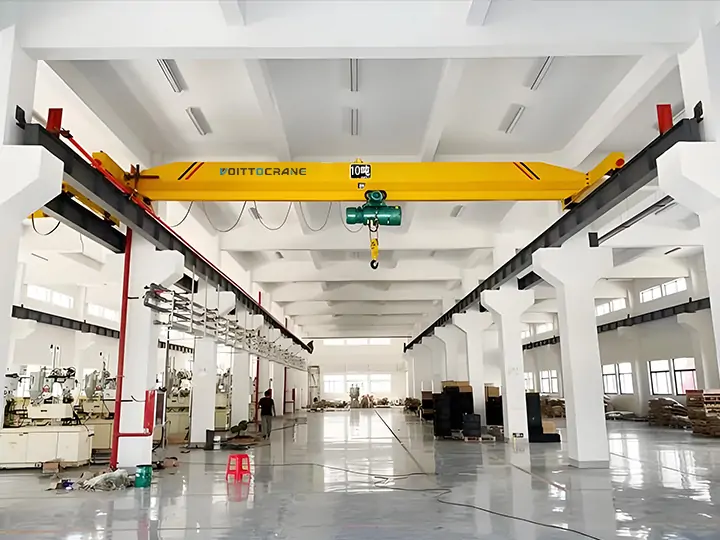
Single Girder Small Overhead Crane
The most common type of small overhead bridge crane, featuring a simple structure and low cost, suitable for warehouse and workshop material handling.

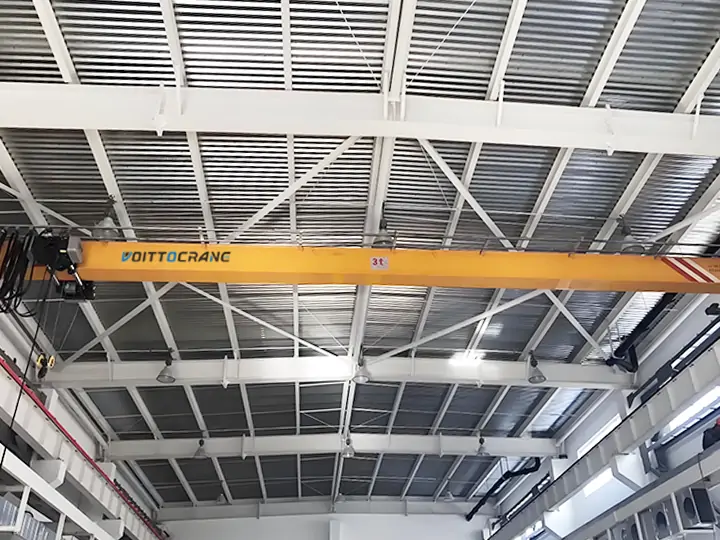
| Parameter | Description |
| Lifting Capacity | 1 ton – 20 tons |
| Span | 7.5 m – 28.5 m |
| Lifting Height | 6 m – 18 m |
| Lifting Equipment | Electric hoist (wire rope/chain) |
| Application | Warehouses, workshops, logistics centers |
KBK Overhead Crane (Flexible Modular Type)
A flexible modular system and a lightweight small overhead bridge crane solution, suitable for high-frequency and precision operations.

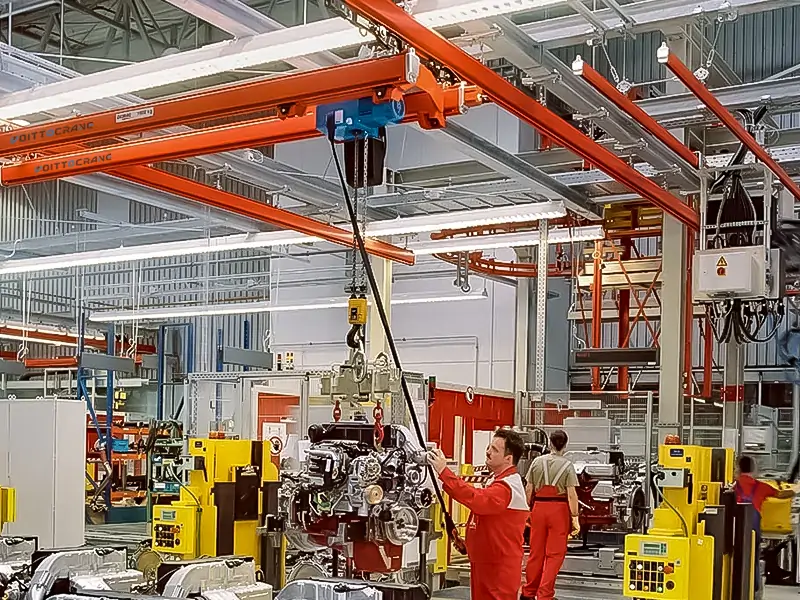
| Parameter | Description |
| Lifting Capacity | 0.125 ton – 5 tons |
| Span | 2 m – 10 m |
| Lifting Height | 2 m – 10 m |
| Lifting Equipment | Electric chain hoist/manual hoist |
| Application | Assembly lines, workstations, light industry |
Freestanding Overhead Crane
A modular system that does not rely on the building structure, and in some cases can replace a small overhead gantry crane. It is particularly suitable for rented workshops or renovation projects.


| Parameter | Description |
| Lifting Capacity | 0.25 ton – 5 tons |
| Span | 3 m – 12 m |
| Lifting Height | 3 m – 10 m |
| Lifting Equipment | Electric chain hoist/wire rope hoist |
| Application | Rental workshops, assembly lines, warehousing |
Suspension Overhead Crane
Suitable for low headroom environments and is a common form of small overhead bridge crane in space-limited scenarios.


| Parameter | Description |
| Lifting Capacity | 0.5 ton – 10 tons |
| Span | 3 m – 16 m |
| Lifting Height | 3 m – 12 m |
| Lifting Equipment | Electric chain hoist |
| Application | Low headroom workshops, warehouses, assembly lines |
Different types of small overhead cranes have their own advantages in structure, capacity, and application scenarios. Enterprises should consider lifting capacity, span, building structure, and usage frequency when selecting the most suitable solution to achieve optimal efficiency and cost balance.
Applications
Small overhead bridge cranes are widely used in:
- Warehousing and logistics centers: loading, unloading, and storage operations in narrow aisle environments
- Manufacturing and assembly workshops: machinery, automotive parts, and electronics production
- Equipment maintenance areas: equipment repair, mold replacement, and component disassembly
- Space-limited or renovation projects: low headroom workshops or leased facilities
Advantages
Small overhead cranes are a compact yet powerful material handling solution designed to improve efficiency in limited spaces. They combine flexibility, cost-effectiveness, and reliable performance, making them ideal for workshops, warehouses, and light manufacturing environments.
- Space-Saving Design
Compact structure allows installation in low-headroom or confined areas, maximizing the use of available workspace. - Improved Work Efficiency
Enables faster and more precise lifting and positioning, significantly reducing manual labor and handling time. - High Flexibility
Can be customized in terms of span, height, and lifting capacity to suit different operational requirements. - Low Cost Investment
Requires lower initial investment and reduced maintenance costs compared to large-scale crane systems. - Easy Installation and Maintenance
Simple structure ensures quick setup and minimal downtime for maintenance or repairs. - High Safety Performance
Equipped with multiple protection devices such as overload limiters and emergency stop systems to ensure safe operation.
Selection Guide for Small Overhead Cranes
Choosing a small overhead bridge crane requires considering parameters and working conditions:
- Lifting capacity and safety margin: reserve 10%–20% extra capacity
- Span: usually 1.5–2 meters smaller than the building width
- Lifting height: determined by handling requirements and building clearance
- Working class: generally A3–A4; higher for frequent operations
- Speed: lower speeds for precision, higher speeds for efficiency
- Environment: special environments require suspended/KBK or explosion-proof designs
Selection should follow the principle of “matching requirements, safety, and cost efficiency.” After defining key parameters, communicate with professional manufacturers. VOITTO is a Chinese crane manufacturer with ISO and CE certifications, provides one-stop services from design to installation.
Case Study
In October 2023, VOITTO provided a 5 ton small overhead bridge crane solution for a recycling paper mill in the Philippines. The plant previously relied on forklifts and manual handling, resulting in restricted movement, 8%–10% material waste, and high labor costs.
Considering a 12-meter span, 65%–70% humidity, and limited operator experience, a 5-ton LD single girder overhead crane (span 18.9 m, lifting height 12 m) was customized, equipped with an IP65 electromagnetic lifter and a lightweight design (25% weight reduction).
After one month of operation, handling efficiency increased by 40%, losses dropped below 2%, and failure rates were less than once per month.

Precautions
- Safety regulations: equip zero-position protection, overload protection, and trained operators
- Maintenance: regularly inspect wire ropes, brakes, and electrical systems
- Application limits: not suitable for explosive or corrosive environments without special design
Small overhead cranes, with their flexibility and cost efficiency, have become essential material handling equipment in modern industry, especially for small and medium-sized enterprises.
FAQ
1. What is the typical lifting capacity of a small overhead crane?
It is usually 1–10 tons, with 1–3 tons being the most common. A 10%–20% safety margin is recommended.
2. What industries use small overhead cranes?
They are widely used in warehousing, manufacturing, electronics, maintenance, and light industry.
3. What is the difference between single girder and double girder cranes?
Single girder cranes are simpler and more economical, while double girder cranes offer higher capacity and stability.
4. Does a small overhead crane require rails?
Yes, most require rails, but suspended or KBK systems can run on overhead structures.
5. How to choose the right crane model?
Consider capacity, span, lifting height, usage frequency, and building structure.
6. Are small overhead cranes safe?
Yes, when equipped with proper safety devices and operated correctly.
7. Can cranes be used in small spaces?
Yes, suspended, KBK, or freestanding cranes are ideal for limited spaces.
8. Is maintenance complicated?
No, it mainly involves cleaning, lubrication, and inspection.
9. What is the price range?
Prices vary widely, from thousands to tens of thousands of dollars depending on specifications.
10. Can small overhead cranes be customized?
Yes, most manufacturers support customization for size, capacity, and special environments.
Conclusion
Small overhead cranes have become indispensable in modern industry due to their efficiency and flexibility. Proper selection requires matching actual working conditions and working with professional crane manufacturers.
Taking VOITTO as an example, it holds ISO and CE certifications and provides integrated services from design to installation, helping businesses achieve efficient, safe, and cost-effective material handling solutions. If you have any questions about crane selection, please contact us.

Alan
Crane Solutions Specialist · Voitto Crane
Specialized in Overhead Crane, Gantry Crane, Jib Crane, Port Crane & EOT Crane export solutions. 10+ years helping global clients with pre-sales consultation, capacity selection and site-specific configurations.




 English
  Español
  Português
  العربية
  Français
  Русский