
Overhead cranes are widely used in workshops, warehouses, factories, steel mills, and other environments. They are mainly responsible for lifting and moving heavy materials. For safe and stable operation, overhead crane manufacturers equip their bridge cranes with various safety devices to prevent accidents such as overloading, collision, or mechanical failure. These safety components work together to monitor operating conditions in real time, protect operators and equipment, and effectively extend the life of the equipment. Understanding and maintaining overhead crane safety devices is crucial for enhancing operational safety, compliance, and productivity. Next, this article will introduce you to the overhead crane safety devices, so that you can recognize and understand their functions.

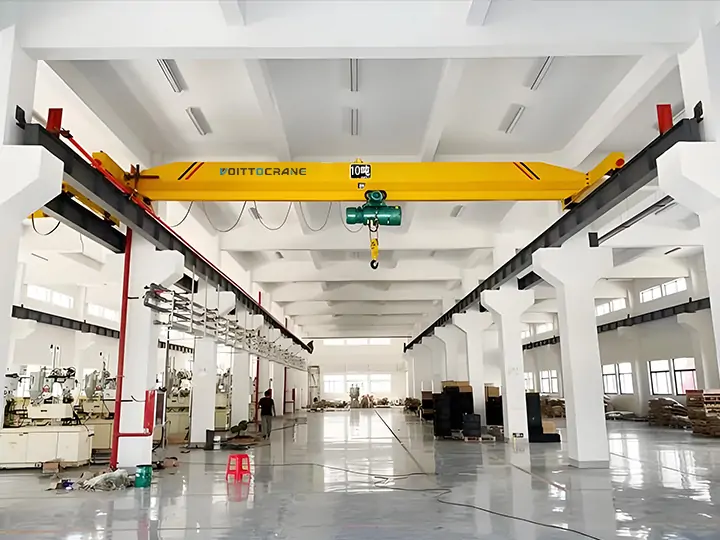
Single Girder Overhead Crane

Double Girder Overhead Crane
What are the Overhead Crane Safety Devices?
The overhead crane safety devices are installed at different parts of the bridge crane. They are responsible for protecting and monitoring the safety, stability, and reliability of the crane during operation. These devices provide real-time monitoring and control of lifting, operational, electrical, and structural aspects to prevent accidents due to overloading, collision, rope breakage, derailment, or electrical failure.
What is the Function of Each Safety Device?
The bridge crane safety devices include the crane travel limit switch, trolley travel limit switch, lifting height limit switch, laser anti-collision system, overload protection devices, buffer, braking system, sound and light alarm, etc. The following is an introduction to each safety device:

- Crane Travel Limit Switch: Crane travel limit switches are installed at both ends of the bridge crane’s track to limit the crane’s operating range. When the crane approaches the end of the track, the limit switch is triggered, automatically cutting off the operating circuit and causing the equipment to slow down or stop.
- Trolley Travel Limit Switch: The trolley limiter is used to control the operating range of the trolley on the main beam. When the trolley approaches the ends of the main beam, the limiter will be activated, cutting off the operating power or sounding an alarm to prevent the trolley from running out of the main beam or hitting the end beam.
- Lifting Height Limit Switch: The lifting height limit switch is installed on the lifting mechanism to control the maximum and minimum positions of the hook. When the hook reaches the upper limit or drops to the lower safety limit, the limiter automatically cuts off the lifting circuit to prevent the hook from hitting the drum or the wire rope from loosening.
- Overload Protection Devices: The overload protection device monitors the hoisting load in real time through sensors. When the hoisting weight exceeds the rated load, the device will immediately alarm or automatically cut off the lifting circuit.
- Laser Anti-collision System: The laser collision avoidance system is an intelligent safety device that uses laser or infrared sensors to detect obstacles ahead or the position of adjacent cranes. If the distance is too close, the system will automatically sound an alarm or slow down and stop the vehicle.
- Buffer: Buffers are usually installed at both ends of the crane and trolley running mechanisms to absorb the impact energy when the equipment stops at the end of its stroke.
- Braking System: The braking system is installed on the lifting mechanism, trolley, and crane operating mechanism, and the braking system adopts electromagnetic braking or hydraulic braking.
- Audible and Visual Alarm: When the crane is started, running, or encounters an abnormality, the sound and light alarm will emit sound and light signals to remind the operator and surrounding people to pay attention to safety.
Why do Overhead Cranes Need Safety Devices?
Bridge cranes are typically used for large-tonnage, high-frequency lifting operations, involving multiple components such as lifting, operation, and braking. Once an overload, limit loss of control, electrical failure, or structural abnormality occurs, it is very easy to cause serious accidents such as falling objects, equipment collision, and even casualties. Therefore, safety devices can provide monitoring, limiting, alarm, and protection functions to effectively prevent the occurrence of risks.
How to Improve the Safety of a Factory?
First, equip your overhead crane with comprehensive safety features. Ensure the equipment is equipped with overload protection, travel limit switches, lifting height limiters, braking systems, buffers, laser anti-collision systems, and audible and visual alarms, and maintain them sensitively and reliably. These safety features work in concert to effectively prevent dangerous situations such as overloading, overrunning, collisions, and falling objects.
Secondly, the factory should establish a complete equipment inspection and maintenance system, conduct regular inspection and maintenance of the bridge crane’s wire rope, brakes, electrical circuits, limiters, and other components, and promptly rectify any hidden dangers found.
Third, operators need to undergo rigorous training and familiarize the safety devices’ functions and correct use.
Finally, factories can go through digitalization and intelligent monitoring systems to improve safety, such as video surveillance, overload alarms, operational data collection, and remote diagnostic systems.
How to Improve Production Efficiency?
In daily operations, overhead crane safety systems play a crucial role in improving production efficiency.
- Installing an overload protection device can prevent shutdowns and equipment damage caused by overload, thereby reducing downtime.
- The travel limit switch and lifting height limit device ensure the crane’s precise operation and avoid collisions.
- Equipped with a laser anti-collision system and anti-sway control technology, the lifting process is smoother, and the material positioning accuracy and improved work speed.
- Regularly maintain the safety system and train operators to ensure that every lifting is completed in a safe and controlled manner.
By ensuring both safety and efficiency, the factory can not only reduce the risk of accidents but also achieve higher production efficiency.
Conclusion
The overhead crane safety devices not only protect the operators’ lives but are also crucial to maintaining the long-term operation of the equipment. Only by combining safety with intelligence can a stable, efficient, and reliable production environment be achieved. The above content introduces the bridge crane’s safety devices. VOITTO crane is committed to providing you with valuable references.
As a professional overhead crane manufacturer and supplier in China, VOITTO Crane’s bridge cranes are equipped with comprehensive safety protection systems, intelligent monitoring, and precise control technologies. The VOITTO manufacturing bridge cranes can achieve higher operating efficiency and lower maintenance costs while ensuring operational safety. If you have any overhead bridge crane special requirements or need advice on selection, please feel free to contact us.




 English
  Español
  Português
  العربية
  Français
  Русский