A straddle carrier crane is a mobile lifting equipment specifically designed for moving and stacking containers. Users utilize it in port terminals, container yards, manufacturing industries, and large logistics centers.
A straddle carrier crane is a self-propelled lifting device that moves on rubber tires. Operators use this equipment to lift 20-foot, 40-foot, or 45-foot containers. The container straddle carrier crane has a load capacity ranging from 35 to 80 tons, a maximum lifting height of up to 13 meters, and the ability to stack containers in 2 to 4 layers. Certified to CE, ISO 9001, and EAC standards, this equipment is widely used in port terminals, intermodal rail yards, and heavy manufacturing plants.
Product Description
A straddle carrier crane is a mobile lifting equipment specifically designed for moving and stacking containers. Users utilize it in port terminals, container yards, manufacturing industries, and large logistics centers. The straddle carrier crane is designed with a “gantry” structure, which allows it to straddle materials directly and lift, transport, and stack goods from the ground to a designated location using a spreader.
The machine is equipped with four to eight large tires, enabling it to maneuver with ease in paved yards, at the dockhead, and within the confined spaces of ship holds. Its effective internal clear width ranges from 3,100 mm to 3,750 mm, which is sufficient to span standard 20-foot or 40-foot containers while leaving ample safety clearance on both sides.
Straddle Carrier Crane
Container Straddle Carrier
A Straddle carrier crane is highly flexible and can handle goods in any complex environment. It is equipped with functions such as straight-line, inclined-line, and Ackerman steering, among others. It has a safety indication and an overload protection device. The electrical drive adopts full digital AC frequency conversion, PLC control, constant power speed regulation, and other technologies.
Types of Straddle Carriers
These straddle carrier cranes can be classified based on their power source. Therefore, before making a purchase, users should carefully consider the specific conditions at ports and rail freight yards to select the appropriate model, as this will directly impact operational efficiency and total lifecycle costs.
Diesel-powered: This is the traditional preferred option for remote or newly constructed terminals lacking grid infrastructure. It offers an unlimited range and allows for quick and convenient refueling.
Hybrid (diesel-electric): By recovering braking energy through capacitors or batteries, it can reduce fuel consumption by up to 30% compared to similar diesel-powered equipment.
All-electric: With zero tailpipe emissions, this is the ideal choice for enclosed facilities and terminals with strict environmental requirements. Charging can be performed during downtime or at dedicated charging stations.
Parts of The Straddle Carrier Crane
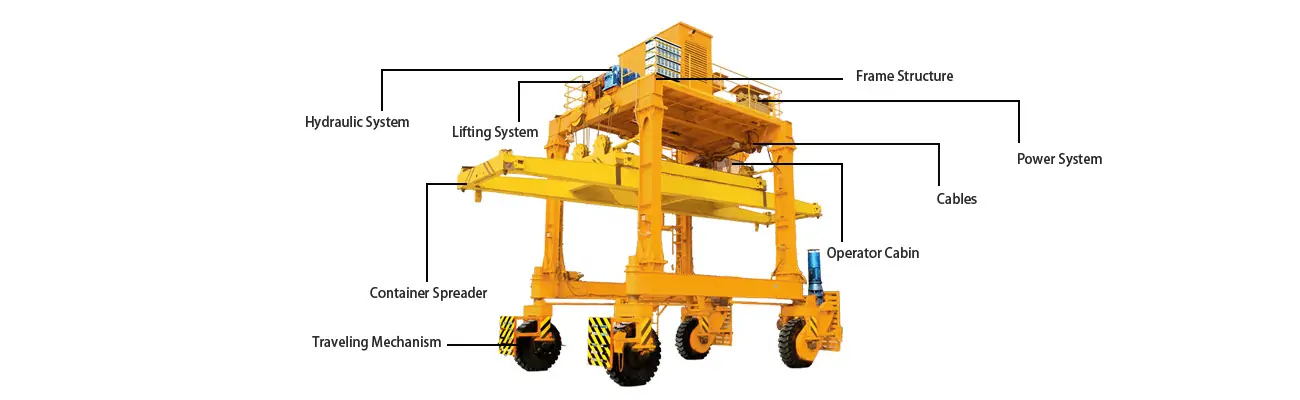
This container straddle carrier consists of a frame structure, spreader, traveling mechanism, lifting system, power system, hydraulic and control system, safety devices, and other components. The following is an introduction to each component of the container straddle carrier crane:
Frame Structure: The main structure of the straddle carrier, which bears the entire weight.
Lifting Spreader: A device for connecting goods. Users can choose different models depending on the size of the material being lifted.
Lifting System: The user controls the equipment for lifting and placing containers.
Travelling Mechanism: Installed at the bottom of the entire device, consisting of drive wheels and steering wheels.
Power System: This is the power source for the straddle carrier, usually diesel, hybrid, or electric.
Hydraulic and Control System: User controls lifting, steering, braking, etc.
Operator Cabin: This is operators control the entire equipment, which is equipped with a control panel and display system.
Cables: provide power and signal connections for control systems, lighting, and sensors.
Safety Devices: This machine is equipped with safety features such as overload protection, collision protection, limit switches, and emergency braking systems.
Users can choose to equip the straddle carrier with 20-foot, 40-foot, telescopic, single-box, double-box, electric, or hydraulic types of spreaders, depending on the size of the cargo being lifted.
Container Spreader Types
The container spreader serves as the critical interface between equipment and containers. Therefore, selecting the correct type of spreader directly determines loading and unloading speed, container compatibility, and maintenance frequency.
20ft Fixed Spreaders
40ft Fixed Spreaders
20&40ft Telescopic Spreaders
Heavy Load Spreader
Application
A straddle carrier crane combines mobility, lifting capacity, and stacking capability, making them suitable for a wide range of heavy-duty logistics applications.
Port Terminal Yard: User-controlled for short-distance transport, stacking, and loading of containers after they are unloaded from ships.
Inland Container Yard: Operators control it for stacking and transshipping containers.
Logistics Center: Users use it to load, unload, and handle large goods or containers.
Railway Freight Yards: Straddle carriers assist in the transfer of containers from trains to the yard or trucks.
Manufacturing: Users use it to move large components or heavy-duty equipment.
Free Trade Zone: Users operate straddle carriers to stack, allocate, and manage import and export goods.
Container Repair and Storage Yard: Operators use it to stack, move, and position containers awaiting inspection or repair.
Features and Advantages
Each machine incorporates multiple engineering systems working in parallel. Therefore, understanding the individual features helps operators and procurement teams match the equipment to their specific duty cycle.
1. This equipment employs a fully digital AC variable-frequency drive system combined with PLC control technology to achieve constant-power speed regulation.
2. Features a high-strength steel gantry frame structure manufactured to FEM 1.001 structural class requirements.
3. A modular component layout houses the power unit, hydraulic unit, and electrical control cabinet in separate compartments.
4. Features anti-tipping geometry, anti-collision sensors, and emergency braking functions.
5. Equipped with an overload protection system that automatically disconnects the hoisting circuit when the load reaches 110% of the rated capacity.
6. The cab’s ergonomic design complies with the ISO 11228 standard for operator workstations; it is fitted with panoramic windows and a high-performance air conditioning system (HVAC), capable of operating within a wide ambient temperature range of -20°C to +50°C.
7. This device offers optional remote control solutions and an autonomous driving upgrade path, enabling the device to undergo gradual automation upgrades.
Straddle Carrier Steering Modes
To accommodate the narrow storage yards in ports, the need for easy manoeuvrability in railway logistics yards, high-density stacking, and frequent transhipment, the straddle carrier manufacturer has equipped the straddle carriers with six different steering modes.
Multidirectional in 4 Directions
Front Wheel Drive Steering
90° Steering
Carousel Steering
Crab-wise Steering
Rear Wheel Drive Steering
Specification
All models are designed and tested to ISO 9001:2015 quality management requirements and certified to CE and EAC. FEM 1.001 structural load classifications apply to the portal frame design.
Model
MST3531
MST6037
MST8037
Capacity
35t
60t
80t
Length×Width×Height
9200×5100×5500mml7110×5100×6100mm
9250×5700×6350mm
12500×6000×6350mm
Effective inner width
3100mm
3750mm
3750mm
wheel base
6010mm
6600mm
7400mm
Duplex Lifting Height
N/A |1550mm
1750mm
1750mm
Max. Lifting Height(Below spreader)
4600mm|6150mm
6300mm
6300mm
Min. Ground Clearance
230mm
310mm
310mm
Tire Qty
4
4
8
Deadweight(not contain spreader)
19T/21T
35T
45T
Empty -load max. speed
115m/min
80m/min
80m/min
Full Hoad max. speed
80m/min
50m/min
50m/min
Turning Radius
6950mm
8900mm
13000mm
No-load/full-load Gradeability
6%/3%
Control mode
Cab or remote control
Tires
solid tire
Lifting Tools
Chain+Lock+Automatic Spreader
Oversized Load Spreader
Note: Users can choose between diesel power, hybrid power, and all-electric power.
Straddle Carrier Crane for Sale
Customers looking to purchase a container straddle carrier crane should focus on evaluating three key factors: whether the rated lifting capacity meets their requirements for the maximum gross weight of the containers, whether the stacking height is compatible with the available space in the yard, and whether the power source configuration is compatible with the on-site infrastructure.
VOITTO Group is a leading supplier and manufacturer of straddle carrier cranes in China, with all products having international certifications such as ISO, CE, and GOST. With advanced design concepts, sophisticated manufacturing processes, and strict quality control, VOITTO has established strategic partnerships with over 70 countries worldwide.
VOITTO can provide customized container straddle carrier solutions with different tonnages (30-80 tons) and drive modes (electric/diesel/hybrid) according to customers’ needs. If you need port crane products, contact us.
Specialized in Overhead Crane, Gantry Crane, Jib Crane, Port Crane & EOT Crane export solutions. 10+ years helping global clients with pre-sales consultation, capacity selection and site-specific configurations.
What is the maximum load a straddle carrier crane can lift?
Standard models handle 35 t, 60 t, and 80 t. The 80-tonne MST8037 variant is designed for fully loaded 40 ft heavy-lift containers.
How does a straddle carrier differ from an RTG crane?
A straddle carrier is a self-contained mobile vehicle that straddles a single lane and lifts the container directly. An RTG (rubber-tyred gantry) crane, however, spans multiple container rows and uses a trolley-hoist mechanism, making it better suited for high-density block stacking over 6 rows wide.
Can the spreader accommodate 45 ft containers?
Yes. The telescopic spreader option extends to 45 ft, compatible with European pallet-wide containers to ISO 668. Therefore, terminals handling a mixed fleet of 20 ft, 40 ft, and 45 ft units can operate a single spreader type across the entire fleet.
Which power source is recommended for indoor container facilities?
All-electric drive is strongly recommended for enclosed or partially enclosed facilities, as it produces zero tailpipe emissions and significantly reduces noise levels compared to diesel. Moreover, regenerative braking returns energy to the battery during lowering cycles, cutting energy consumption per lift by up to 25%.
Is remote control or autonomous operation available?
Both options are supported. Remote control (via encrypted 2.4 GHz radio link) allows one operator to manage the crane from a ground-level position. Autonomous driving capability is available as a retrofit package compatible with standard yard operating systems (YOS), enabling semi-automated or fully automated operation as the terminal’s infrastructure develops.
Qualification and Honor
Engineered Strength, Global Crane Supplier
service
Exclusive and Considerable, Customer First.
01
Reliable and Customized Solutions
Our pre-sale team provides consultations, tailoring solutions to your needs and environment.
Offer customization options for lifting capacity, span and lifting height etc. to meet specific needs.
02
Updated Production Process
Real-Time Progress Updates: Weekly reports and PM communication.
3-5 years warranty and free replacement for non-manufacturing defects.
24/7 online support and on-site assistance for crane issues.
FAQ
Engineered Strength, Global Crane Supplier
What’s the delivery time for an overseas order?
Transit time varies depending on many factors, including the destination of the goods, distance, shipping method and shipping service provider, etc. Generally speaking, international shipping may take about a month.
What’s included in your after-sales service?
We offer comprehensive after-sales service, including regular maintenance, rapid technical support, and spare parts supply. The standard warranty period is 1 year, with options for extension based on your needs.
What’s your warranty policy for gantry cranes?
All parts of our gantry cranes come with a one-year warranty.
We also provide online customer service, ready to solve your problems at any time, and after-sales documentation support.
If the problem is still not solved, we can appoint our engineers to your site.
Can you design a gantry crane for extreme outdoor conditions?
Yes, our gantry cranes can be used stably in harsh environments such as strong winds or low temperatures due to their special construction and material structure.
Get In Touch
Please feel free to leave a message. We will reply in 24 hours.
Please specify your requirement by referring to the following aspects:
Which crane product do you need?
What is the maximum lifting capacity (in tons) required for your project?
Could you specify the lifting height (in meters) needed?
Can you provide details on the working environment, such as ground conditions, space limitations, and any obstacles?
What is the expected frequency of use and the duration of the project?




 English
  Español
  Português
  العربية
  Français
  Русский