
A container gantry crane is a specialized overhead lifting system designed to handle standardized shipping containers in ports, intermodal terminals, and logistics facilities. These structures enable efficient transfer of containers between vessels, rail cars, trucks, and storage yards with precision and speed. Understanding their capabilities and specifications is essential for operations managers planning equipment procurement or facility upgrades.
This guide, written by a Voitto Crane technical engineer with 15 years of experience, provides comprehensive technical parameters, performance specifications, and market pricing information. You will learn how different types of cranes meet specific operational needs and what factors influence the selection of container handling equipment.
Understanding Container Gantry Crane Fundamentals
Container gantry crane feature a horizontal bridge beam supported by vertical legs forming a portal structure. A trolley system travels along this beam, carrying a container spreader that locks onto container corner castings using twist-lock mechanisms. Modern designs incorporate double-girder construction with variable frequency drives for precise positioning control.
These container cranes handle standardized ISO containers from 20 to 45 feet in length. Lifting capacities range from 35 to 75 tons depending on application requirements. Hoisting speeds reach 50-180 meters per minute, trolley traverse speeds hit 180-240 meters per minute, and gantry travel ranges from 30-45 meters per minute. Advanced systems achieve positioning accuracy within ±25mm for high-density stacking operations.
Primary Container Gantry Crane Types
Rubber-Tired Gantry Cranes (RTG)
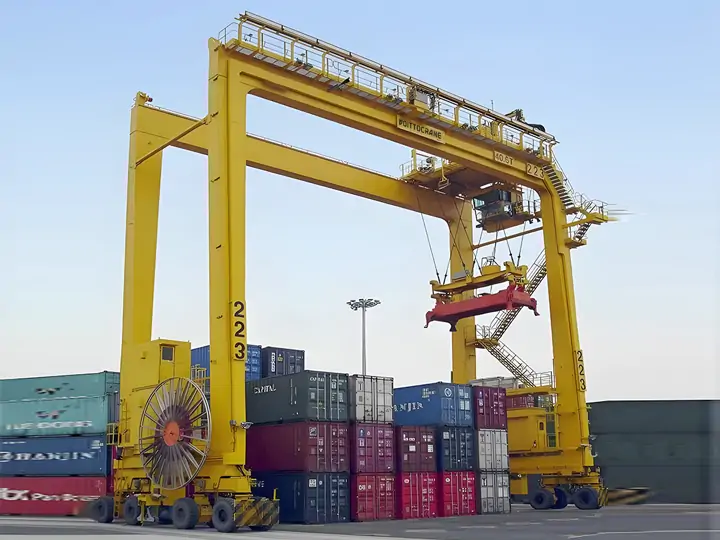
RTG Rubber Tyred Gantry Crane

Electric RTG Cranes
RTG cranes provide operational flexibility through rubber tire mobility, eliminating fixed rail infrastructure requirements. These units serve container yards needing adaptable layouts and flexible positioning.
RTG Technical Specifications:
| Parameter | 35-41 Ton | 70 Ton |
|---|---|---|
| Span | 23.47 – 26m | 23.47 – 26m |
| Lifting Height | 15.5 / 18.5m | 15.5 / 18.5m |
| Stacking | 5+1 / 6+1 containers | 6+1 containers |
| Hoisting Speed (full/empty) | 20-25 / 40-50 m/min | 25 / 50 m/min |
RTG crane price reference:
| Lifting Capacity (ton) | Span(m) | Lifting Height(m) | Power Supply | Price(USD) |
|---|---|---|---|---|
| 35 ton | 23.47~26 | 15.5/18.5 | Diesel generator set or three-phase AC380V 50Hz | $750680 ~ $1200875, depending on specifications |
| 41 ton | 23.47~26 | 15.5/18.5 | ||
| 70 ton | 23.47~26 | 15.5/18.5 |
RTG systems dominate medium-sized terminals requiring layout flexibility. Tire-based mobility allows repositioning across yard blocks as patterns change. Power options include diesel generators, diesel-electric hybrid (reducing fuel consumption 30-40%), or full electric via cable reel.
Fuel consumption represents significant operational cost for diesel variants. Hybrid systems achieve payback within 4-6 years through reduced fuel expenses in high-utilization environments.
Rail-Mounted Gantry Cranes (RMG)

RMG Gantry Crane
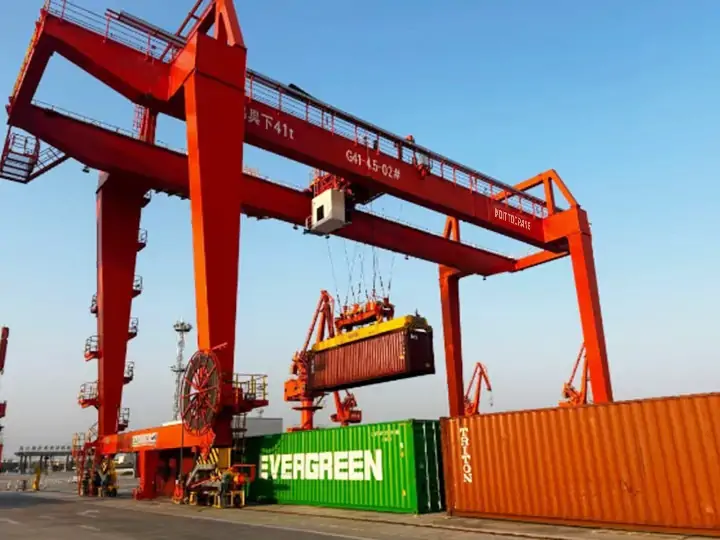
RMG Container Gantry Crane
RMG systems deliver superior precision through fixed rail guidance, serving high-density yards where consistent stacking patterns maximize storage capacity. These container cranes run on ground-level rails with electric power delivery through busbar or cable systems.
RMG Configuration Specifications:
| Span | Lifting Capacity | Lifting Height | Stacking Width |
|---|---|---|---|
| 18m | 35-40 tons | 12-16m | 4-5 containers |
| 26m | 40-41 tons | 15-20m | 6-7 containers |
| 30m | 41-45 tons | 18-25m | 8-9 containers |
| 35m | 41-50 tons | 20-28m | 10-11 containers |
RMG crane price reference:
| Lifting Capacity (ton) | Span(m) | Lifting Height(m) | Power Supply | Price(USD) |
|---|---|---|---|---|
| 35 | 26 | 15.4/18.3 | Diesel generator set or three-phase AC380V 50Hz | $465, 217 ~ $523, 188, depending on specifications |
| 30 | 15.4/18.3 | |||
| 35 | 15.4/18.3 |
RMG Performance Advantages:
| Feature | Standard RMG | Automated RMG |
|---|---|---|
| Positioning Accuracy | ±30mm | ±20mm |
| Container Moves/Hour | 25-30 | 30-35 |
| Automation Level | Semi-automated | Fully automated |
| Energy Efficiency | 100% baseline | 110-120% (regenerative) |
| Labor Requirement | 1-2 operators | Remote control center |
RMG installations require substantial rail infrastructure investment but deliver long-term operational advantages. Positioning accuracy within ±25mm enables tight stacking patterns, increasing yard density by 15-20% compared to RTG operations. Electric power consumption runs 20-30% lower than equivalent RTG systems, with regenerative braking capturing energy during lowering operations.
Automation compatibility represents a key RMG strength. Approximately 85-90% of new RMG installations incorporate automation capabilities, enabling remote operation and continuous operations without operator fatigue constraints.
Ship-to-Shore Container Cranes (STS)

STS Ship to Shore Crane

STS Crane Parts
STS cranes represent the vessel-to-shore interface for container operations. These structures span vessel widths, with front outreach determining serviceable ship sizes.
STS Specifications by Vessel Class:
| Vessel Type | Outreach | Lift Height | Capacity |
|---|---|---|---|
| Panamax | 40-45m | 30-35m | 40-50 tons |
| Post-Panamax | 48-52m | 35-40m | 50-65 tons |
| Super Post-Panamax | 55-60m | 38-42m | 60-65 tons |
| Mega-Max | 65m+ | 40-45m | 65-75 tons |
STS Crane Price Reference:
| Load Capacity | Lifting Height | Price |
|---|---|---|
| 41 ton | 22 m | $1,184,000, depending on specifications |
| 40 m | $3,170,850, depending on specifications |
Performance Parameters:
Lifting speeds range from 50-90 m/min (full load) to 120-180 m/min (empty). Trolley speeds reach 180-240 m/min, with productivity of 25-60 container moves per hour depending on automation level.
Modern STS designs incorporate dual-trolley systems enabling simultaneous handling. Twin-lift manages two 20-foot or one 40-foot container. Tandem-lift handles two 40-foot containers simultaneously. Asian manufacturers typically offer 20-30% lower pricing than European suppliers for comparable specifications.
Critical Technical Selection Factors
Capacity Planning Requirements
Container weight varies by trade route and cargo type. Export routes from manufacturing regions often feature heavier containers averaging 18-24 tons for 40-foot units. Empty repositioning reduces average weights to 10-14 tons.
Capacity Selection Matrix:
| Terminal Type | Container Profile | Recommended Capacity | Safety Margin |
|---|---|---|---|
| Feeder port | 70% 20ft, 30% 40ft | 35-40 tons | 25-30% |
| Regional terminal | 50% 20ft, 50% 40ft | 40-45 tons | 30% |
| Main port | 30% 20ft, 70% 40ft | 45-50 tons | 30-35% |
| Heavy cargo port | Mixed high-density | 50-65 tons | 35% |
Future planning should account for increasing maximum gross weights. Some jurisdictions now permit 32-ton payloads in 40-foot containers, requiring container crane capacities of 45-50 tons with appropriate safety factors.
Span and Outreach Determination
Span requirements depend on yard stacking configurations and vessel dimensions. Container yard blocks typically range from 18 to 35 meters width, determining RMG/RTG span specifications.
Outreach Planning for Different Applications:
| Application | Operational Requirement | Required Dimension |
|---|---|---|
| Yard stacking (6-wide) | 6 containers × 2.4m + clearance | 18-20m span |
| Yard stacking (8-wide) | 8 containers × 2.4m + clearance | 24-26m span |
| Panamax vessels | 32m beam + clearance | 40-45m outreach |
| New Panamax vessels | 49m beam + clearance | 60-65m outreach |
| ULCV vessels | 59m+ beam + clearance | 70-75m outreach |
Back reach dimensions determine landside operational capability. Insufficient back reach creates bottlenecks in container delivery to trucks or rail cars. STS cranes typically feature 10-25m back reach depending on terminal layout and equipment positioning requirements.
Environmental and Operational Conditions
Wind loads represent the primary environmental design factor. Coastal terminals experience sustained winds and storm events requiring enhanced structural specifications.
Wind Speed Operational Limits:
| Condition | Wind Speed | Operational Status | Safety Response |
|---|---|---|---|
| Normal operation | 0-20 m/s | Full productivity | Standard procedures |
| Cautious operation | 20-25 m/s | Reduced speeds | Enhanced monitoring |
| Restricted operation | 25-28 m/s | Limited movements | Position containers safely |
| Shutdown required | 28-30 m/s | Secure equipment | Storm preparation |
| Storm anchoring | 30+ m/s | Full lockdown | Tie-down engaged |
Automated wind monitoring systems continuously measure conditions and trigger alerts. Modern cranes incorporate automatic shutdown sequences that engage storm anchoring within 15-20 minutes of exceeding safe operating limits.
Seismic design requirements vary by location. Facilities in earthquake-prone regions incorporate base isolation or enhanced bracing, typically adding 8-12% to structural costs.
Investment and Operational Economics
Total Project Investment
Equipment purchase represents one portion of total costs. Infrastructure and installation add substantial investment.
RMG Project Cost Breakdown:
| Component | Percentage |
|---|---|
| Container crane equipment | 55-65% |
| Rail infrastructure | 15-20% |
| Electrical systems | 8-12% |
| Foundation & Installation | 13-18% |
| Total Turnkey | 100% |
Equipment Procurement Strategy
Successful procurement requires comprehensive operational analysis. Document current throughput, peak demands, and vessel size projections. Plan for 10-15 year growth horizons to avoid premature capacity constraints.
Key Specification Decision Factors:
| Decision Area | Impact on Investment |
|---|---|
| Automation level (Manual to Fully automated) | +20% to +45% |
| Power system (Diesel to Hybrid to Electric) | Baseline / +12% / +8% |
| Enhanced outreach (per 5 meter extension) | +10% to +18% |
| Seismic design requirements | +8% to +12% |
| Advanced control systems | +8% to +15% |
Manufacturer selection balances initial pricing, technical capability, and long-term support. Asian manufacturers offer competitive pricing, often 20-30% below European suppliers. European manufacturers emphasize engineering quality and advanced automation, delivering superior reliability despite higher initial investment.
25-Year Total Cost of Ownership (RMG Example):
| Cost Category | Percentage of Total |
|---|---|
| Initial investment | 16-18% |
| Energy costs | 18-22% |
| Maintenance & repairs | 28-32% |
| Labor costs | 24-28% |
| Major overhauls | 4-6% |
Energy-efficient designs and automation reduce long-term operating expenses significantly. Equipment with 15% higher initial cost but 25% lower operating costs delivers superior lifecycle value, typically achieving payback within 6-8 years of operation.
Making Informed Equipment Decisions
Container gantry crane procurement represents major infrastructure investment shaping terminal capabilities for 25-30 years. Success requires balancing immediate operational needs with long-term strategic positioning.
Begin with thorough throughput analysis and growth projections. Engage consultants for site assessments covering soil conditions, wind exposure, and power capacity. These factors fundamentally influence specifications and total project costs.
Evaluate multiple manufacturers and request detailed proposals including performance guarantees and lifecycle support commitments. Consider total ownership costs rather than initial price alone. Energy efficiency, automation capabilities, and maintenance requirements dramatically impact economics over multi-decade service lives.
What throughput volumes and vessel size requirements define your facility’s operational profile? Understanding these parameters guides optimal container cranes selection and configuration for your specific container handling application.
For any questions during the selection process, please feel free to consult our technical engineers. Voitto Crane has the most professional technical team, and our 26 years of project experience will help you solve any selection challenges. Click here to get free technical support.


 English
  Español
  Português
  العربية
  Français
  Русский