
Choosing between a pillar jib crane and a wall mounted jib crane is one of the most common decisions buyers face. Both are practical, cost-effective lifting solutions — but they suit very different workspaces and workflows.
The short answer: if you need full 360° coverage and freedom to position the jib crane anywhere in your facility, a pillar jib crane is the better fit. If floor space is tight and your work happens near a wall or column, a wall mounted jib crane is the smarter choice.
This guide walks you through the key differences — structure, rotation range, load capacity, installation requirements, and cost — so you can make a confident decision without second-guessing.
What Each Jib Crane Actually Is
Before diving into comparisons, it helps to understand what sets these two types apart at a structural level.
Pillar Jib Crane
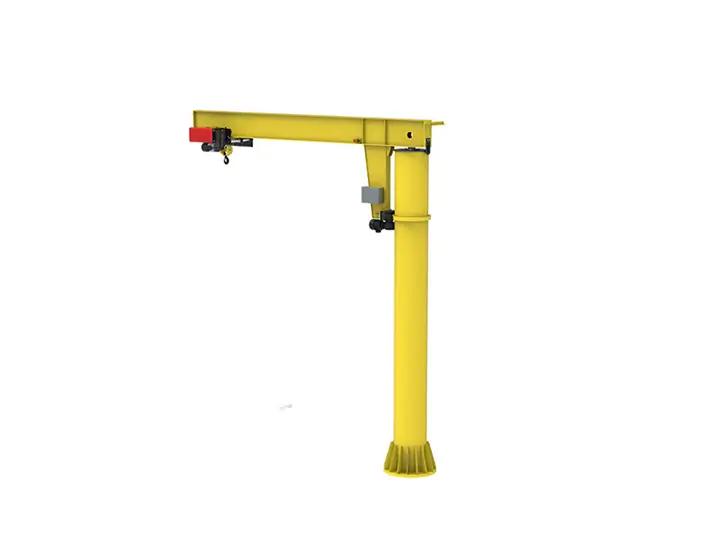
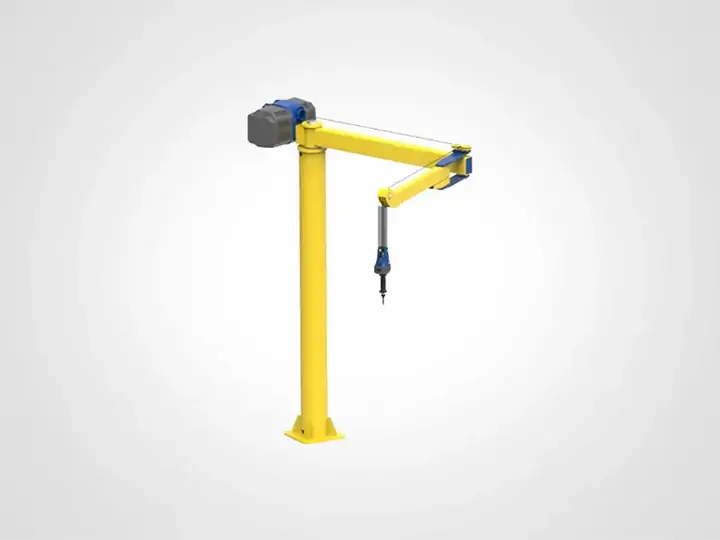
A pillar jib crane is a free-standing unit anchored directly to the floor via a reinforced concrete foundation. The jib arm rotates around a central steel column. This design provides a slew range of up to 360°, with jib arm lengths reaching up to 10 meters and safe working loads of up to 6.3 tonnes.
Because it doesn’t depend on any existing wall or building structure, it can be installed virtually anywhere on the shop floor. This independence makes it highly flexible for central workstations, assembly lines, and open warehouse bays.
Wall Mounted Jib Crane
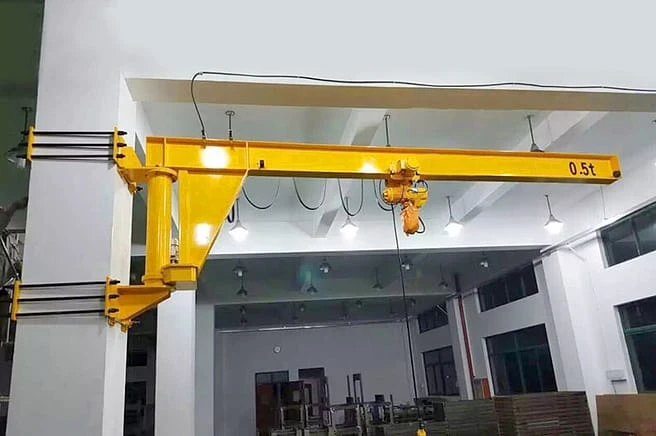

A wall mounted jib crane is bolted to an existing load-bearing wall, structural column, or piece of machinery. It doesn’t require a dedicated floor foundation. A major advantage is that it requires no floor space, and it comes with a ready-to-fit bracket that eliminates complicated alignment work.
The trade-off is rotation. Most wall mounted models rotate between 180° and 270°, which is sufficient for workstations positioned along walls or production lines — but not for work requiring full circular coverage.
Head-to-Head Comparison
Here’s a quick overview of how the two types stack up across the factors that matter most to buyers:
| Factor | Pillar Jib Crane | Wall Mounted Jib Crane |
|---|---|---|
| Installation base | Floor foundation | Wall / column / structure |
| Rotation range | Up to 360° | Typically 180°–270° |
| Floor space used | Requires footprint for column | Zero floor space |
| Max load capacity | Up to 10 tonnes | Typically up to 2–5 tonnes |
| Jib arm length | Up to 10–12 m | Up to 8 m |
| Installation complexity | Higher (foundation required) | Lower (bracket-based) |
| Flexibility of placement | Very high (anywhere on floor) | Limited to wall/column location |
| Best for | Central work areas, open bays | Wall-aligned stations, tight spaces |
Key Differences in Detail
Rotation Range and Working Coverage
This is often the deciding factor. Pillar mounted jib cranes are free-standing and can be installed anywhere there is enough space for the pillar, while wall-mounted jib cranes are attached to a wall or existing structure, which limits their range based on wall position.
If your operators need to swing loads across a full workstation or rotate materials from one machine to another on multiple sides, a pillar crane gives you that freedom. Wall mounted cranes work well for tasks that stay within a half-circle — think loading/unloading a single machine, feeding parts to an assembly bench, or moving materials along one side of a production line.
Load Capacity
Wall mounted jib cranes are comparatively cost-effective for light to medium loads, typically up to 2–5 tonnes, while floor-mounted pillar cranes handle heavier loads and offer more extensive coverage.
For most light manufacturing, maintenance, and assembly applications, wall mounted cranes handle the load comfortably. If you’re regularly lifting heavier components — castings, engine blocks, fabricated steel parts — a pillar crane gives you more headroom on capacity.
Installation Requirements
Wall mounted cranes are simpler to install, but they come with a critical prerequisite: the supporting wall or column must be structurally capable of bearing the jib crane’s load. Installation requires a structural integrity assessment to verify the supporting structure’s load-bearing capacity, along with precise engineering load calculations and a check on vertical clearance for safe operation.
Pillar cranes require a proper concrete foundation, which adds time and cost upfront. However, once installed, they are completely independent — no concerns about wall strength, building structure, or future renovations affecting the jib crane’s mounting point. Slab thickness, concrete strength grade, and anchor bolt torque specs for that foundation work all vary by capacity — the full breakdown by load range is covered in this jib crane installation guide.
Space Efficiency
Wall mounted jib cranes do not need an independent column, using brackets fixed to the structure instead — this maximizes vertical space and reduces floor occupation.
In workshops where every square meter counts, this is a significant advantage. Pillar cranes take up floor space for the column base and foundation, which can interfere with forklift paths, pallet zones, or equipment layouts if not planned carefully.
Which One Should You Choose?
Use this as a practical decision guide based on your actual site conditions:
Choose a Pillar Jib Crane if:
- You need full 360° rotation to cover a complete workstation
- jib crane will be positioned away from walls, in the center of a bay or open floor area
- You need higher load capacities (above 3–5 tonnes)
- The building walls or columns cannot support the additional load
- You want flexibility to serve multiple machines or work positions from jib crane
Choose a Wall Mounted Jib Crane if:
- Floor space is limited and every square meter matters
- The work happens along a wall, near a machine line, or at a fixed bench
- 180°–270° rotation is sufficient for your workflow
- The existing wall or structural column has been confirmed to support the load
- You need a faster, lower-cost installation with minimal civil work
If your production line is long and a single fixed crane doesn’t provide enough reach, traveling wall jib cranes can rotate and move along wall rails, achieving three-dimensional coverage across a larger area. This is worth exploring if you need wall-mounted simplicity with extended linear reach.

Alan
Crane Solutions Specialist · Voitto Crane
Specialized in Overhead Crane, Gantry Crane, Jib Crane, Port Crane & EOT Crane export solutions. 10+ years helping global clients with pre-sales consultation, capacity selection and site-specific configurations.
Compliance and Safety Standards
Regardless of which type you choose, jib crane should comply with recognized international standards. Look for:
- ISO 9927 – Inspection of cranes
- FEM 1.001 – Rules for the design of hoisting appliances
- CE Marking – Required for cranes sold and used in the European market
- ASME B30.12 – Handling loads below the hook (relevant for US buyers)
Always request documentation confirming the jib crane has been load-tested and certified before delivery. A reputable supplier will provide this as standard.
Conclusion
Both pillar jib cranes and wall mounted jib cranes are reliable, proven solutions — the right choice depends entirely on your workspace layout, load requirements, and installation conditions.
Pillar cranes offer more flexibility, greater coverage, and higher capacity. Wall mounted cranes save floor space, install faster, and cost less upfront. Neither is universally better. The best crane is the one that fits your specific operation without compromise.
Before making a final decision, walk your floor with a tape measure. Note where the work actually happens, where loads need to travel, and what your walls or columns can structurally support. That site assessment will give you a clearer answer than any spec sheet.
If you’re still unsure, ask your supplier for a layout review. A good crane supplier will assess your floor plan and recommend the right type, span, and capacity before you commit.
Frequently Asked Questions
Can a wall mounted jib crane rotate 360°?
Most wall mounted jib cranes rotate between 180° and 270°. Full 360° rotation is generally not possible because the wall or column mounting limits the swing arc. If full rotation is essential for your operation, a pillar jib crane or a free-standing floor-mounted model is a better fit.
How much foundation work does a pillar jib crane need?
A pillar jib crane requires a reinforced concrete foundation, typically specified by the crane manufacturer based on load capacity and soil conditions. Foundation depth and dimensions vary, but this work adds to both installation time and upfront cost. Your supplier should provide detailed foundation drawings as part of the order.
What is the typical load capacity for a wall mounted jib crane?
Wall mounted jib cranes are most commonly used for loads up to 2–5 tonnes, depending on the structural integrity of the supporting wall or column. Some heavy-duty models can handle more, but a structural engineering assessment is required before installation to confirm the wall can safely bear the load.
Can I install a wall mounted jib crane on any wall?
No. The wall or column must be load-bearing and structurally capable of supporting the crane’s weight plus the rated lifting load. Partition walls, lightweight steel frames, or older masonry structures may not qualify. Always get a professional structural assessment before purchasing.
Which type is easier to relocate if my facility layout changes?
Wall mounted jib cranes are generally easier to remove and reinstall, since they use a bracket-based mounting system rather than a buried foundation. Pillar cranes involve more civil work to relocate. If flexibility for future moves matters to you, factor this into your decision alongside the operational requirements.


 English
  Español
  Português
  العربية
  Français
  Русский