For most buyers, one of the first questions before purchasing is simple: how much does a jib crane cost? The answer depends on far more than the crane type alone. Load capacity, boom length, installation method, hoist configuration, and site conditions all directly affect the final quotation. In real industrial projects, the total cost often includes not only the crane unit, but also foundation work, electrical wiring, load testing, and freight. This guide breaks down typical price ranges and the key factors that influence total project cost, helping buyers plan a more accurate budget before requesting quotes.
Average Jib Crane Price Range by Type
Jib crane pricing varies significantly depending on the installation type, load capacity, boom length, and structural design. For most buyers, understanding the average price range by crane type is the fastest way to estimate project budget before requesting a formal quotation. In general, wall-mounted and articulating jib cranes offer a lower entry cost, while floor-mounted and heavy-duty custom models require a higher investment due to larger steel structures and foundation requirements. The table below provides a practical price reference based on common market configurations and typical industrial applications.
Jib Crane Type
Capacity Range
Typical Price Range (USD)
Wall Mounted Jib Crane
0.25–2 ton
$950–$3,500
Portable Jib Crane
0.25–1 ton
$2,000–$6,000
Floor Mounted Jib Crane
0.5–5 ton
$8,000–$20,000
Articulating Jib Crane
0.125–2 ton
$1,500–$4,200
Heavy Duty Custom Jib Crane
3–10 ton
$15,000–$50,000+
Wall-mounted jib cranes are usually the most cost-effective option for light-duty lifting tasks and workshops with limited floor space. Portable jib cranes offer flexibility and mobility, making them suitable for changing workstations and maintenance areas. Floor-mounted jib cranes are widely used in heavy-duty workshops, fabrication plants, and warehouses where higher load capacity and full rotation are required. Articulating jib cranes are commonly chosen for confined work areas where precise positioning is needed. For large-scale industrial applications, heavy-duty custom jib cranes with capacities above 3 ton often involve customized boom lengths, special hoists, and reinforced foundations, which significantly increase total project cost.
As a practical reference, 1 ton and 2 ton models are the most commonly quoted configurations, as they cover most workshop and machine-handling requirements.
What Factors Affect Jib Crane Cost?
The cost of a jib crane is influenced by several technical and project-related factors, not just the equipment type alone. In actual procurement projects, the final quotation usually depends on load capacity, boom length, installation method, hoist configuration, and site conditions. Understanding these key cost drivers helps buyers build a realistic budget and compare supplier quotations more effectively. In most cases, differences in specifications can change the total price by 20%–50% or more. Key factors that affect cost include:
Site conditions and installation scope Freight, foundation work, electrical wiring, and load testing can add another 20%–50% to the final installed cost.
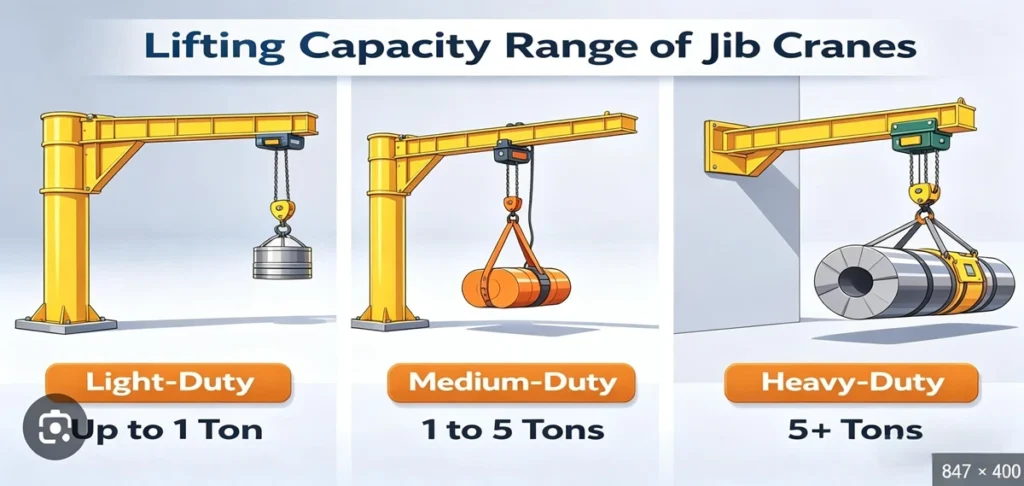
Load capacity Higher capacities require heavier steel structures and stronger support systems. For example, a 1 ton jib crane typically costs $2,500–$8,000, while a 5 ton model may exceed $15,000.
Boom length and working radius Longer boom lengths increase material usage and bending moment. A 5–6 m boom is often 20%–40% more expensive than a standard 3 m configuration.
Installation type Wall-mounted models usually have a lower initial cost, while floor-mounted jib cranes require concrete foundations and installation labor, increasing the total project budget.
Hoist and control system Manual hoists are more economical, while electric chain hoists, wire rope hoists, and remote control systems can add $500–$2,000+ to the quotation.
Equipment Cost vs Installed Cost
When evaluating jib crane pricing, it is important to distinguish between equipment cost and total installed cost. Many buyers initially focus only on the crane unit price, but in actual projects, the final budget is often significantly higher. Simply put, total project cost ≠ crane price only. Besides the equipment itself, installation-related expenses such as freight, foundation work, electrical setup, labor, and load testing can add a substantial amount to the overall investment.
Equipment cost usually refers to the crane body and standard accessories, such as the boom, mast, rotation mechanism, and sometimes the hoist. For example, a 1 ton wall-mounted jib crane may be quoted at $2,500–$4,000, while a 1 ton floor-mounted model may range from $5,000–$8,000 depending on boom length and hoist type.
Installed cost includes all project-related expenses required to put the crane into safe operation.
Typical cost breakdown:
Cost Item
Typical Range (USD)
Crane equipment
$3,000–$8,000
Freight / shipping
$300–$1,500
Concrete foundation
$1,000–$5,000
Electrical wiring
$300–$1,000
Installation labor
$800–$3,000
Load testing
$300–$800
As a practical example, a jib crane quoted at $6,000 may reach a final installed cost of $8,500–$12,000, depending on site conditions and local labor rates.
How to Budget Before Requesting a Quote?
Before requesting a jib crane quotation, it is important to prepare complete and accurate project information. In engineering practice, unclear requirements are one of the main reasons for large price variations between suppliers. A well-prepared brief not only helps receive faster quotations but also ensures the solution matches real working conditions. From an engineering perspective, budgeting should focus on actual lifting requirements rather than only equipment price.
To prepare a proper budget, the following key parameters should be clearly defined:
Load capacity Define the maximum lifting weight, including workpiece, fixture, and hoist. For example, a 750 kg load often requires a 1-ton crane selection margin for safe operation.
Boom length The working radius directly affects structural cost. A 5 m boom can increase material and structural cost by 20%–40% compared to a 3 m standard boom.
Lifting height Determine the required hook travel height. Higher lifting height may require a taller mast or modified column design, increasing steel usage and cost.
Duty cycle (usage frequency) Low-frequency use (a few lifts per day) and high-frequency production use (50+ cycles per shift) require different structural and hoist configurations.
Indoor or outdoor use Outdoor cranes require additional surface treatment such as hot-dip galvanizing or corrosion-resistant coating, which increases cost.
Installation photos or layout drawings Site images or CAD layouts help engineers confirm space constraints, structural anchoring points, and rotation clearance before quotation.
Floor or wall structure condition The supporting structure is critical. A 150–200 mm reinforced concrete floor is typically required for light to medium-duty systems, while wall-mounted cranes require verified load-bearing columns or structural beams.
From a practical engineering standpoint, providing these details allows suppliers to design a more accurate and safer solution while avoiding cost deviations during installation. In most real projects, complete technical information can reduce quotation variance by 15%–30%, making the budgeting process more efficient and predictable.
Which Type Offers the Best Value?
Choosing the best-value jib crane is not about selecting the lowest price, but about matching the crane type with the actual working environment. In real engineering projects, “value” is determined by installation cost, lifting efficiency, space conditions, and long-term maintenance needs. A well-matched crane type can reduce unnecessary investment while improving daily operation efficiency. Below is a practical breakdown of common jib crane types based on different application scenarios.
Best for low budget – Wall-mounted jib crane
Wall-mounted jib cranes are generally the most cost-effective solution when a suitable structural wall is available. They do not require floor foundations, which significantly reduces installation cost.
Capacity range: 250 kg – 2 ton
Price range: $950 – $3,500
Low installation cost (no concrete base required)
They are widely used in maintenance workshops and light assembly areas. However, they require a reinforced concrete wall or steel column, which limits application flexibility.
Best for flexible workspace – Portable jib crane
Portable jib cranes are designed for mobility and changing workstations. They are commonly used in maintenance zones, small factories, and multi-location lifting tasks.
Capacity range: 250 kg – 1 ton
Price range: $2,000 – $6,000
No permanent installation required
They provide high flexibility, especially in workshops where lifting points change frequently. The trade-off is a slightly higher unit cost and lower maximum capacity compared to fixed systems.
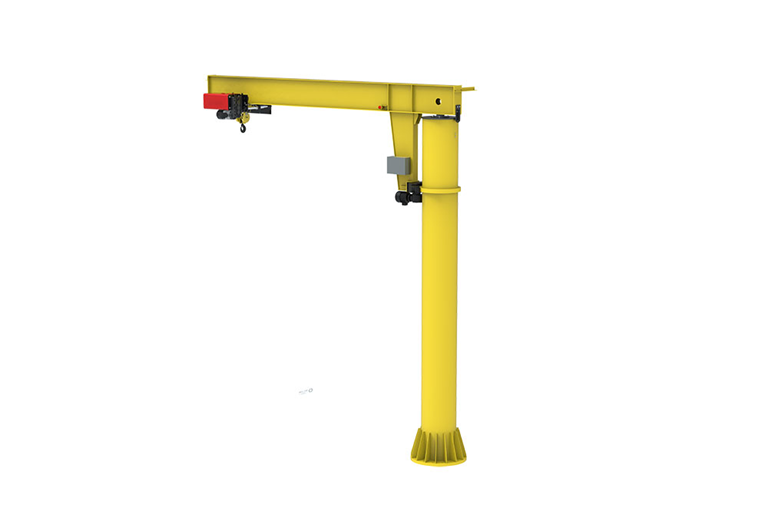
Portable Jib Crane
Best for heavy-duty use – Floor-mounted jib crane
Floor-mounted jib cranes are the most widely used solution in industrial environments requiring stable, high-capacity lifting.
Capacity range: 0.5 ton – 5 ton
Price range: $8,000 – $20,000+
Requires reinforced concrete foundation (typically 150–300 mm slab depending on load)
They offer full 360° rotation and strong structural stability, making them suitable for machining, fabrication, and warehouse loading operations. Although installation cost is higher, they provide the best long-term durability and lifting performance.
Best for confined spaces – Articulating jib crane
Articulating jib cranes are designed for areas with limited space or obstacles where standard boom rotation is restricted.
Capacity range: 125 kg – 2 ton
Price range: $1,500 – $4,200
Dual-arm structure for flexible positioning
They are commonly used around machines, production lines, and assembly stations where precise load positioning is required. Their key advantage is maneuverability in tight or obstructed work areas.
In summary, the best-value jib crane depends entirely on application conditions. Wall-mounted systems offer the lowest entry cost, portable models provide maximum flexibility, floor-mounted cranes deliver the highest stability and capacity, while articulating designs solve space limitation challenges. In engineering practice, selecting the correct type based on working conditions delivers far greater long-term value than focusing only on initial purchase price.
Conclusion
Understanding jib crane pricing requires looking beyond the unit cost alone. Capacity, boom length, hoist type, installation method, and site conditions all contribute to the final budget. In most projects, the total installed cost is often 20%–50% higher than the equipment price itself. For buyers planning a new lifting system, preparing complete project details in advance helps ensure accurate quotations and better cost control. If you need a project-based estimate, our team can help recommend the most suitable solution and provide fast pricing support.
Specialized in Overhead Crane, Gantry Crane, Jib Crane, Port Crane & EOT Crane export solutions. 10+ years helping global clients with pre-sales consultation, capacity selection and site-specific configurations.
A jib crane typically costs between $950 and $20,000+, depending on type, capacity, and installation. Wall-mounted models are the lowest cost, while floor-mounted heavy-duty systems require a higher investment.
Why do jib crane prices vary so much?
Prices vary due to load capacity, boom length, structure type, hoist system, and installation requirements. A 1-ton basic model can be a few thousand dollars, while customized heavy-duty systems cost significantly more.
Does the installation cost include the jib crane price?
Usually not. Most suppliers quote equipment only. Installation, foundation work, electrical wiring, and load testing may add 20%–50% to the total project cost, depending on site conditions.
How much is a 1-ton jib crane?
A standard 1-ton jib crane typically ranges from $2,500 to $8,000. Final price depends on structure type (wall or floor mounted), boom length, and hoist configuration.
Which jib crane type is the cheapest?
Wall-mounted jib cranes are generally the most affordable, starting from around $950. They require no floor foundation, which helps reduce the total installation cost significantly.
What is the hidden cost of a jib crane?
Hidden costs may include freight, foundation construction, electrical installation, and load testing. These can increase the total budget by 20%–50% beyond the equipment price.






 English
  Español
  Português
  العربية
  Français
  Русский