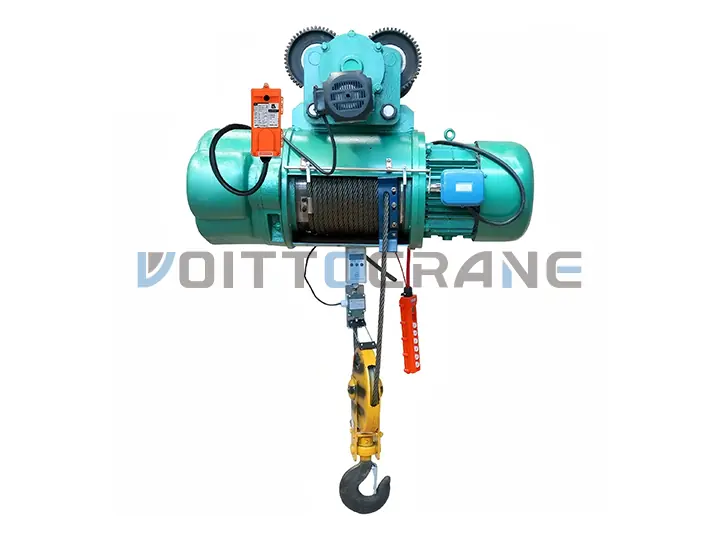
A heavy-duty electric winch is a lifting device driven by an electric motor, primarily used for lifting, pulling, or moving heavy objects. Typically, electric winches have a lifting capacity ranging from 0.5 to 100 tons.
A heavy duty electric winch is a lifting and pulling device rated for loads between 1 and 100 tons, with rope capacity up to 5,000 m and working speeds of 5–35 m/min. Designed for duty classes M3–M7 per FEM 1.001, it serves steel metallurgy, port logistics, and power grid construction. All units are CE (2006/42/EC), ISO 9001:2015, and EAC certified.
What Is an Electric Winch?
An electric winch is a mechanical device that uses an electric motor to wind or unwind a wire rope drum, converting electrical energy into a controlled lifting or pulling force. Unlike manual or hydraulic alternatives, it enables precise load positioning over rope lengths reaching 5,000 m, with no hydraulic fluid maintenance. Typically, users employ an electric winch to perform lifting and traction tasks during light-to-moderate load operations in standard environments. This equipment is easy to install and simple to operate, making it particularly suitable for work environments that do not require prolonged, continuous heavy-duty operation.
Types of Heavy Duty Electric Winch
A Winches electric is available in four principal configurations, each engineered for a specific rope-load geometry and installation envelope. Electric winch can be classified into single-speed and dual-speed models based on their control methods, and further categorized into friction-type and Variable-Speed-type models based on their transmission structures.
Single-Drum Winch: Standard single-layer rope drum, with a lifting capacity of 1–32 tons. Users apply it in industrial lifting applications utilizing a single-reeving configuration.
Double-Drum Winch: Two independent drums share a single gearbox, enabling the equipment to perform synchronized dual-hook operations. The device has a load-bearing capacity of up to 100 tons.
Friction Winch: Lebus-grooved friction drum for ultra-long rope runs exceeding 2,000 m. Users widely apply it in the fields of deep-well mining and offshore mooring.
Variable-Speed Winch: Inverter-controlled motor delivers stepless speed adjustment from creep (0.3 m/min) to full speed (35 m/min) under A7 duty class. Widely applied in hoisting and lifting operations, factory production lines, port handling, and precision control scenarios.
What Are the Key Features of a Heavy Duty Electric Winch?
Each electrical winch unit incorporates six meticulously designed technical features.
High-Capacity Wire Rope Drum: This grooved steel drum is equipped with an automatic rope-laying mechanism that effectively eliminates wear caused by wire rope cross-twisting.
Heavy-Duty Gear Reducer: Features a hardened-tooth spiral bevel gearbox—manufactured in strict accordance with ISO 6336 gear strength standards—delivering a transmission efficiency of over 95%.
Dual Electromagnetic Braking System: Equipped with two independent drum-type disc brakes, each meeting the braking torque requirements of FEM 1.001, ensuring fail-safe load-holding capability.
Variable Frequency Drive (VFD): The standard VFD control system provides soft-start torque of up to 150% of the rated current, thereby eliminating mechanical shock to the wire rope and hook.
Overload Limiter and Travel Limit Switches: Electronic load cells or torque-based overload limiters strictly adhere to the EN 13135 standard, triggering protective action when the load reaches 110% of the Safe Working Load (SWL).
High adaptability: Both the motor and control cabinet feature an IP55 protection rating (in accordance with IEC 60529), enabling deployment in outdoor and coastal environments where salt fog or fine particulate contamination is present.
Which Industries Can Apply an Electric Winch?
The application scenarios for electric winches are extensive. Moreover, each specific field imposes distinct requirements regarding operational cycle frequency and environmental conditions.
Steel Metallurgy — ladle transfer, furnace charging up to 100 t
Port & Shipping Logistics — container and bulk cargo hoisting
Power Grid Construction — transformer installation and tower erection
Underground Mining — skip hoisting and man-riding systems
Hydropower & Dam — gate-lifting winches per SL 381 standard
Offshore Oil & Gas — mooring and subsea equipment deployment
Forestry & Timber — log yarder and skyline cable systems
Civil & Bridge Construction — cable tensioning, formwork hoisting
Specifications
The table below lists the standard specifications for our electric winches. Please contact us for custom configurations outside of the ranges listed above.
Parameter
Range / Value
Standard Reference
Lifting Capacity
1 – 100 ton (SWL)
FEM 1.001 / ISO 4301-1
Rope Capacity
20 – 5,000 m
ISO 2408 wire rope
Working Speed
5 – 35 m/min
FEM 1.001 Section 3
Working Grade (Duty Class)
M3-M7
FEM 1.001 / ISO 4301-1
Hoisting Mechanism
Crane Trolley
ISO 22986 / EN 15011
Motor Insulation Class
Class F (155 °C), IP55
IEC 60034 / IEC 60529
Brake Safety Factor
≥ 1.75 × rated load moment
FEM 1.001 / EN 13135
Power Supply
380–660 V, 50/60 Hz, 3-phase
IEC 60038
Ambient Temperature
−20 °C to +50 °C
ISO 4306-1
Certification
CE / ISO / EAC
2006/42/EC · ISO 9001:2015 · TR CU 010/2011
Customized Electric Winch
VOITTO is a leading enterprise specializing in the customized design and manufacturing of heavy-duty electric winches. It can be designed according to your specific needs, such as a particular working environment, load requirements, power type, lifting height, etc.
Electric Winch Suppliers and Manufacturers
As a manufacturer and supplier of electric winches, VOITTO manages every stage of production—from steel plate cutting and gear hobbing to motor winding and final load testing—within its 45,000-square-meter facility. As a result, we are able to achieve delivery times of 15 to 45 days without relying on third-party suppliers.
For detailed technical specifications or industry-specific solutions, please feel free to contact us.
FAQ
What determines the correct duty class (M5, M6, or M7) for an electric winch?
Duty class is determined by two factors per FEM 1.001: total design working life in hours (from 3,200 h for A5 to over 12,500 h for A7) and the load spectrum coefficient.
Can a VOITTO electric winch be integrated into an existing overhead crane trolley?
Yes. VOITTO winch units are engineered to ISO 22986 dimensional interfaces, allowing direct retrofit onto most standard crane trolleys. The control system interfaces via CANopen or Modbus RTU to existing PLC systems, reducing integration time. However, a structural load-path review of the existing trolley frame is recommended before installation.
Is variable-frequency drive (VFD) control standard on all electric winch models?
VFD control is standard on all A6 and A7 duty-class units and is optional on A5 models.
Qualification and Honor
Engineered Strength, Global Crane Supplier
service
Exclusive and Considerable, Customer First.
01
Reliable and Customized Solutions
Our pre-sale team provides consultations, tailoring solutions to your needs and environment.
Offer customization options for lifting capacity, span and lifting height etc. to meet specific needs.
02
Updated Production Process
Real-Time Progress Updates: Weekly reports and PM communication.
3-5 years warranty and free replacement for non-manufacturing defects.
24/7 online support and on-site assistance for crane issues.
FAQ
Engineered Strength, Global Crane Supplier
What’s included in your after-sales service?
We offer comprehensive after-sales service, including regular maintenance, rapid technical support, and spare parts supply. The standard warranty period is 1 year, with options for extension based on your needs.
What’s the delivery time for an overseas order?
Transit time varies depending on many factors, including the destination of the goods, distance, shipping method and shipping service provider, etc. Generally speaking, international shipping may take about a month.
Can it be customized?
Yes, lifting capacity, span, height, structure type, and hoist options can be customized to match specific working conditions.
Do you ship internationally?
Yes, international shipping and export support are available for global customers.
Get In Touch
Please feel free to leave a message. We will reply in 24 hours.
Please specify your requirement by referring to the following aspects:
Which crane product do you need?
What is the maximum lifting capacity (in tons) required for your project?
Could you specify the lifting height (in meters) needed?
Can you provide details on the working environment, such as ground conditions, space limitations, and any obstacles?
What is the expected frequency of use and the duration of the project?



 English
  Español
  Português
  العربية
  Français
  Русский