
Choosing the wrong hoist for a job can slow down your operation, create safety risks, and waste budget. If you’ve been comparing a lever chain hoist and a hand chain hoist, you’re already asking the right question — because these two tools look similar but serve very different purposes. This article gives you a clear breakdown: what each hoist does best, where they fall short, and how to match the right tool to your specific application.
- 1 What Is a Lever Chain Hoist?
- 2 What Is a Hand Chain Hoist?
- 3 Lever Hoist vs Hand Chain Hoist: A Direct Comparison
- 4 How to Choose Between a Lever Hoist and a Chain Hoist
- 5 Safety and Compliance Considerations
- 6 Summary and Buying Guidance
-
7
FAQ
- 7.1 Q1: Can a lever chain hoist be used for horizontal pulling?
- 7.2 Q2: What is the difference between a lever hoist and a chain hoist in terms of maintenance?
- 7.3 Q3: Is a mini lever chain hoist suitable for professional lifting work?
- 7.4 Q4: How do I know if my hoist meets current safety standards?
- 7.5 Q5: Can a hand chain hoist be used outdoors?
What Is a Lever Chain Hoist?

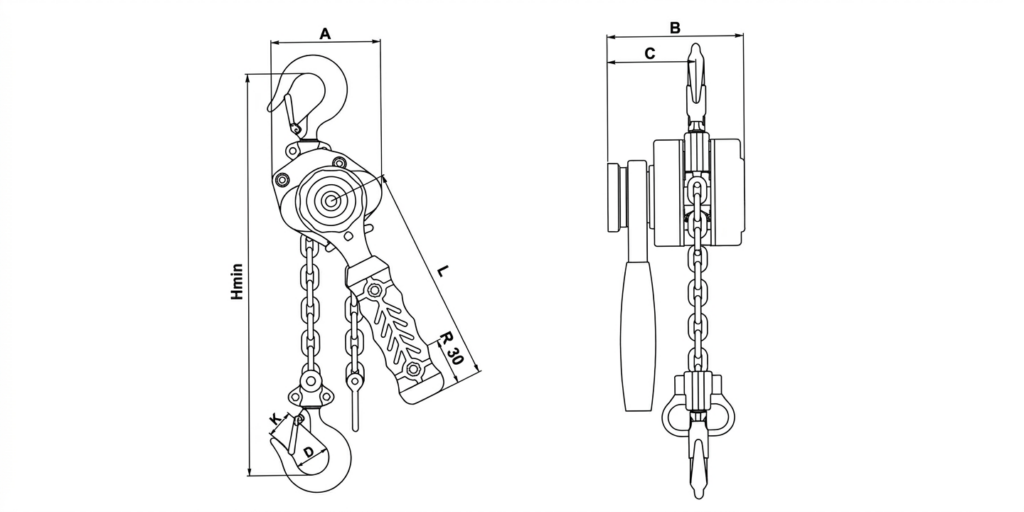
A lever chain hoist (also called a lever block chain hoist or hoist lever chain) uses a short operating lever to apply mechanical force through a ratchet mechanism. The operator pumps the lever back and forth to lift, lower, or pull a load.
How It Works
The lever feeds into a gear system that multiplies the input force. This allows the user to move heavy loads with relatively little physical effort. Most models also allow load positioning in any direction — not just straight up — which makes them highly versatile on job sites.
Key Technical Characteristics
- Lifting capacity: Typically 0.25 to 9 tonnes for standard models
- Chain type: Short, linked load chain with precise travel per stroke
- Operation: One-hand capable in many configurations
- Compliance: Should meet ISO 16625 and CE marking requirements for lifting equipment
Ideal Use Cases for a Manual Lever Chain Hoist
A manual lever chain hoist excels in situations where:
- Space is confined (low headroom, tight angles)
- The load needs to be pulled horizontally or at an angle
- Precise, incremental load positioning is required
- The hoist must be compact and portable for field use
Typical applications include rigging on construction sites, tensioning during pipeline installation, maintenance work in engine bays, and load securing in fabrication shops.
What Is a Hand Chain Hoist?


A hand chain hoist uses an endless loop hand chain to drive a lifting mechanism. The operator pulls the chain continuously in one direction to raise a load, and in the opposite direction to lower it.
How It Works
Pulling the hand chain rotates a drive wheel connected to a gear reduction system. This system transfers force to the load chain, which lifts the hook and attached load. The design is straightforward and reliable for vertical lifting tasks.
Key Technical Characteristics
- Lifting capacity: Commonly 0.5 to 20 tonnes, with heavy-duty models exceeding this
- Chain travel: Unlimited vertical travel (limited only by chain length)
- Operation: Requires two hands and sufficient headroom
- Compliance: Should conform to ISO 16625 and applicable CE safety standards
Ideal Use Cases for a Hand Chain Hoist
A hand chain hoist (sometimes compared as chain hoist vs lever hoist) works best when:
- Loads need to be lifted vertically over a consistent, repeatable path
- Longer lift heights are required
- A fixed overhead beam or trolley is available
- Speed of lifting is more important than precise incremental control
Common settings include warehouses, manufacturing floors, maintenance bays with fixed gantry systems, and anywhere with consistent vertical lifting needs.
Lever Hoist vs Hand Chain Hoist: A Direct Comparison
| Feature | Lever Chain Hoist | Hand Chain Hoist |
|---|---|---|
| Operation Direction | Vertical, horizontal, angular | Primarily vertical |
| Load Control | Incremental, precise | Continuous pull |
| Headroom Required | Minimal | Moderate to significant |
| Lift Height | Limited by chain length | Longer ranges available |
| Portability | High – compact and lightweight | Medium – fixed to overhead point |
| Typical Capacity Range | 0.25 – 9 tonnes | 0.5 – 20+ tonnes |
| Best Environment | Field work, confined spaces | Fixed workshop, warehouse |
| CE / ISO Compliance | Required | Required |
This table reflects general industry benchmarks. Always verify specifications with your supplier against your specific application requirements.
How to Choose Between a Lever Hoist and a Chain Hoist
Evaluate Your Lifting Direction
If your work requires pulling loads sideways, tensioning cables, or lifting at an angle, a lever hoist vs chain hoist comparison will consistently favour the lever block chain hoist. Hand chain hoists are designed for vertical operation and are not suitable for horizontal pulling.
Consider Your Working Environment
In confined spaces — think ship engine rooms, structural steel frames, or underground utilities — a mini lever chain hoist is often the only practical option. It requires minimal overhead clearance and can be operated in awkward positions. A hand chain hoist requires a clear vertical path and usually a fixed beam or trolley system.
Assess Required Lift Height
For jobs requiring the load to travel a significant vertical distance repeatedly, a hand chain hoist with an extended load chain tends to be more efficient. Lever hoists are better suited to shorter travel distances where fine control matters more than speed.
Factor In Your Frequency of Use
For repetitive, high-volume lifting in a controlled environment, a hand chain hoist offers better operator efficiency over long shifts. For intermittent use on varied tasks and locations, the portability of a lever chain hoist gives it the edge.

Alan
Crane Solutions Specialist · Voitto Crane
Specialized in Overhead Crane, Gantry Crane, Jib Crane, Port Crane & EOT Crane export solutions. 10+ years helping global clients with pre-sales consultation, capacity selection and site-specific configurations.
Safety and Compliance Considerations
Both hoist types should comply with relevant standards before use on any worksite. In most markets, this means:
- CE marking (required for equipment sold in the EU/UK market)
- ISO 16625 for chain hoists and lever hoists
- ASME B30.21 for lever hoists used in North American applications
- Regular inspection intervals as defined by the manufacturer and local regulations
Never exceed the rated Working Load Limit (WLL) marked on the hoist. Overloading — even briefly — can cause irreversible internal damage that is not always visible externally. This applies equally to both lever and hand chain hoists.
Summary and Buying Guidance
Both the lever chain hoist and the hand chain hoist are proven, reliable tools — the right choice depends on your specific job conditions.
Choose a lever chain hoist (lever block chain hoist) when:
- You work in confined or low-headroom environments
- You need to pull loads at angles or horizontally
- Portability and compact size are priorities
- You require incremental, fine load positioning
Choose a hand chain hoist when:
- You need vertical lifting with longer travel heights
- You have a fixed overhead structure to work from
- Lifting is repetitive and high-frequency
- Higher capacity (10+ tonnes) is required
Before purchasing, cross-check the rated capacity, chain grade, compliance certifications, and supplier’s inspection and maintenance documentation. Reputable suppliers will provide full CE declarations of conformity and traceability for load-bearing components.
FAQ
Q1: Can a lever chain hoist be used for horizontal pulling?
Yes — this is one of the primary advantages of a lever chain hoist over a hand chain hoist. The ratchet-and-lever mechanism allows it to apply controlled tension in any direction, making it suitable for cable tensioning, load dragging, and angular rigging. Always ensure the anchor point is rated for the load direction and magnitude being applied.
Q2: What is the difference between a lever hoist and a chain hoist in terms of maintenance?
Both require periodic inspection of the load chain, hook latch, brake system, and housing. Lever hoists have more mechanical components in the ratchet and pawl system, which may need more frequent lubrication in harsh environments. Hand chain hoists should be checked for hand chain wear and drive wheel condition. Always follow the manufacturer’s maintenance schedule — most recommend a detailed inspection every 12 months or after any overload event.
Q3: Is a mini lever chain hoist suitable for professional lifting work?
A mini lever chain hoist is appropriate for professional use as long as its Working Load Limit (WLL) matches the application and the unit carries valid CE marking or equivalent certification. These compact models are widely used in automotive, utilities, and construction trades. They are not suitable as a substitute for a higher-capacity hoist when loads exceed their rated limit.
Q4: How do I know if my hoist meets current safety standards?
Look for CE marking on the hoist body, a rated WLL clearly stamped or labelled, and a declaration of conformity document from the manufacturer. For ISO 16625 compliance, the supplier should be able to provide test certification for the chain and hook components. If purchasing secondhand equipment, have it inspected by a qualified rigger or competent person before use.
Q5: Can a hand chain hoist be used outdoors?
Most standard hand chain hoists are designed for indoor or sheltered use. Extended outdoor use — particularly in wet, corrosive, or dusty environments — can accelerate wear and affect brake performance. If outdoor use is required, look for models with stainless steel or galvanised components and check whether the manufacturer’s IP rating (if provided) is suitable for your conditions.


 English
  Español
  Português
  العربية
  Français
  Русский