
For most manufacturing plants, the fastest way to narrow down crane options is to work backward from what’s happening on the line — not from a catalog of crane types. A single-girder overhead crane rated for 5–10 tons typically runs $8,000–$25,000, while a double-girder crane in the 20–50 ton range moves into $30,000–$120,000+ depending on span and duty class.
The harder problem isn’t the price — it’s that most buying guides list crane types and specs without connecting them to what’s actually happening at each stage of a production line, leaving procurement teams to guess whether a jib crane or an overhead system fits their assembly bay.
This guide flips that order. It matches cranes for manufacturing industry buyers to production line stages — raw material intake, assembly, machining, and packaging — then covers the parameters and certifications that actually affect your purchase decision.
- 1 Quick Reference: Cranes for Manufacturing Industry
- 2 Crane Types Built for Manufacturing Production Lines
- 3 Matching Crane Type to Your Production Line Stage
- 4 Selection Parameters That Actually Matter
- 5 Certification and Compliance for Manufacturing-Plant Cranes
- 6 Conclusion
-
7
FAQ
- 7.1 Q1: What type of crane is best for a small manufacturing workshop?
- 7.2 Q2: How much does an overhead crane for a manufacturing plant cost?
- 7.3 Q3: Do I need CE certification to import a crane for my factory?
- 7.4 Q4: What’s the difference between duty class and rated capacity?
- 7.5 Q5: Can one crane type cover an entire production line?
Quick Reference: Cranes for Manufacturing Industry
The table below compares the crane types most commonly used across manufacturing production lines, before we get into which one fits which stage of your process.
| Type de grue | Capacité typique | Meilleur pour | Reference Price |
|---|---|---|---|
| Pont roulant monopoutre | 1–32 tons | General workshop lifting, budget-conscious lines | $8,000–$25,000 |
| Pont roulant bipoutre | 5-800 tonnes | Heavy fabrication, large workpieces | $30,000–$120,000+ |
| Electric Suspension Crane | Light–medium loads | Low-headroom assembly, small parts | $3,000–$15,000 |
| Single/Double Girder Gantry Crane | 2–800 tons | Outdoor yards, no factory-column support | $10,000–$90,000+ |
| Grue à flèche | 0,25-5 tonnes | Localized, repetitive workstation lifts | $800–$6,000 |
| Electric Hoist (standalone) | 0.5–20 tons | Add-on lifting for existing structures | $500–$3,500 |
| Electromagnetic Overhead Crane | 5–64 tons | Steel plate/scrap handling in fabrication | $40,000+ |
Prices are market reference ranges based on typical Chinese-manufacturer export pricing; final cost depends on span, lifting height, duty class, and customization. Request a quote for your specific spec
Obtenir un devisCrane Types Built for Manufacturing Production Lines
Most cranes for manufacturing industry use fall into three structural families — overhead, gantry, and jib/suspension — and each one solves a different coverage problem rather than simply a different capacity range.
Overhead (Bridge) Cranes Cover Full-Bay Material Movement


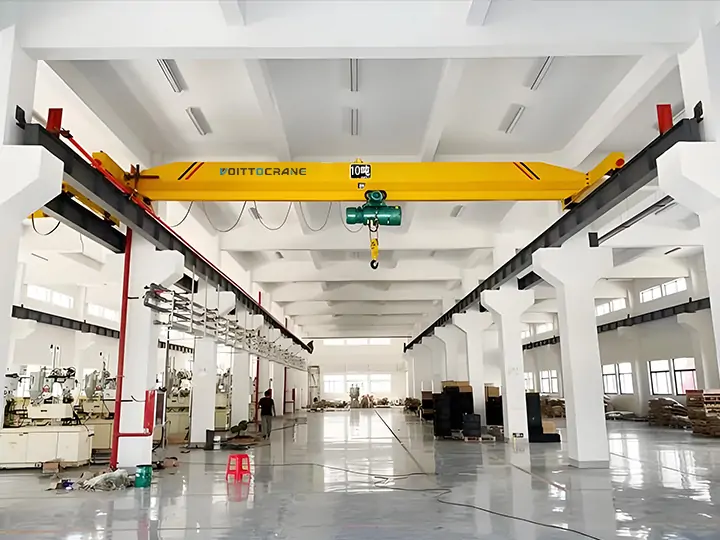
Ponts roulants are the default choice when a line needs to move material across the entire width of a bay rather than a fixed point. The reason is structural: the bridge rides on runway rails mounted to the building columns, so the working area is the full rectangle beneath the rails rather than a single radius. Single girder configurations (1–32 tons) suit lighter, budget-constrained lines — they’re less steel-intensive and cost roughly 30–40% less than an equivalent double girder unit. Double girder overhead cranes (5–800 tons) trade that cost advantage for load-sharing across two main beams, which is what makes them viable for heavy castings, forgings, or press-line feeding. The trade-off: double girder systems need more headroom and a stronger runway structure, so retrofitting one into an older building often costs more than the crane itself.
Gantry Cranes Skip the Building-Structure Dependency
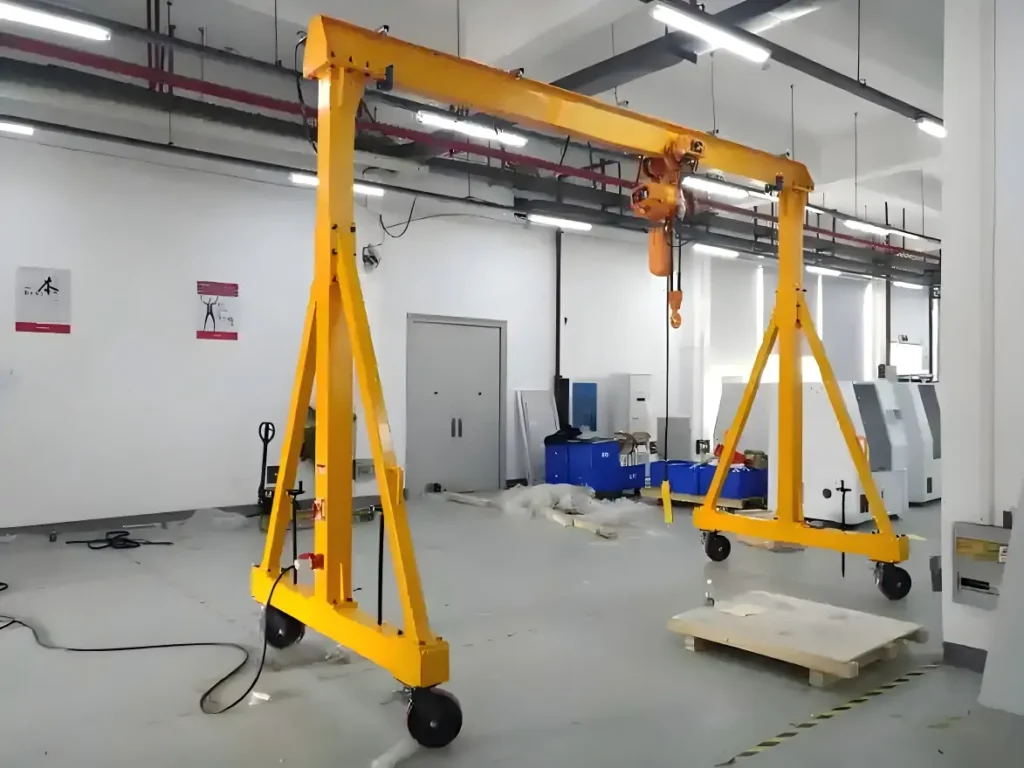
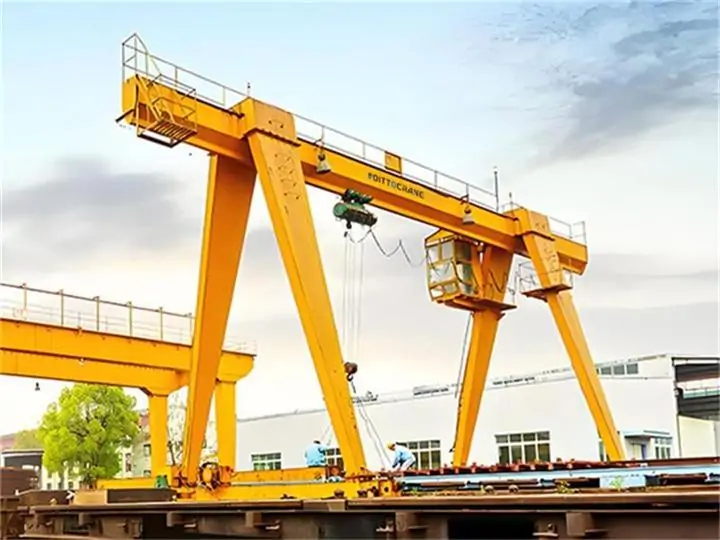

A gantry crane’s core value is that it doesn’t rely on the factory’s columns or roof structure — it stands on its own legs, running on ground rails or wheels. That matters most when a manufacturing plant needs lifting capability in an area where the building wasn’t originally engineered to carry runway loads, such as an outdoor yard, a newly added bay, or a rented facility where structural modification isn’t an option. Ponts roulants monopoutre reduce the machine’s own weight by roughly 30–40% versus a double girder equivalent, which lowers both the rail/foundation requirement and the price — but that weight saving caps out around the same practical load range as single girder overhead cranes (2–32 tons). For heavy-duty outdoor lifting — steel plate yards, large equipment installation — double girder or FEM-standard gantry cranes extend that range up to several hundred tons, at a foundation and civil-works cost that should be budgeted separately from the crane price itself.
Jib and Suspension Cranes Handle Workstation-Level, Repetitive Lifts
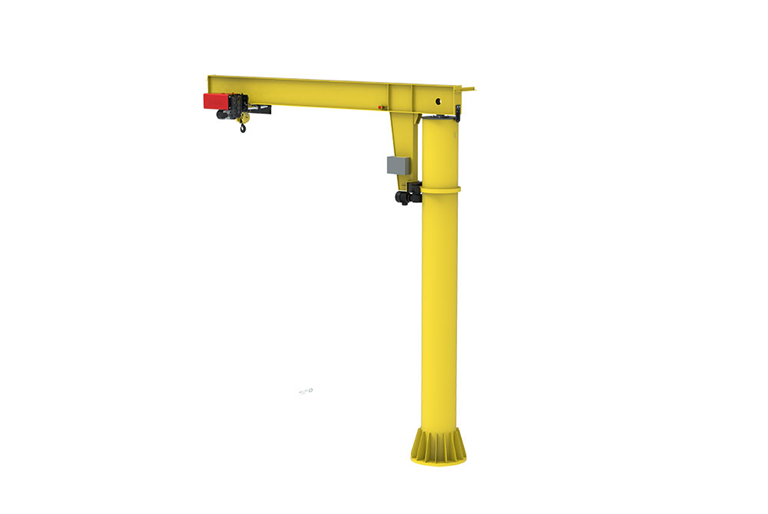


Jib and electric suspension cranes solve a different problem than bridge or gantry systems: covering one fixed work point efficiently rather than a whole bay. A jib crane’s rotating arm covers a defined radius (typically 180°–360°) around a mast or wall mount, which fits repetitive tasks like loading a CNC machine or positioning a part at a single assembly station — without the cost of a full bridge system that would sit mostly idle outside that radius. Suspension cranes take the opposite structural approach: they hang from the roof structure rather than standing on legs, so they add zero floor footprint, which is the deciding factor for plants with tight aisle space or low ceiling clearance. Both types are undersized for anything beyond light-to-medium loads — pushing a suspension crane toward the top of its capacity range on a low-headroom mount is a common cause of premature wear on the runway beam, so matching capacity to the actual duty cycle matters more here than on larger systems.
Matching Crane Type to Your Production Line Stage
Raw Material Intake and Heavy Component Loading
The crane at material intake needs to handle inconsistent, often irregular loads — plate stock, coils, castings — without slowing the unloading cycle. For ferromagnetic materials specifically, an electromagnetic overhead crane (5–64 tons, work grade A5–A8) removes the sling/hook step entirely, which is the main reason plants handling steel plate or scrap switch to one: it’s not just about lifting capacity, it’s about cutting the seconds-per-lift on a task repeated hundreds of times a shift. For non-magnetic raw materials — plastics, non-ferrous metals, palletized stock — a double girder overhead crane or heavy-duty gantry crane is the more common fit, sized to the heaviest single load you’ll intake rather than the average, since undersizing at this stage is the most common source of overload incidents on a factory floor. For palletized PVC plastic sheet or other plastic sheet stock, buyers should confirm bundle weight, pallet size, and handling method before sizing the crane.
Assembly Line Material Transfer
Assembly stations typically move lighter, more frequent loads across a fixed, repetitive path — which is a duty-cycle problem more than a capacity problem. An electric suspension crane fits well here because its low-headroom, ceiling-mounted design keeps the floor clear for workers and fixtures, and its lighter structure supports quick reconfiguration when the line layout changes — a real advantage on assembly lines that get re-tooled every product cycle. Where the assembly task is confined to a single station rather than a path — engine sub-assembly, fixture loading — a jib crane is usually the more cost-effective choice, since paying for full-bay bridge coverage for a single-point task adds cost without adding usable capability. The trade-off to flag: suspension and jib cranes are not built for continuous heavy-duty cycling — if daily lift counts climb into the hundreds at higher loads, the duty class requirement typically pushes the decision back toward a purpose-built workstation bridge crane.
Machining and Heavy Fabrication
Machining and fabrication bays deal with the heaviest, least frequent loads in most plants — large castings, forged parts, machine tool changeovers — which is where double girder overhead cranes justify their higher upfront cost. A general pattern worth noting: single girder cranes handle loads up to roughly 20 tons economically, but beyond that range, the added steel and stability of a double girder structure isn’t optional — it’s what keeps deflection within tolerance for precision machine loading. Plants running frequency-conversion drives on the hoist can achieve positioning accuracy in the low single-digit millimeter range, which matters when the crane is placing a part directly onto a machining fixture rather than just relocating it.
Packaging and Finished-Goods Handling
Packaging and shipping lines usually deal with predictable, lighter loads moving in a straight or looped path, which makes this the stage where over-specifying equipment wastes the most budget. A standalone electric hoist mounted on an existing monorail or light single-girder bridge typically covers this stage without needing a purpose-built heavy crane. The main risk at this stage isn’t undercapacity — it’s choosing a duty class rated for occasional use on a line that actually cycles continuously through a shift, which shortens component life faster than the rated tonnage would suggest.
Selection Parameters That Actually Matter
Duty Cycle Determines Real-World Lifespan, Not Just Rated Capacity
The single biggest selection mistake in procurement isn’t picking the wrong tonnage — it’s ignoring duty class (FEM) or service class (CMAA/ASME) and buying purely on rated capacity. The reason this matters: two cranes can share the same 10-ton rating but be engineered for completely different lift frequencies — a light-duty class (FEM M3–M4) crane cycling continuously at high tonnage will wear out mechanisms and structural components years ahead of schedule, even though it never technically exceeded its rated load. As a practical rule, if your line runs more than roughly 20–30 lifts per shift at or near rated capacity, spec toward the higher end of the duty class range rather than the minimum that meets tonnage alone.
Headroom and Floor Space Dictate Crane Family, Not Just Model
Available headroom under the roof structure and floor space at ground level typically eliminate entire crane families before capacity is even considered. Overhead cranes need runway clearance built into the existing structure — retrofitting one into a low-clearance older building often costs more in structural reinforcement than the crane itself. Gantry cranes solve the structural-dependency problem but consume floor space for their legs and rail path, which is a real constraint in tight-aisle facilities. Suspension and jib cranes minimize both footprint and headroom demand, which is exactly why they dominate low-clearance assembly and workstation applications rather than heavy fabrication bays.
Span and Lifting Height Set the Working Envelope
Span (the crane’s width across the bay) and lifting height (vertical hook travel) define the physical envelope the crane can actually service — and both are far more expensive to change after installation than to spec correctly upfront. A typical single girder overhead crane spans 7.5–31.5 meters with 6–30 meters of lift height; double girder systems extend that envelope to spans up to 50 meters for very large bays. The practical guidance: measure your actual bay width and required hook height against your busiest, heaviest workstation — not the average — since undersizing span means dead zones the crane simply can’t reach.
Certification and Compliance for Manufacturing-Plant Cranes
Which Standards to Ask About
For import buyers, certification isn’t a formality — it affects customs clearance, insurance validity, and liability if an incident occurs on the floor. At minimum, expect a manufacturing-grade crane sold into the EU to carry CE marking under the Machinery Directive (2006/42/EC); FEM 1.001 design rules and ISO 4301 crane classification are the technical backbone behind duty-class ratings referenced earlier in this guide. A supplier’s own production system should be backed by ISO 9001 quality management certification. Depending on your destination market, you may also need EAC certification (Eurasian Customs Union) or documentation supporting OSHA compliance for US-based operations.
Why It’s a Common Procurement Blind Spot
The reason certification gets missed isn’t that buyers don’t know it matters — it’s that “CE-compliant” gets treated as a checkbox rather than a documentation requirement. A crane can be marketed as CE-compliant without the buyer ever seeing the actual EC Declaration of Conformity, which is the document customs and insurers will actually ask for. Missing that paperwork at the port is one of the more expensive procurement mistakes in this category — clearance delays and demurrage fees routinely outweigh what a proper documentation request would have cost in time.
What to Request From Your Supplier Before Ordering
Ask for the EC Declaration of Conformity (not just a CE logo on the spec sheet), the supplier’s ISO 9001 certificate, and load/overload test certification for the specific unit or unit family you’re ordering. On the safety-device side, confirm in writing that overload protection, anti-collision limits, and emergency stop functions are included as standard rather than optional add-ons — these show up in the fabrication-bay and heavy-load use cases covered earlier in this guide, where a failure has the highest consequence. Reputable manufacturers, Voitto included, should be able to provide this documentation on request before you commit to an order — treat a supplier’s reluctance to share it as a red flag, not a formality to skip.
Conclusion
Matching a crane to your production line starts with the task at each stage — intake, assembly, machining, packaging — not with a spec sheet. Overhead and gantry cranes suit full-bay, heavier-load stages; jib and suspension cranes fit workstation-level, repetitive lifts; and duty class matters as much as rated tonnage once you know which family fits. Before you request quotes, walk your line stage by stage, note the heaviest single lift and the daily cycle count at each point, and ask any supplier of cranes for manufacturing industry use for their EC Declaration of Conformity and ISO 9001 certificate up front.
Ready to size a crane for your specific line? Get a factory-direct,quote Our engineering team can confirm capacity, duty class, and certification requirements for your facility.

Alan
Spécialiste des solutions de grue · Voitto Crane
Spécialisé dans les solutions d'exportation de ponts roulants, de portiques, de grues à flèche, de grues portuaires et de grues EOT. Plus de 10 ans d'aide aux clients internationaux en matière de consultation avant la vente, de sélection de la capacité et de configurations spécifiques au site.
FAQ
Q1: What type of crane is best for a small manufacturing workshop?
For small workshops with limited headroom and budget, a jib crane or electric suspension crane is usually the best fit. Both minimize floor footprint and structural requirements, and typically cost $800–$15,000 depending on capacity — far less than a full bridge crane system sized for a whole bay.
Q2: How much does an overhead crane for a manufacturing plant cost?
Single girder overhead cranes (1–32 tons) typically run $8,000–$25,000, while double girder systems (5–800 tons) range from $30,000 to $120,000 or more. Final pricing depends on span, lifting height, duty class, and any customization — request a spec-based quote for an accurate figure.
Q3: Do I need CE certification to import a crane for my factory?
If your facility is in the EU, yes — the crane must carry CE marking under the Machinery Directive (2006/42/EC), backed by an actual EC Declaration of Conformity document. Buyers outside the EU should still check destination-specific requirements (OSHA documentation in the US, EAC certification for the Eurasian Customs Union).
Q4: What’s the difference between duty class and rated capacity?
Rated capacity is the maximum load a crane can lift; duty class (FEM) or service class (CMAA/ASME) describes how often and how intensely it’s designed to lift that load over its service life. Two cranes can share the same tonnage rating but have very different real-world lifespans if duty class doesn’t match actual cycle frequency.
Q5: Can one crane type cover an entire production line?
Usually not efficiently. Most cranes for manufacturing industry projects are combined by stage — for example, a double girder overhead crane at heavy fabrication paired with jib cranes at individual assembly stations — because sizing one crane family for the heaviest task on the line typically over-specifies (and overpays for) the lighter, more frequent lifts elsewhere.




 English
  Español
  Português
  العربية
  Français
  Русский