Pont roulant autoportant : conception modulaire et solutions de postes de travail autonomes
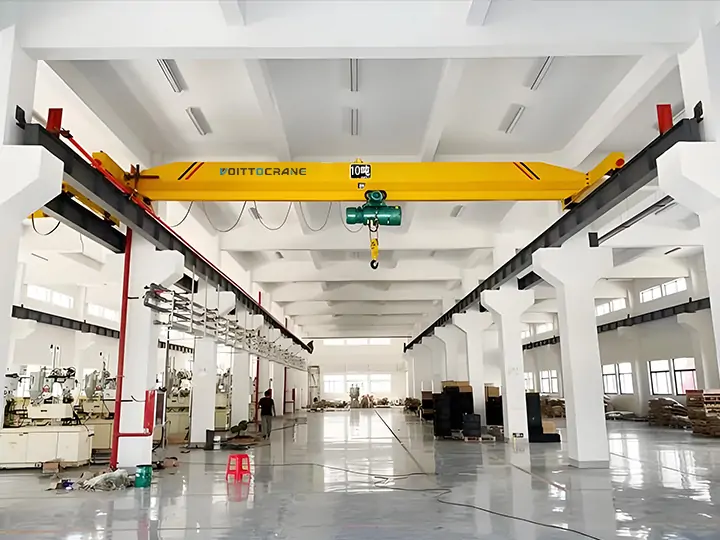
Un pont roulant autoportant est un appareil de levage autoportant. L'ensemble de l'équipement ne repose pas sur la charpente ou les colonnes de l'usine pour supporter la charge. Il ne nécessite qu'une fondation simple (béton C30, épaisseur > 200 mm), ce qui réduit considérablement les coûts de construction d'une usine ou d'un atelier de réparation.
Un pont roulant autoportant est un système de levage autonome de conception modulaire, ne nécessitant qu'une simple fondation en béton C30 sans renforcement de toiture. Sa capacité de levage varie de 0,25 à 5 tonnes, avec des portées de 1 à 12,5 mètres. Il est utilisé dans les secteurs de la production industrielle, de l'automobile et des ateliers de réparation. La page suivante présente en détail cet appareil de levage autonome.
Description du produit
Un pont roulant autoportant est un système de levage aérien indépendant de la charpente ou des colonnes du bâtiment. Sa conception autoportante facilite son installation et son démontage, permettant ainsi son déploiement sur différents chantiers et constituant une solution économique pour répondre à l'évolution constante des besoins de production. De ce fait, les ponts roulants autoportants sont un choix idéal pour les installations dont la capacité portante est limitée.
Contrairement aux ponts roulants traditionnels, ce pont roulant d'atelier est doté d'une structure modulaire, avec un châssis autoportant monté sur une dalle de béton au niveau du sol. Seule une fondation simple (béton C30, épaisseur > 200 mm) est nécessaire, ce qui réduit considérablement les coûts de construction pour une usine ou un atelier de réparation. Cette conception offre aux usines et aux ateliers les avantages d'une installation rapide, de coûts de construction réduits et d'une grande flexibilité.
Le pont roulant autoportant est une solution de manutention idéale : efficace, économique et facile à installer. VOITTO propose des modèles sur mesure, adaptés aux besoins spécifiques des utilisateurs et aux itinéraires de manutention.
Types de ponts roulants autonomes
Les ponts roulants autoportants peuvent être classés en différentes catégories selon leur structure et leurs matériaux : ponts roulants autoportants flexibles, ponts roulants autoportants rigides, ponts roulants à poutre unique, ponts roulants à poutre double et ponts roulants autoportants en alliage d’aluminium. Ces catégories sont décrites ci-dessous.
Pont roulant monopoutre autoportant
Pont roulant à double poutre pour poste de travail
Système de grue monorail rigide
Grue de poste de travail flexible
Pont roulant autoportant en alliage d'aluminium
Pont roulant monopoutre autoportantCe type de grue est doté d'une seule poutre principale. Le mécanisme de levage, situé le long de la semelle inférieure de cette poutre, assure le levage vertical et la manutention horizontale des matériaux. Sa capacité de levage nominale ne dépasse généralement pas 2 tonnes.
Pont roulant à double poutreComparées aux structures à poutre unique, les grues d'atelier autoportantes à poutre double offrent une capacité de charge supérieure et un fonctionnement plus fluide, ce qui les rend adaptées à la manutention de matériaux de taille moyenne à grande. Leur capacité de levage varie de 125 kilogrammes à 3,2 tonnes.
Système de grue monorail rigideCet équipement utilise une structure rigide en acier comme système de support. Ces grues présentent une déformation minimale en fonctionnement, offrant une grande stabilité et une forte résistance au balancement. Leur capacité de levage nominale varie généralement de 125 kilogrammes à 2 tonnes, certaines structures renforcées pouvant supporter jusqu'à 3 tonnes.
Grue de poste de travail flexibleCe type de pont roulant est construit à partir d'éléments modulaires en acier léger. La poutre principale et les rails sont boulonnés ensemble pour former une structure à ossature, ce qui facilite grandement le montage et le démontage. Ces ponts roulants sont adaptés aux environnements de travail où la capacité de charge ne dépasse pas 2 tonnes.
Pont roulant autoportant en alliage d'aluminiumCe type d'appareil utilise un alliage d'aluminium comme matériau structurel principal. L'ensemble se caractérise par sa légèreté, sa haute résistance, sa résistance à la corrosion et son absence de rouille. Il est largement utilisé dans des environnements exigeant une propreté et une flexibilité élevées, tels que l'agroalimentaire, la pharmacie, l'électronique, l'aérospatiale, les chaînes de montage et les laboratoires.
Caractéristiques et avantages
Grâce à leur conception modulaire et à leur déploiement rapide, les ponts roulants pour postes de travail autonomes ont permis d'accroître la productivité de 30 % de manière constante. Je détaillerai ci-dessous chacune de leurs caractéristiques :
StructurelCette conception structurelle permet non seulement de réduire les coûts de construction, mais aussi un assemblage rapide sur le terrain.
Installation facileLe pont roulant autoportant est doté d'une conception modulaire, ce qui facilite grandement son installation, son démontage et son déplacement. Les utilisateurs peuvent ajuster sa position et sa plage de fonctionnement en fonction de l'agencement de la ligne de production.
Fonctionnement fluideDoté de rails de haute précision et d'un système d'entraînement, cet équipement fonctionne de manière fluide et silencieuse, avec des vibrations minimales.
Entretien facileL'équipement utilise des composants modulaires, ce qui facilite l'inspection et le remplacement, et permet de maintenir les coûts de maintenance quotidiens à un niveau bas.
Rentable et pratiqueComparée aux ponts roulants traditionnels, la structure autoportante ne nécessite aucune rénovation d'usine, a un cycle d'installation court et consomme moins d'énergie.
Haute mobilitéLa grue à pont roulant autoportante peut être entièrement démontée ou déplacée vers de nouveaux postes de travail, ateliers ou chantiers pour y être utilisée.
Large gamme d'optionsLes utilisateurs peuvent choisir parmi différentes configurations structurelles, notamment à poutre unique, à double poutre, rigide, flexible ou en alliage d'aluminium, en fonction de leurs besoins de levage.
Application
Les ponts roulants autoportants sont largement utilisés dans divers contextes industriels et de production. Voici quelques exemples d'application du pont roulant pour poste de travail :
Fabrication industrielle: Les utilisateurs utilisent le pont roulant mobile autonome pour l'usinage, l'assemblage d'équipements, l'installation et le remplacement de moules, etc.
Secteur de la fabrication automobile: L'opérateur utilise des ponts roulants EOT autonomes pour soulever des pièces automobiles, des moteurs et de gros équipements mécaniques.
Entreposage et logistiquePonts roulants autonomes à commande utilisateur pour le chargement, le déchargement, l'empilage et le tri des marchandises.
Production électronique et industrielle légère: Les utilisateurs utilisent des ponts roulants EOT autonomes en alliage d'aluminium pour l'assemblage de produits, les essais et la manutention de matériaux légers.
Industries alimentaires et médicalesLes ponts roulants autoportants, grâce à leur légèreté et à leur fonctionnement propre, sont utilisés pour la manutention, le chargement et le déchargement de matériaux.
Domaine aérospatial: Les opérateurs commandent l'équipement pour soulever des composants de précision.
Atelier de réparation: Utilisé par les utilisateurs pour l'inspection, le remplacement de pièces et le renouvellement des matériaux.
Éléments du pont roulant de poste de travail autonome
Un pont roulant autoportant se compose de colonnes de support, d'une poutre de roulement, d'une poutre de pont, d'un mécanisme de levage, d'un système de fixation aux fondations, d'un système d'alimentation électrique et d'un système de commande.
Spécifications
Modèle
Pont roulant autoportant
Capacité de charge
0,1 à 3,2 tonnes
La portée
1-12,5 m (Personnalisable en fonction de la zone de travail)
Hauteur de levage
3,7 – 13,5 m
Alimentation électrique
380 V, 50 Hz, triphasé
Équipement de levage
Palan à chaîne ou palan à câble métallique
Méthode de contrôle
Télécommande
Types de voyageurs
Manuel ou électrique
Classe de service
A2-A3
Prix d'un pont roulant autoportant
Le prix des ponts roulants autoportants varie en fonction de leur capacité de levage, de leur type et des matériaux utilisés. Vous trouverez ci-dessous une indication des prix. Pour obtenir un devis personnalisé, veuillez préciser vos besoins en matière de levage, les dimensions de la portée et l'environnement d'utilisation.
Type
Capacité
La portée
Fourchette de prix (USD)
Pont roulant monopoutre autoportant
0,1 à 2 tonnes
3-12 m
$3 500–15 000
Pont roulant à double poutre
0,1 à 3,2 tonnes
5–15 m
$8 000–35 000
Système de grue monorail rigide
0,125–3,2 tonnes
Sur mesure
$1 500–12 000
Grue de poste de travail flexible
0,125–2 tonnes
3-10 m
$2 000–10 000
Pont roulant autoportant en alliage d'aluminium
0,125–2 tonnes
2–8 m
$3 000–18 000
RemarqueLa liste de prix ci-dessus est donnée à titre indicatif uniquement. Les prix réels dépendent des spécifications exactes.
Pont roulant autoportant à vendre
VOITTO s'engage à fournir à ses clients des solutions de levage par pont roulant autoportant efficaces, sûres et fiables. Grâce à des concepts de conception avancés, des processus de fabrication sophistiqués et un contrôle qualité rigoureux, VOITTO a établi des partenariats stratégiques avec plus de 70 pays à travers le monde.
Le fabricant et fournisseur de grues VOITTO peut fournir des solutions personnalisées de ponts roulants autonomes pour postes de travail en fonction de la largeur et de la hauteur de l'usine du client. Si vous avez des exigences spécifiques ou besoin d'aide supplémentaire, n'hésitez pas à nous contacter.
Spécialisés dans les solutions d'exportation de ponts roulants, portiques, grues à flèche, grues portuaires et ponts roulants. Plus de 10 ans d'expérience dans l'accompagnement de clients internationaux : conseils avant-vente, choix de la capacité et configurations sur mesure.
Quelle est la principale différence entre un pont roulant autoportant et un pont roulant traditionnel fixé au plafond ?
Un pont roulant autoportant fonctionne sur une structure autoportante ne nécessitant qu'une simple fondation en béton, tandis que les ponts roulants traditionnels dépendent d'un renforcement par poutres de toiture.
À quelle vitesse peut-on installer et déplacer un pont roulant autoportant ?
Grâce à sa conception modulaire, un pont roulant autoportant peut être assemblé au sol en 2 à 4 jours. De plus, l'ensemble du système est démontable et transportable vers de nouveaux emplacements, ce qui le rend idéal pour les environnements de production en constante évolution.
Une grue à pont roulant autoportante peut-elle être personnalisée pour répondre à des exigences de levage spécifiques ?
Oui, la personnalisation couvre la capacité de levage (0,25 à 3 tonnes), la portée (1 à 12,5 mètres), la hauteur de levage et le type de palan. Ainsi, notre équipe d'ingénieurs conçoit des solutions parfaitement adaptées à vos besoins opérationnels et aux contraintes de votre installation.
Quels sont les besoins en matière d'entretien et de support d'une grue à pont roulant autoportante ?
La conception modulaire facilite l'inspection et le remplacement des composants, ce qui permet de réduire les coûts de maintenance. De plus, nous offrons une assistance technique 24 h/24 et 7 j/7, la disponibilité des pièces de rechange et une garantie complète avec des options d'extension.
Un pont roulant autoportant est-il adapté aux ateliers de réparation lourde ?
Absolument. Sa portabilité, sa structure autoportante et sa capacité (jusqu'à 5 tonnes) la rendent particulièrement adaptée aux ateliers de réparation. Par conséquent, les opérateurs bénéficient d'une manutention efficace des matériaux sans modifications coûteuses de leurs installations.
Qualification et honneur
Engineered Strength, fournisseur mondial de grues
service
Exclusif et considérable, le client d'abord.
01
Des solutions fiables et personnalisées
Notre équipe de prévente propose des consultations, en adaptant les solutions à vos besoins et à votre environnement.
Offrir des options de personnalisation pour la capacité de levage, la portée et la hauteur de levage, etc. pour répondre à des besoins spécifiques.
02
Processus de production actualisé
Mise à jour des progrès en temps réel : Rapports hebdomadaires et communication avec les PM.
Essais avant livraison : 100% contrôles de charge et de sécurité, rapports détaillés.
03
Un service après-vente digne de confiance
Garantie de 3 à 5 ans et remplacement gratuit en cas de défaut de fabrication.
Assistance en ligne 24 heures sur 24, 7 jours sur 7, et assistance sur place pour les problèmes liés aux grues.
FAQ
Engineered Strength, fournisseur mondial de grues
Livrez-vous à l'étranger ?
Oui, l'expédition internationale et l'assistance à l'exportation sont disponibles pour les clients internationaux.
Êtes-vous fabricant ou fournisseur ?
VIOTTO est un fabricant et fournisseur de plateformes élévatrices à ciseaux robustes, proposant des solutions directes d'usine et des options personnalisées.
Que comprend votre service après-vente ?
Nous offrons un service après-vente complet, comprenant une maintenance régulière, une assistance technique rapide et la fourniture de pièces détachées. La période de garantie standard est d'un an, avec des options d'extension en fonction de vos besoins.
Peut-il être personnalisé ?
Oui, la capacité de levage, la portée, la hauteur, le type de structure et les options de levage peuvent être personnalisés pour répondre à des conditions de travail spécifiques.
Prendre contact
N'hésitez pas à nous laisser un message. Nous vous répondrons dans les 24 heures.
Veuillez préciser vos besoins en vous référant aux aspects suivants :
De quel produit de grue avez-vous besoin ?
Quelle est la capacité de levage maximale (en tonnes) requise pour votre projet ?
Pouvez-vous préciser la hauteur de levage nécessaire (en mètres) ?
Pouvez-vous fournir des détails sur l'environnement de travail, tels que l'état du sol, les limites de l'espace et les obstacles éventuels ?
Quelle est la fréquence d'utilisation prévue et la durée du projet ?







 English
  Español
  Português
  العربية
  Français
  Русский