Ceiling mounted bridge cranes are primarily installed on the roof structures of industrial buildings and are used for lifting and handling materials in workshops, assembly lines, warehouses, and similar facilities. They move along overhead tracks via a girder and, in conjunction with electric hoists, lift and transport equipment components, tooling fixtures, molds, and small-to-medium-sized materials. Since they do not occupy floor space, they are ideal for production environments with limited space.
Voitto is a bridge crane manufacturer that provides customized solutions based on requirements such as lifting capacity, span, lifting height, and factory structural conditions.
The ceiling mounted bridge crane features a compact design and stable operation, and can be custom-designed to suit the workshop span, lifting capacity, and frequency of use.
Types Of Ceiling Mounted Bridge Crane
Ceiling mounted bridge cranes can be classified into various types based on their structural design and operational requirements. Below are the five most common types of ceiling-mounted bridge cranes.
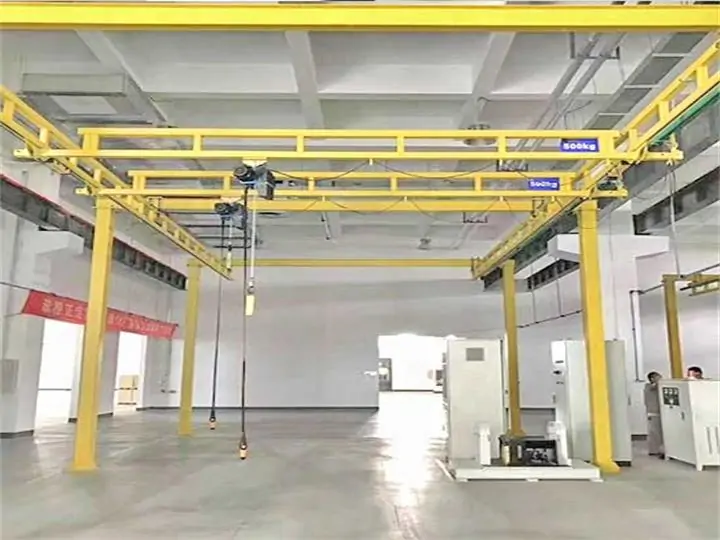
Flexible Single Girder Ceiling Mounted Bridge Crane
The Flexible Single Girder Ceiling-Mounted Bridge Crane features a flexible track structure, is lightweight, and offers flexible installation options, making it suitable for light material handling and production line workstations.
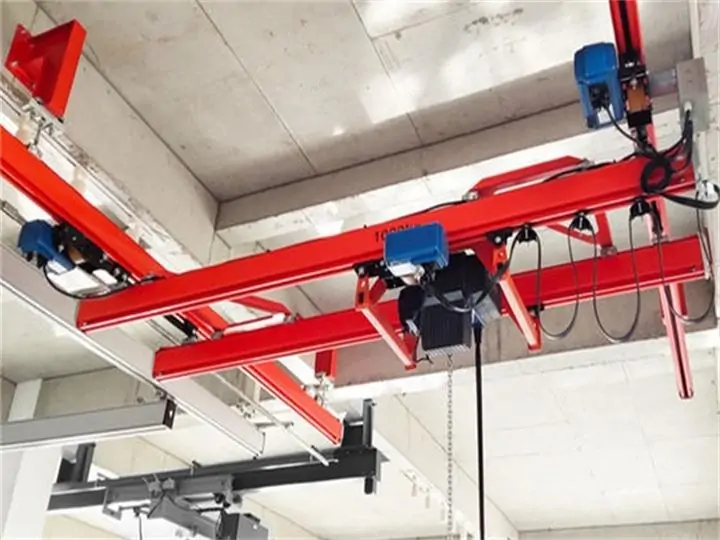
The flexible double-girder structure offers higher load-bearing capacity and is used in production lines or assembly areas that require more stable lifting operations and longer spans.
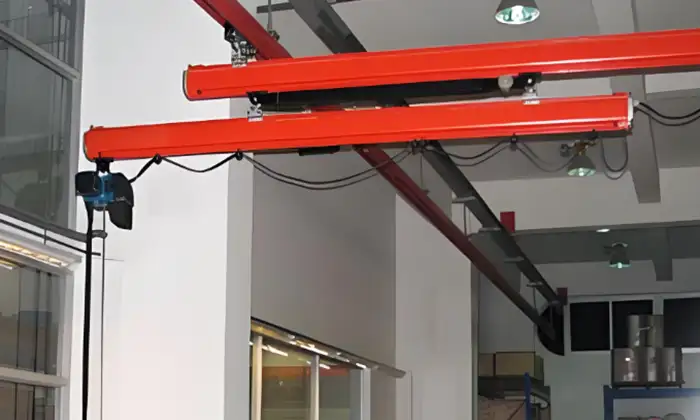
The Telescopic Beam Suspension Workstation Crane extends its working range via a telescopic beam, making it easy to reach inside equipment or workstations.
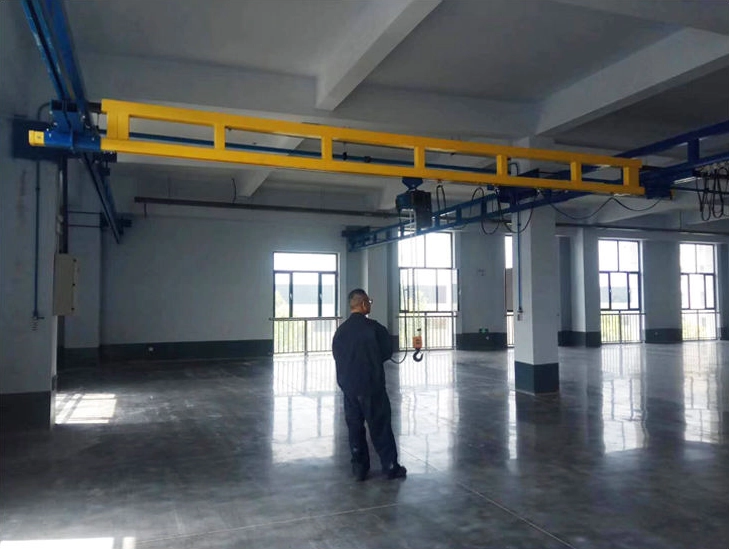
Rigid Connection Single Girder Ceiling Mounted Bridge Crane
Rigidly connected single-girder structures offer high strength and stable operation, making them suitable for frequent lifting operations involving medium-weight materials.
The Rigid Connection Double Girder Ceiling-Mounted Bridge Crane offers high load-bearing capacity and is suitable for lifting and handling heavy equipment, molds, or large components.
A ceiling mounted overhead crane primarily consists of the following key components:
Bridge Girder: The main load-bearing structure of the crane, spanning the rails to support the operation of the electric hoist and trolley.
Hoist and Trolley: Enable the lifting and lateral movement of materials, as well as the precise hoisting and positioning of cargo.
Runway Rails: Installed on the roof structure of the factory building, providing track support for the crane’s overall operation.
End Trucks: Connect the two ends of the main girder and are equipped with running wheels, enabling the crane to move forward and backward along the rails.
Control System: Used to control the crane’s hoisting, travel, and positioning; common methods include push-button control or wireless remote control.
Key Advantages of Ceiling Mounted Bridge Cranes
Space Saving Design: Installed on the roof structure of the facility, these cranes eliminate the need for floor columns, saving workshop space.
Flexible Installation: Can be installed on steel or concrete structures, offering flexible installation options.
Efficient Material Handling: Enables rapid lifting and transport of materials, reducing manual handling and improving operational efficiency.
Suitable for Limited Floor Space: Ideal for workspaces and production lines with limited floor space.
Highly Customizable: Lifting capacity, span, and track configurations can all be customized to meet specific operational requirements.
Specifications
When selecting a ceiling-mounted bridge crane, technical parameters such as lifting capacity, span, and lifting height are key factors. Equipment specifications will vary depending on the structure of the workshop and specific operational requirements. Below are the reference specifications for common ceiling-mounted bridge cranes.
Specification
Range
Lifting Capacity
0.25–20 Ton
Span
3–20 m
Lifting Height
3–12 m
Lifting Speed
0.8–8 m/min
Trolley Travel Speed
10–20 m/min
Crane Travel Speed
20–30 m/min
Power Supply
380V / 50Hz / 3 Phase
Control Method
Pendant Control / Remote Control
Application
Ceiling mounted bridge cranes are used in industrial settings where material lifting and handling are required. They improve operational efficiency and save floor space. Common applications include:
Manufacturing plants: For lifting and moving equipment components, raw materials, and finished products.
Automotive manufacturing facilities: Used for lifting and transporting automotive parts, tooling, and assembly equipment.
Warehouses and logistics centers: Used for loading, unloading, and internal transport of heavy cargo.
Assembly lines: Used to transport parts or equipment between workstations.
Steel processing facilities: Used for lifting and handling steel, structural components, and metal materials.
Projects Show
Warehouse Workshop Light Material Efficient LiftingHeavy Industry Workshop Multi-process Material Collaborative ConveyingClean Workshop Precision Component Dust-free LiftingMachine Tool Processing Area Workpiece Loading & Unloading TransferLaboratory Precision Equipment Safe Lifting & PositioningLong-distance Production Line Material Continuous Conveying
Ceiling Mounted Bridge Crane vs Traditional Overhead Crane
When selecting a bridge crane, people often compare ceiling-mounted bridge cranes with traditional overhead cranes. There are certain differences between the two in terms of installation structure, space requirements, and cost. Here is a brief comparison:
Feature
Ceiling Mounted Crane
Floor Supported Crane
Support Structure
Installed on building ceiling or roof beams
Supported by floor-mounted columns
Floor Space
No floor columns, saves workspace
Requires floor columns
Installation
Depends on building structure strength
Independent support structure
Cost
Lower structural cost
Higher installation and structure cost
Customized Ceiling Mounted Bridge Crane
Vitto cranes can be custom-designed to suit workshop layouts and operational requirements. Customization options include:
Custom lifting capacity: Select the appropriate tonnage based on material weight
Custom span: Design the appropriate span based on facility dimensions
Explosion-proof configuration: For special environments with explosion-proof requirements
Intelligent control system: Supports remote or intelligent control to improve operational efficiency
Ceiling Mounted Bridge Crane Manufacturer and Supplier
VOITTO has specialized in the manufacture of lifting equipment for over 20 years, boasting extensive project experience and a well-established production system. Our products are certified to ISO, CE, and other standards, and have been deployed in industrial projects across numerous countries and regions, providing stable and reliable lifting solutions.
We offer services tailored to customer needs, including equipment selection, engineering design, installation, and commissioning. If you would like to learn more about our Ceiling Mounted Bridge Crane solutions or request a quote, please feel free to contact us.
Qualification and Honor
Engineered Strength, Global Crane Supplier
service
Exclusive and Considerable, Customer First.
01
Reliable and Customized Solutions
Our pre-sale team provides consultations, tailoring solutions to your needs and environment.
Offer customization options for lifting capacity, span and lifting height etc. to meet specific needs.
02
Updated Production Process
Real-Time Progress Updates: Weekly reports and PM communication.
3-5 years warranty and free replacement for non-manufacturing defects.
24/7 online support and on-site assistance for crane issues.
FAQ
Engineered Strength, Global Crane Supplier
Is a ceiling mounted crane suitable for warehouses?
Yes, especially where floor space is limited and efficient overhead lifting is required.
Can ceiling mounted cranes be customized?
Yes, span, lifting height, hoist type, and control system can all be customized.
What capacity is available?
Most systems range from 1 ton to 20 tons, depending on structural support.
What is a ceiling mounted bridge crane?
A ceiling mounted bridge crane is an overhead lifting system installed directly on the building structure, eliminating the need for floor columns.
What industries use ceiling mounted bridge cranes?
Ceiling mounted bridge cranes are commonly used in warehouses, workshops, and manufacturing facilities where efficient overhead material handling is needed.
Get In Touch
Please feel free to leave a message. We will reply in 24 hours.
Please specify your requirement by referring to the following aspects:
Which crane product do you need?
What is the maximum lifting capacity (in tons) required for your project?
Could you specify the lifting height (in meters) needed?
Can you provide details on the working environment, such as ground conditions, space limitations, and any obstacles?
What is the expected frequency of use and the duration of the project?





 English
  Español
  Português
  العربية
  Français
  Русский