
Introduction
In automotive workshops, lifting tasks such as engine handling, parts positioning, and tool movement are often challenged by limited space and the need for frequent relocation. Traditional lifting equipment like overhead cranes can be costly and lack flexibility for small or medium-sized shops. This is where a portable jib crane becomes a practical solution. It has a mobile design, easy operation, and cost efficiency, it provides a flexible lifting solution for modern automotive environments. In this guide, we’ll explore its key benefits, typical applications, and how to choose the best portable jib crane for your specific workshop needs.
What Is a Portable Jib Crane?
A portable jib crane is a compact small crane designed for flexible lifting and material handling in confined workspaces. It typically consists of a vertical column, a rotating jib arm, and an electric hoist or manual hoist to perform precise automotive lifting tasks. Unlike fixed systems, it features a movable base, often equipped with wheels or forklift pockets—allowing easy relocation within the workshop. This modular structure ensures quick setup, stable operation, and efficient load handling without permanent installation.


Why It Fits Automotive Shops
In automotive workshops, where space is limited and workflows are dynamic, a portable jib crane offers a practical lifting solution. Its compact footprint makes it ideal for tight areas, while its mobility supports multi-station use across different repair or assembly points. Compared to overhead cranes or fixed jib systems, this small crane reduces installation costs and increases flexibility, making it highly suitable for various automotive lifting applications such as engine handling, parts positioning, and maintenance tasks.
Benefits of Portable Jib Cranes in Automotive Workshops
A portable jib crane provides an efficient and flexible automotive lifting solution for modern workshops. Designed for mobility and ease of use, this small crane helps improve workflow efficiency, reduce manual handling, and optimize limited workspace without the need for complex installation.
Flexible Movement Across Workstations
Easily relocated between different work areas, allowing one crane to serve multiple stations and improve equipment utilization.
Space-Saving Design for Compact Shops
Compact structure with no permanent installation required, making it ideal for workshops with limited floor space.
Easy Operation and Reduced Labor Cost
Simple control system enables one-person operation, reducing reliance on manual lifting and lowering labor intensity.
Cost-Effective Alternative to Overhead Cranes
Lower initial investment and no structural modification needed, offering a practical alternative to overhead or fixed crane systems.
Quick Installation and Minimal Setup
Ready-to-use design with fast deployment, minimizing downtime, and allowing immediate integration into existing workflows.
Versatile for Multiple Automotive Applications
Suitable for various automotive lifting tasks such as engine removal, parts handling, and assembly support across different repair scenarios.
Video Show
Applications in Automotive Shops
A portable jib crane is widely used in automotive workshops for efficient and precise automotive lifting tasks. Its mobility and compact design make this small crane ideal for handling various components across different workstations, improving productivity while reducing manual effort.
Engine Lifting and Positioning
Safely lift and position engines during assembly, disassembly, or replacement with improved accuracy and control.
Transmission Handling
Facilitates the removal, installation, and alignment of transmissions, reducing handling risks and labor intensity.
Mold and Tooling Movement
Efficiently transport molds, fixtures, and tooling between workstations, supporting flexible production and maintenance needs.
Loading/Unloading and Maintenance Operations
Used for loading and unloading auto parts as well as supporting daily maintenance and repair tasks, ensuring smooth and efficient workshop operations.
Factors to Consider When Choosing the Best Portable Jib Crane
Choosing the right portable jib crane is critical to ensure safe, efficient, and cost-effective automotive lifting operations. Buyers should evaluate actual workshop needs, load requirements, and working conditions to select a small crane that delivers both performance and long-term value. The following points explain how to choose portable jib crane solutions for automotive applications.
Lifting Capacity (e.g. 250kg–1000kg)
Start by defining your typical load range. For most automotive workshops, a capacity between 250kg and 1000kg is sufficient for engines, transmissions, and components. Always allow a safety margin above your maximum load.
Boom Length and Rotation Angle
Select the appropriate boom length based on workstation layout and reach requirements. A longer boom increases coverage, while a 180°–360° rotation improves flexibility for multi-position lifting tasks.
Mobility Design (Casters / Forklift Pockets)
Consider how frequently the crane needs to be moved. Casters are ideal for smooth indoor floors and frequent repositioning, while forklift pockets are better for heavier-duty movement and less frequent relocation.
Power Options (Manual vs Electric)
Manual hoists are cost-effective and suitable for light-duty use, while electric hoists improve efficiency and reduce operator fatigue for frequent or heavier automotive lifting tasks.
Floor Conditions and Safety
Evaluate floor load capacity, flatness, and working environment. Ensure the crane base provides sufficient stability, and prioritize safety features such as locking casters, overload protection, and reliable braking systems.
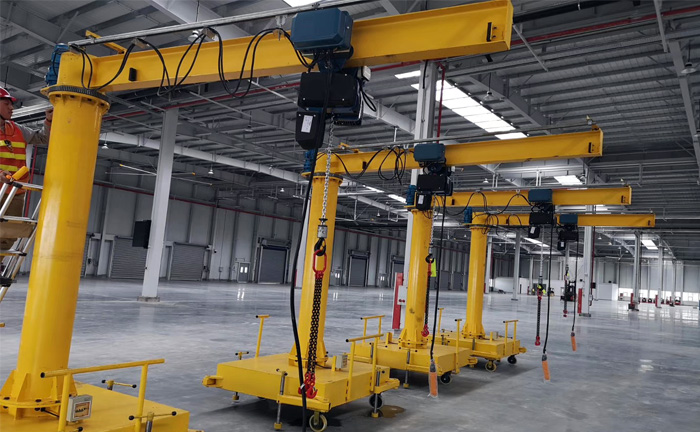
Portable Jib Crane vs Other Lifting Equipment
A portable jib crane is a flexible and cost-efficient automotive lifting solution, especially suitable for workshops with limited space and changing workflows. Compared with traditional lifting equipment such as overhead cranes, gantry cranes, and shop cranes, this small crane offers a balanced combination of mobility, capacity, and ease of use.
To better understand the differences, the following comparison highlights key parameters and practical considerations for buyers.
| Parameter | Portable Jib Crane | Overhead Crane (Bridge Crane) | Gantry Crane |
|---|---|---|---|
| Typical Capacity | 250kg–1000kg (light duty) | 1 ton – 100+ tons | Installed on the building structure |
| Structure | Column + rotating arm | Bridge beam on elevated rails | Bridge beam + supporting legs |
| Installation | No installation required | Covers the entire workshop span | Self-supported, ground rails |
| Mobility | High (movable base) | None (fixed system) | Medium (rail or wheel movement) |
| Coverage Area | Small circular area | Requires a large floor space | Large rectangular area |
| Space Requirement | Very low (compact) | No floor space, uses overhead | Requires large floor space |
| Cost Level | Low | High (civil structure required) | Medium–high |
| Best Use Scenario | Automotive repair, small parts handling | High-frequency industrial production | Yards, construction, heavy material handling |
| Flexibility | Very high | Low | Medium |
| Indoor/Outdoor | Mainly indoor | Indoor | Indoor & outdoor |
Buyer Guidance
Choose a portable jib crane
If your focus is automotive workshops, maintenance stations, and flexible lifting, where loads are moderate and space is limited.
Choose an overhead crane
If you need continuous, high-capacity lifting across the entire workshop, especially in manufacturing plants with fixed workflows.
Choose a gantry crane
If your application involves heavy loads, large areas, or outdoor operations, such as construction sites, yards, or precast handling.
Reliable Portable Jib Crane Manufacturer
Choosing a reliable portable jib crane supplier is essential to ensure long-term performance, safety, and efficiency in automotive lifting applications. As a professional manufacturer, VOITTO crane provides not only high-quality small crane equipment, but also complete lifting solutions tailored to real workshop needs.
We have rich project experience in over 100 countries. VOITTO crane understands diverse industry requirements and delivers proven solutions for automotive workshops, maintenance stations, and production lines. The company offers custom design services, including lifting capacity, boom length, mobility configuration, and power options—ensuring each portable jib crane fits specific application scenarios.
To support global customers, VOITTO crane provides comprehensive after-sales service, including technical guidance, installation support, and responsive spare parts supply, helping clients maintain efficient and safe operations worldwide.
Looking for a reliable portable jib crane supplier? Contact us today for customized solutions and competitive pricing.
Conclusion
A portable jib crane is an ideal solution for modern automotive workshops, offering efficient and reliable automotive lifting in limited spaces. It has flexibility, easy operation, and low installation requirements; this small crane helps improve workflow while delivering a strong return on investment (ROI).
Whether for engine handling, parts movement, or daily maintenance, a portable jib crane provides the versatility that traditional lifting equipment often lacks.
Get the best portable jib crane for your automotive shop. Contact our team for expert advice and a fast quotation.

Alan
Crane Solutions Specialist · Voitto Crane
Specialized in Overhead Crane, Gantry Crane, Jib Crane, Port Crane & EOT Crane export solutions. 10+ years helping global clients with pre-sales consultation, capacity selection and site-specific configurations.
FAQ
1. What capacity portable jib crane do I need for my workshop?
Most automotive workshops need 250kg–1000kg capacity depending on engine and component weight. Always select slightly higher capacity than your maximum load for safety and long-term reliability.
2. Is a portable jib crane suitable for small automotive shops?
Yes, it is ideal for small workshops due to its compact structure, space-saving design, and ability to operate in tight areas without permanent installation or structural modification.
3. Can one portable jib crane be used at multiple workstations?
Yes, its movable base allows easy relocation between different work areas, enabling one crane to serve multiple stations and significantly improving equipment utilization efficiency.
4. What is the difference between electric and manual hoist options?
Manual hoists are cost-effective and suitable for light use, while electric hoists provide faster lifting, higher efficiency, and reduced operator effort for frequent automotive lifting tasks.
5. How safe is a portable jib crane for automotive lifting?
It is very safe when properly used, featuring stable base design, overload protection options, and reliable braking systems to ensure controlled and secure lifting operations.
6. Does it require special installation or foundation?
No, a portable jib crane does not require permanent installation or foundation work. It can be used immediately after delivery, saving time and installation costs.
7. Can it handle engine and transmission lifting?
Yes, it is widely used for engine and transmission handling in automotive workshops, offering precise positioning, stable lifting, and reduced manual labor risk.
8. How long is the service life of a portable jib crane?
With proper maintenance, a high-quality portable jib crane can last 10–15 years or more, ensuring stable performance and long-term return on investment.


 English
  Español
  Português
  العربية
  Français
  Русский