
A mobile gantry crane typically costs between $800 and $25,000+ for factory-direct units in the 0.5–10 ton range — the exact number depends on material (aluminum vs. steel), capacity, span, and whether you need a manual or electric hoist. If you’re comparing options before committing to a purchase, you’re in the right place.
The challenge most procurement managers face isn’t finding a supplier. It’s knowing which configuration actually fits their floor layout, load requirements, and mobility needs — before they get a quote that’s either wildly overkill or dangerously undersized.
This guide walks you through every decision point: product types and price benchmarks, the steel vs. aluminum trade-off, how to spec a portable gantry crane with electric hoist, and what certifications to verify before signing a purchase order.
- 1 Quick Reference: Mobile Gantry Crane Types & Price Ranges
- 2 Types of Mobile Gantry Cranes: Which One Fits Your Operation?
- 3 Portable Gantry Crane with Electric Hoist: When to Upgrade
- 4 Steel vs. Aluminum: A Direct Comparison for Procurement Decisions
- 5 Certifications and Supplier Evaluation
- 6 Conclusion
-
7
FAQ
- 7.1 Q1: What is the typical lead time for a factory-direct mobile gantry crane?
- 7.2 Q2: How much does a portable gantry crane with electric hoist cost compared to a manual version?
- 7.3 Q3: Can a mobile gantry crane be used outdoors?
- 7.4 Q4: What is the difference between a mobile gantry crane and a fixed overhead crane?
- 7.5 Q5: What certifications should I require when buying a mobile gantry crane from an overseas manufacturer?
Quick Reference: Mobile Gantry Crane Types & Price Ranges
| Type | Capacity | Typical Price (FOB Factory) | Best For |
|---|---|---|---|
| Portable Aluminum Gantry Crane | 0.5–2t | $800–$4,500 | Frequent relocation, light assembly |
| Steel Mobile Gantry Crane (manual) | 1–10t | $1,500–$12,000 | Workshop / warehouse, moderate duty |
| Portable Gantry Crane with Electric Hoist | 0.5–10t | $2,500–$18,000 | Production lines, reduced labor cost |
| Adjustable Height Gantry Crane | 1–5t | $1,200–$8,000 | Multi-height workstations |
| Heavy-Duty Steel Mobile Gantry | 10–20t | $12,000–$25,000+ | Outdoor yards, heavy machinery |
Price reference: indicative FOB factory, based on standard configurations. Custom span, special coatings, or VFD controls will affect final pricing.
→ Need a price for your specific tonnage and span?
Get QuoteTypes of Mobile Gantry Cranes: Which One Fits Your Operation?
Portable Aluminum Gantry Crane


The most mobile option in the lineup. For gantry cranes with comparable load rating and size, steel can weigh 2.5 to 3 times more than aluminum, which means an aluminum unit can realistically be repositioned by two workers without mechanical assistance. Capacity typically runs from 500 kg to 2 tons — sufficient for maintenance bays, light assembly, and repair shops where the crane moves between workstations multiple times per shift.
Aluminum gantry cranes also offer excellent corrosion resistance, making them suitable for outdoor or marine environments where exposure to moisture, saltwater, or corrosive substances is a concern. If your operation is near a coastline or involves chemical exposure, this material advantage over painted steel is worth factoring into the total cost of ownership, not just the sticker price.
The tradeoff: aluminum tops out at around 2 tons for most standard configurations. Steel cranes have a stronger carrying capacity and can easily handle loads of 3 tons, 5 tons or even higher, making them suitable for lifting large equipment or heavy workpieces.
Steel Mobile Gantry Crane


Steel remains the default for anything above 2 tons. Steel cranes are incredibly strong, making them suitable for consistently handling heavy loads. They are also built to last in demanding environments, including factories and construction sites. The standard capacity range spans 1–20 tons, and the structural integrity makes steel the preferred choice for continuous-duty cycles (FEM group A3–A5) where aluminum would be over-stressed.
The practical downside: steel cranes typically require mechanical assistance or larger crews to reposition, and outdoor units need protective coatings or galvanizing to manage long-term corrosion. Budget accordingly for annual inspection and touch-up maintenance.
Adjustable Height Gantry Crane
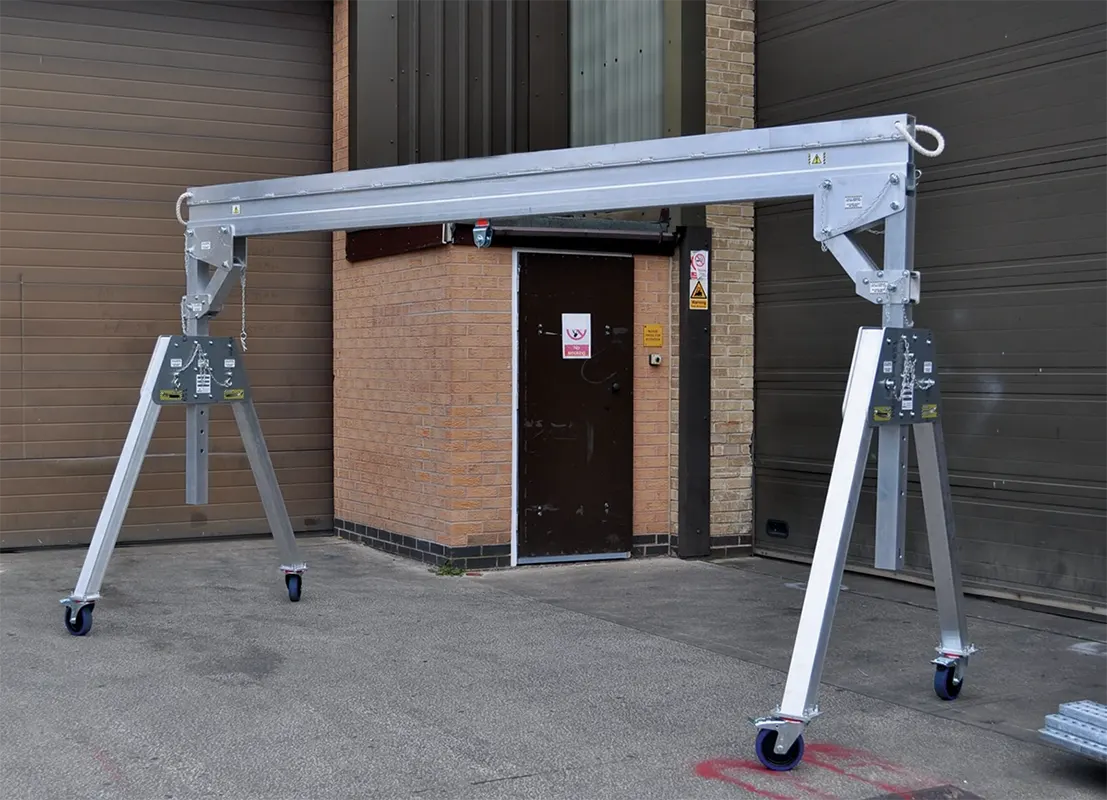
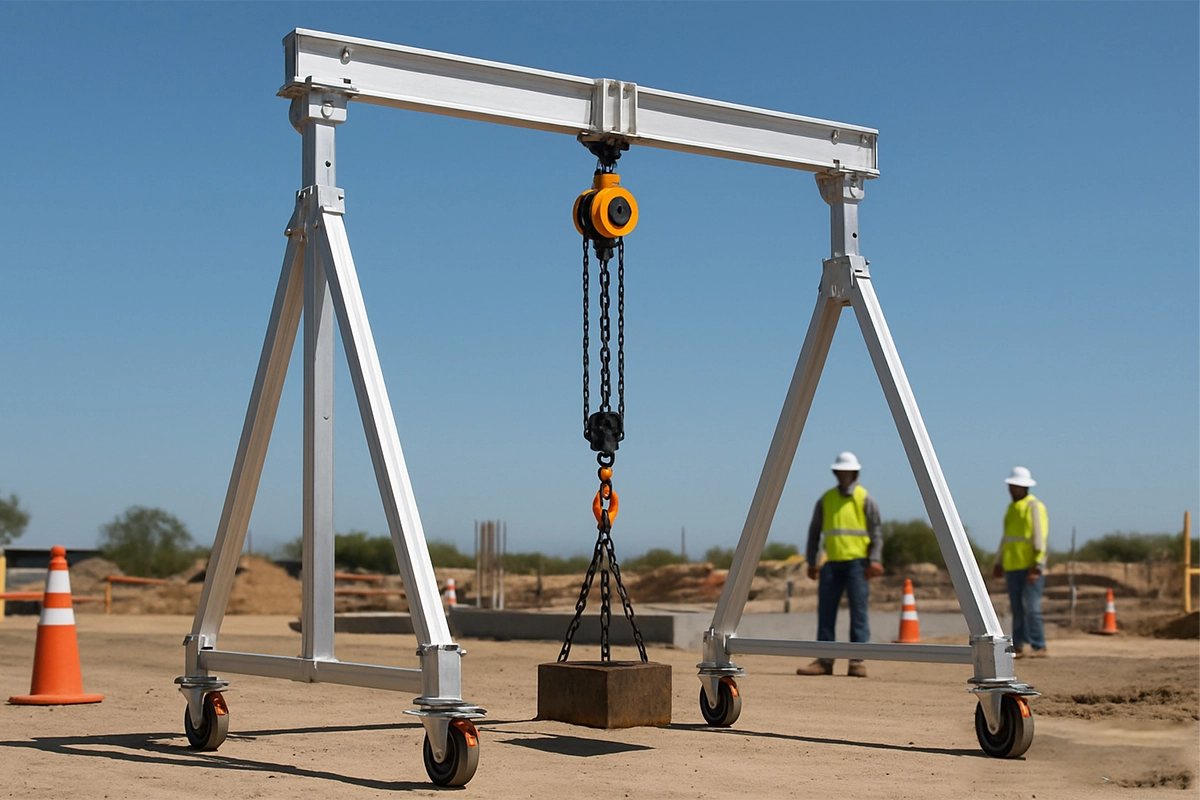
A telescoping gantry crane is the right answer when your hook height requirements vary by job. Most models offer a height adjustment range of roughly 2.4 m to 4.8 m, lockable at fixed increments. This configuration suits multi-product assembly lines, maintenance facilities serving different machine heights, and rental fleets that need a single unit to serve multiple customer applications.
Portable Gantry Crane with Electric Hoist: When to Upgrade
Manual vs. Electric Hoist — The Decision Framework
A manual chain hoist is adequate for lift cycles under 10–15 per shift and loads under 3 tons. Once lift frequency rises or your team is moving loads above 2 tons multiple times per hour, the labor cost and fatigue accumulation justify the electric hoist premium — typically $600–$2,500 additional cost depending on capacity and brand.
The motorized portable gantry crane integrates electric lifting and motorized traveling functions, offering easier operation, higher efficiency, and significant time and labor savings compared to traditional manual gantry cranes. With an electric control system, operators can achieve precise lifting and movement, greatly improving work efficiency and reducing manual effort.
For production-line applications, look for models with variable frequency drive (VFD) control. VFD reduces mechanical shock on startup, extends hoist life, and allows fine positioning control — especially important for assembly operations where a load needs to land within a tight tolerance.
Key Specs to Confirm Before Ordering
Load capacity ranges from 0.5 to 20 tons depending on the model. It must match the items being lifted — a weak crane might break or cause accidents if overloaded. Beyond rated capacity, confirm these parameters before finalizing a configuration:
- Span (beam length): The usable lift zone, not the full footprint. Standard options run 3–10 m; confirm clearance for your widest load.
- Lift height: Hook height under beam at full elevation. Account for the hoist body itself (typically 400–600 mm) when calculating usable hook height.
- Duty class: FEM group (European) or ASME service class (US) — A3/M3 for light duty, A5/M5 for continuous production.
- Power supply: Single-phase 110/220V for light electric hoists; three-phase 380–480V for 3 ton and above.
- Caster type: Standard swivel casters vs. V-groove casters on floor tracks — critical for controlled linear travel under load.

Alan
Crane Solutions Specialist · Voitto Crane
Specialized in Overhead Crane, Gantry Crane, Jib Crane, Port Crane & EOT Crane export solutions. 10+ years helping global clients with pre-sales consultation, capacity selection and site-specific configurations.
Steel vs. Aluminum: A Direct Comparison for Procurement Decisions
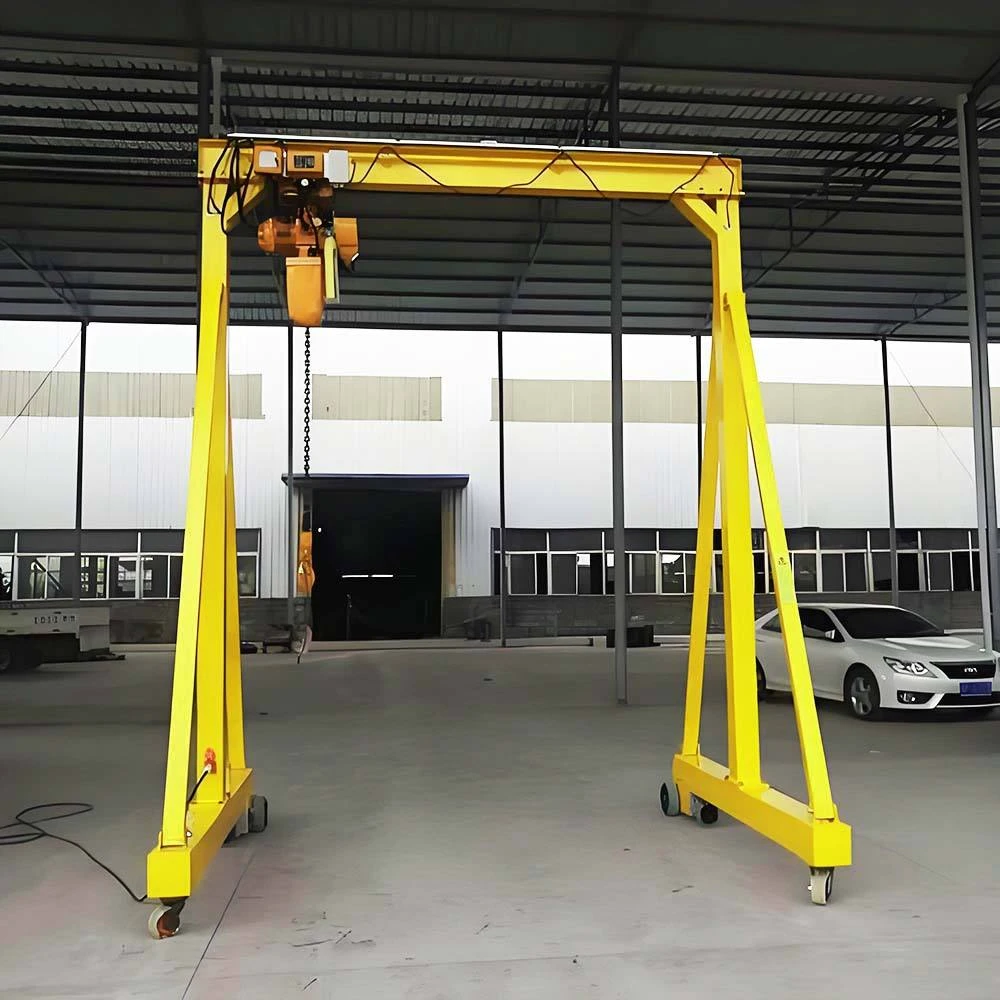
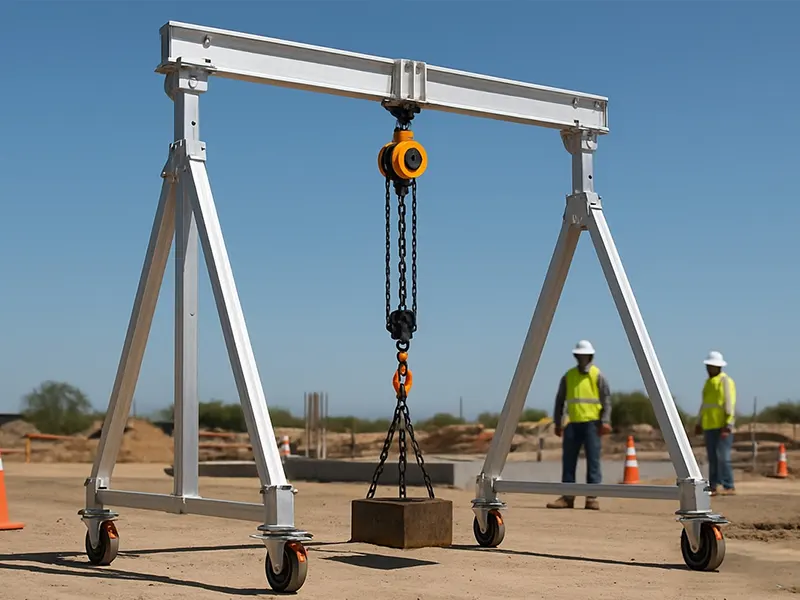
This is the most common question we receive from procurement managers, and the answer is never simply one or the other — it depends on three variables: maximum load, relocation frequency, and environment.
| Decision Factor | Aluminum | Steel |
|---|---|---|
| Max capacity (standard) | Up to 2t | Up to 20t+ |
| Unit weight (1t, 3m span, indicative) | ~36–60 kg | ~150–180 kg |
| Repositioning | 1–2 people, no tools | Mechanical assist typically required |
| Corrosion resistance | Excellent (no coating needed) | Requires protective coating outdoors |
| Maintenance cost (5-year estimate) | Lower | Moderate–higher |
| Price premium vs. steel | +20–40% upfront | Baseline |
| Duty cycle suitability | Light–medium (FEM A3 max) | Light–heavy (up to FEM A5+) |
The practical decision rule: if you’re lifting more than 2 tons or running more than 20 lift cycles per shift, go steel. If your team relocates the crane daily and load weights stay under 2 tons, the aluminum unit’s total cost of ownership — including less maintenance and easier handling — often wins over a 5-year horizon.
Certifications and Supplier Evaluation
What Standards Apply to Mobile Gantry Cranes
Compliance requirements differ by market. For the US market, ASME B30.2-2022 provides requirements for the construction, installation, operation, inspection, and maintenance of hand-operated and power-driven overhead and gantry cranes, including cantilever gantry cranes and semi-gantry cranes. For European and export markets, CE marking under Machinery Directive 2006/42/EC is the baseline, with EN 13001 (crane design) and EN 15011 (bridge and gantry cranes) as the relevant harmonized standards.
At minimum, request documentation for:
- CE certificate (EU/export) or ASME B30.2 compliance declaration (US)
- Load test certificate — proof the unit was tested at 125% of rated capacity before shipment
- Material certificates for structural steel or aluminum alloy used in the main beam and legs
Red Flags in Supplier Evaluation
A reputable manufacturer should be able to provide load test certificates without hesitation. Watch for these warning signs: rated capacity markings without documentation, reluctance to share material certifications, and quoted lead times under 7 days for a custom-span unit (structural fabrication cannot be rushed safely). Also verify that the hoist-to-crane compatibility has been validated — a hoist sourced separately and retrofit onto a gantry frame voids most crane certifications.
Conclusion
A mobile gantry crane is a high-leverage investment when it’s specced correctly — and an expensive liability when it’s not. The right starting point is always your actual load, your lift frequency, and how often the crane needs to move. From there, the aluminum vs. steel and manual vs. electric decisions follow logically.
Three actions to take before you request a quote:
- Document your heaviest expected load — not average load, but the worst-case lift you’ll need to complete in the next 12 months.
- Measure your floor span and minimum/maximum required hook height — even a rough sketch saves multiple back-and-forth emails with your supplier.
- Confirm your power supply voltage and phase if you’re considering an electric hoist — this affects both the hoist selection and the total price.
Ready to move forward? Browse Voitto Crane’s mobile gantry crane product range or contact our engineering team directly for a configuration-specific quote.
Alan
Crane Solutions Specialist · Voitto Crane
Specialized in Overhead Crane, Gantry Crane, Jib Crane, Port Crane & EOT Crane export solutions. 10+ years helping global clients with pre-sales consultation, capacity selection and site-specific configurations.
FAQ
Q1: What is the typical lead time for a factory-direct mobile gantry crane?
Standard steel mobile gantry cranes in common capacities (1–5 ton, standard span) typically ship in 7–15 business days from a stocked factory. Custom configurations — non-standard beam length, special duty class, VFD-equipped electric hoist, or specific surface treatments — generally require 20–35 business days. Portable aluminum units in standard sizes often have shorter lead times, around 5–10 business days. Always confirm lead time in writing and request a production schedule for custom orders. If a supplier quotes less than 5 days for a custom structural fabrication, treat that as a red flag.
Q2: How much does a portable gantry crane with electric hoist cost compared to a manual version?
For a comparable 1-ton steel mobile gantry crane, a manual chain hoist configuration typically runs $1,500–$3,500 (FOB factory), while adding a standard electric chain hoist (single-speed, pendant control) brings the total to approximately $2,500–$5,500. Upgrading to a VFD-equipped electric hoist with variable-speed travel adds another $500–$1,200 depending on brand and capacity. The electric option pays back in reduced labor hours and lower operator fatigue, typically within 12–18 months in a production environment running 15+ lifts per shift. Always confirm voltage compatibility with your facility before ordering.
Q3: Can a mobile gantry crane be used outdoors?
Yes, but the configuration matters. Steel units used outdoors require hot-dip galvanizing or a marine-grade epoxy coating — standard paint is insufficient for prolonged outdoor exposure. Aluminum gantry cranes are inherently corrosion-resistant and require no additional coating, making them a natural fit for outdoor or semi-outdoor environments. For permanent outdoor use with an electric hoist, specify IP54-rated (minimum) hoist enclosures and weatherproof pendant controls. Also confirm caster material — standard polyurethane casters degrade in UV exposure and outdoor temperatures; steel wheel casters on floor tracks are more durable for outdoor yards.
Q4: What is the difference between a mobile gantry crane and a fixed overhead crane?
A mobile gantry crane is freestanding on wheels or casters — it requires no building structure and can be repositioned anywhere on a flat floor. A fixed overhead crane is permanently installed on runway rails attached to building columns or dedicated runway supports. Mobile gantry cranes offer flexibility and zero installation cost, making them ideal for facilities without runway infrastructure or for operations that need lifting capability in multiple zones. The trade-off is capacity ceiling (most mobile gantry units top out at 10–20 tons) and cycle-rate suitability — heavy continuous-production lifting at 20+ tons is better served by a fixed runway crane. For applications under 10 tons with mixed-location lifting needs, a mobile gantry crane is often the more cost-effective solution.
Q5: What certifications should I require when buying a mobile gantry crane from an overseas manufacturer?
At minimum, request a CE Declaration of Conformity (for EU or international markets) or ASME B30.2 compliance documentation (for US operations), along with a factory load test certificate showing the unit was proof-tested at 125% of rated capacity. For the electric hoist, verify CE marking on the hoist unit itself — not just on the overall crane assembly. Additional useful documentation: material test certificates for structural steel or aluminum alloy, weld inspection records, and a dimensional inspection report. Reputable factory-direct suppliers routinely provide these as part of the shipment package; if a supplier is reluctant to share them, reconsider the source.




 English
  Español
  Português
  العربية
  Français
  Русский