Crane span, gauge and base distance are three different horizontal dimensions. Span is the distance between runway rail centerlines, gauge is the rail-to-rail distance of a travelling mechanism, and base distance is the spacing between support centerlines along the direction of travel.
The three terms are easily confused. Some suppliers use “gauge” and “wheelbase” interchangeably, and some treat span and trolley gauge as the same thing. In reality each one measures a different direction on a different part of the crane.
This guide defines each term, compares them side by side, shows how base distance is read on layouts from two to twelve wheels, and explains the reference plane all of them are measured from. After reading, you should be able to check a crane drawing and say which dimension is which.
Base distance (symbol b or B) is the horizontal distance between a crane’s support centerlines, measured parallel to its direction of travel, as defined in crane terminology standards such as GB/T 6974.1.
What Do Span, Gauge and Base Distance Mean?
Span (S): The Distance Between Rail Centerlines
Span is the horizontal distance between the centerlines of the two rails a crane travels on. For a bridge crane, it is measured across the bay, from one runway rail to the other.
Span drives most of the structural design. It sets the girder length, affects how much the girder deflects under load, and fixes how wide a hall the crane can serve. Spans range from under 10 m in small workshops to well over 30 m in large halls, depending on the application.
Span is a rail-centerline dimension. It is not the building width, and it is not the overall length of the girder, which is longer because it overhangs the rails at both ends.
Gauge (K): Crane Gauge and Trolley Gauge
Gauge is the centerline distance between the two parallel rails of a travelling mechanism. A crane has up to two gauges, one for the crane itself and one for its trolley.
The crane gauge is the distance between the rails the whole crane runs on. For a bridge crane this is the same dimension as the span. The trolley gauge is the distance between the two trolley rails on the girders.
A trolley gauge normally exists only on double-girder cranes, where the trolley runs on rails on two girders. A single-girder crane whose hoist runs along the flange of one beam typically has no trolley gauge.
Base Distance (b or B): Spacing Along the Travel Direction
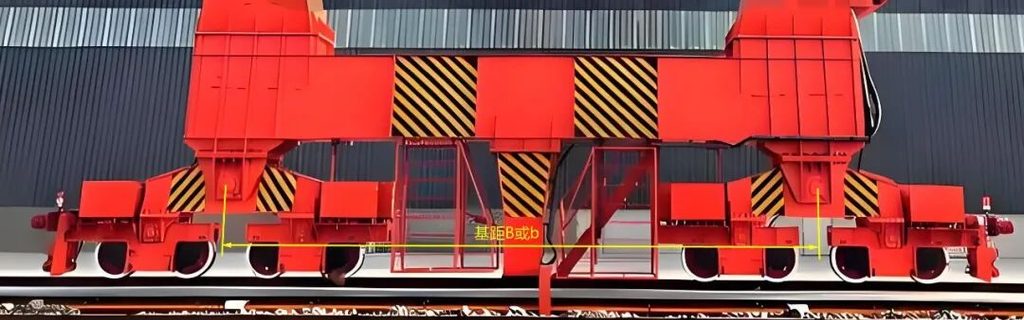
Base distance is measured along the direction of travel, not across it. It is the distance between the support centerlines on the same side of the crane.
Where there are two wheels per side, base distance is simply the wheel-center distance. With more wheels grouped on balance beams, it is taken between the support (pivot) centerlines of the wheel groups, not between individual wheels.
Base distance is set by the manufacturer from the mechanism layout and the overall stability requirements. As a general principle, a longer base distance relative to the span makes a crane more resistant to skewing. The exact proportions come from the manufacturer’s design, not from a universal ratio.
Where the Definitions Come From
Crane terminology is standardized nationally and internationally. In Chinese standards, GB/T 6974.1-2008 (terminology) uses the lowercase symbol b for base distance, while GB/T 3811-2008 (design rules) uses the uppercase B. Both refer to the same dimension. International vocabulary standards such as ISO 4306-1 cover general crane terms.
Translations of these terms vary between suppliers and countries, so always confirm each dimension on the drawing rather than relying on the word alone.
Crane Span, Gauge and Base Distance Compared
Side-by-Side Comparison
Span and gauge are measured across the crane, while base distance is measured along it.
| Parameter | Symbol | Measured between | Direction | Typically confirmed by |
|---|---|---|---|---|
| Span | S | Centerlines of the two runway rails | Across the bay | Buyer, from the site |
| Crane gauge | K | Centerlines of the crane’s travel rails (equals span on a bridge crane) | Across the bay | Follows from span |
| Trolley gauge | K | Centerlines of the trolley rails | Along the girder | Manufacturer |
| Base distance | b / B | Support centerlines on one side | Along the direction of travel | Manufacturer |
If two dimensions have the same direction, they are usually the same family of parameter. If they run in different directions, they are never interchangeable.
Three Common Mix-Ups
“Gauge is the wheelbase.” Not so. Gauge runs across the crane between two rails, while wheelbase or base distance runs along the crane between supports on one side.
“Span equals trolley gauge.” Not so. Span belongs to the whole crane and its runway. Trolley gauge belongs to the trolley and its rails on the girder.
“Base distance is the distance between the outermost wheels.” Not always. On multi-wheel layouts it is taken between support or pivot centerlines.
Which Dimension Does a Buyer Normally Confirm?
Span is the dimension normally taken from the site, because it must match the runway rails. Gauges and base distance usually follow from the manufacturer’s design for the chosen capacity and duty. Final dimensions should always be checked on the manufacturer’s approved drawing.
How Base Distance Is Read on Different Wheel Layouts
Two-Wheel and Four-Wheel Layouts
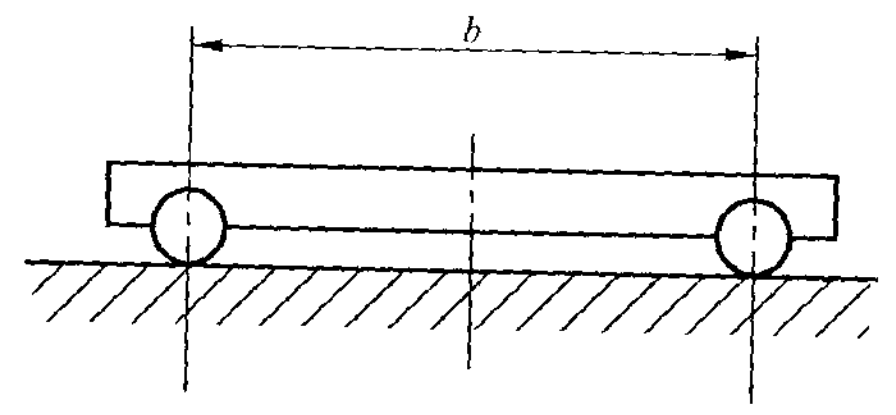
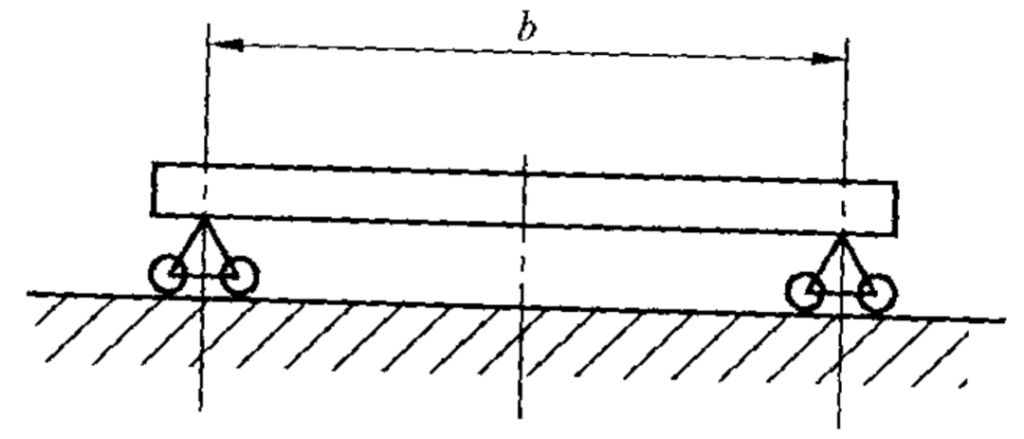
On a two-wheel-per-side layout, the base distance is the distance between the two wheel centers. This is the simplest case, and it is why base distance is sometimes called wheel spacing.
On a four-wheel layout, each side carries two wheel pairs on balance beams. The base distance is measured between the pivot centerlines of the two beams, not between individual wheels.
Six-, Eight- and Twelve-Wheel Layouts
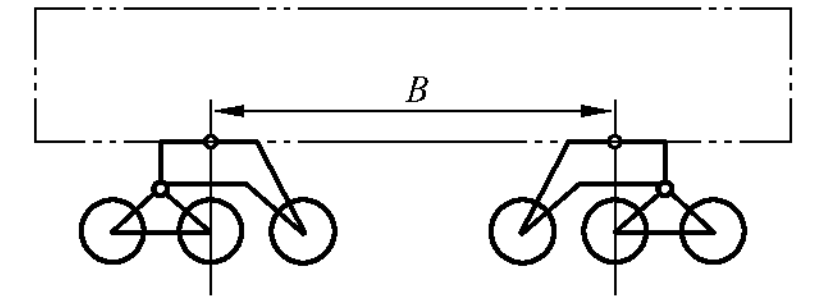
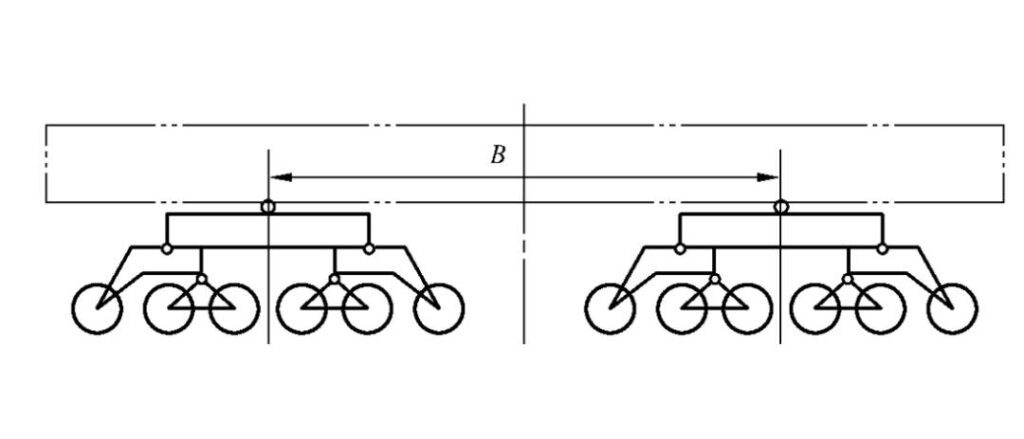
Heavier cranes spread the load over more wheels using nested balance beams. In six-, eight- and twelve-wheel layouts, the base distance is still taken between the central support, or hinge-pin, centerlines of the wheel groups on one side.
The practical rule is simple. Find the main support point of each wheel group, then measure between those points along the rail direction. The number of wheels changes how the load is shared, not where base distance is measured.
Bridge Cranes vs Gantry Cranes
On a bridge crane, the base distance is the distance between the support centerlines of the end carriages (end trucks). On a gantry crane, it is the distance between the centerlines of the hinge pins connecting the wheel assemblies to the lower cross beam (sill beam).
What Is the Crane Reference Plane?
Definition
The crane reference plane, also called the supporting surface, is the horizontal plane formed by the foundation or rail top that supports the crane’s running frame. Crane dimensions are related to this plane.
When Rails Sit at Different Levels
When the supporting rails are at different levels, the lower rail defines the reference plane. This happens, for example, on gantry-type cranes with one rail at ground level and the other on a raised platform. Taking the lower surface gives one consistent datum for the whole crane.
Conclusion
Crane span, gauge and base distance describe three separate things: span and gauge run across the crane between rails, while base distance runs along it between supports. Keeping them apart avoids most drawing and specification errors.
Before approving a drawing, check three things: which dimension each label actually refers to, where base distance is measured on the wheel layout, and which rail defines the reference plane.
Have a specific dimension or drawing question? Our engineering team can help.

Alan
Crane Solutions Specialist · Voitto Crane
Specialized in Overhead Crane, Gantry Crane, Jib Crane, Port Crane & EOT Crane export solutions. 10+ years helping global clients with pre-sales consultation, capacity selection and site-specific configurations.
FAQ
Q1:What is the difference between crane span and gauge?
Span is the distance between the runway rail centerlines. Crane gauge is the distance between the rails the crane itself travels on, so on a bridge crane the two are the same dimension. Trolley gauge is a separate, smaller dimension between the trolley rails on the girders.
Q2:Is crane base distance the same as wheelbase?
Only on simple two-wheel layouts. There, base distance equals the wheel-center distance. On multi-wheel layouts it is measured between the support or hinge-pin centerlines of the wheel groups, not between individual wheels.
Q3:Do single-girder cranes have a trolley gauge?
Typically not. When the hoist runs along the flange of a single beam, there are no separate trolley rails, so the concept does not apply. Double-girder cranes have trolley rails on both girders and therefore a trolley gauge.
Q4:How is crane span measured?
Span is measured between the centerlines of the two rails, typically by a qualified inspector using a calibrated steel tape or a laser distance meter. Allowed tolerances come from the applicable standard and the manufacturer’s drawing.




 English
 Español
 Português
 العربية
 Français
 Русский