
- 1 Introduction
- 2 What Is a Jib Crane?
- 3 Different Types of Jib Cranes
- 4 Which Type Is Best for Your Workshop?
- 5 5 Factors Buyers Need Should Consider
- 6 Jib Crane vs Gantry Crane
- 7 Jib Crane vs Gantry Crane Comparison Table
- 8 Which One Should You Choose?
- 9 What Capacity Do You Need?
- 10 How Much Does a Jib Crane Cost?
- 11 Jib Crane Price Range
- 12 Key Factors That Affect the Price
- 13 Why Prices Vary So Much
- 14 Get an Accurate Quote from Voitto Crane
- 15 Conclusion
- 16 FAQ
-
17
Frequently Asked Questions (FAQ)
- 17.1 1. What is a jib crane used for?
- 17.2 2. What capacity jib crane do I need?
- 17.3 3. What are the main types of jib cranes?
- 17.4 4. How much space does a jib crane need?
- 17.5 5. What is the difference between jib crane and overhead crane?
- 17.6 6. Can a jib crane rotate 360 degrees?
- 17.7 7. How much does a jib crane cost?
- 17.8 8. How do I choose the right jib crane supplier?
Introduction
In modern workshops, warehouses, and production lines, moving heavy materials safely and efficiently is a daily challenge. When floor space is limited and lifting tasks are frequent, choosing the right equipment can significantly improve productivity and workplace safety. A jib crane is one of the most practical and cost-effective lifting solutions for localized material handling, widely used across manufacturing, maintenance, and assembly operations.
But what exactly is a jib crane, how does it work, and which type is best for your application? In this guide, we’ll explore its structure, common types, key benefits, and how buyers can choose the right model for their facility.
What Is a Jib Crane?
A jib crane is a versatile lifting device designed to move heavy materials within a specific work area. It typically consists of a horizontal arm, known as the jib or boom, mounted on a vertical column or wall bracket, allowing loads to be lifted and rotated with ease. Commonly used in workshops, warehouses, manufacturing plants, and maintenance stations, jib cranes help improve handling efficiency while reducing manual labor and safety risks. Depending on the application, they are available in floor-mounted, wall-mounted, portable, and articulating designs to meet different lifting and space requirements.
Different Types of Jib Cranes
Jib cranes are available in several configurations to suit different lifting tasks, workspace layouts, and installation requirements. Choosing the right type depends on factors such as load capacity, working radius, floor space, and whether the crane needs to be fixed or movable. The most common types include floor mounted, wall mounted, portable, and articulating jib cranes, each designed for specific industrial applications.
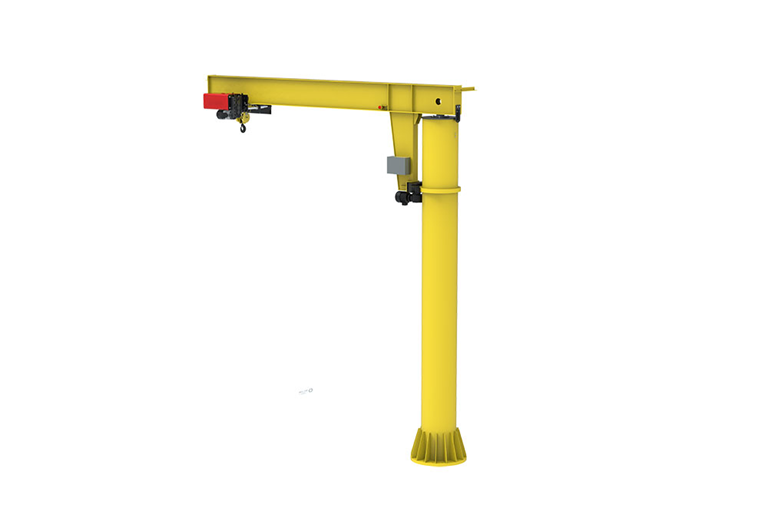
Floor Mounted Jib Crane
A floor mounted jib crane is one of the most widely used types in workshops and production facilities. It is installed directly on the floor with anchor bolts, offering excellent stability and a large rotation range, often up to 360°. This type is ideal for frequent lifting of molds, machine parts, and heavy materials at fixed workstations.
Basic Parameters:
- Capacity: 250kg–5 ton
- Rotation: 180°–360°
- Arm length: 2–8 m
- Lifting height: 2–6 m
Wall Mounted Jib Crane
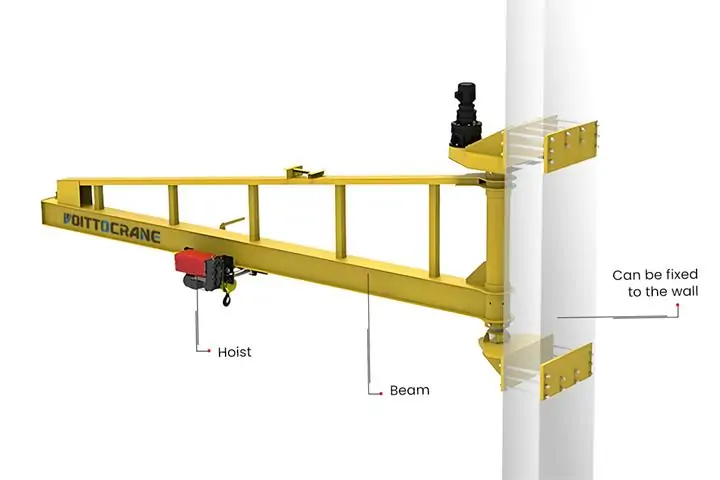
A wall mounted jib crane is attached to an existing wall, column, or building structure, making it an excellent choice for facilities with limited floor space. It helps maximize usable workspace while providing efficient localized lifting for assembly lines, maintenance areas, and warehouse loading stations.
Basic Parameters:
- Capacity: 125kg–2 ton
- Rotation: 180°–200°
- Arm length: 2–6 m
- Installation: wall or column mounted
Portable Jib Crane
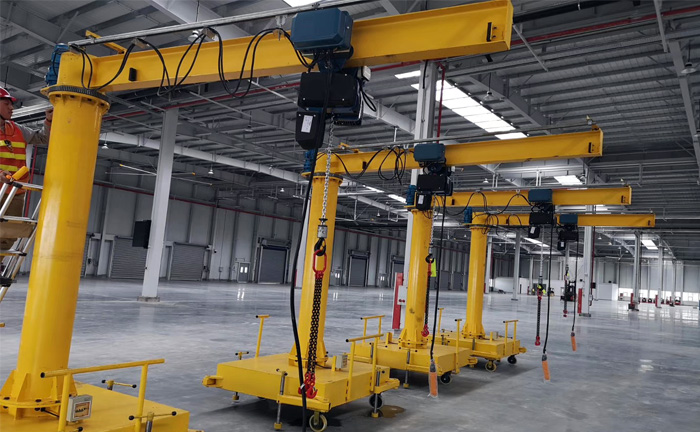
A portable jib crane is designed with a movable base, allowing it to be easily relocated between workstations. This makes it a flexible solution for workshops that require lifting support in multiple areas without permanent installation. It is especially popular in mold shops, repair workshops, and automotive service centers.
Basic Parameters:
- Capacity: 250kg–1 ton
- Rotation: 180°–360°
- Arm length: 2–4 m
- Feature: mobile base with wheels

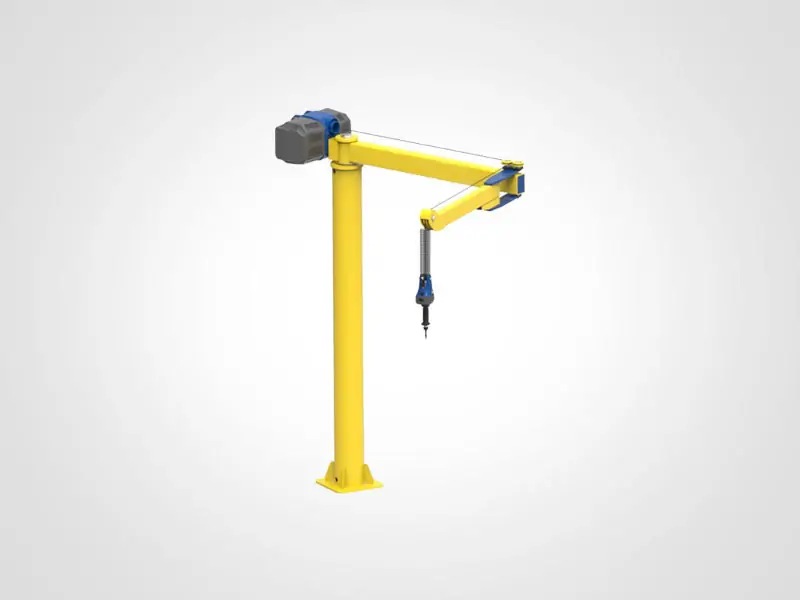
Articulating Jib Crane
An articulating jib crane features a two-arm design with multiple pivot points, allowing it to maneuver around obstacles and serve complex work areas. This type is ideal for machine loading, tight corners, and production lines where flexibility is critical.
Basic Parameters:
- Capacity: 125kg–1 ton
- Rotation: up to 360°
- Arm length: 2–6 m
- Feature: dual-arm articulation
Which Type Is Best for Your Workshop?
Choosing the best jib crane for your workshop depends on more than just load capacity. Buyers should evaluate the available floor space, lifting frequency, material weight, workstation layout, and whether the crane needs to serve a fixed point or multiple areas. There is no one-size-fits-all solution—the right choice should balance efficiency, installation conditions, and long-term operating costs. Below is a practical comparison based on common workshop scenarios.
For Fixed Workstations and Heavy Lifting
Best Choice: Floor Mounted Jib Crane
If your workshop has a dedicated lifting station for mold toolings, machine parts, or production components, a floor mounted jib crane is usually the most reliable option. Its rigid base structure provides excellent stability and supports higher capacities, making it suitable for continuous daily use.
Recommended for:
- mold and injection workshops
- machine loading stations
- heavy component assembly
Typical capacity: 500kg–5 ton
Key advantage: high stability and wide working radius


For Limited Floor Space
Best Choice: Wall Mounted Jib Crane
For workshops where floor space is already occupied by machines, benches, or storage racks, a wall mounted jib crane is often the most efficient solution. Since it is installed on an existing wall or column, it frees up valuable floor area while still providing efficient localized lifting.
Recommended for:
- compact workshops
- assembly lines
- maintenance areas
Typical capacity: 125kg–2 ton
Key advantage: saves floor space
For Multiple Workstations
Best Choice: Portable Jib Crane
If lifting tasks need to be performed in different areas of the workshop, a portable jib crane offers greater flexibility. Its movable base allows operators to reposition the crane as needed, which is ideal for facilities with changing workflows.
Recommended for:
- mold transfer
- repair workshops
- automotive shops
Typical capacity: 250kg–1 ton
Key advantage: easy relocation

For Complex Layouts and Obstacles
Best Choice: Articulating Jib Crane
When the lifting area includes obstacles such as machines, columns, or narrow corners, an articulating jib crane is often the best choice. Its dual-arm structure provides greater maneuverability and allows loads to reach difficult positions.
Recommended for:
- machine feeding
- corner workstations
- complex assembly cells
Typical capacity: 125kg–1 ton
Key advantage: superior flexibility


5 Factors Buyers Need Should Consider
Before selecting a jib crane, buyers should look beyond the basic specifications and evaluate how the equipment will actually be used in daily operations. A model that fits the workshop layout and workflow will always deliver better long-term value than simply choosing the highest capacity.
1) Load Capacity and Safety Margin
Start with the maximum weight of the heaviest item to be lifted, such as molds, machine components, or raw materials. In most projects, it is recommended to reserve at least a 15%–20% safety margin to account for lifting accessories, possible future upgrades, and repeated use under load. For example, if the typical load is around 800 kg, a 1-ton jib crane is usually the more practical choice. How boom length, daily lift frequency, and duty class interact with that margin is covered in more detail in this jib crane capacity guide.
2) Working Radius and Arm Length
The boom length should match the workstation’s actual service area. Buyers should confirm the distance from the mounting point to the farthest lifting position, rather than selecting the longest arm by default. An oversized arm may increase cost and reduce efficiency, while an undersized one can limit coverage and require additional handling steps.
3) Rotation Angle and Coverage Area
The required slewing range depends on the workflow.
A 180° rotation is often sufficient for wall-mounted units serving a single side of a workstation, while 270° or 360° rotation is better suited for central loading points, assembly cells, or mold transfer stations where wider coverage is needed.
4) Installation Conditions
The workshop structure should be checked before finalizing the type. Floor-mounted cranes require adequate concrete thickness and anchor support, while wall-mounted models depend on the strength of existing columns or steel structures. For facilities with changing layouts, a portable design may offer better practicality.
5) Future Production Needs
A jib crane is usually a long-term investment, so it is worth considering whether production volume, product size, or workstation arrangement may change in the next few years. Choosing a slightly more flexible configuration today can help avoid replacement costs later.
Jib Crane vs Gantry Crane
Both jib cranes and gantry cranes are widely used for material handling in workshops, warehouses, and industrial plants, but they serve different operational needs. A jib crane is designed for localized lifting within a fixed work area, while a gantry crane is better suited for moving loads across a wider workspace or multiple stations. The right choice depends on floor layout, load capacity, mobility requirements, and installation conditions.
In simple terms, if your lifting tasks are concentrated around one workstation, a jib crane is usually the more efficient option. If loads need to be transported over a larger area, a gantry crane often offers better flexibility.
Main Differences Between Jib Crane and Gantry Crane
1) Working Area
A jib crane operates within a defined radius around its column or wall mounting point. It is ideal for machine loading, mold transfer, and repetitive lifting at fixed stations.
A gantry crane moves along wheels or rails and can cover a much larger working area, making it suitable for warehouses, fabrication shops, and open-floor production lines.
2) Installation Method
Jib cranes are typically floor mounted or wall mounted, often requiring fixed installation and anchor support.
Gantry cranes are generally free-standing structures, which means they require less permanent installation and can be moved more easily, especially portable models.
3) Mobility
A jib crane provides rotational movement within its arm radius but remains fixed in one location.
A gantry crane offers better horizontal movement across multiple work zones, especially when equipped with casters or rail systems.
4) Load Capacity
Jib cranes are commonly used for light to medium lifting tasks, typically from 250 kg to 5 tons.
Gantry cranes often support higher capacities, ranging from 500 kg to 20 tons or more, depending on the design.
5) Cost and Investment
For localized lifting, a jib crane is usually the more cost-effective solution.
For larger workshops requiring wider coverage, a gantry crane may provide better long-term efficiency despite the higher initial cost.
Jib Crane vs Gantry Crane Comparison Table
| Factor | Jib Crane | Gantry Crane |
|---|---|---|
| Working area | Fixed radius | Large area coverage |
| Movement | Rotation only | Horizontal travel |
| Installation | Fixed mounting | Free-standing |
| Mobility | Low to medium | High |
| Capacity | 250kg–5 ton | 500kg–20 ton+ |
| Best for | Workstations | Large workshops |
| Cost | Lower | Higher |
Which One Should You Choose?
If your workshop needs frequent lifting at a fixed station, such as mold handling, machine loading, or assembly support, a jib crane is usually the more practical choice.
If materials need to be transferred between multiple workstations or across a large floor area, a gantry crane will generally provide better operational flexibility.
What Capacity Do You Need?
Selecting the right jib crane capacity is not just a technical decision—it directly impacts safety, efficiency, and long-term operating cost. Many buyers either choose a capacity that is too small for real workloads or over-spec the equipment, leading to unnecessary investment. The most practical approach is to base the selection on the maximum regular lifting load, with a reasonable safety margin for daily operation and future needs.
Below is a clear and practical guide to the most commonly used capacity ranges.
250kg Jib Crane
A 250kg jib crane is designed for very light-duty lifting tasks, typically used in small workshops or stations where components are compact and easy to handle. It is suitable for repetitive handling of small parts, supporting assembly work, or assisting manual operations where full heavy lifting equipment is not required. This capacity is often chosen when space is limited and workloads are relatively light but frequent.
500kg Jib Crane
A 500kg jib crane is one of the most widely used specifications in general industrial environments because it offers a balanced combination of flexibility and lifting capability. It is commonly used for handling moderate-weight components such as machine parts, molds, and maintenance items, making it a practical choice for most small to medium-sized workshops with regular lifting tasks.
1 Ton Jib Crane
A 1 ton jib crane is suitable for more demanding industrial applications where medium-weight components need to be lifted safely and efficiently. It is often used in manufacturing lines, mold workshops, and equipment assembly areas where daily operations involve consistent handling of heavier materials, offering a reliable balance between capacity and operational efficiency.
2 Ton Jib Crane
A 2 ton jib crane is designed for heavy-duty working environments where larger and heavier components are handled on a regular basis. It is commonly applied in machine shops, fabrication workshops, and maintenance facilities dealing with steel parts or heavy equipment, requiring strong structural support and stable installation conditions to ensure safe operation.
Final Selection Advice
In practical applications, most buyers are advised to select a capacity that is slightly higher than their maximum expected load, typically with a 20% safety margin. However, oversizing should be avoided when unnecessary, as it can increase cost and reduce operational efficiency. The best choice always depends on balancing actual workload, working space, and future production requirements.
How Much Does a Jib Crane Cost?
The cost of a jib crane varies widely depending on its type, capacity, structure, and installation requirements. In general, price is not determined by lifting capacity alone—factors such as boom length, rotation design, mounting method, electric hoist system, and customization level all have a direct impact on the final budget. For example, a wall-mounted unit with a basic manual hoist will be significantly more affordable than a heavy-duty floor-mounted system with electric operation nd extended reach. Installation conditions and shipping costs can also influence the total project price, especially for overseas buyers.
Jib Crane Price Range
Below is a general market reference for common jib crane configurations. These ranges are intended for budget planning only, as final quotations will vary based on specifications and project requirements.
| Capacity | Typical Price Range (USD) | Common Applications |
|---|---|---|
| 250 kg | $800 – $2,500 | light assembly, small workshops, maintenance tasks |
| 500 kg | $1,200 – $4,000 | general workshop use, parts handling |
| 1 ton | $1,500 – $8,000 | mold handling, manufacturing lines, machine shops |
| 2 ton | $3,000 – $12,000+ | heavy components, fabrication, industrial maintenance |
Key Factors That Affect the Price
Several practical factors influence the final cost beyond capacity. Structural type is one of the biggest drivers—wall-mounted systems are usually more economical, while floor-mounted cranes require stronger foundations and higher material input. Working reach (boom length) also increases cost as it demands higher structural strength. In addition, choosing between manual and electric hoist systems can significantly change the budget. Custom requirements such as outdoor use, higher duty class, or special coatings will further increase pricing.
Why Prices Vary So Much
Even for the same 1-ton rating, jib crane prices can differ greatly between projects. This is because each workshop has different layout conditions, lifting frequency, and safety requirements. A standard configuration for a small workshop may cost only a fraction of a fully customized industrial system designed for continuous production use. That’s why most suppliers provide pricing only after reviewing technical requirements.
Get an Accurate Quote from Voitto Crane
To avoid overpaying or selecting the wrong configuration, it is recommended to request a tailored quotation based on your actual working conditions. The Voitto Crane engineering team can evaluate your application, recommend the right structure, and provide a cost-effective solution based on your workshop layout and lifting needs.
Contact us to get a detailed quotation and technical proposal for your jib crane project.

Alan
Crane Solutions Specialist · Voitto Crane
Specialized in Overhead Crane, Gantry Crane, Jib Crane, Port Crane & EOT Crane export solutions. 10+ years helping global clients with pre-sales consultation, capacity selection and site-specific configurations.
Conclusion
A jib crane is a practical and cost-effective lifting solution for improving material handling efficiency in workshops, warehouses, and production environments. As we have seen, selecting the right type and capacity depends on several real working factors, including load weight, workspace layout, installation conditions, and daily operation requirements. Whether you need a light-duty 250kg unit or a heavier 2-ton system, the key is to match the equipment with your actual application rather than choosing based on specifications alone.
If you are planning a project and still unsure which jib crane is right for your facility, it is always better to get professional guidance before making a decision. The Voitto Crane team can help evaluate your needs and provide a suitable, cost-efficient solution based on your working conditions.
FAQ
Frequently Asked Questions (FAQ)
1. What is a jib crane used for?
A jib crane is used for lifting and moving heavy materials within a fixed work area, such as workshops, warehouses, and assembly lines. It improves handling efficiency and reduces manual labor in repetitive lifting tasks.
2. What capacity jib crane do I need?
Most workshops choose 500kg to 1 ton. The right capacity depends on your heaviest load, with a recommended 20% safety margin to ensure safe and stable daily operation.
3. What are the main types of jib cranes?
Common types include floor-mounted, wall-mounted, portable, and articulating jib cranes. Each type is designed for different space conditions, lifting needs, and operational flexibility in industrial environments.
4. How much space does a jib crane need?
It depends on the boom length and rotation range. Most jib cranes require only a small working footprint, making them suitable for compact workshops and fixed workstation applications.
5. What is the difference between jib crane and overhead crane?
A jib crane works within a limited circular area, while an overhead crane covers the entire workshop. Jib cranes are ideal for localized lifting, while overhead cranes handle large-scale material movement.
6. Can a jib crane rotate 360 degrees?
Yes, many floor-mounted jib cranes can rotate up to 360 degrees, depending on the design. Wall-mounted models usually have a limited rotation range due to structural constraints.
7. How much does a jib crane cost?
Prices typically range from $800 to $12,000+, depending on capacity, structure, boom length, and customization. Final cost varies based on technical requirements and installation conditions.For a full breakdown by crane type — including the difference between equipment cost and total installed cost, and how foundation work, electrical setup, and load testing affect the final budget — see our jib crane cost guide.
8. How do I choose the right jib crane supplier?
Choose a supplier with engineering support, customization ability, and proven export experience. A professional manufacturer can help match the crane to your workshop layout and ensure safe operation.


 English
  Español
  Português
  العربية
  Français
  Русский