

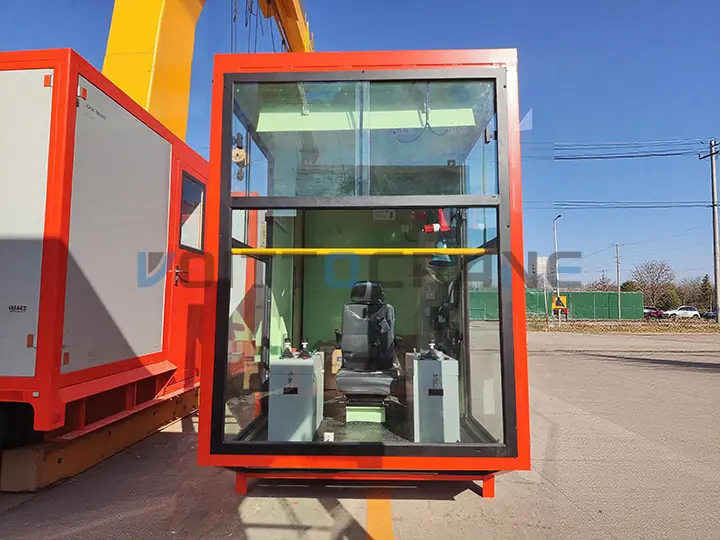
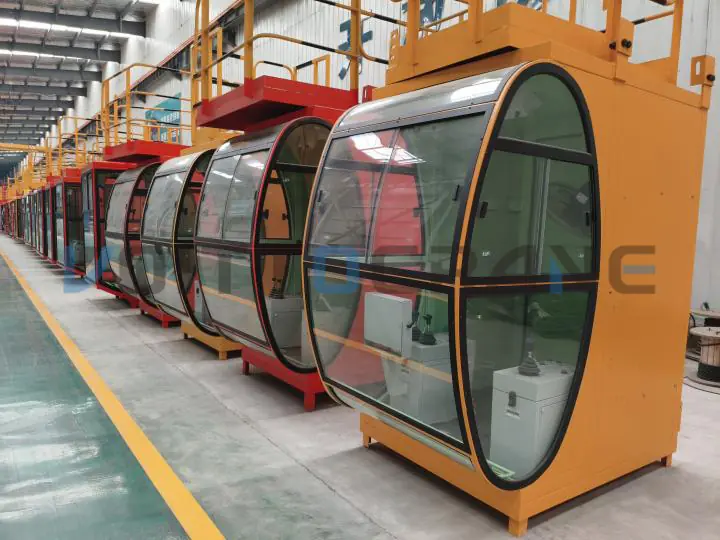
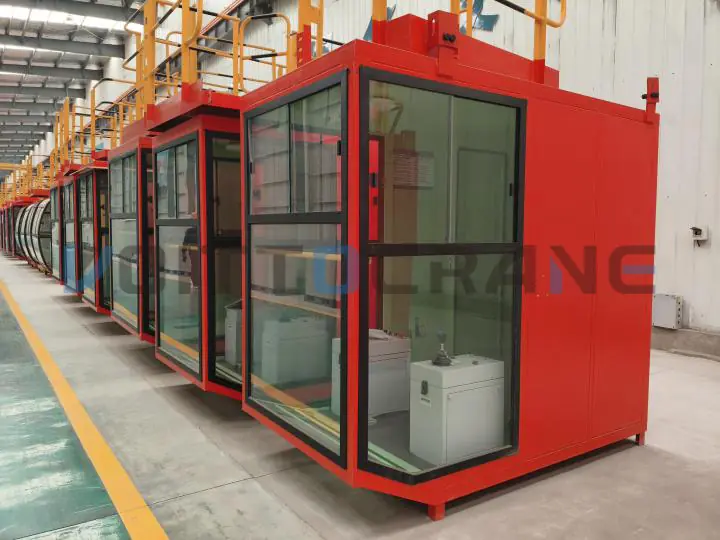
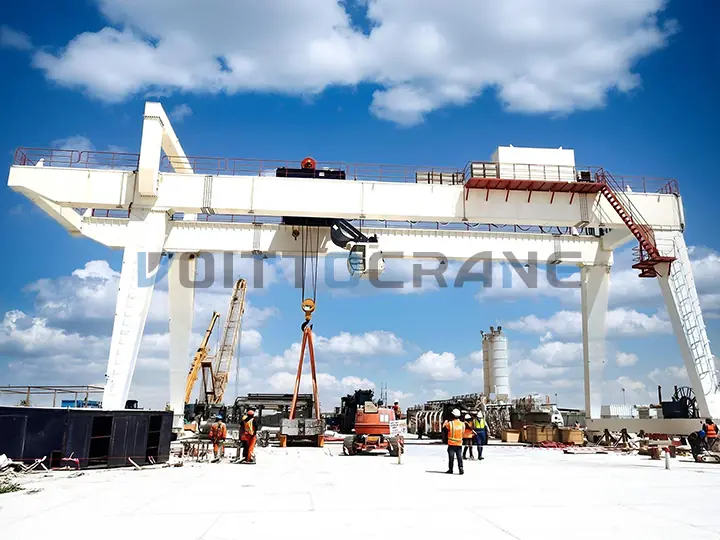
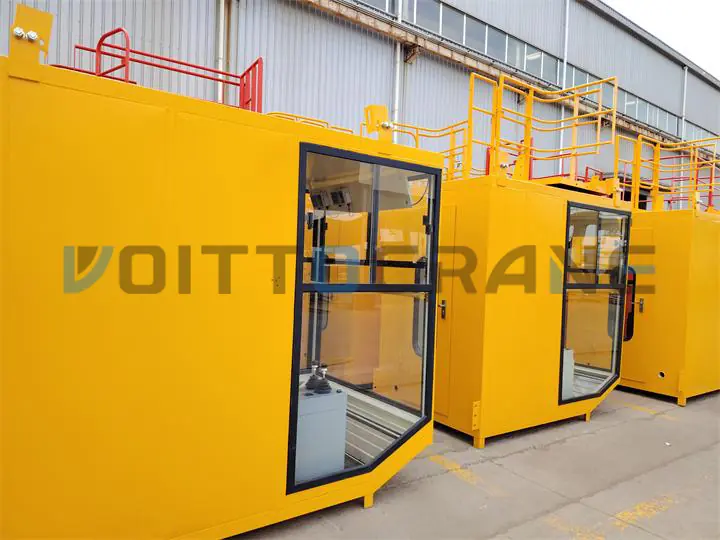
VOITTO crane cabins are supplied for the main girder, end carriage, gantry leg or hoist trolley of the host crane, with the mounting bracket drawn 1:1 to the crane structure. The cabin gives a horizontal viewing angle above 270° plus a bottom floor window, and its floor carries a 10–15 kV high-voltage insulated rubber mat.
A crane cabin (also known as an operator’s cab) is an enclosed control station from which the crane operator can control the hoisting mechanism, the trolley, and the travel of the bridge or gantry. This unit is typically installed on overhead cranes, gantry cranes, metallurgical cranes, or port cranes, and can be positioned on the main girder, end girder, gantry legs, or hoisting trolley. The VOITTO crane cab consists of a welded steel structure shell, safety glass with a bottom viewing window, a suspended seat with a joystick control console, an insulated electrical floor, and an air conditioning system equipped with auxiliary safety devices.
The crane cabin serves as the crane’s control center. From a position at approximately the same height as the load, the operator can control the crane’s operation from within the cab. This eliminates the blind spots that can occur when operating the crane from the ground using pendant controls or a remote control. The main components of the cab include: a welded steel shell and frame; safety glass windows with floor grating; a joystick control console and seat; an electrical cabinet with an insulated floor; as well as a heating, ventilation, and air conditioning (HVAC) system and various safety devices. Inside the sealed and insulated shell, the operator is protected from radiant heat, dust, corrosive fumes, and noise.
The structural shell is fabricated from 2.5 mm to 5.0 mm CNC-bent cold-rolled steel plate conforming to GB/T 700 (Q235B) or GB/T 1591 (Q355B), with a yield strength of 235–355 MPa. Cabins are designed for duty classes M5 to M8 (A5 to A8) and are the standard choice when the host crane exceeds 32 tons capacity or 25 m span, or works multiple shifts in severe-duty service.
Crane cabins are divided into different types based on environmental protection, host crane structure, and mounting mechanism. The four types below cover most overhead, gantry, metallurgical, and port crane installations.
Standard Closed Crane Cabin: The standard closed crane cabin is a fully enclosed welded steel structure with EPDM-sealed doors and windows, designed to keep rain, dust, and drafts out of the operator station. It is the base configuration for indoor EOT cranes and outdoor gantry cranes.
Insulated Metallurgical Crane Cabin: The insulated crane cabin is built for locations near radiant heat. It has a double-wall shell filled with 60–80 mm flame-retardant rock wool, double-glazed heat-reflective glass, a heat shield under the floor, and a high-temperature crane air conditioner that works up to +70°C ambient. A sealed shell reaching IP55/IP65 keeps metallurgical fumes and dust out of the cabin.
Port and Container Gantry Crane Cabin: The port crane cabin has a forward-inclined profile and an enlarged floor-to-ceiling bottom window, which gives the operator a vertical view down to the spreader and the container below. It is blasted to Sa2.5 and coated to ISO 12944 C5-M for salt-laden marine atmospheres, and carries a CMS/HMI touchscreen for crane monitoring.
Fixed Suspended vs. Trolley-Mounted Crane Cabin: A fixed suspended crane cabin is bolted to the end beam or gantry leg and stays at one position on the span. A trolley-mounted crane cabin is carried on the hoist trolley and moves in sync with it, so the operator stays directly above the hook. Cable supply to a moving cabin runs through a festoon or energy chain system. The trolley-mounted type is used for precision positioning on spans longer than 30 m.
A crane cabin consists of five subsystems, each with a defined structural or safety function.
Welded Steel Enclosure and Frame: Constructed from 2.5–5.0 mm Q235B/Q355B steel plates bent using computer numerical control (CNC) and welded to a tubular structural frame; the surface is sandblasted (to Sa2.5 standard) and coated with a zinc-rich epoxy primer and a polyurethane topcoat. This structure is designed to support operators, control consoles, air conditioning units, and other installed loads, transferring these loads to the crane’s main structure via brackets.
Panoramic Glass and Floor Grating: Equipped with 5–8 mm tempered safety glass or 8–12 mm laminated glass, providing a horizontal field of view exceeding 270°; an observation window is also provided at the bottom. The area above the observation window is covered with a removable, heavy-duty steel protective grating (with a load-bearing capacity exceeding 200 kg) to prevent personnel from accidentally stepping through.
Ergonomic Control Console: Equipped with a rotatable (90°–180°) shock-absorbing suspension seat and an integrated dual-axis master controller or cam controller. The console also includes safety foot/handle switches, an emergency stop button, and mounting brackets for a human-machine interface (HMI) or condition monitoring system (CMS) display.
Electrical Cabinet and Insulated Floor: The cab is equipped with an electrical cabinet and a central junction box, with wiring compliant with the IEC 60204-32 standard. The floor features non-slip checkered steel plates and is covered with high-voltage insulated rubber mats rated for 10 kV to 15 kV.
Industrial-Grade HVAC and Auxiliary Safety Equipment: The cab is equipped with a vibration-resistant air conditioning unit designed specifically for cranes, capable of operating normally at ambient temperatures ranging from -40°C to +70°C. Auxiliary equipment includes windshield wipers, sunshades, an intercom system, audible and visual alarms, fire extinguishers, and an emergency escape hammer.
Each VOITTO crane cabin incorporates engineering features that align with FEM 1.001, EN 13557, and OSHA crane operator station safety directives:
VOITTO Crane has designed and manufactured cranes and crane components since 2003 and supplies customers in more than 60 countries. Our crane cabins are CE, ISO, and FEM certified, and each order is approved against a 1:1 CAD drawing before production starts. If you need a crane cabin solution, please feel free to nous contacter.

Alan
Spécialiste des solutions de grue · Voitto Crane
Spécialisés dans les solutions d'exportation de ponts roulants, portiques, grues à flèche, grues portuaires et ponts roulants. Plus de 10 ans d'expérience dans l'accompagnement de clients internationaux : conseils avant-vente, choix de la capacité et configurations sur mesure.
Choose a crane cabin when the crane exceeds 32 tons capacity, 25 m span or 16 m lifting height, works at A6–A8 duty, or when the load path has blind spots or floor-level hazards such as molten metal, fumes, heat, and noise. In clear, single-shift bays under those limits, a wireless remote or pendant is normally enough. For mixed duty, VOITTO supplies the Cabin + Wireless Remote Dual-Control System: the operator controls the crane from the cabin during production and switches to the wireless remote for maintenance, set-up, and close-range hooking.
Yes. We build the replacement crane cabin to your existing bolt pattern, bracket geometry and electrical plugs. You send the old cabin’s drawings or measured photos, we issue a 1:1 CAD drawing for your approval, and production begins after approval. The new cabin bolts to the original mounting points and connects to the existing control cables.
The floor window uses 5–8 mm tempered safety glass or 8–12 mm laminated glass, which holds together on impact instead of falling out as fragments. A removable heavy-duty steel protective foot grate rated for more than 200 kg covers the glass, so the operator cannot step through the opening and the glass does not carry foot loads.
The cabin is pre-wired at the factory per IEC 60204-32: lighting, A/C, console, seat switches, alarms and intercom run to a central junction box on the cabin. On site, the electrician connects the junction box terminals to the crane control panel. For trolley-mounted cabins, the supply and control cables run through a festoon or energy-chain system that moves with the trolley.

Notre équipe de prévente propose des consultations, en adaptant les solutions à vos besoins et à votre environnement.
Offrir des options de personnalisation pour la capacité de levage, la portée et la hauteur de levage, etc. pour répondre à des besoins spécifiques.

Mise à jour des progrès en temps réel : Rapports hebdomadaires et communication avec les PM.
Essais avant livraison : 100% contrôles de charge et de sécurité, rapports détaillés.

Garantie de 3 à 5 ans et remplacement gratuit en cas de défaut de fabrication.
Assistance en ligne 24 heures sur 24, 7 jours sur 7, et assistance sur place pour les problèmes liés aux grues.
Oui, l'expédition internationale et l'assistance à l'exportation sont disponibles pour les clients internationaux.
Le temps de transit varie en fonction de nombreux facteurs, notamment la destination des marchandises, la distance, la méthode d'expédition et le fournisseur de services d'expédition, etc. D'une manière générale, les envois internationaux peuvent prendre environ un mois.
Nous offrons un service après-vente complet, comprenant une maintenance régulière, une assistance technique rapide et la fourniture de pièces détachées. La période de garantie standard est d'un an, avec des options d'extension en fonction de vos besoins.


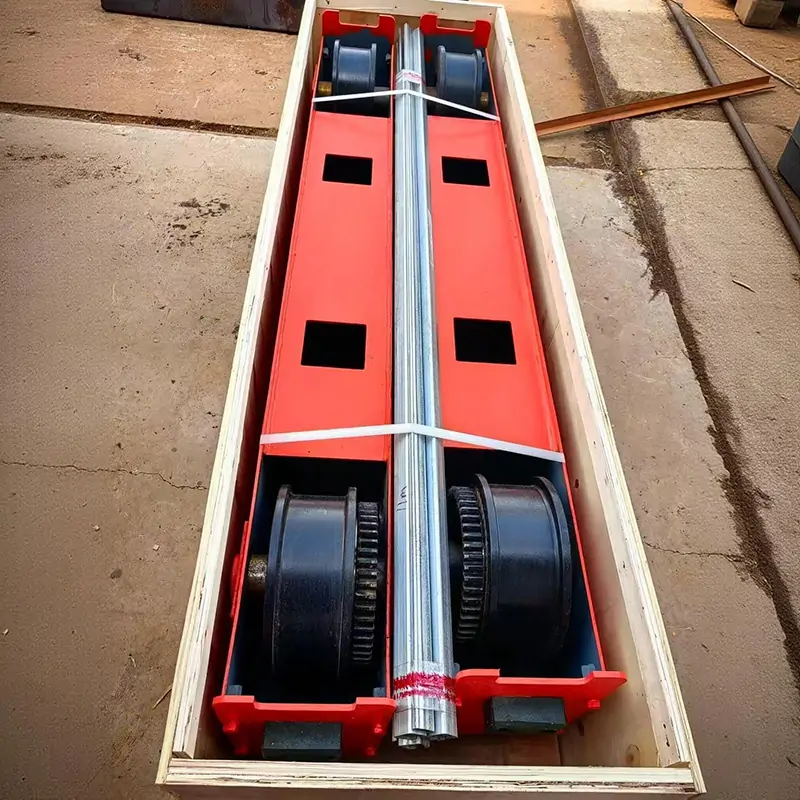
Une grue à portique est un équipement de levage de matériaux de grande taille. Elle est couramment utilisée dans les chantiers de construction, les terminaux portuaires, les usines, les entrepôts à ciel ouvert et les chantiers navals. Cet équipement de levage industriel est assemblé à partir de diverses pièces clés, ce qui facilite également son transport depuis la production jusqu'à l'utilisation sur le site, ainsi que l'entretien et la réparation ultérieurs. Cet article vous aidera à comprendre les principales pièces d'une grue portique, à analyser leurs caractéristiques structurelles et leurs principes fonctionnels, afin de vous aider à mieux comprendre ce système de grue à usage intensif et ses composants. Quelles sont les pièces d'une grue portique ? Une grue à portique comprend plusieurs éléments clés, notamment la poutre principale, les béquilles, les rails, le mécanisme de translation, le mécanisme de levage et le système électrique. D'autres éléments importants sont le contrôleur ou la cabine de l'opérateur, les poulies, les freins et divers dispositifs de sécurité. Ces composants travaillent ensemble pour déplacer les marchandises d'un point A à un point B. Ce qui suit vous présentera la description fonctionnelle des pièces de la grue à portique. Diagramme des pièces d'une grue portique Composants et fonctions des différents types de grues portiques Grue portique portable : Description structurelle Le portique portable...
Dans la production industrielle moderne et la construction d'ouvrages d'art à grande échelle, le pont roulant, l'équipement de base pour la manutention des matériaux, grâce à son efficacité élevée et à ses performances stables, est devenu le choix préféré des ateliers, des entrepôts, etc. Comme nous le savons tous, le pont roulant est assemblé à partir de différentes pièces, ce qui facilite également son transport depuis la production jusqu'à l'utilisation sur le site, ainsi que l'entretien et la réparation ultérieurs. Cet article vous aidera à comprendre les principales pièces du pont roulant, à analyser leurs caractéristiques structurelles et leurs principes fonctionnels, afin de vous aider à acquérir une compréhension plus complète du pont roulant et de ses composants. Pièces du pont roulant Dans la production industrielle moderne et la construction d'ingénierie à grande échelle, le pont roulant, l'équipement de base pour la manutention des matériaux, avec son efficacité élevée et ses performances stables, est devenu le choix préféré des ateliers, des entrepôts, etc. Comme nous le savons tous, le pont roulant est assemblé à partir de différentes pièces, ce qui facilite également son transport depuis la production jusqu'à l'utilisation sur le site, ainsi que l'entretien et la réparation ultérieurs. Cet article vous aidera à comprendre les principales pièces des ponts roulants, à analyser leurs caractéristiques structurelles et leurs principes fonctionnels, afin de vous aider à...
Un pont roulant est un type d'équipement de manutention largement utilisé dans les ateliers, les entrepôts et les usines, principalement chargé du levage, du transport horizontal, du chargement et du déchargement des matières premières, des produits finis et des produits semi-finis. Son fonctionnement efficace et sûr est indissociable de la coordination et de la coopération de divers composants clés du pont roulant, chacun remplissant une fonction spécifique. Par conséquent, la compréhension des composants du pont roulant permet non seulement d'utiliser et d'entretenir correctement l'équipement, mais aussi d'aider les usines à améliorer leur efficacité et leur sécurité de production. Cet article présente les composants du pont roulant, ainsi que leur définition et leurs fonctions, afin de vous aider à vous familiariser avec eux et à les comprendre. Quels sont les composants d'un pont roulant ? Un pont roulant se compose d'une poutre principale, d'une poutre d'extrémité, d'un mécanisme de déplacement, d'un mécanisme de fonctionnement du chariot, d'un mécanisme de levage, d'un système électrique et de dispositifs de sécurité. Ces pièces du pont roulant fonctionnent ensemble pour déplacer des marchandises d'un point A à un point B. Vous trouverez ci-dessous des images des différents composants du pont roulant et leur définition. Poutre principale La poutre principale...
Un pont roulant, souvent appelé grue à pont, est un système de levage industriel essentiel pour la manutention de charges lourdes dans des installations telles que les usines, les ports et les entrepôts. Il existe des ponts roulants monopoutres (pour les charges légères, 1-32 tonnes), des ponts roulants bipoutres (pour les tâches plus lourdes, 5-500 tonnes) ou des ponts roulants flexibles KBK Light (pour les lignes de traitement, moins de 5 tonnes). Il utilise une structure aérienne pour économiser de l'espace et éviter l'encombrement au sol. Cet article se penche ensuite sur la définition, l'image, l'application, la structure et les spécifications techniques d'un pont roulant afin de vous aider à en avoir une compréhension globale. Qu'est-ce qu'un pont roulant ? Un pont roulant est un appareil de levage lourd installé au-dessus des zones de travail (usines, entrepôts, etc.) sur des rails aériens fixes. Contrairement aux grues mobiles, il fonctionne le long d'une trajectoire fixe, ce qui permet d'économiser de l'espace au sol. Ses composants de base comprennent des poutres principales (la structure porteuse), des bogies d'extrémité (pour le mouvement longitudinal), un chariot de levage (pour le mouvement latéral) et un mécanisme de levage (pour le levage vertical), ainsi qu'un système de contrôle (pour un fonctionnement facile et précis). La structure principale d'un pont roulant comprend une poutre principale enjambant le...
La solution de levage conçue pour l'échelle Certains travaux de levage exigent plus qu'une grue fixe ne peut offrir. Lorsque les charges sont lourdes, que les portées sont larges et que le travail s'effectue à l'extérieur ou sur de grandes surfaces ouvertes, une grue portique est souvent la seule solution pratique. Des terminaux de conteneurs portuaires aux sites d'assemblage d'éoliennes, les grues à portique assurent le déplacement de matériaux à une échelle que peu d'autres systèmes peuvent égaler. Leur structure stable, leur capacité de charge élevée et leur vaste champ d'action en font une pièce maîtresse de l'équipement de l'industrie lourde dans le monde entier. Ce guide présente tout ce qu'il faut savoir sur les grues à portique : ce qu'elles sont, comment elles fonctionnent, quels sont les types existants, de quoi elles sont faites et où chaque configuration est la plus performante. Qu'est-ce qu'une grue portique ? Une grue à portique est un grand système de manutention de matériaux construit autour d'une structure à portique. Deux jambes de support verticales portent une poutre principale horizontale à travers la zone de travail. Cette combinaison de jambes et de poutres forme un cadre de porte - ou portique - qui donne son nom à l'équipement. L'ensemble de la structure se déplace sur des rails au niveau du sol, le chariot et le palan se déplaçant...

 English English
 Español
 Português
 العربية
 Français
 Русский