
A pont roulant bipoutre Le coût est généralement compris entre $7,900 and $1,772,500, depending on capacity, span, configuration, and duty class. Light-duty units — a 5-ton or 10-ton standard double girder — start at $7,900 and $8,500 respectively. Mid-range QD hook configurations covering 5–50 tons run $23,000–$149,000. Heavy-duty units above 100 tons start at $200,000, with the largest 320–800-ton configurations reaching $1,772,500 (all figures are ex-works market reference prices from Voitto Crane, excluding shipping and installation).
If your operation regularly lifts loads above 20 tons, requires spans beyond 25 meters, or needs the hook to reach within 300–600 mm of the building end wall, a double girder crane is almost certainly the right direction. Below that threshold, a single girder crane may serve you more economically.
This guide walks you through the complete decision process: what separates a double girder design from the alternatives, how specs translate into real prices, what certifications your import order must carry, and the five variables you need to confirm before sending a single RFQ.
- 1 Quick Reference: Double Girder vs. Single Girder Overhead Crane
- 2 What Makes a Double Girder Overhead Crane the Right Choice
- 3 Double Girder Overhead Crane Specs and Configurations
- 4 Double Girder Overhead Crane Pricing Guide
- 5 Certifications and Compliance for Import Buyers
- 6 The Pre-RFQ Checklist: What to Confirm Before You Contact a Supplier
- 7 Conclusion
-
8
FAQ
- 8.1 Q1:What is the price of a double girder overhead crane?
- 8.2 Q2:When should I choose a double girder crane over a single girder crane?
- 8.3 Q3:What duty class do I need for my double girder overhead crane?
- 8.4 Q4:What certifications should I require from a double girder overhead crane supplier?
- 8.5 Q5:How much does span affect the cost of a double girder overhead crane?
Quick Reference: Double Girder vs. Single Girder Overhead Crane
| Paramètres | Double poutre | Monopoutre |
|---|---|---|
| Plage de capacité | 5–800 ton | 1–32 ton |
| Plage de portée | 10-50 m | 7.5-31.5 m |
| Hauteur de levage | 10–40 m | 6–30 m |
| Hook approach (end) | 300–600 mm | 600–1,200 mm |
| Min. building clearance | ~5.5 m | ~3.5 m (chain hoist) |
| Meilleur pour | Heavy loads, long spans, high duty cycle, precision end-approach | Light-to-medium loads, standard shops, budget-sensitive projects |
Bottom line: Standard double girder units start at roughly $8,000 for light configurations; heavy-duty QD-type cranes above 50 tons start at $80,000 and scale to over $1.7 million at 800 tons. The cost gap vs. single girder widens significantly above 20 tons, where the double girder’s structural advantages become engineering necessities rather than optional upgrades.
Obtenir un devis

What Makes a Double Girder Overhead Crane the Right Choice
How the Two-Girder Structure Changes the Physics of Lifting
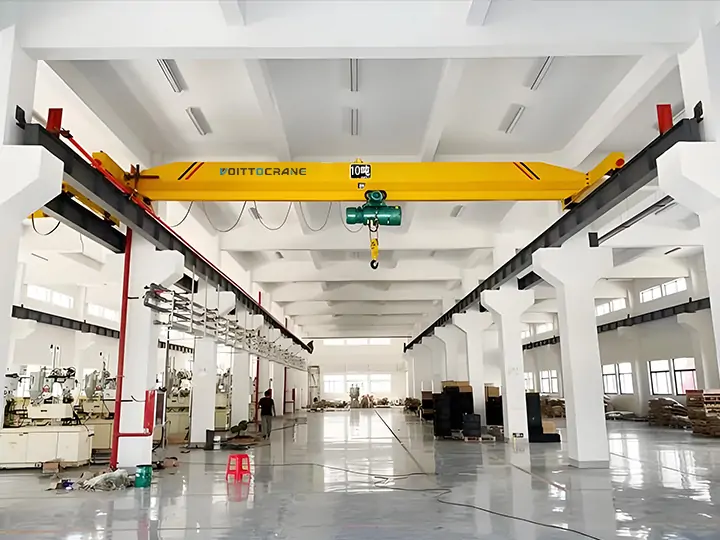
A double girder overhead crane carries its load between two parallel main girders, which allows the hoist trolley to run along top-mounted rails rather than hanging beneath a single beam. This one structural difference cascades into three practical advantages: higher rigidity under load, lower mid-span deflection, and a dramatically closer hook approach to the runway ends.
Structurally, two girders of equivalent steel can carry roughly twice the bending moment of a single girder at the same span — which is why double girder designs dominate the 20-ton-and-above market. At a 28-meter span, for example, mid-span deflection on a single girder crane under rated load will typically exceed L/800 (the FEM 1.001 general design limit), requiring beam upsizing that quickly pushes cost past the double girder option anyway. The two-girder bridge sidesteps this by distributing the bending load across two sections, keeping deflection within standard limits without excessive steel.
The second advantage is hook approach. Because the hoist sits between — not below — the girders, the hook can travel to within 300–600 mm of the runway end beam. That matters enormously in process environments where operators must lift loads directly adjacent to loading stations, presses, or building columns. On a single girder crane, the same clearance requirement often cannot be met without a custom low-headroom hoist at significant added cost.
When to Choose Double Girder — and When Not To
Double girder is the correct structural choice when any one of four conditions is met: load above 20 tons, span above 25 meters, lifting height above 20 meters, or hook approach requirement below 600 mm from the runway end.
Below all four thresholds simultaneously, a single girder crane will almost always deliver better value. The single girder’s lighter dead weight reduces wheel loads on your runway structure — a meaningful saving if the building is not purpose-built for heavy crane service. It also installs faster and requires fewer people to erect. For a facility doing 5-ton lifts across a 15-meter span in a general workshop, the double girder’s structural advantages do not translate into operational gains, and the price premium is hard to justify.
The overlap zone — roughly 10 to 20 tons — is where the decision becomes genuinely case-specific. At 10 tons and a 22-meter span, a single girder design may still be structurally sound, but the beam will be heavier and stiffer than optimal. At 15 tons, 28 meters, duty class A5, the double girder is almost always the more cost-efficient total solution once you factor in the structural cost of a heavy single girder and the wheel load implications for the runway.
Double Girder Overhead Crane Specs and Configurations
Capacity, Span, and Lifting Height: The Three Primary Inputs
A standard double girder overhead crane covers capacities from 5 tons to 800 tons, spans from 10 to 50 meters, and lifting heights from 10 to 40 meters — and every combination of these three variables drives a different structural solution. Treat them as interdependent, not independent.
Span has a nonlinear effect on cost: moving from a 22-meter to a 28-meter span on a 20-ton crane typically adds 15–25% to the main girder cost alone, because the girder section must deepen to control deflection. Lifting height adds cost more linearly — each additional 5 meters of lift height adds hoist rope length, drum length, and structural height to the end trucks. Before finalizing either figure, measure your actual building dimensions (rail top to floor, and between runway centerlines), not nominal dimensions from drawings. Site-measured values and as-built drawings frequently differ by 200–500 mm — enough to invalidate an order if not caught pre-fabrication.
Duty Class: The Specification Most Buyers Get Wrong
Duty class is the single variable most likely to cause a budget overrun or premature crane failure if selected incorrectly. It describes how intensively the crane works over its design life, combining two factors: the load spectrum (how often the crane operates near its rated capacity) and the number of operating cycles. Voitto’s configurations follow the Chinese GB/ISO A-class notation, which maps directly to FEM and ISO 4301 classification.
The practical classes most relevant to industrial buyers are A3 through A8. A3–A4 is designed for light, occasional use — maintenance lifts, warehousing, a handful of cycles per shift. A5–A6 handles medium-heavy duty: one to two production shifts, moderate load spectrum, typical for manufacturing or fabrication shops. A7–A8 is built for intensive multi-shift production — steel processing, foundry, continuous heavy manufacturing. Specifying A4 where A6 is needed does not simply mean earlier wear; it means motors, gearboxes, brakes, and structural joints are all undersized for the actual workload from day one.
The cost implication is concrete: moving from A4 to A6 on a 20-ton double girder crane typically adds 20–35% to the structural and drivetrain cost. That uplift is almost always less than the cost of a premature rebuild or a structural inspection failure at year three. Specify duty class based on your actual shift pattern and load profile, not on a conservative instinct to keep the initial price down.
Hook Approach, Building Clearance, and Electrical Supply
Three site variables that are easy to overlook in the RFQ stage consistently cause the most expensive surprises on arrival.
Hook approach (minimum end approach) determines how close the hook can travel to the end wall or runway column. On a double girder crane, this typically ranges from 300 to 600 mm depending on hoist size and span. If your process stations are positioned within 400 mm of the runway end, confirm this dimension explicitly with your supplier before approving the general arrangement drawing — not after.
Building clearance is the second critical variable. Double girder cranes with wire rope hoists typically require 5.5 meters or more of clear height from floor to the underside of the runway rail. In a building with 6 meters of total interior height and existing structural beams, this can be impossibly tight. Measure actual clear height at the runway rail mounting point, not at the roof apex.
Electrical supply compatibility is the third. Standard Chinese factory supply is 380V / 50Hz / 3-phase. North American projects require 460V / 60Hz; Middle Eastern sites often require 415V / 50Hz. Motor rewinding or replacement for a non-standard voltage, discovered after shipment, adds cost, delay, and warranty uncertainty. Confirm supply voltage in the RFQ, and have it specified in the technical datasheet you approve before production begins.
Double Girder Overhead Crane Pricing Guide
Market Reference Prices by Model and Capacity
The table below reflects Voitto Crane ex-works prices — uninstalled, standard configuration, excluding shipping, taxes, and optional features such as operator cabin, radio remote, or special environmental treatment.
| Model / Type | Capacité | Portée (m) | Fourchette de prix |
|---|---|---|---|
| Standard DG (5T) | 5 tonnes | 10.5–31.5 | $8,500–$18,000 |
| Standard DG (10T) | 10 tonnes | 10.5–31.5 | $7,900–$15,000 |
| LH Electric Hoist DG | 3–32 ton | 10.5–31.5 | $22,000–$78,000 |
| QD Hook Double Girder | 5–50 ton | 10.5–50 | $23,000–$149,000 |
| QD Hook Double Girder | 50 à 100 tonnes | 10.5–50 | $80,000–$250,000 |
| QD Hook Double Girder | 100 à 320 tonnes | 10.5–50 | $200,000–$600,000 |
| QD Hook Double Girder | 320–800 ton | 10.5–50 | $600,000–$1,772,500 |
| QB Explosion-proof DG | 5–320 ton | 10.5–37.5 | $24,000–$533,250 |
| QY Insulation DG | 5–320 ton | 10.5–40 | $24,500–$533,750 |
| QZ Grab DG | 5–32 ton | 10.5–40 | $23,000–$80,000 |
| QC Electromagnetic DG | 5–32 ton | 10.5–40 | $23,500–$80,500 |
| DG Workstation Crane | 0.1–3.2 ton | 5–15 | $8,000–$35,000 |
Le QD hook type is the most widely ordered configuration and the best baseline for budget planning. The LH electric hoist model trades some heavy-duty capacity for a more compact drivetrain — a practical choice for 3–32 ton applications where the full winch-trolley system is over-specified.


What Drives the Final Price Up
Five variables consistently push a quote above the band midpoint, and most real projects involve at least two of them.
Classe de service is the largest single variable after capacity and span. Moving from A4 to A6 on the same 20-ton frame typically adds 20–35% to structural and drivetrain cost; A7–A8 adds further. Specify based on your actual shift pattern, not a conservative instinct to save upfront.
Special environments carry a fixed premium: explosion-proof (QB) and insulation (QY) models add roughly 20–50% over a standard QD configuration of the same capacity, reflecting the cost of certified components and additional engineering.
Control method escalates in three steps: pendant control is the baseline; radio remote adds approximately $600–$2,200 for standard multi-axis systems; an operator cabin adds $3,000–$8,000 depending on HVAC specification and access configuration.
Span above 28 meters requires deeper main girder sections and typically adds 15–25% to bridge cost alone, independent of capacity.
Hoist type follows a clear cost hierarchy: standard wire rope hoist is the baseline, European FEM-class hoist adds cost and compliance documentation, and an open winch trolley (used on the QD/QE heavy series) is the most expensive but the correct choice for high-capacity, high-cycle applications.
Certifications and Compliance for Import Buyers
Which Standards and Certifications Apply to Your Order
The certification requirements for a double girder overhead crane depend on your destination market, but three layers apply to virtually all international import buyers and should be non-negotiable in your supplier evaluation.
CE Marking and the EU Machinery Directive (2006/42/EC) are required for any crane destined for EU member states, and are increasingly required by insurance providers and facility risk assessors worldwide even outside the EU. CE marking confirms that the crane has been designed and built to meet essential safety requirements — it is not a quality label; it is a legal prerequisite for placing the equipment in service in covered markets.
FEM 1.001 (design rules for series lifting equipment) and ISO 4301 (crane classification) define the structural and duty class methodology used in engineering the crane. Requesting that your supplier reference these standards in the technical documentation ensures the duty class specification was applied consistently with the design calculation, not arbitrarily assigned.
ISO 9001 quality management system certification for the manufacturer is the operational backstop: it governs the consistency of fabrication, inspection, and documentation processes. A manufacturer without ISO 9001 certification cannot provide meaningful process assurance on a custom-engineered product.
For buyers in the Eurasian Customs Union (Russia, Kazakhstan, Belarus, Armenia, Kyrgyzstan), EAC (TR CU) certification is additionally required. For US-based facilities, crane operation must comply with OSHA 29 CFR 1910.179, which governs inspection intervals, rated load testing, and operator qualification.
How to Verify Compliance Before Releasing Payment
Demanding a verbal confirmation of CE or FEM compliance from a supplier is insufficient — compliance is demonstrated through documents, not declarations. Before releasing payment or approving fabrication, request and verify the following four items.
First, an Déclaration de conformité CE referencing the specific serial number of your unit, identifying the applicable Directives and standards, and signed by an authorized representative of the manufacturer. A generic template with no serial number is not acceptable. Second, a Technical Construction File (TCF) confirming that the crane was engineered to the declared duty class and span — not simply certified by analogy to a similar unit. Third, overload test and rated load test certificates, typically conducted at 125% of rated load for static testing and 110% for dynamic testing per FEM/ISO practice. Fourth, an Certificat ISO 9001 for the manufacturing facility, with scope covering crane design and manufacturing.
A supplier unwilling to provide these four documents before order placement is indicating a compliance gap — regardless of what their marketing materials state.
The Pre-RFQ Checklist: What to Confirm Before You Contact a Supplier
Four Technical Variables That Determine Your Price
Every double girder overhead crane is built to order. The four variables below are the minimum inputs your supplier needs to produce a meaningful quotation. Having all four ready when you first make contact cuts the quoting cycle from several days to hours and eliminates the most common source of post-quote price revisions.
Lifting capacity (tons): Use the maximum load you will ever handle in normal operation, not an average. Do not build in an informal safety buffer — duty class accounts for the load spectrum; inflating the rated capacity means paying for structural steel and hoist components you will never use.
Span (meters): This is the center-to-center distance between the runway rails. Measure it from your building structure, not from drawings — as-built dimensions frequently differ from design dimensions by 200–500 mm.
Lifting height (meters): The vertical distance from floor level to the highest hook position needed in operation. Add clearance for the load, rigging hardware, and any underhung fixtures. A common error is specifying hook height from the crane rail without accounting for the load itself.
Duty class (A-class / FEM M-class): Requires honest input on shift pattern and load frequency. If your team needs help selecting the correct class, ask the supplier to walk through the FEM classification table with you before the order is placed — any reputable supplier will do this without charge.
Site Variables Your Supplier Must Know Before Fabrication
Beyond the four core technical inputs, three site variables must be confirmed before the supplier finalizes the general arrangement drawing for your approval.
Building clear height at the runway rail mounting point (not at the roof peak), electrical supply voltage and frequency, and whether an operator cabin is required — and if so, with what access configuration and whether air conditioning is needed. All three are cheaper to specify correctly at order than to correct after fabrication.
Always request and approve a General Arrangement (GA) drawing before releasing the production order. The GA drawing shows external dimensions, wheel base, buffer positions, runway rail requirements, and end approach dimensions. It is the single most effective tool for catching dimensional incompatibilities before they become field problems.
Conclusion
A double girder overhead crane is the right investment when your operation genuinely needs the structural capacity, span, or hook approach that the design provides — and an unnecessary expense when it doesn’t. Loads above 20 tons, spans above 25 meters, lifting heights above 20 meters, or hook-approach requirements below 600 mm each independently point to a double girder solution. For Voitto double girder overhead crane configurations covering 5 to 800 tons with spans up to 50 meters, the practical path is to confirm your four technical variables first, then request a GA drawing before approving production.
Three actions before your next step:
- Confirm lifting capacity, span, lift height, and duty class from your actual site measurements — not estimates.
- Request CE/FEM compliance documentation and ISO 9001 certificate from any supplier you shortlist.
- Approve a GA drawing before releasing the production order.

Alan
Spécialiste des solutions de grue · Voitto Crane
Spécialisé dans les solutions d'exportation de ponts roulants, de portiques, de grues à flèche, de grues portuaires et de grues EOT. Plus de 10 ans d'aide aux clients internationaux en matière de consultation avant la vente, de sélection de la capacité et de configurations spécifiques au site.
FAQ
Q1:What is the price of a double girder overhead crane?
Prices range from around $7,900 for a standard 10-ton unit to over $1,770,000 for an 800-ton heavy-duty configuration. The most common mid-range transactions — QD hook double girder cranes in the 5–50 ton range — fall between $23,000 and $149,000 ex-works. Special-purpose models (explosion-proof, insulation, grab, electromagnetic) carry a 20–50% premium over a standard QD unit of equivalent capacity. All figures are market reference prices excluding shipping, installation, and taxes; contact Voitto Crane with your exact specifications for a project quote.
Q2:When should I choose a double girder crane over a single girder crane?
Choose a double girder crane when your load exceeds 20 tons, your span exceeds 25 meters, your lifting height exceeds 20 meters, or your process requires the hook within 600 mm of the runway end. Below all four thresholds simultaneously, a single girder crane will usually deliver better cost-to-performance value. The 10–20 ton range is a genuine overlap zone where duty class and span together determine the optimal choice.
Q3:What duty class do I need for my double girder overhead crane?
Duty class depends on your actual shift pattern and load frequency, not your rated capacity. A3–A4 suits occasional or light-duty use (maintenance lifts, warehousing). A5–A6 covers medium-heavy manufacturing with one to two shifts. A7–A8 is required for intensive multi-shift production environments such as steel processing or foundry work. Underspecifying duty class is one of the most common causes of premature crane failure — always confirm your shift hours and load spectrum with your supplier before finalizing the specification.
Q4:What certifications should I require from a double girder overhead crane supplier?
At minimum, require an EC Declaration of Conformity (with your unit’s serial number), a load test certificate confirming 125% static and 110% dynamic overload testing, a Technical Construction File confirming FEM/ISO design compliance, and a valid ISO 9001 manufacturing certificate. For the EU market, CE marking under Machinery Directive 2006/42/EC is a legal requirement. For the Eurasian Customs Union, EAC certification is additionally required.
Q5:How much does span affect the cost of a double girder overhead crane?
Span has a disproportionate effect on girder cost. Moving from a 22-meter to a 28-meter span on a 20-ton double girder crane typically increases main girder cost by 15–25%, because the beam must deepen to maintain deflection within FEM/ISO limits. Non-standard spans above 35 meters generally require custom engineering review and add further cost. Always measure the as-built rail centerline distance before specifying span — a 200–500 mm discrepancy between drawing and field dimension is common and can require costly rework if caught after fabrication.




 English
  Español
  Português
  العربية
  Français
  Русский