
Motorized gantry cranes for sale start at around $9,000 for a compact semi-gantry unit and scale past $800,000 for heavy-duty double girder configurations. The price gap matters less than the structural decision you make before requesting a quote — picking the wrong crane type, or under-specifying duty class, creates maintenance costs that typically outrun any initial saving within two years of operation.
Most procurement teams know their required lifting capacity. The harder parameters — duty class, hook clearance, drive system, and compliance certification for the destination country — are where specification errors concentrate. Getting those right determines whether the crane you buy actually matches the workload you’re running it under.
This guide covers the four main motorized gantry crane categories available from Voitto Crane, with real published specifications, a parameter-by-parameter selection framework, a 2026 price reference table, and a compliance checklist covering CE, FEM, and ISO standards.
- 1 Quick Reference: Motorized Gantry Crane Types at a Glance
- 2 Types of Motorized Gantry Cranes: What Each Category Covers
- 3 How to Choose: 4 Parameters That Define Fit
- 4 2026 Price Reference Table
- 5 Certifications and Compliance Checklist
- 6 Conclusion
-
7
FAQ
- 7.1 Q1:What is a motorized gantry crane and how is it different from a manual type?
- 7.2 Q2:How much does a motorized gantry crane for sale cost?
- 7.3 Q3:What duty class should I specify?
- 7.4 Q4:What is the difference between a single girder and a double girder gantry crane?
- 7.5 Q5:When should I choose a semi-gantry instead of a full gantry?
- 7.6 Q5:What certifications should I require from the supplier?
Quick Reference: Motorized Gantry Crane Types at a Glance
| Catégorie | Plage de capacité | La portée | Utilisation typique |
|---|---|---|---|
| Monopoutre | 1–32 ton | 5–40 m | Workshops, yards, outdoor operations |
| Double poutre | 5–500 ton | 6-40 m | Heavy manufacturing, steel, infrastructure |
| Semi-Gantry | 1–32 ton | 5-35 m | Confined workshops, production lines |
| Portable / Mobile | 0.25–10 ton | 2–30 m | Flexible, temporary, or light-duty sites |
Parameters based on Voitto Crane standard product configurations. Final specifications subject to engineering confirmation for each project.
Looking for a motorized gantry crane that matches your capacity and span? Contact Voitto Crane — get a detailed quote within 24 hours.
Obtenir un devisTypes of Motorized Gantry Cranes: What Each Category Covers
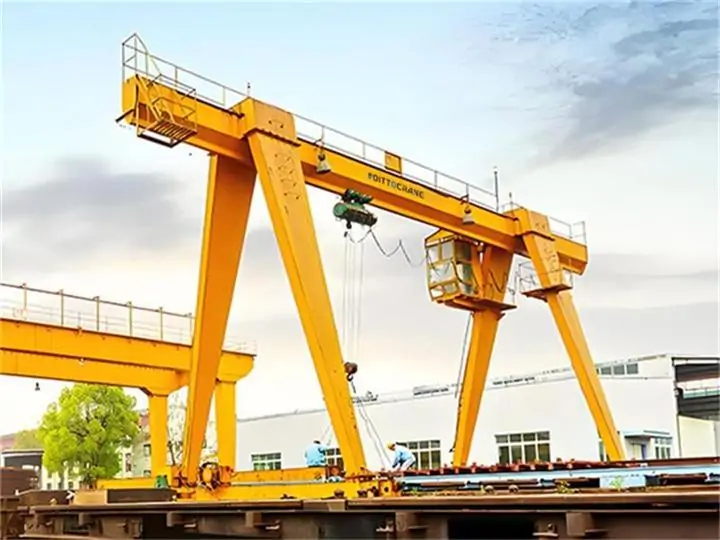

1. Single Girder Motorized Gantry Crane (1–32 Ton)
Single girder motorized gantry cranes are the broadest category in Voitto’s range and the most cost-efficient starting point for facilities with moderate lifting cycles — typically A4 or A5 duty class (up to 8–10 hours of active lifting per day at medium load fractions).
The category covers several structural configurations suited to different site conditions. Box girder designs (MH Box type) offer high rigidity and are the standard choice for manufacturing plants and logistics facilities with frequent but varied loading. Truss girder designs reduce structural weight and deliver better wind resistance for outdoor yards — the right call for open-span installations in areas with significant wind loading, and where greater lifting height (up to 24 m) is required. L-type designs use an inclined outrigger leg to maximize clearance beneath the crane, allowing trucks or railcars to pass through during operations.
Across all single girder configurations, capacity runs 1–32 tons with spans from 5 to 40 m and lifting heights from 6 to 24 m. Work duty is typically A5, reflecting regular production use at moderate to high load fractions. Travel speeds reach 20–40 m/min on faster configurations.
Single girder cranes are the right starting point for most workshops, steel yards, precast facilities, and general logistics operations. They become the wrong choice when duty class exceeds A5, when lifting cycles are counted in hundreds per shift, or when hook clearance requirements can’t be met within the building’s eave height — at which point double girder is the correct direction.
Price reference: $11,000 – $88,000 (EXW China, depending on capacity, span, and configuration)
2. Double Girder Motorized Gantry Crane (5–500 Ton)
Double girder motorized gantry cranes use two parallel main girders, with the hoist trolley running between them rather than hanging below. This structural arrangement has three practical consequences.
First, hook approach height improves significantly. Because the hoist sits between the girders, a given building height yields more usable lift — in a 10 m facility, a double girder crane may deliver 7.5–8 m of hook travel where a single girder would give 6–6.5 m. For operations lifting tall molds, dies, or stacked structural sections, that additional headroom is often the deciding factor.
Second, structural deflection under load decreases. Two girders distribute load more uniformly, reducing mid-span sag and improving positioning accuracy when setting heavy components with tight tolerances — relevant to steel fabrication, mold shops, and power plant maintenance.
Third, double girder designs accommodate heavier duty classes — A5 through A7 — that are structurally inappropriate for single girder construction. Any operation cycling loads more than a few hundred times per day should start from double girder as the baseline, not as an upgrade.
Voitto’s double girder range covers 5–500 tons with spans to 40 m and lifting heights to 30 m. The MG Heavy Duty Trolley configuration extends this further with span options up to 35 m and lifting height to 15 m, suited to heavy outdoor industrial applications. Truss double girder variants are available where structural weight reduction and wind resistance are priorities for outdoor high-span installations.
Price reference: $35,000 – $800,000+ (EXW China, depending on capacity, span, and duty class)

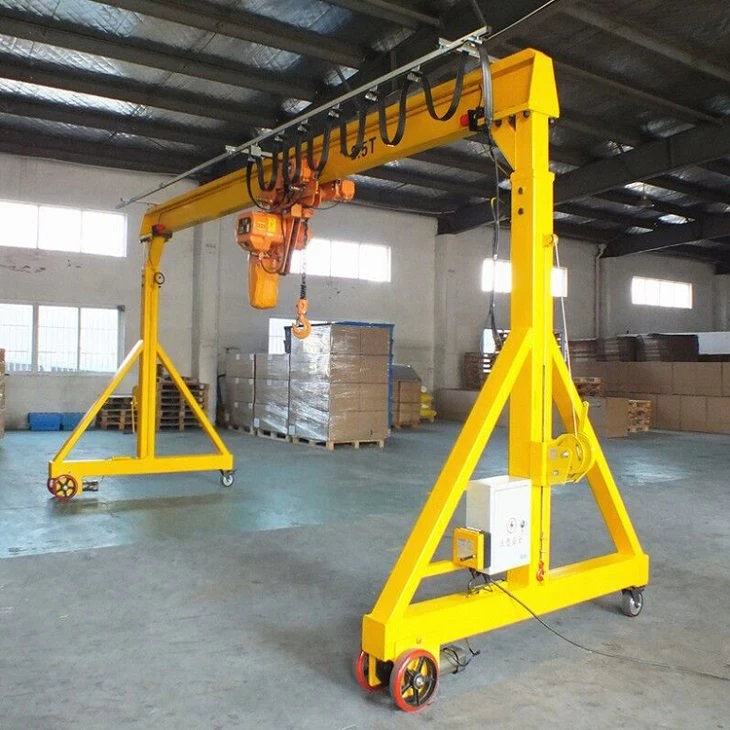
3. Semi-Gantry Crane (1–32 Ton)
Ponts roulants semi-portiques solve a specific layout problem: one end of the bridge runs on an overhead rail fixed to the building structure, while the other end is supported by a ground leg that travels on a floor-level rail. This halves the ground-level infrastructure requirement compared to a full gantry and reduces the structural steel needed for the crane itself.
The practical result is a crane that fits inside workshops where the building structure can carry one side of the crane load, where floor space is constrained, or where the investment in bilateral ground rail foundations isn’t justified by the operating requirements. Production lines in automotive and general manufacturing facilities are the most common application. Confined workshop bays where a full gantry’s leg clearance would obstruct material flow are another.
Voitto’s semi-gantry range covers 1–32 tons with spans from 5 to 35 m and lifting heights from 4 to 24 m, across both single girder and standard semi-gantry configurations. Work duty ranges from A4 (lighter production cycles) to A5 (regular multi-shift operations). The single girder semi-gantry at 1–20 tons is the entry-level configuration; the full semi-gantry at 2–32 tons covers heavier production loads with greater span flexibility.
The most common selection error with semi-gantry cranes is assuming the building structure can carry the overhead rail without a structural assessment. Before specifying a semi-gantry, confirm that the building column or wall to which the overhead rail will be fixed has been structurally checked for the combined crane and load reaction — this is a pre-specification step, not a post-order one.
Price reference: $9,000 – $60,000 (EXW China, depending on capacity and span)
4. Portable and Mobile Gantry Crane (0.25–10 Ton)
Portable and mobile gantry cranes cover the segment of the market where a fixed crane installation isn’t warranted — either because the lifting need is light and intermittent, the site is temporary, or the load needs to be moved between locations that fixed infrastructure can’t serve.
The category includes several distinct configurations. Portable steel gantry cranes (0.5–10 tons) are bolt-together or pin-assembled structures that can be relocated within a facility without civil work. Portable aluminum gantry cranes (0.25–3 tons) are lighter still — a single person can typically move and reassemble them — making them practical for maintenance workshops, laboratories, and light fabrication bays. Mobile gantry cranes and mobile hoist cranes (0.25–10 tons) add wheeled bases or motorized travel, allowing the crane to be repositioned without disassembly.
Hydraulic gantry lifting systems occupy a separate operational niche within this category: they’re not lifting cranes in the conventional sense but synchronized hydraulic jacking systems for precision heavy lifts in confined or specialized environments, covering 5–800 tons at spans of 6–18 m and heights of 5–12 m. They’re used for transformer handling, industrial equipment installation, and heavy component positioning where a conventional crane can’t access or set up.
For all portable and mobile configurations, the honest trade-off relative to fixed cranes is capacity and duty cycle. These systems work within their design envelope — occasional lifts, light to moderate loads, repositionable operation — and fail quickly when treated as a substitute for a fixed installation that was avoided to save budget. Specifying a portable crane for an application that actually requires 20+ cycles per shift at 3–5 tons is an operational mismatch that shows up in wheel wear, frame fatigue, and hoist service intervals within months.
Price reference: $2,000 – $30,000 (EXW China, depending on capacity and configuration; hydraulic systems quoted separately)
Have your required capacity, span, and operating environment ready? Voitto Crane’s engineers will confirm the correct type and provide a detailed quote — typically within 24 hours.
Obtenir un devisHow to Choose: 4 Parameters That Define Fit
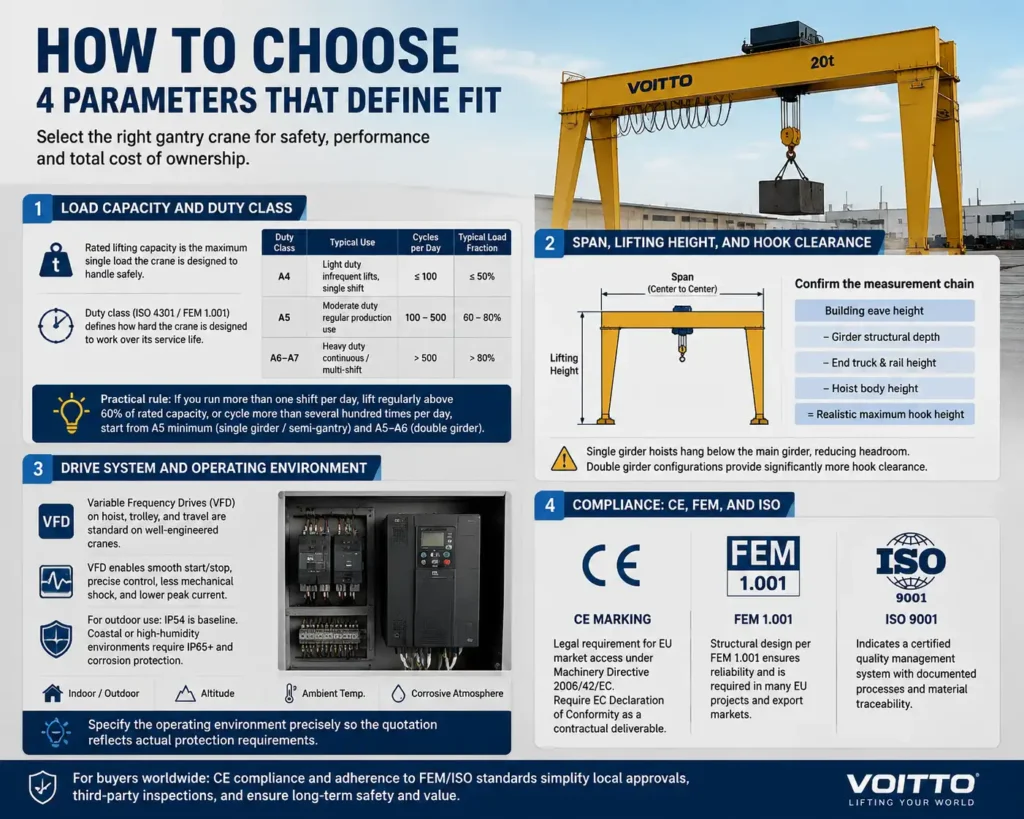
Load Capacity and Duty Class
Rated lifting capacity tells you the maximum single load the crane is designed to handle safely. Duty class (per ISO 4301 / FEM 1.001) tells you how hard the crane is designed to work over its service life — and duty class is where the most consequential specification errors happen.
Duty class combines two factors: how often the crane operates (cycles per shift and per year) and at what fraction of rated capacity it typically works. A4 suits light operations — infrequent lifts, low average load fraction, single shift. A5 is appropriate for regular production use — multiple cycles per hour, 4–8 hours of active lifting, 60–80% of rated load common. A6–A7 is required for heavy continuous operations such as steel processing or multi-shift port terminals.
The practical rule: if your operation runs more than one shift per day, lifts regularly above 60% of rated capacity, or cycles more than several hundred times per day, start from A5 minimum for single girder and semi-gantry configurations and A5–A6 for double girder. Specifying one duty class below your actual operating pattern doesn’t produce immediate failure — it produces accelerated structural fatigue in end carriages and girder welds, compressing the crane’s economic life by several years and increasing maintenance frequency well above the manufacturer’s baseline.
Span, Lifting Height, and Hook Clearance
Span is the center-to-center distance between ground rails (or between the outer leg positions). Lifting height is the distance from floor to hook at the highest position. Both need to be confirmed against actual facility geometry, not estimated.
The figure buyers most consistently underestimate is effective hook clearance. For single girder configurations, the hoist hangs below the main girder, consuming headroom. In a 7 m eave height building, after accounting for girder depth, end truck height, and hoist body height, effective hook travel may be 4.5–5.5 m — not 7 m. Double girder configurations recover significant headroom because the hoist sits between the girders.
Confirm the measurement chain before specifying: building eave height → subtract girder structural depth → subtract end truck and rail height → subtract hoist body height → the result is your realistic maximum hook height. If that figure doesn’t accommodate your tallest load plus rigging clearance, you need either a taller bay or a different configuration.
Drive System and Operating Environment
All motorized gantry cranes in Voitto’s range are electrically driven. Variable frequency drives (VFD) on hoisting, trolley, and travel motions are standard on well-engineered configurations — VFD eliminates mechanical shock at start/stop, enables precise speed control, and reduces peak current draw at start-up. Budget configurations that omit VFD on travel or trolley motions look competitive at quotation; in high-cycle applications, the difference in component wear is measurable within the first operational year.
For outdoor installations, confirm electrical component IP rating. IP54 is the baseline for general outdoor exposure. Coastal or high-humidity environments warrant IP65 or higher, along with corrosion-resistant surface treatment on structural steel. Specify the operating environment precisely when inquiring — indoor/outdoor, altitude, ambient temperature, corrosive atmosphere — so the quotation reflects actual protection requirements.
Compliance: CE, FEM, and ISO
For EU-destined equipment, CE marking under Machinery Directive 2006/42/EC is a legal precondition for market access — require the EC Declaration of Conformity as a contractual deliverable, not a post-delivery afterthought. For projects referencing FEM 1.001 structural rules (common in EU projects and many export markets), confirm the supplier’s structural calculations explicitly reference this methodology. ISO 9001 factory certification indicates documented production processes and material traceability — verify it is current and that its scope explicitly covers crane manufacturing.
For buyers outside the EU sourcing for markets that reference EU standards in local safety regulations (Middle East, parts of Africa, Southeast Asia), CE compliance also smooths local authority approvals and third-party inspection sign-off.
2026 Price Reference Table
| Crane Category | Capacité | Market Price Reference (EXW China) |
|---|---|---|
| Grue portique monopoutre | 1–32 ton | $11,000 – $56,000 |
| Grue portique bipoutre | 5–100 ton | $35,000 – $200,000 |
| Grue portique bipoutre | 100–500 ton | $200,000 – $800,000+ |
| Grue semi-pantagonale | 1–32 ton | $9,000 – $60,000 |
| Portable / Mobile Gantry Crane | 0.25–10 ton | $2,000 – $30,000 |
Final pricing is project-specific: span, lifting height, duty class, drive options, certifications, and environmental specifications all affect the final figure. Contact Voitto Crane for a detailed quotation.
Obtenir un devisWhat the Quote Doesn’t Include
The fully-landed cost for international projects typically runs 35–65% above EXW price once the following are added:
Rail and civil works — Ground-embedded rails require engineered concrete foundations. On soft or waterlogged ground, piling may be required. Civil packages typically represent 15–30% of equipment cost on first-installation projects.
Electrical infrastructure — Power supply to the crane runway (transformer, main cable, distribution panel, busbar or festoon system) is almost never included in the crane quotation. For larger cranes, the electrical package can be significant.
Freight and import duty — Ocean freight for a disassembled 30-ton gantry can range from $3,000–$15,000+ depending on destination and market conditions. Import duties vary by HS code and country.
Commissioning and operator certification — Factory load testing is standard and included. Site commissioning is typically quoted separately. In markets where crane operator certification is legally required, this is not optional.
Certifications and Compliance Checklist
Before signing a supply contract, request and verify the following documentation:
- Déclaration de conformité CE — Check that the directive (2006/42/EC), authorized signatory, and equipment description match what you are ordering. Generic or undated declarations are a red flag.
- Static and dynamic load test certificate — Standard tests are 125% rated load (static) and 110% (dynamic). Results including deflection, brake performance, and structural condition should be documented with inspector signatures.
- ISO 9001 factory certificate — Confirm it is current and within its audit cycle, and that the scope statement explicitly includes crane or lifting equipment manufacturing.
- Primary steel mill certificates — Material traceability for main structural steel confirms the actual grade matches the design specification.
- FEM 1.001 structural calculation reference — For compliance-critical projects, confirm the supplier’s structural calculations reference this methodology explicitly.
Suppliers who delay or resist producing these documents before contract placement are indicating what post-order cooperation will look like.
Conclusion
Choosing the right motorized gantry crane comes down to three decisions made in sequence: which structural category — single girder, double girder, semi-gantry, or portable — fits your load, span, and site conditions; whether the specification (duty class, clearance, drive system, environment) genuinely matches your operating reality; and whether the supplier can provide the compliance documentation your market requires.
The most expensive specification errors don’t announce themselves at delivery. They show up in maintenance logs, insurance queries, and inspection reports over the first two years of operation.
Voitto Crane covers the full range from 0.25-ton portable units through 500-ton heavy-duty double girder systems, with CE and FEM-compliant configurations for export projects. Share your capacity, span, operating environment, and destination country — the engineering team will confirm the right configuration and provide a detailed quote, typically within 24 hours.
Ready to specify your motorized gantry crane?

Alan
Spécialiste des solutions de grue · Voitto Crane
Spécialisé dans les solutions d'exportation de ponts roulants, de portiques, de grues à flèche, de grues portuaires et de grues EOT. Plus de 10 ans d'aide aux clients internationaux en matière de consultation avant la vente, de sélection de la capacité et de configurations spécifiques au site.
FAQ
Q1:What is a motorized gantry crane and how is it different from a manual type?
A motorized gantry crane uses electric motors to drive all three axes of motion — hoisting, trolley travel, and bridge travel — allowing remote or cabin control without manual chain operation. Manual gantry cranes require hand-chain pulling for at least the hoisting function, limiting practical capacity and making them unsuitable for operations with more than occasional lifts per shift. For any facility with regular, repeating lifting requirements, a motorized gantry crane is the correct choice on both ergonomic and economic grounds.
Q2:How much does a motorized gantry crane for sale cost?
Market reference prices range from approximately $9,000 for a compact semi-gantry at 1–3 tons, to $11,000–$56,000 for standard single girder configurations, and $35,000–$800,000+ for double girder systems depending on tonnage and duty class. Portable and mobile configurations start from around $2,000. These figures are EXW China and exclude freight, import duties, civil works, and commissioning — items that typically add 35–65% to the base equipment price for international projects.
Q3:What duty class should I specify?
Duty class should reflect your actual operating cycle, not your theoretical maximum. A4 suits light operations — infrequent lifts, low average load, single shift. A5 is appropriate for regular production use with multiple cycles per hour. A6–A7 is required for heavy continuous operations. Specifying one class below your real cycle creates structural fatigue beyond the design envelope, shortening the crane’s economic life and increasing maintenance frequency above the manufacturer’s baseline.
Q4:What is the difference between a single girder and a double girder gantry crane?
Single girder cranes use one main girder with the hoist hanging below it — more economical, covering 1–32 tons, suited for moderate duty cycles. Double girder cranes use two parallel girders with the hoist between them — providing greater hook clearance, lower structural deflection under load, and the ability to handle heavier duty classes (A5–A7) and higher capacities (up to 500 tons). The right choice depends on your required capacity, available headroom, and operating cycle intensity.
Q5:When should I choose a semi-gantry instead of a full gantry?
A semi-gantry is the right choice when one side of the crane can be supported by an existing building column or wall structure, reducing the need for bilateral ground rail foundations. It suits confined workshops, production lines, and facilities where floor-level infrastructure on both sides of the crane bay isn’t practical. The building structure supporting the overhead rail must be assessed and confirmed as adequate before specifying — this is a pre-specification step.
Q5:What certifications should I require from the supplier?
For EU-destined equipment, CE marking under Machinery Directive 2006/42/EC is mandatory — require the EC Declaration of Conformity as a contractual deliverable. For all projects: static (125%) and dynamic (110%) load test certificates with inspector signatures; a current ISO 9001 factory certificate covering crane manufacturing; structural calculations referencing FEM 1.001 or equivalent; and primary steel mill certificates for structural members.




 English
  Español
  Português
  العربية
  Français
  Русский