
For copper and gold mining facilities in Uzbekistan — including the Almalyk copper concentrator expansion and Muruntau gold mine operations in Navoi — overhead crane requirements split cleanly across four distinct working environments: ore processing, smelter ladle handling, electrolytic tankhouse, and open-pit stockyard. Each environment defines a different crane type, different duty class, and different engineering specification. Choosing the wrong configuration for any one bay does not just create a maintenance headache — it creates a compliance failure or a production stoppage in an environment where shutdowns carry serious cost.
This guide maps each working environment to the crane type that actually fits it, explains the engineering logic behind each selection, and covers the certification requirements that Uzbekistan-bound project orders need to address.
Quick Reference: Crane Configuration by Working Environment
| Environnement de travail | Type de grue recommandé | Classe de service | Plage de capacité | Price Reference |
|---|---|---|---|---|
| Concentrator — mill overhaul | Pont roulant à double poutre QD | A5–A6 | 20–100T | $35,000–$250,000 |
| Smelter — ladle handling | Grue d'aciérie (Ladle / Casting) | A7–A8 | 50–320T | $120,000–$600,000+ |
| Tankhouse — copper electrolysis | Pont roulant d'isolation QY | A7–A8 | 5–100T | $30,000–$200,000 |
| Open-pit stockyard — ore handling | QZ Grab Gantry / Double Girder + Grab | A6–A7 | 10–100T | $40,000–$300,000 |
| Explosive gas zones (any above) | Pont roulant antidéflagrant QB | A4–A5 | 5–320T | $24,000–$533,000 |
Prices are market reference ranges (ex-works, RMB-based supplier pricing). Actual cost depends on span, lifting height, control configuration, and environmental protection scope.
Obtenir un devis- 1 Quick Reference: Crane Configuration by Working Environment
- 2 Why Uzbekistan’s Mining Expansion Creates Specific Crane Procurement Demands
- 3 Crane Selection by Working Environment
- 4 Duty Class Decision Framework
- 5 Certification and Compliance for Uzbekistan Projects
- 6 Conclusion
-
7
FAQ
- 7.1 Q1:What type of overhead crane is used in a copper concentrator plant?
- 7.2 Q2:Why does a copper tankhouse need a specialized insulation crane?
- 7.3 Q3:What duty class is required for a smelter ladle crane in a copper mining facility?
- 7.4 Q4:Is EAC certification required for overhead cranes exported to Uzbekistan?
- 7.5 Q5:What is the price range for overhead cranes for copper mining projects?
Why Uzbekistan’s Mining Expansion Creates Specific Crane Procurement Demands
Uzbekistan is repositioning itself as one of Central Asia’s leading mineral producers. The Almalyk Mining and Metallurgical Combine (AGMK) copper expansion — covering both the concentrator and a new copper metallurgical complex — and the Navoi Mining and Metallurgical Combine’s (NGMK) Muruntau gold mine capacity increase together represent multi-billion-dollar infrastructure programs. Uzbekistan has publicly targeted 175 tonnes of gold production annually by 2030, with Muruntau as the core production asset.
These are not greenfield projects starting from a blank specification. They are expansions of operating facilities that already have crane infrastructure in place — which means incoming equipment must match existing runway gauge and rail systems where possible, and must integrate with running production cycles rather than commissioning in an empty bay. That context changes the selection process in two important ways.
First, delivery lead times and documentation requirements are tighter than for a new-build project. Existing operations cannot wait six months for a non-compliant crane to be recertified. Second, the equipment will be expected to run at mining-grade duty from day one — there is no “break-in” period at reduced cycle frequency. Both factors mean that duty class, IP protection level, and certification documentation need to be locked in before the purchase order is issued, not treated as post-order details.
Crane Selection by Working Environment
Concentrator Plant: Mill Overhaul and Equipment Maintenance


The right crane for a copper concentrator mill bay is a QD Double Girder Overhead Crane rated A5 or A6, with IP55 minimum motor protection and a dust-resistant electrical cabinet.
The primary lifting task in a concentrator is not continuous production handling — it is heavy maintenance: pulling ball mill grinding shells, replacing trunnion bearings, lifting classifier banks and flotation cell assemblies. These are large, high-tonnage lifts (commonly 30–80 tons for major mill components) that occur at planned maintenance intervals rather than continuously. That cycle profile corresponds to duty class A5 (medium service) or A6 (heavy service), depending on the frequency of planned maintenance shutdowns and whether the crane is shared between multiple mill trains.
The reason A7 or A8 is not required here: concentrator maintenance cranes are not cycle-intensive between overhauls. Specifying A7 adds structural cost — heavier main girder, larger-section gearboxes, higher-rated motors — that the actual cycle count does not justify. The tradeoff runs the other way in a ladle bay or tankhouse, where cycles are continuous.
What does need to be specified carefully in a concentrator crane: the hook approach to the end wall, because ball mill removal typically requires the hook to reach within 300–400mm of the building end wall to clear the mill trunnion during extraction. Standard end approach dimensions on catalog cranes often do not satisfy this requirement; custom end truck geometry should be specified in the tender document.
For concentrators with grinding media storage or ore dust processing in adjacent bays where combustible dust may be present, the QB Explosion-Proof configuration is appropriate for those specific bays. For the main mill bay where dust concentrations are heavy but below explosive thresholds, IP55–IP65 motor protection with dust-tight panel enclosures is the standard specification.
Copper Smelter: Ladle Handling at the Furnace Front
Smelter ladle handling requires a metallurgical-grade Steel Mill Crane — specifically a Double Girder Ladle Crane or Casting Overhead Crane — rated A7 or A8, with heat-resistant construction, anti-sway control, and redundant braking.
The working environment at the furnace front is fundamentally different from any other bay in a copper processing facility. Radiant heat from flash smelting furnaces and converters reaches sustained temperatures that will destroy standard motor insulation within months. Wire rope lubricant carbonizes at temperatures above approximately 150°C, which means standard hoist rope specification will fail in a high-radiant-heat environment even if the load ratings are correct. Copper matte ladles typically weigh 30–150 tons loaded, and the consequences of a hoist failure during pouring are severe enough that redundant braking systems are not optional — they are the standard engineering requirement for this application.
The anti-sway requirement is also specific to ladle handling: a swinging ladle over the furnace front or casting ladle turret creates a collision risk with fixed infrastructure and a spill risk at the pouring point. Anti-sway control systems on metallurgical cranes work by adjusting trolley acceleration and deceleration curves to suppress the pendulum motion of the load — this is a software function of the drive system, and it should be specified as a functional requirement (maximum sway angle at rated speed and load) rather than as a component specification.
A casting crane for the continuous casting bay handling copper anodes typically runs at A7–A8 duty, with capacity up to 500 tons for larger smelter configurations. The Voitto Steel Mill Crane product line — covering Double Girder Ladle Cranes (5–85T) and Casting Overhead Cranes (up to 500T at A7–A8) — covers this requirement range.
Copper Electrolysis and Electrowinning Tankhouse

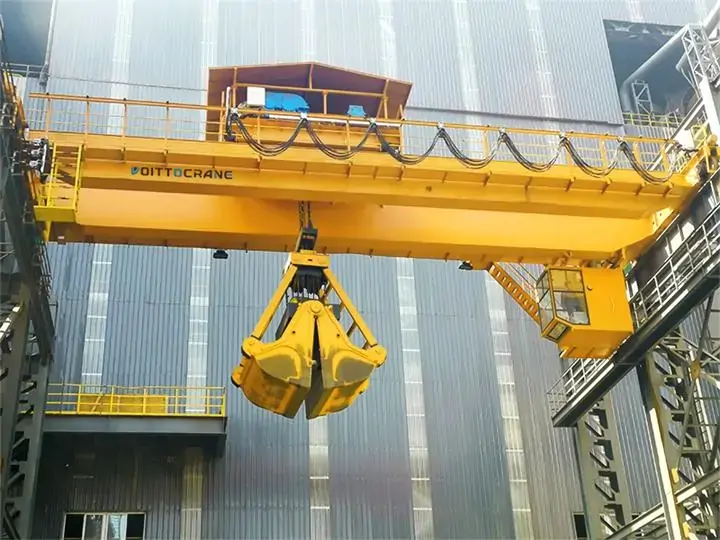
The tankhouse requires a QY Insulation Overhead Crane, rated A7–A8, with comprehensive electrical insulation on hooks, wire ropes, and structural connections, combined with acid-resistant protective coatings on all exposed steel surfaces.
The tankhouse is the environment most frequently under-specified by procurement teams unfamiliar with copper hydrometallurgy. Copper electrolysis and electrowinning processes involve large electrolyte baths carrying direct current at low voltage and very high amperage — typically hundreds of thousands of amperes flowing through interconnected cell circuits. The crane operating above these cells is structurally connected to the building, which means an uninsolated crane bridge creates a conductive path to earth that can divert cell current through the crane structure and into the runway system. The consequences range from electrolytic corrosion of structural steel (which is invisible until it fails) to electrical shock hazard for operators on the cabin or maintenance platform.
The QY Insulation Overhead Crane addresses this through insulating sleeves on wire ropes, non-conductive hook swivel assemblies, and insulation monitoring devices on the crane structure that alert operators if insulation resistance drops below the rated threshold. The monitoring system is as important as the insulation itself — insulation degrades over time in the acidic, humid tankhouse atmosphere, and a crane that was properly insulated at commissioning may have developed conductive paths within 12–18 months if insulation condition is not actively tracked.
Acid resistance is the second critical specification for tankhouse cranes. Sulfuric acid mist is present throughout the tankhouse atmosphere in copper electrorefining and electrowinning operations. Standard epoxy primer corrodes at a rate that requires repainting within 2–3 years. Specify a full corrosion protection system: acid-resistant primer, intermediate coat, and polyurethane or epoxy-polyester topcoat rated for continuous sulfuric acid mist exposure. The conductor rail system for the crane should use acid-resistant materials or be encased in acid-resistant conduit.
For the anode/cathode handling function specifically — positioning anode frames and cathode blanks in cells — fine positioning control at low speeds is more important than maximum rated speed. Specify micro-speed capability (typically 1–5% of rated travel speed) and load-swing monitoring as functional requirements.
Open-Pit Stockyard: Ore Handling with Grab
For open-pit ore stockyards and bulk material handling areas, the appropriate configuration is a QZ Grab Double Girder Overhead Crane or a Double Girder Gantry Crane fitted with a multi-flap grab bucket, rated A6 or A7.
The key selection decision for open-pit ore handling is whether the facility uses an overhead crane running on building-mounted runway beams, or a gantry crane running on ground-level rails. For covered stockyards within the plant boundary, overhead cranes are standard. For open outdoor ore storage areas where building coverage does not exist, double girder gantry cranes allow ground-level rail installation without a building structure.
Duty class for grab handling depends directly on the cycle frequency. If the crane feeds a crusher or reclaim conveyor continuously across two or three shifts, A7 is the appropriate specification — grab cranes make approximately 4–8 full cycles per hour at continuous operation, and over a 20-year service life that accumulates into the M6–M7 cycle range. If the crane primarily handles batch stockpile management at lower frequency, A6 may be sufficient, but the duty calculation should be done from actual operating data, not estimated.
For stockyards in zones where explosive gases may be present — which applies to certain underground ventilation extraction areas and fuel storage adjacencies — the QB Explosion-Proof configuration applies regardless of whether the primary function is ore handling.
Duty Class Decision Framework
The most common procurement error on mining projects is specifying a duty class lower than the actual operating cycle demands. Every crane in a Uzbekistan copper or gold mining facility should be sized by working out the actual expected cycle count, not by using generic “mining” assumptions.
The ISO 4301 (FEM 1.001) classification method works as follows: estimate the number of lifts per shift, multiply by shifts per day and working days per year, project over the intended service life (typically 15–25 years for major mining infrastructure), then apply the load spectrum — the ratio of actual lifted loads to the crane’s rated WLL averaged across all lifts — to determine the duty class. For a concentrator crane doing 8 major lifts per day at average 70% of rated load across 15 years, the calculation typically lands in A5–A6. For a ladle crane doing 24 cycles per day at 80–90% of rated load across 20 years, the result is consistently A7–A8.
The Voitto Crane Duty Classification Calculator allows engineers to run this calculation directly against their facility’s operating parameters before writing the specification.
A practical rule of thumb for this project context: if the crane is in a production-critical position — ladle handling, cathode/anode positioning, continuous ore reclaim — start at A7 and verify downward only if the cycle count calculation supports it. If the crane is a maintenance-only or standby configuration, A5–A6 is generally the correct starting point.
Certification and Compliance for Uzbekistan Projects
The following covers the standard certification framework for industrial lifting equipment exported to Uzbekistan and the Eurasian Economic Union.
EAC Certification (Mandatory for Customs Clearance)
EAC certification under Technical Regulation TR CU 010/2011 (Safety of Machinery and Equipment) is the mandatory import compliance requirement for overhead cranes entering Uzbekistan and other Eurasian Customs Union member states. A crane without valid EAC certification will not clear Uzbekistan customs — this is a hard gate, not a formality. Chinese suppliers serving the CIS and EAC market should hold current TR CU certificates; if a supplier does not, budget 3–6 months for certification before the planned equipment delivery date.
When requesting EAC documentation from a supplier, ask for the actual certificate number and validity dates — EAC certificates expire and must be renewed. Expired certificates create the same clearance problem as no certificate.
Design Standards and Structural Documentation
For the crane design itself, the following documents should be requested before order placement:
- Structural design calculations confirming the specified duty class (A5, A6, A7, or A8) was used in the main girder and gearbox sizing — not a lower class that makes the structure lighter and cheaper
- Certificat d'essai de charge: static test at 125% of working load limit, dynamic test at 110% WLL, conducted before shipment
- Certificat de gestion de la qualité ISO 9001 for the manufacturing facility, with scope covering crane manufacturing
- Weld inspection records for main girder welds — UT (ultrasonic testing) or RT (radiographic testing), not visual inspection only
For cranes in explosive atmosphere zones (QB configuration), the ATEX or IECEx certificate for each electrical component (motors, contactors, limit switches, control panels) in the applicable zone classification must be included.
A Practical Verification Step Often Skipped
The single verification step that most procurement teams skip: request the FEM or ISO 4301 design calculation sheet from the crane supplier, not just the nameplate duty class. The nameplate says “A7” because that is what the buyer specified. The calculation sheet shows whether the main girder section modulus, gearbox service factor, and drum design actually correspond to A7 cycles at the quoted WLL. A supplier who cannot or will not provide this document is not in a position to guarantee the duty class claim.
Ready to specify the right crane configuration for your Uzbekistan copper or gold mining project? Contact the Voitto Crane engineering team for a project-specific configuration review and quotation.
Obtenir un devisConclusion
Overhead crane selection for Uzbekistan copper and gold mining facilities is a four-environment decision, not a single specification. Concentrator mill bays need QD double girder cranes at A5–A6, sized for heavy maintenance lifts rather than high cycle frequency. Smelter ladle and casting positions need A7–A8 metallurgical cranes with heat-resistant construction and anti-sway control. Electrowinning and electrolysis tankhouses need QY insulation cranes with active insulation monitoring and acid-resistant coatings. Open-pit stockyards and ore handling areas need QZ grab overhead cranes or grab-equipped gantry cranes at A6–A7. Wherever explosive atmosphere zones are involved, QB explosion-proof configuration takes precedence.
Before placing any order for overhead cranes for copper mining in Uzbekistan, confirm the duty class from an actual cycle calculation, verify EAC certification status, and request the structural design calculation to confirm the duty class claim is supported by the engineering.

Alan
Spécialiste des solutions de grue · Voitto Crane
Spécialisé dans les solutions d'exportation de ponts roulants, de portiques, de grues à flèche, de grues portuaires et de grues EOT. Plus de 10 ans d'aide aux clients internationaux en matière de consultation avant la vente, de sélection de la capacité et de configurations spécifiques au site.
FAQ
Q1:What type of overhead crane is used in a copper concentrator plant?
A QD Double Girder Overhead Crane at duty class A5 or A6 is the standard for concentrator mill bays. The work is maintenance-focused — pulling grinding mill components, replacing bearings — rather than continuous production cycling, so A5–A6 matches the actual cycle count better than heavier-rated metallurgical configurations. IP55 minimum motor protection is required for the ore dust environment.
Q2:Why does a copper tankhouse need a specialized insulation crane?
Electrorefining and electrowinning tankhouses carry very high direct currents through interconnected cell circuits. An uninsulated crane structure creates a conductive path that can divert cell current through the building’s runway system, causing both electrolytic corrosion of structural steel and electrical hazard for personnel. The QY Insulation Overhead Crane addresses this with insulated wire ropes, non-conductive hook assemblies, and active insulation monitoring to detect degradation before it becomes a safety issue.
Q3:What duty class is required for a smelter ladle crane in a copper mining facility?
Smelter ladle cranes handling molten copper matte or blister copper should be rated A7 or A8 under ISO 4301 / FEM 1.001. The continuous shift operation, high average load relative to WLL, and accumulated cycle count over a 20-year service life all push into the A7–A8 range. Using a lower duty class in this position creates structural fatigue risk and gearbox failure well before end of design life.
Q4:Is EAC certification required for overhead cranes exported to Uzbekistan?
Yes. EAC certification under TR CU 010/2011 is mandatory for overhead cranes entering Uzbekistan as part of the Eurasian Customs Union. Cranes without valid EAC certificates will not clear Uzbekistan customs. Verify the certificate number, scope, and validity dates before placing an order — expired EAC certificates create the same clearance problem as absent ones.
Q5:What is the price range for overhead cranes for copper mining projects?
Reference price ranges depend heavily on configuration and duty class. A QD double girder crane for concentrator maintenance at 20–50 tons typically runs $35,000–$150,000. A metallurgical ladle or casting crane at A7–A8 for 50–200 tons starts from approximately $120,000 and can reach $600,000+ for high-capacity configurations. A QY insulation crane for a tankhouse at 10–50 tons runs approximately $30,000–$120,000. All figures are ex-works market reference prices; actual project cost includes runway system, electrical installation, and commissioning.


 English
 Español
 Português
 العربية
 Français
 Русский