
A bridge crane end carriage is the structural assembly mounted at each end of a bridge crane’s main girder that houses the traveling wheels, wheel shafts, and drive mechanism. It is the component that allows the entire crane bridge to move back and forth along the runway rails installed on either side of the workshop.
Without a properly functioning end carriage, a bridge crane cannot travel, no matter how strong the main girder or hoist may be. The main girder carries and lifts the load, the end carriage supports the girder and transfers that load down through the wheels, and the wheels roll along the runway system. Together, these parts form the crane’s traveling mechanism, making the end carriage essential to safe, stable, and efficient overhead crane operation.


What Is a Bridge Crane End Carriage?
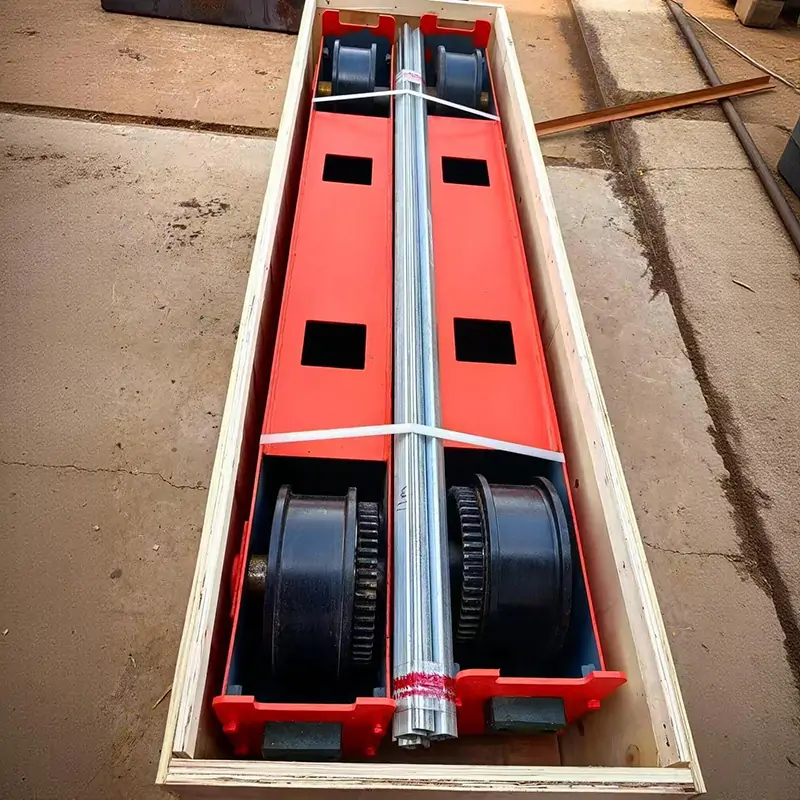
A bridge crane end carriage is a welded steel structure positioned at each end of the crane’s main girder, perpendicular to it, that connects the girder to the traveling wheels. Structurally, it sits between the bridge and the runway rail, acting as both a support base and a mobile platform. Its main functions are straightforward but critical:
- The overhead crane end carriages support the main girder—this component bears the combined weight of the main girder, the trolley, the hoisting mechanism, and the load.
- This mechanism enables longitudinal movement along the track beams—wheels mounted within the end girder frame roll along the tracks, propelling the entire crane along the length of the workshop.
- It transfers loads from the crane structure to the track system—all static and dynamic loads generated during hoisting and travel are transmitted through the end girder to the track beams and the workshop columns.
Users can think of the bridge crane end carriage as the wheel assembly at the bottom of a train car. The main body of the train car is used to carry cargo, while the wheel assembly enables the car to run along the tracks and ensures even weight distribution. The end girder of a bridge crane serves the same purpose. Since the end girder must support the entire weight of the crane system during operation, it must be designed with sufficient rigidity to withstand the bending, torsional, and fatigue stresses generated over tens of thousands of operating cycles.
What Is a Crane End Truck?
“Crane end truck” and “bridge crane end carriage” refer to the same component. The difference is regional terminology rather than design or function.
- The term “crane end truck” is more commonly used in North America. In that region, crane buyers, engineers, and manufacturers who adhere to CMAA standards typically use the term “truck” to refer to the wheeled assemblies mounted at both ends of a crane’s main girder.
- The term “end carriage” is more common in Europe and the international crane industry, particularly in markets that follow FEM or ISO crane standards. The term “carriage” more accurately reflects the structural and load-bearing functions of this component.
Some technical documents also use “end beam” interchangeably, especially in single-girder crane designs where the end structure is a simpler beam rather than a fully enclosed box frame. Regardless of the term used, the component’s job stays the same: supporting the girder and driving the crane along the runway.
For procurement teams sourcing cranes internationally, it is worth confirming terminology with the supplier early on, since drawings, spare parts lists, and technical datasheets may use “end truck,” “end carriage,” or “end beam” depending on the manufacturer’s home market.
How Does a Bridge Crane End Carriage Work?
The end carriage works together with the drive system to move the crane bridge along the runway. The process follows four basic steps:
- 1. The travel motor generates power—typically mounted on or near the end beam — the electric travel motor converts electrical energy into rotational mechanical energy.
- 2. The gear reducer transmits torque—the high-speed, low-torque power output from the motor is processed by the gear reducer, which reduces the speed and amplifies the torque to a level suitable for driving the wheels.
- 3. Wheels roll along the rails—The reduced-speed torque drives one or more wheels within the end beam frame, causing them to grip the rails and roll along them.
- 4. The end beam moves the entire crane girder structure—As the wheels rotate, the end beam (and the main girder connected to it) travels along the rails, thereby moving the entire crane girder to the desired position.
In most designs, the crane end carriages on both sides of the bridge are driven synchronously by the drive system, ensuring that the bridge travels in a straight line without skewing. Skew control is particularly important for long-span cranes. This is because, in such cases, even a slight difference in speed between the two sides can cause the crane to become stuck on the track or subject the structure to uneven stress.
Main Components of a Bridge Crane End Carriage
A bridge crane end carriage is made up of several coordinated components, each with a specific structural or mechanical role.


- 1. End Girder Frame: The overall structure consists of a box-type structure welded from steel plates. This box-type welded structure offers high rigidity in both the vertical and horizontal directions, enabling it to support crane loads without excessive deformation.
- 2. Crane Wheels: These components come into direct contact with and roll along the rails. They are manufactured entirely from forged steel to ensure sufficient strength and resistance to surface wear. Precision machining of the flange and wheel face ensures precise contact between the wheel and the rail, thereby reducing abnormal wear, noise, and the risk of derailment during crane operation.
- 3. Wheel Axles and Bearing Housings: The wheel axle and bearing housing assembly supports the rotation of the wheels while also bearing loads from the frame. The bearings inside the housing reduce friction between the rotating axle and the stationary frame, thereby extending service life and reducing the power required to drive the crane.
- 4. Drive System: The travel motor and gearbox work together to provide the driving force that propels the crane along the track.
- 5. Buffers and Safety Devices: Buffers are installed at both ends of the end girder. Their function is to absorb impact forces when the crane reaches the end of the track or approaches another crane on the same track.
Types of Bridge Crane End Carriages
| Type | Application | Caractéristiques |
|---|---|---|
| Single Girder Bridge Crane End Carriage | Light and medium-duty workshops, general manufacturing, warehouses | Lightweight structure; suitable for light and medium duty applications; lower cost, simpler maintenance |
| Double Girder Bridge Crane End Carriage | Heavy-duty industrial plants, steel mills, foundries | Higher load capacity; better rigidity; designed for larger spans and heavier lifting duties |
| European Standard End Carriage | Precision manufacturing, automotive, workshops requiring smooth control | Modular design; low noise; precision movement; typically built to FEM specifications |
Single-girder Bridge Crane End Carriage: These end beams are specifically designed for lighter loads and are used in conjunction with a single main girder; they typically feature a relatively simple structural design. Their lightweight construction reduces the crane’s dead weight, thereby alleviating the load on the tracks and supporting steel structures.
Double-girder Overhead Crane End Truck: These end beams are specifically designed for heavy-duty and long-span applications and are capable of withstanding the increased loads imposed by dual main girders and overhead or underhung trolleys. Compared to single-girder designs, their increased structural height provides these end beams with higher load-bearing capacity and superior rigidity.
European Standard End Carriages: These end carriages are commonly found on cranes compliant with FEM 1.001 or similar European standards and are characterized by their compact, modular components. The modular design simplifies maintenance and component replacement, while precision-machined wheels and drive components ensure quiet operation and precise movement.
Bridge Crane End Carriage vs Crane Main Girder
The main girder and end carriage are complementary structures. The main girder is designed primarily to resist bending under the lifted load as the trolley moves across the span, while the end carriage is designed to resist the combined vertical and horizontal forces generated by both lifting and traveling. Neither component can perform its role without the other. A crane needs both a rigid girder and a stable, well-aligned end carriage to operate safely.

Poutre principale du pont roulant

Bridge Crane End Carriage
| Aspect | Poutre principale | End Carriage |
|---|---|---|
| Fonction | Supports lifting loads and the trolley/hoist system | Supports bridge structure and enables crane travel |
| Position | Runs horizontally across the crane span | Mounted perpendicular to the girder, at each end |
| Load Responsibility | Carries the lifted load and trolley weight | Carries the combined weight of girder, trolley, and load, transferring it to the wheels |
| Movement Role | Provides the track for trolley (cross) travel | Drives the crane’s longitudinal travel along runway rails |
How to Choose the Right Bridge Crane End Carriage?
Selecting the correct end carriage involves matching its design to the crane’s operating conditions. Key factors include:
- 1. Load-carrying capacity—The higher the equipment’s rated load, the more robust the end girder structure must be, and it must be equipped with larger wheels and bearings with higher load-carrying capacity.
- 2. Span — The longer the overall span, the greater the load and bending stress on the end girder, which affects the girder’s height (girder depth) and wheelbase design.
- 3. Duty Class — For cranes that frequently perform heavy-duty operations, the end girder must possess higher fatigue resistance.
- 4. Travel Speed—Higher travel speeds place greater demands on motor power, gearbox selection, and brake response.
- 5. Operating Environment—In outdoor, corrosive, high-temperature, or dusty environments, special protective coatings, sealed bearings, or specialized wheel materials may be required.
- 6. Rail Specifications—The wheel diameter and flange/tread shape must match the dimensions and type of the running rails to ensure even load distribution and minimize wear.
Common Problems of Bridge Crane End Carriage
Wheel Wear
Causes: Poor alignment between the crane and the track, or poor track conditions, results in uneven force distribution across the wheel tread, thereby accelerating one-sided wear.
Solution: Users should regularly check alignment and maintain the track to help distribute the load evenly and extend the service life of the wheels.
Rail Gouging / Wheel Flange Wear
Cause: Misalignment of the wheels causes the flanges to squeeze against the rail edges rather than roll freely, resulting in flange wear and increased friction.
Solution: Maintenance personnel should regularly inspect wheel alignment and rail straightness, and make timely adjustments to prevent flange contact issues from worsening.
Excessive Noise
Cause: Bearing failure or wheel damage are common causes of abnormal operating noise, typically indicating insufficient lubrication or pitting on the surface.
Solution: Maintenance personnel should lubricate the bearings and promptly replace worn wheels; this will reduce noise and prevent further mechanical damage.
Conclusion
The bridge crane end carriage may not be as visible as the main girder or hoist, but it plays an equally important role in crane performance. By supporting the bridge structure and enabling controlled travel along the runway, it directly affects lifting safety, positioning accuracy, and long-term equipment reliability. Understanding its structure — from the welded frame and wheels to the drive motor and safety buffers — helps buyers, engineers, and maintenance teams make more informed decisions about crane selection and upkeep.
As a professional crane manufacturer, Voitto Crane designs end carriages engineered to match each project’s load, span, and duty requirements, supporting safe and efficient bridge crane end carriage operation across a wide range of industries. Contactez nous for customized bridge crane solutions.

Alan
Spécialiste des solutions de grue · Voitto Crane
Spécialisés dans les solutions d'exportation de ponts roulants, portiques, grues à flèche, grues portuaires et ponts roulants. Plus de 10 ans d'expérience dans l'accompagnement de clients internationaux : conseils avant-vente, choix de la capacité et configurations sur mesure.
FAQ
What is a bridge crane end carriage?
A bridge crane end carriage is the structural assembly at each end of a crane’s main girder that houses the wheels and drive components, supporting the bridge and enabling it to travel along the runway rails.
What is the difference between an end carriage and an end truck?
There is no functional difference — “end truck” is the term commonly used in North America, while “end carriage” is used in Europe and most international crane markets to describe the same component.
What components are included in a crane end carriage?
A typical end carriage includes the frame, crane wheels, wheel shaft and bearing housing, travel motor and gear reducer, and buffer or safety devices at each end.
How long does a bridge crane end carriage last?
Their service life depends on the duty class, maintenance status, and operating environment. However, if manufactured in accordance with FEM or ISO standards and properly maintained, end beams typically have a service life comparable to that of the crane’s structural design life, often lasting 15 to 20 years or even longer.
Can bridge crane end carriages be customized?
Yes. VOITTO offers customized crane end beam solutions based on load capacity, span, wheelbase, track gauge, operating speed, and environmental requirements.




 English
  Español
  Português
  العربية
  Français
  Русский