
A gantry crane for sale in Peru typically runs $9,000 to $230,500+ (approximately S/ 30,400 to S/ 779,000+) FOB factory, depending on lifting capacity, span, and whether the unit is destined for a mine maintenance yard or a coastal port terminal. At current exchange rates (1 USD ≈ 3.38 PEN, August 2026), a mid-range 10-ton double girder unit lands around $22,000–$40,000, or roughly S/ 74,400–S/ 135,200.
Peru’s mining sector — led by Antamina, Cerro Verde, and Las Bambas — and its three main Pacific ports (Callao, Matarani, and the newer Chancay terminal) drive most of the country’s demand for gantry cranes. Procurement teams sourcing for these environments face a problem generic buying guides don’t address: a crane spec written for a European warehouse doesn’t automatically hold up at 4,000 meters of altitude in the Andes, or under the salt-air corrosion load at a container terminal on the coast.
This guide walks through which gantry crane type fits which Peruvian application, how capacity and duty class should be set for mining versus port duty cycles, what certification your supplier needs to provide for smooth SUNAT customs clearance, and how pricing breaks down in both US dollars and Peruvian soles so your finance team doesn’t have to do the conversion themselves.
Quick Reference: Gantry Crane Types & Pricing for Peru
| Type | Capacité de charge | La portée | Fourchette de prix (USD) | Price Range (PEN, approx.) | Best Fit in Peru |
|---|---|---|---|---|---|
| L Type single girder | 5–10 t | 16–30 m | $11,000–$48,000 | S/ 37,200–S/ 162,200 | Mine workshop truck/wagon loading |
| MH Box single girder | 3.2–32 t | 7.5–35 m | $13,000–$54,000 | S/ 43,900–S/ 182,500 | General mine warehouse & light port storage |
| MH Truss single girder | 3–20 t | 7.5-31.5 m | $14,000–$56,000 | S/ 47,300–S/ 189,300 | Wind-exposed outdoor yards |
| BMH single girder semi-gantry | 2-16 t | 5–20 m | $9,000–$40,000 | S/ 30,400–S/ 135,200 | Retrofit site with one existing runway wall |
| U Type double girder | 5–50 t | 18–35 m | $22,000–$210,000 | S/ 74,400–S/ 709,800 | Medium-heavy mine equipment bays |
| MG Box double girder | 5-800 t | 18–36 m | $19,500–$205,500 | S/ 65,900–S/ 694,600 | Precast/steel-plate handling at mine or plant |
| Châssis à double poutre en A | 50–120 t | 18–35 m | $23,000–$215,500 | S/ 77,700–S/ 728,400 | Steel-coil, wind-blade, bulk mineral lifting |
| BMG double girder semi-gantry | 30–40 t | 6-24 m | $23,000–$80,000 | S/ 77,700–S/ 270,400 | Processing plant with limited civil budget |
| RTG container gantry | 35-70 t | 23.5–26 m | $42,000–$138,000 | S/ 141,960–S/ 466,440 | Container stacking at Callao, Matarani, Chancay |
| RMG rail-mounted container gantry | 35-70 t | 30–40 m | $55,000–$155,000 | S/ 185,900–S/ 523,900 | Fixed-lane terminal backyard sorting |
Prices are factory-direct FOB reference figures from Voitto Crane’s published price tables, not third-party estimates — actual quotes depend on duty class, corrosion protection, and control specification. PEN figures use a reference rate of 1 USD ≈ 3.38 PEN; confirm the live rate before budgeting.
Have your capacity, span, and site conditions ready?
Obtenir un devisGantry Crane Types for Peru’s Mining and Port Sites
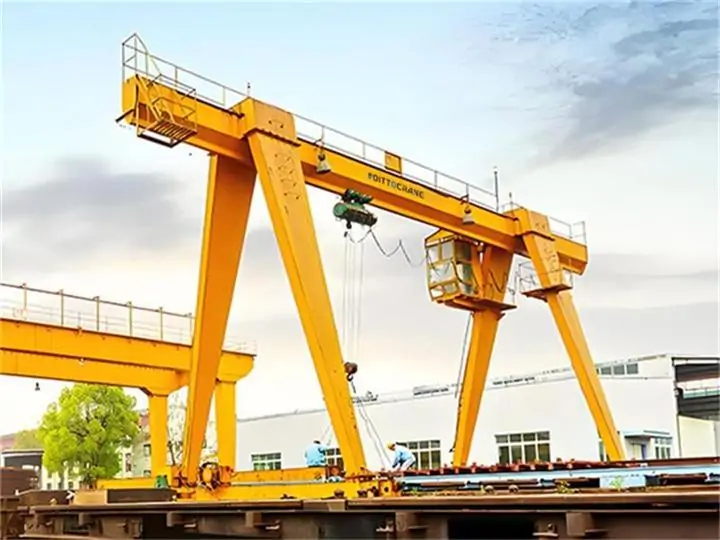


Single girder gantry cranes suit mine workshops and light-duty yards
A pont roulant à poutre unique is the right call for maintenance bays and material yards handling loads under roughly 20–32 tons, which covers most mine-site workshop lifting. The reason is structural: single girder configurations (MH Box, MH Truss, L Type) cost noticeably less at the same capacity — the MH Box range runs $13,000–$54,000 (S/ 43,900–S/ 182,500) versus $19,500 and up for a comparable double girder MG Box unit — because the design carries load across one beam instead of two, reducing steel and drive requirements. At a mine like Antamina or Las Bambas, workshop lifting — engine blocks, pump assemblies, conveyor idlers — rarely exceeds this range, so specifying a double girder crane here mostly adds unrecovered capital cost. The trade-off is headroom: single girder cranes need slightly more vertical clearance for the same lifting height, which matters in retrofit buildings with fixed roof structures.
Double girder gantry cranes handle heavy mining equipment and bulk terminal loads
A portique bipoutre becomes the better choice once loads exceed roughly 20–30 tons or the duty cycle moves into continuous, high-frequency operation. This is the structural logic: double girder configurations distribute load across two beams instead of one, which is what lets the MG Box design scale from 5 tons up to 800 tons ($19,500–$205,500 / S/ 65,900–S/ 694,600) for mill components, crusher parts, and bulk cargo handling. The Double Girder A Frame variant, priced $23,000–$215,500 (S/ 77,700–S/ 728,400) for 50–120 tons, is specifically built with A-frame wind stability for steel-coil and wind-turbine-blade handling — relevant for Peru’s coastal wind-power sites as well as steel processing. For a mine that runs equipment changeouts a few times a week, a standard A5 work-duty spec is usually sufficient; for a port terminal or continuous mill-feed application, look at configurations rated A6–A8, which run at the higher end of each price band because of heavier wheels, thicker plate, and a hoist rated for continuous cycling.
Semi-gantry cranes cut civil cost where one side already has overhead infrastructure
A pont roulant semi-portique — one end carriage on an elevated wall-mounted runway, the other on a ground-level rail — is worth specifying whenever a site already has a building wall or existing steel that can carry one runway beam. In practice, the BMH single-girder configuration (2–16 t, $9,000–$40,000 / S/ 30,400–S/ 135,200) fits light-to-medium workshop retrofits, while the BMG double-girder configuration (30–40 t, $23,000–$80,000 / S/ 77,700–S/ 270,400) covers heavier processing-plant applications. The saving comes from avoiding a full second column row — a meaningful advantage at altitude sites where concrete and steel logistics already carry a cost premium from transport distance alone.
RTG and RMG cranes are the standard for container handling at Peru’s ports
An RTG (rubber-tyred gantry) container crane, priced $42,000–$138,000 (S/ 141,960–S/ 466,440) for 35–70 tons, is the type most Peruvian port operators specify for container yard stacking because it moves autonomously on tires without requiring fixed track — a real advantage for terminals still expanding layout, such as newer capacity coming online at Chancay. An RMG (rail-mounted) container gantry, at $55,000–$155,000 (S/ 185,900–S/ 523,900) for the same capacity range, costs more but delivers higher positioning accuracy and lower long-run energy consumption on fixed, high-throughput lanes — the better fit for an established, high-volume yard layout like Callao’s core terminal, which already handles roughly 60% of Peru’s mineral exports. Port operators evaluating either type should size capacity against projected container throughput growth, not current volume, since a mid-life capacity upgrade on rail-mounted equipment is far more disruptive than specifying correctly at purchase.
Selecting Capacity, Span, and Duty Class for Peruvian Conditions
Altitude and corrosion exposure should shape the spec, not just tonnage
Peru’s mining and port sites sit at opposite environmental extremes, and both push against a generic capacity-only spec. Highland mine sites — many above 3,500–4,000 meters — see reduced air density, which affects motor cooling and can call for derated or altitude-compensated drive selection depending on the hoist manufacturer’s guidance; coastal terminals at Callao and Matarani face continuous salt-air exposure, which accelerates corrosion on unprotected steel far faster than in an inland facility. A crane sized correctly on paper but specified with standard-grade paint at a coastal site will show structural corrosion within a few years — the fix (marine-grade corrosion protection, typically a multi-coat epoxy or hot-dip galvanized system) costs more upfront but is far cheaper than mid-life structural remediation or early replacement.
Duty class should match actual cycle frequency, not just peak load
The core mistake buyers make when specifying a gantry crane for sale is sizing purely by maximum load and ignoring how often the crane actually cycles. Voitto’s own double girder line spans work-duty ratings from A5 (standard industrial use) up to A6–A8 for the RMG and RTG container types — a crane rated for the correct tonnage but the wrong duty class reaches its maintenance threshold in a fraction of its design life. This shows up first as premature wheel and bearing wear, then as unplanned downtime during exactly the high-throughput periods (a port vessel call, a mine equipment turnaround) when the crane can least afford to be out of service. A workshop crane used a few times daily sits comfortably at A5; a port container gantry or mill-feed unit cycling continuously should be specified at A6 or above, which is reflected in the higher end of each product’s price range above.
Procurement, Import Clearance & Certification in Peru
Certification requirements exist to protect import clearance, insurance, and safety compliance — not as paperwork formality
Sourcing a gantry crane for sale from an overseas manufacturer without confirming certification is one of the most common and costly procurement errors, because a missing or incomplete certificate can hold a shipment at SUNAT customs, void an insurance claim after an incident, or block acceptance by an EPC contractor’s safety department. The documents that matter fall into a few categories:
- ISO 9001: confirms the factory operates under a documented quality management system — this is the baseline document to request from any supplier and relevant to consistency across a multi-unit order.
- FEM design rules and ISO 4301 crane classification: define duty class (A/M-rating) and load spectrum — ask your supplier which class each component (structure, mechanism, hoist) is rated to, not just the crane as a whole.
- CE marking under the EU Machinery Directive (2006/42/EC): Peru is not an EU market, so CE marking is not a legal import requirement here — it functions as an optional international benchmark some EPC contractors or multinational operators ask for contractually. Confirm with your supplier whether CE is available as an add-on certification for your order rather than assuming it’s included by default; not every factory carries it as standard.
- US OSHA-aligned safety practice: not a Peruvian legal requirement, but many US-headquartered mining operators (for example, Freeport-McMoRan at Cerro Verde) apply OSHA-consistent safety expectations contractually to their equipment and contractors.
Verify certification with documents, not supplier claims
A supplier stating a crane “meets international standards” is not the same as holding the paperwork — request the actual ISO 9001 certificate and load/overload test certificates before final payment, and confirm these documents will accompany the shipment for SUNAT clearance. If your project specifically requires CE marking — for instance, an EPC contractor’s internal policy or an equipment financing condition — confirm with your supplier upfront whether it’s available as an optional add-on for your order, since it typically isn’t included in standard factory-direct pricing. Also confirm the crane’s safety devices — overload protection, anti-collision limits, load display — are listed as standard or optional in the quotation, since these are frequently the line items omitted from a low headline price.
Conclusion
A gantry crane for sale in Peru should be selected by matching duty class and corrosion protection to the actual site — altitude and cycle frequency for mining applications, salt-air exposure and stacking density for port terminals — not by tonnage alone. Before requesting quotes, confirm your capacity, span, duty class, and target port or mine site, and ask any supplier for ISO 4301 and ISO 9001 documentation upfront — and if your project specifically requires CE marking, confirm its availability and cost as an add-on before the purchase order is signed rather than assuming it’s standard.

Alan
Spécialiste des solutions de grue · Voitto Crane
Spécialisés dans les solutions d'exportation de ponts roulants, portiques, grues à flèche, grues portuaires et ponts roulants. Plus de 10 ans d'expérience dans l'accompagnement de clients internationaux : conseils avant-vente, choix de la capacité et configurations sur mesure.
FAQ
Q1:How much does a gantry crane cost in Peru?
A gantry crane for sale in Peru typically costs $9,000 to $230,500+ (roughly S/ 30,400 to S/ 779,000+), depending on type, capacity, span, and duty class. A common mid-range 10-ton double girder unit runs $22,000–$40,000 (S/ 74,400–S/ 135,200), while port-duty RTG and RMG container cranes run $42,000–$155,000 (S/ 142,000–S/ 523,900) due to their higher duty class and specialized undercarriage.
Q2:What certification does a gantry crane need for import into Peru?
Most Peruvian buyers should request ISO 4301 duty classification documentation and ISO 9001 factory certification as standard. CE marking under the EU Machinery Directive is not legally required for Peru — since it’s not an EU market — but is available from some suppliers as an optional add-on if your EPC contractor or financing partner specifically asks for it; confirm availability before assuming it’s included.
Q3:What’s the difference between an RTG crane and an RMG crane?
An RTG (rubber-tyred gantry) crane travels on tires for yard flexibility and costs less upfront ($42,000–$138,000), while an RMG (rail-mounted gantry) crane runs on fixed rails, costs more ($55,000–$155,000), and delivers higher positioning accuracy for established high-volume terminal lanes.For a detailed comparison, please view the article at Grue RTG vs grue RMG : comprendre les différences entre les deux
Q4:What capacity gantry crane do I need for a copper mine in Peru?
Most mine workshop and maintenance-yard lifting in Peru falls under 20–32 tons, which a single girder gantry crane (MH Box, MH Truss, or L Type) handles at lower cost than a double girder unit. Heavier mill or crusher component handling above that range typically calls for a double girder crane such as the MG Box or A Frame type, rated A5–A8 depending on cycle frequency.


 English
  Español
  Português
  العربية
  Français
  Русский