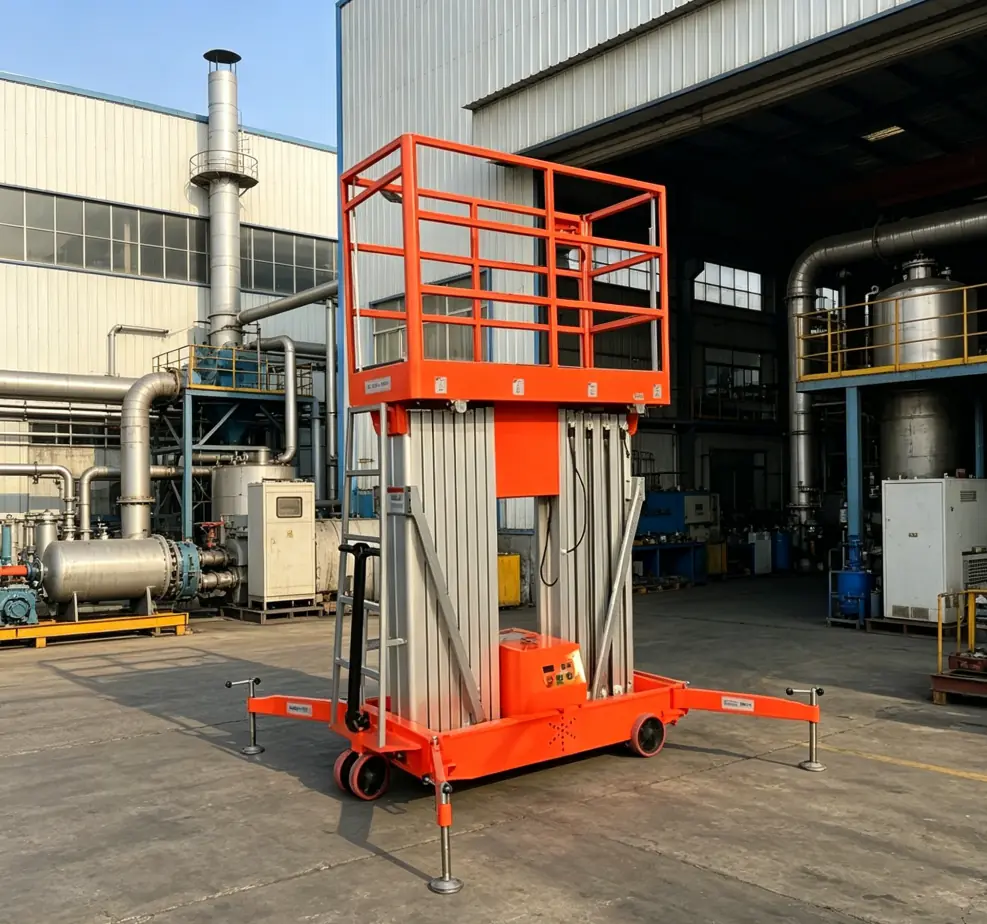
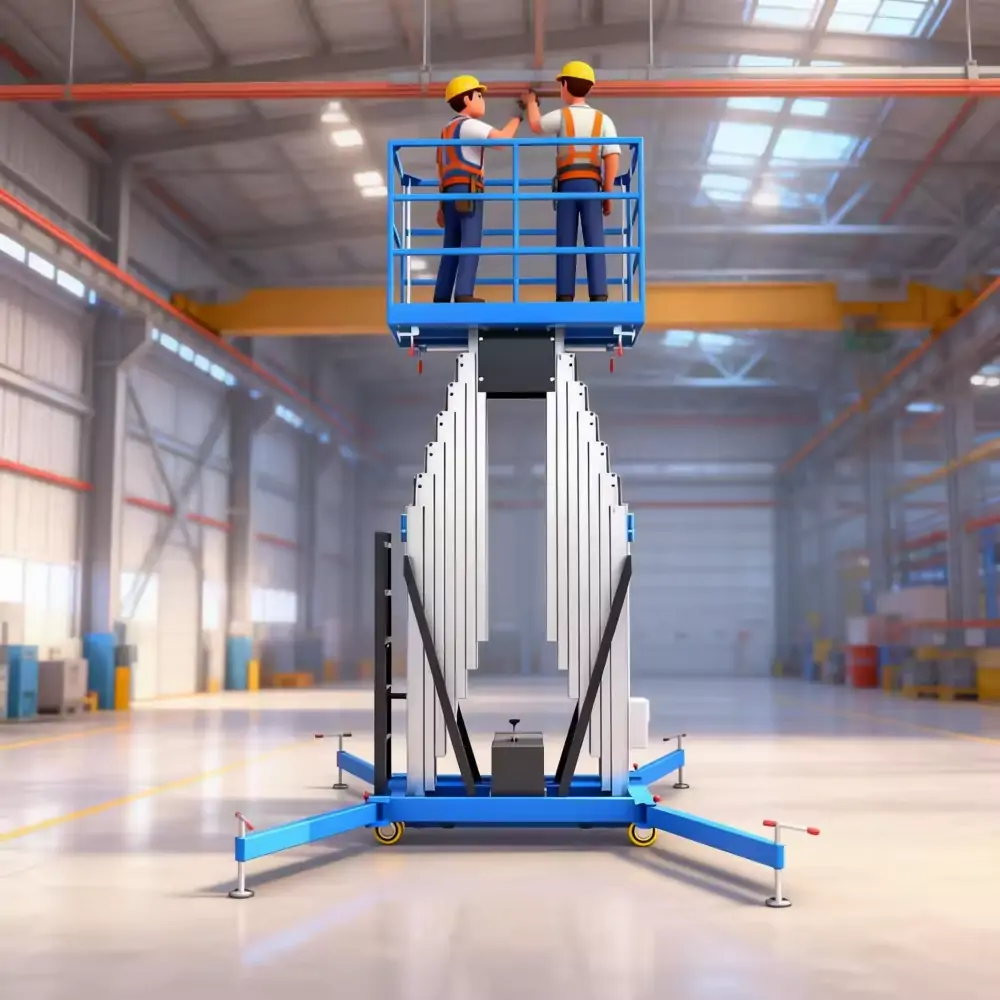
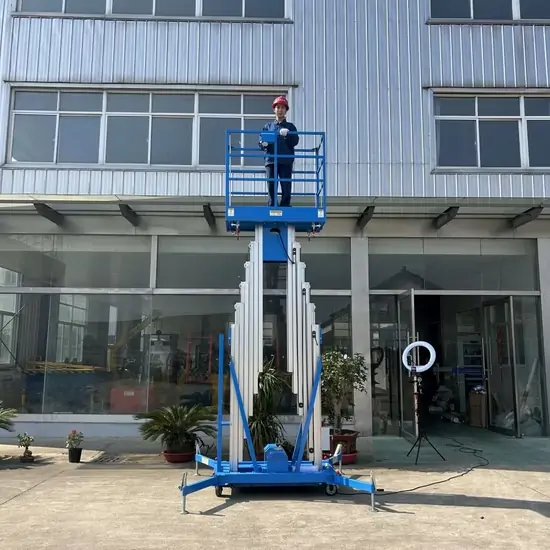
This Double Mast Aluminum Lift Platform is specifically designed for two-person aerial work, utilizing high-strength aluminum alloy masts to balance lightweight construction with ultimate stability. The maximum working height reaches up to 16 meters with a rated load of 200kg, easily carrying two operators and their tools. The compact structure offers powerful high-altitude performance while maintaining the flexibility to pass through narrow indoor areas.
The Double Mast Aluminum Lift Platform features a reinforced dual-mast design, offering an operational height of up to 16 meters, anti-sway performance, and a stable load capacity of 200 kg. Its lightweight aluminum alloy structure and compact base configuration allow two people to work simultaneously and enable flexible movement through standard doorways and elevators. For scenarios with even tighter space constraints, you can use a Single Portable Aluminum Lift Platform. Precision hydraulic systems and comprehensive safety outrigger interlock functions make these platforms ideal for high-altitude maintenance in large shopping malls, gymnasiums, and industrial plants.
Working Principle
The working principle of the Double Mast Aluminum Lift Platform is the precision coordination of hydraulic lifting technology and the stable dual-mast structure, providing higher load capacity and operational stability for two-person aerial work.
Power Source Drive: The motor drives a high-pressure gear pump to introduce hydraulic oil into the circuit as the core source of kinetic energy.
Synchronous Dual-Mast Extension: The power flow drives two sets of symmetrical hydraulic cylinders, pushing the high-strength aluminum alloy masts simultaneously. Utilizing dual-point support effectively disperses stress and enhances the platform’s anti-sway performance at high altitudes.
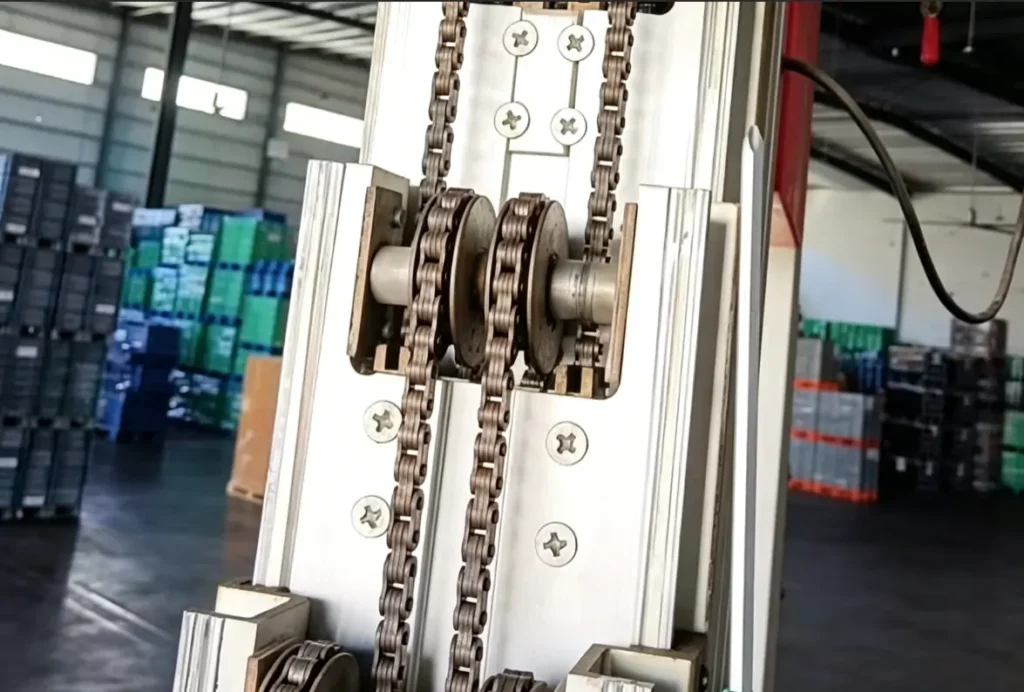
Double-Speed Chain Transmission: Built-in high-strength synchronous leaf chains work with pulley sets to achieve double-speed transmission. This allows the compact vertical lift to reach working positions up to 16 meters smoothly while maintaining a low stowed height.
Safety Interlock Monitoring: The intelligent electronic control system integrates an outrigger interlock function. Once the four sets of outriggers are fully deployed, leveled, and the sensors confirm the base is stable, the lift platform unlocks its lifting function to ensure operational safety.
Precision Return Control: During descent, the electromagnetic valve precisely controls the hydraulic oil return flow, using the platform’s self-weight to achieve a constant speed descent. An emergency manual pressure relief valve is equipped so personnel can still descend safely to the ground in extreme conditions, such as a power failure.
Through synchronous dual-mast hydraulic drive and multiple safety interlock mechanisms, the Double Mast Aluminum Lift Platform achieves a high degree of unity between large load and high operating height, serving as a professional-grade stable solution for indoor and outdoor collaborative aerial work.
Parts
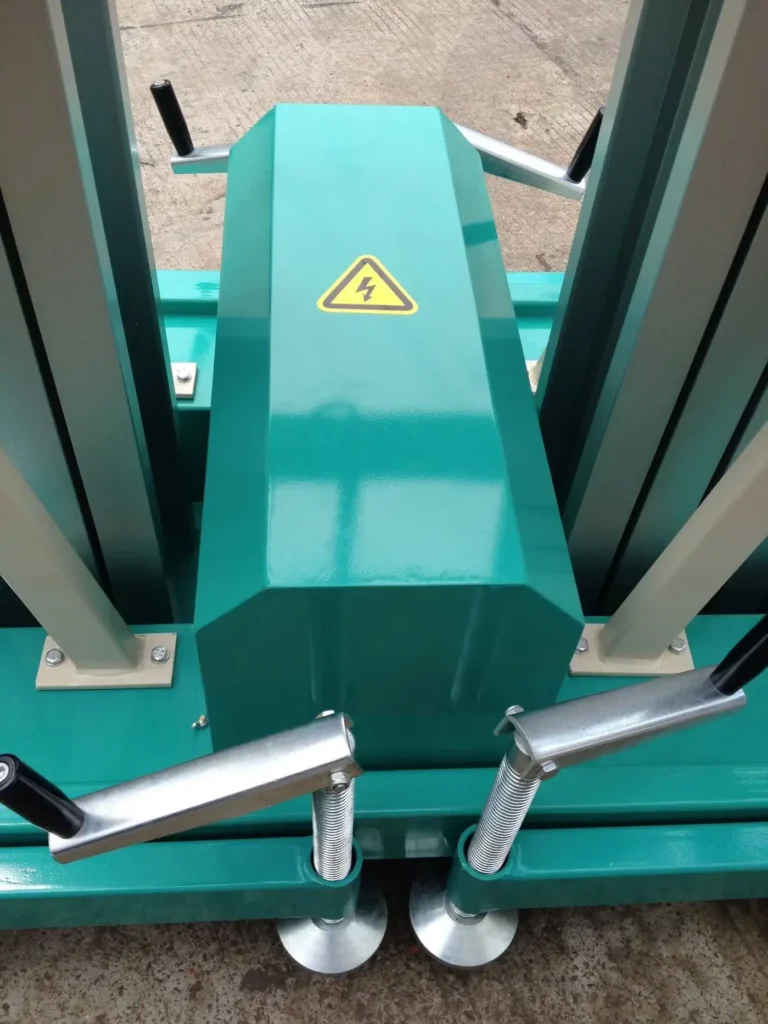
Outriggers
Mast
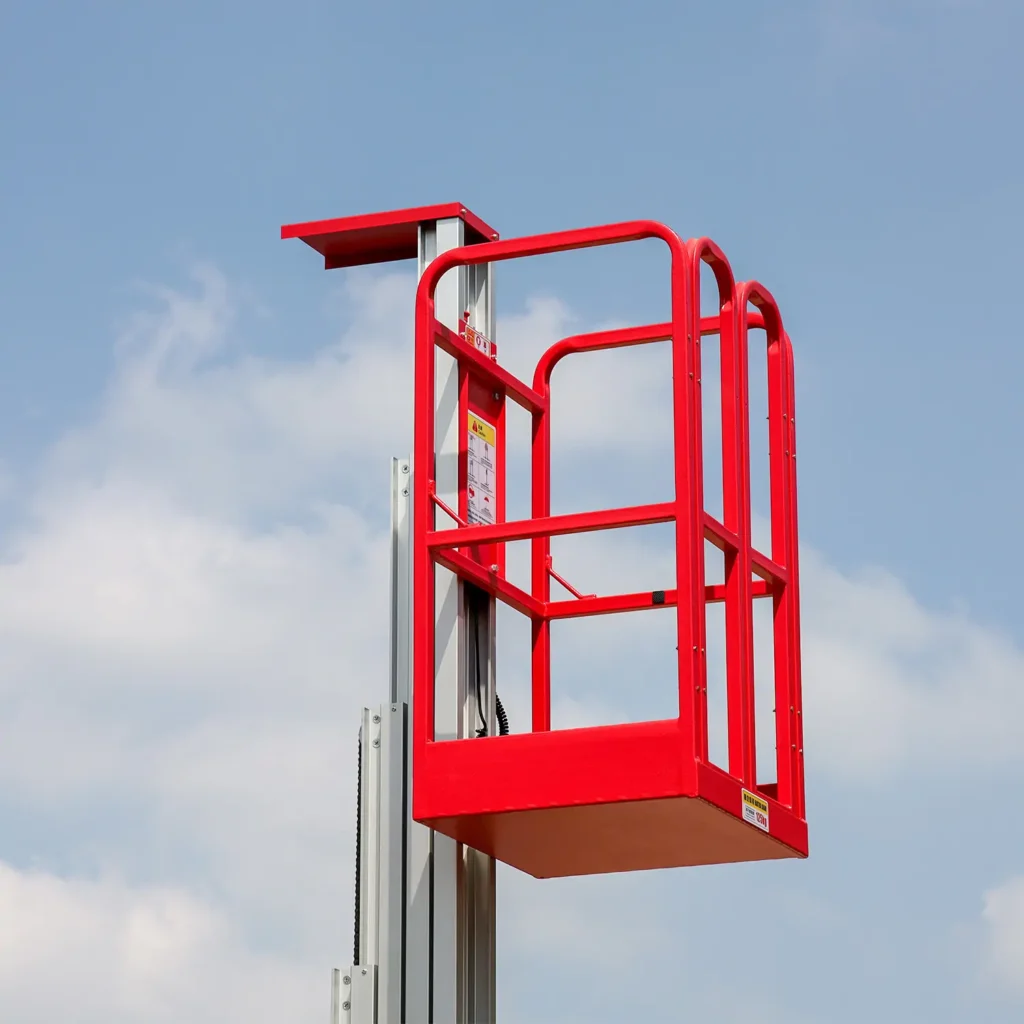
Work platform
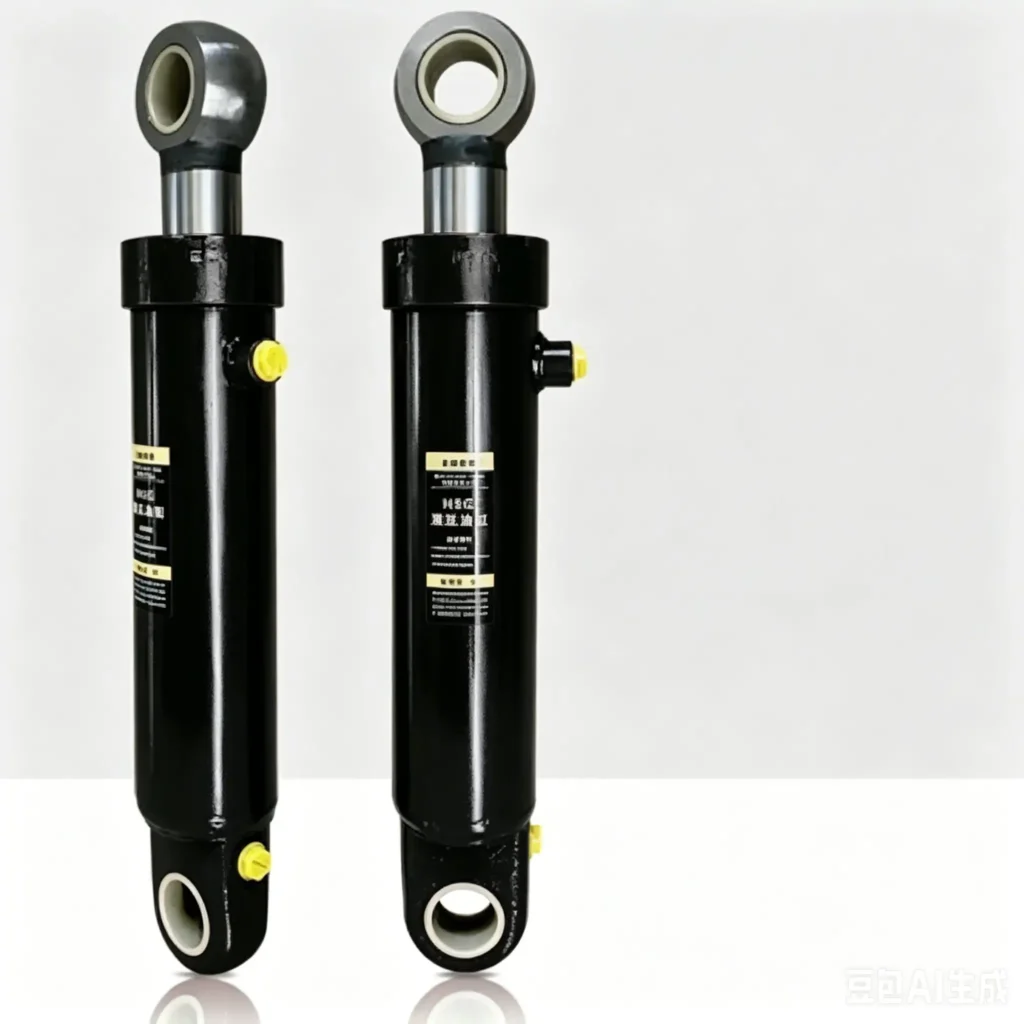
Power cylinder
Hydraulic system
Linkage hinge
Chassis
Control panel
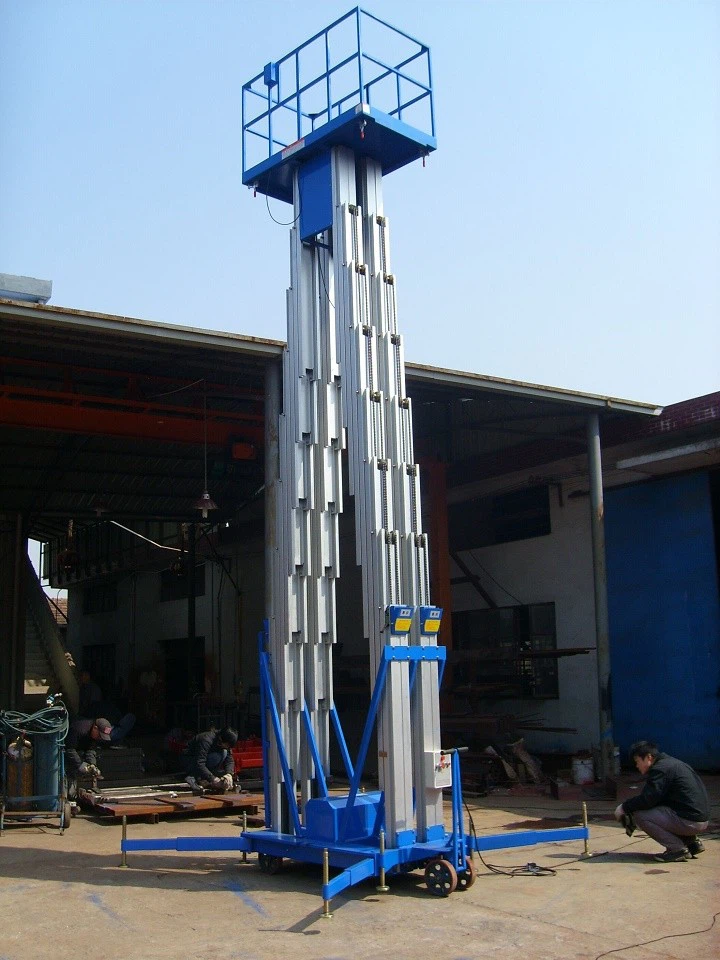
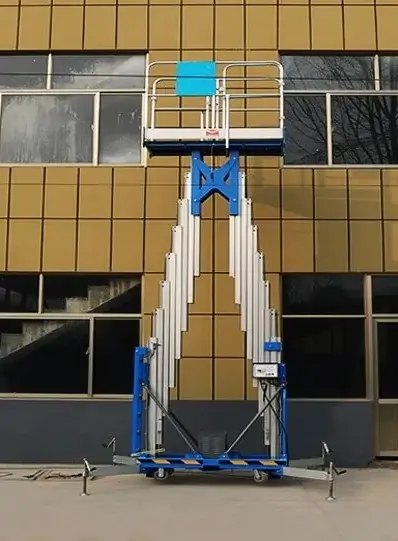
Double Mast System: Utilizes two sets of high-strength aluminum alloy profiles nesting to provide double the support stability and significantly reduce high-altitude sway.
Enlarged Platform: A spacious area with guardrails and a 200 kg-rated load, specifically designed for two-person collaborative work.
Synchronous Cylinders: Dual-cylinder linkage design ensures the platform remains absolutely level and power-balanced during lifting.
Hydraulic Power Unit: The core power source, integrating precision valve groups to provide smooth, quiet, and strong vertical thrust.
Leaf Chains: Connecting multi-stage masts to ensure consistent lifting speed and serving as a key secondary safety load-bearing guarantee.
Mobile Chassis: Equipped with four sets of polyurethane non-marking wheels, balancing floor protection performance with lightweight mobility.
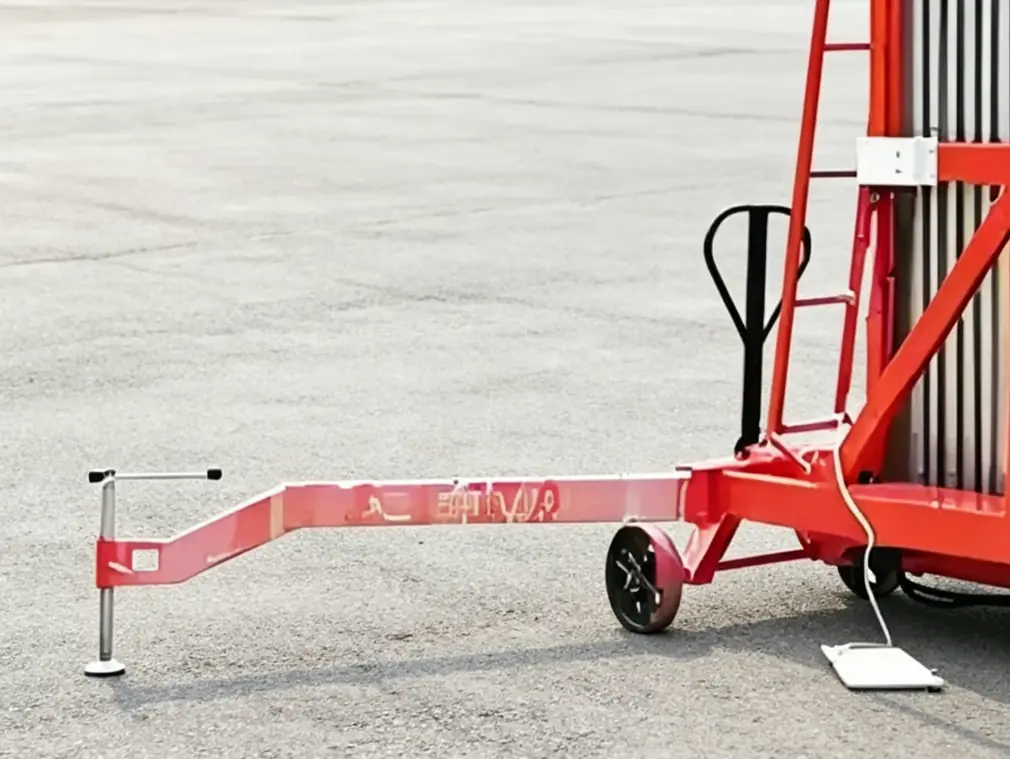
Outriggers: Featuring screw-type lifting and leveling functions with integrated interlock induction to ensure stable base support before operation.
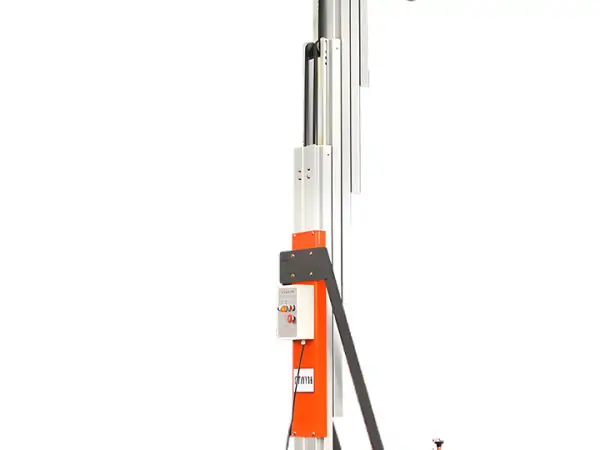
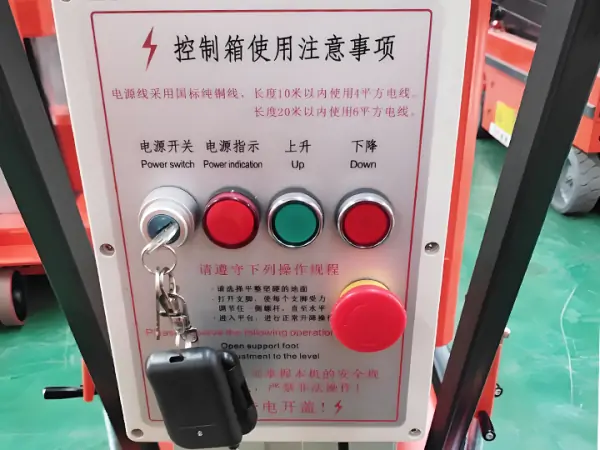
Dual Control System: Control panels are located at both the ground and platform levels, featuring emergency stop buttons and platform-level monitoring warnings.
Advantages
The Double Mast Aluminum Lift Platform offers high stability and high collaborative operation capability. Its main characteristics include:
Two-Person Collaborative Load: Utilizing a reinforced dual-mast structure with a rated load of 200kg, it can easily carry two operators and their tools, significantly improving high-altitude maintenance efficiency.
Extreme Operational Stability: The dual-point support design effectively disperses center-of-gravity stress. Compared to single-mast models, the high-altitude anti-sway performance is improved by more than 30%, providing a more stable working feel.
Flexible High-Altitude Access: Balancing height and compactness, the working height reaches up to 16m, and the stowed dimensions are exquisite, allowing it to pass through standard double doors and enter large elevators, adapting to various indoor conditions.
Comprehensive Safety Guarantee: Integrated outrigger interlock systems, emergency descent valves, and overload protection ensure the machine only operates when the base is completely stable, strictly maintaining the safety bottom line.
This equipment is heavy-duty, stable, offers high-altitude coverage, and is lightweight and portable, making it the best choice for two-person collaborative aerial work in large venues, industrial plants, and commercial complexes.
Specifications
Model
V-DML 6
V-DML 8
V-DML 10
V-DML 12
V-DML 14
Max. Platform Height (m)
6.0
8.0
10.0
12.0
14.0
Max. Working Height (m)
8.0
10.0
12.0
14.0
16.0
Rated Load (kg)
200
200
200
200
150/200
Platform Size (mm)
1150×600
1380×600
1500×600
1500×600
1500×600
Stowed Dimension (mm)
1450×800×1980
1580×800×1980
1750×850×2100
1750×850×2100
1800×900×2100
Outrigger Size (mm)
1850×1750
2000×1900
2250×2100
2250×2100
2450×2250
Motor Power (kW)
1.1 / 1.5
1.1 / 1.5
1.5
1.5 / 2.2
2.2
Voltage (V)
AC 220V/110V
AC 220V/110V
AC 220V/110V
AC 220V/110V
AC 220V/110V
Total Weight (kg)
480
560
680
750
880
Working Height: Usually the platform height plus the human working height (approx. 2 meters).
Custom Power: DC 24V battery power or AC & DC dual power modes are optional for the above models.
Floor Protection: The entire machine is standard with polyurethane (PU) non-marking casters, suitable for epoxy, marble, and other high-grade floors.
Standard Compliance: All parameters comply with CE (EN280) and ISO9001 international safety and quality standards.
Applications
Large Venue Maintenance: Used for high-position lighting debugging, sound system maintenance, and large-area cleaning in gymnasiums, theaters, and exhibition centers.
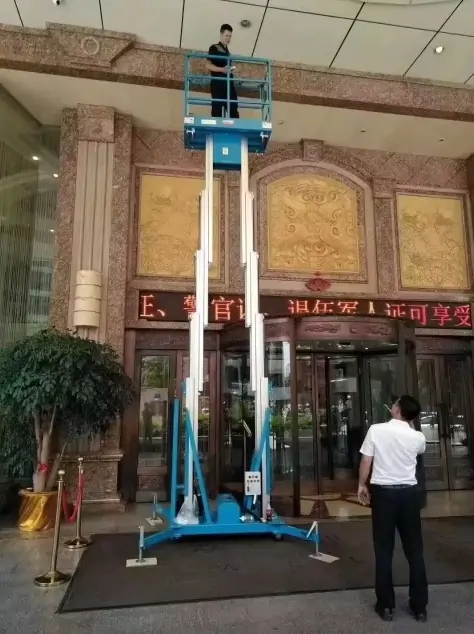
Star Hotel Lobbies: Targeted at chandelier replacement, ceiling decoration, and regular inspection of central air conditioning systems in high-ceiling lobbies.
Industrial Plant Facilities: In factories such as electronics and precision machinery, supporting two-person collaboration for aerial pipeline installation and equipment maintenance.
Commercial Complex Management: Applicable for hanging advertising banners, holiday decorations, and monitoring system maintenance in shopping center atriums.
Airports and Transportation Hubs: Used for high-altitude sign replacement and exterior glass cleaning in terminals and high-speed rail stations.
Power and Telecom Operations: Providing a stable platform for circuit maintenance and equipment debugging in indoor or outdoor distribution rooms and server rooms.
Custom Double Mast Aluminum Lift Platform
Items
Standard Range
Customized Extension Range
Platform Height
6m – 14m
Customizable up to 16m (Working height 18m)
Load Capacity
200 kg
Can be increased to 250kg – 300kg (Reinforced Dual Mast)
Power System
AC 220V / 50Hz
DC battery, explosion-proof motor, AC/DC switching system
Platform Size
1500 × 600 mm
Widened platform or telescopic sub-platform
Mobility
Manual push
Electric auxiliary walking function (Self-propelled)
Two-Person Collaborative Optimization: The work platform can be widened according to operational needs, with additional dual toolboxes and dual control points.
Extreme Passability: If entry into narrow doors or ultra-low elevators is required, tiltable structures or folding guardrails can be customized.
Double Mast Aluminum Lift Platform Manufacturer and Supplier
VIOTTO is a manufacturer and supplier of the Double Mast Aluminum Lift Platform, providing more stable and efficient aerial work solutions for large venues and industrial conditions. The dual-mast design includes stability and industry-leading lightweight technology, ensuring the safety of two-person collaborative work while balancing spatial passability. VIOTTO strictly implements CE and ISO quality standards to ensure every piece of equipment leaving the factory is a reliable partner in your aerial tasks. Contact us for professional Aluminum Alloy Lift Platform technical support, customized solutions, and global supply quotations.
Qualification and Honor
Engineered Strength, Global Crane Supplier
service
Exclusive and Considerable, Customer First.
01
Reliable and Customized Solutions
Our pre-sale team provides consultations, tailoring solutions to your needs and environment.
Offer customization options for lifting capacity, span and lifting height etc. to meet specific needs.
02
Updated Production Process
Real-Time Progress Updates: Weekly reports and PM communication.
3-5 years warranty and free replacement for non-manufacturing defects.
24/7 online support and on-site assistance for crane issues.
FAQ
Engineered Strength, Global Crane Supplier
What is the core advantage of a double mast lift compared to a single mast model?
The core advantage is high-altitude stability and load capacity. The double-mast structure, supported by two sets of parallel aluminum alloy masts, not only increases the load capacity to 200kg (supporting two-person operation) but also significantly reduces the sway at high positions, providing a more stable working feel.
Can this equipment carry two people working at the same time?
Yes. The double-mast series is specifically designed for two-person collaborative work. The spacious work platform and reinforced hydraulic thrust system ensure that two operators and their tools are lifted steadily, greatly improving construction efficiency.
Despite the double-mast design, can it still pass through standard indoor doors?
Yes. Although the platform size has increased, its base width remains around 0.8m – 0.9m, allowing it to easily pass through standard indoor double doors and enter most freight elevators.
Can the equipment run safely if the ground is uneven?
The equipment must be used on flat ground. To ensure safety, we provide screw-type support legs for fine-tuning the level and have built-in outrigger interlock sensors; if the ground inclination exceeds the safety range, the system will automatically cut off power to prevent tipping.
Is this large Aluminum Alloy Lift Platform convenient to move?
Although slightly larger than the single-mast model, its self-weight is still far lighter than steel scissor lifts due to the use of aerospace-grade aluminum alloy. The machine is equipped with non-marking polyurethane wheels, allowing one or two people to push it easily without damaging epoxy or tile floors.
Get In Touch
Please feel free to leave a message. We will reply in 24 hours.
Please specify your requirement by referring to the following aspects:
Which crane product do you need?
What is the maximum lifting capacity (in tons) required for your project?
Could you specify the lifting height (in meters) needed?
Can you provide details on the working environment, such as ground conditions, space limitations, and any obstacles?
What is the expected frequency of use and the duration of the project?




 English
  Español
  Português
  العربية
  Français
  Русский