


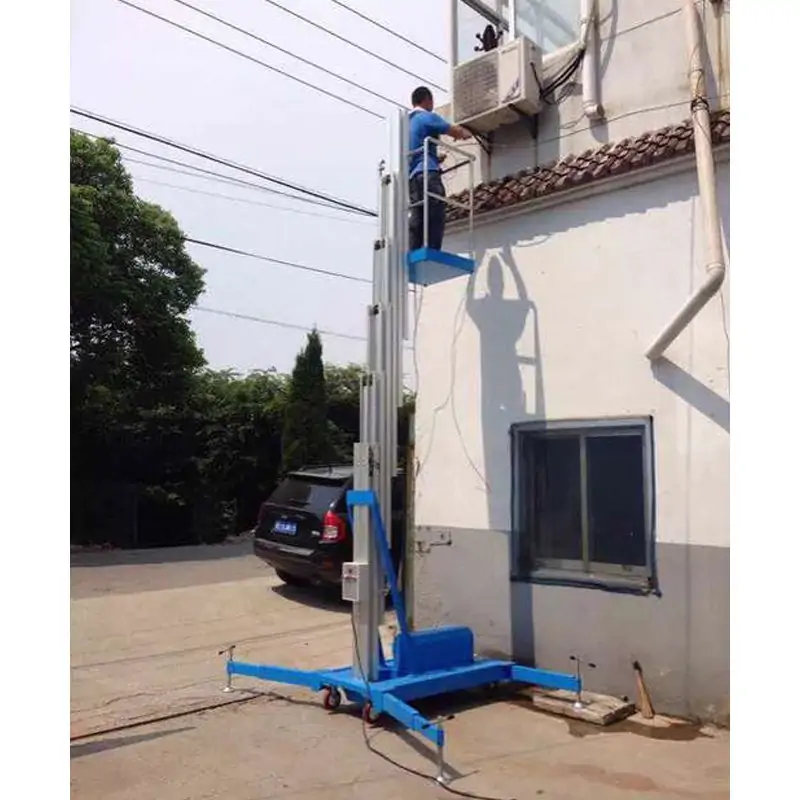
The Single Mast Portable Aluminum Lift Platform is specifically designed for indoor single-person operations. Its ultra-light weight and compact dimensions allow it to easily pass through standard single doors and narrow corridors, while the precision hydraulic system ensures smooth platform lifting. It is widely used in hotel lobbies, supermarkets, factories, and property maintenance.
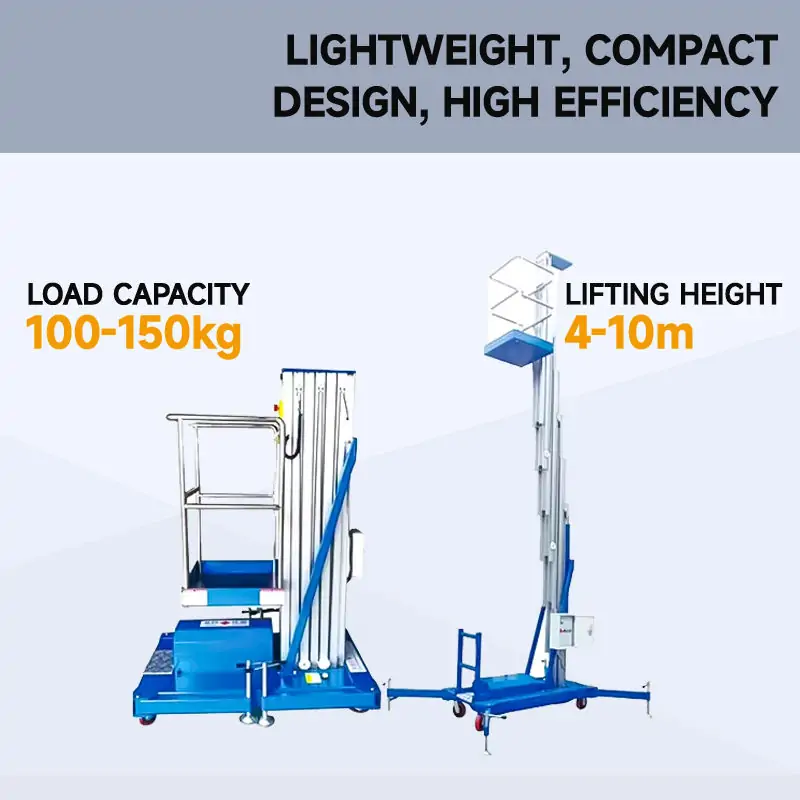
Rated Load Capacity: 100 kg – 150 kg
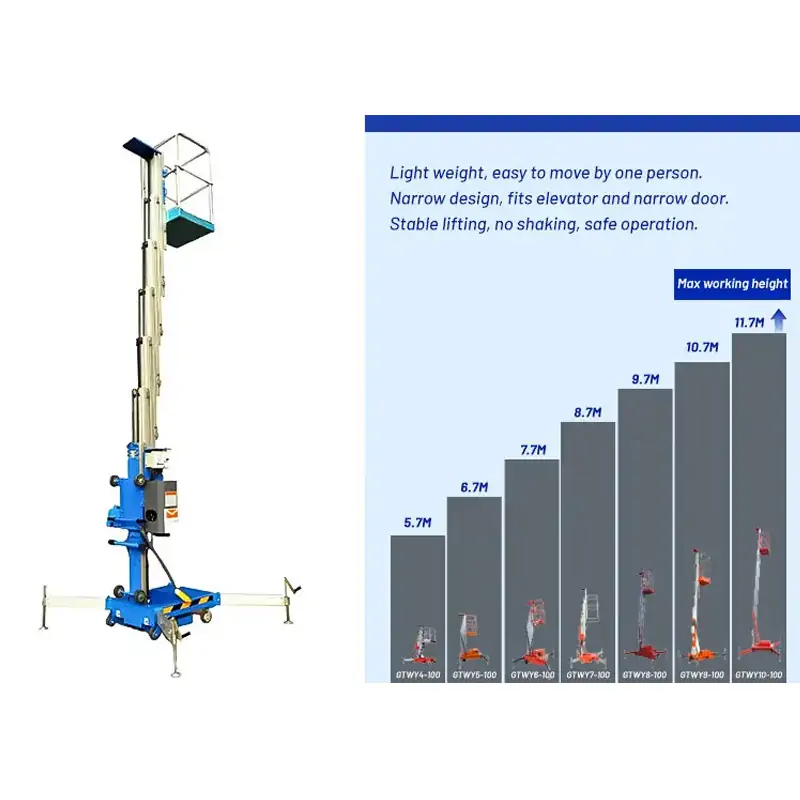
Max. Platform Height: 4 m / 6 m / 8 m / 10 m
Overall Weight: 280 kg – 490 kg
Stowed Dimension: 1300×800×1980 mm
The Portable Aluminum Lift Platform is constructed from high-strength aerospace-grade aluminum alloy profiles, featuring a lightweight design and excellent stability. The compact structure allows it to easily pass through standard single doors and enter passenger elevators. It is designed for single-person aerial maintenance in indoor environments such as office buildings, hotels, and warehouses. The precision hydraulic system provides smooth lifting, and multiple safety outrigger protections ensure this equipment provides sufficient working height while maintaining safety in confined spaces.
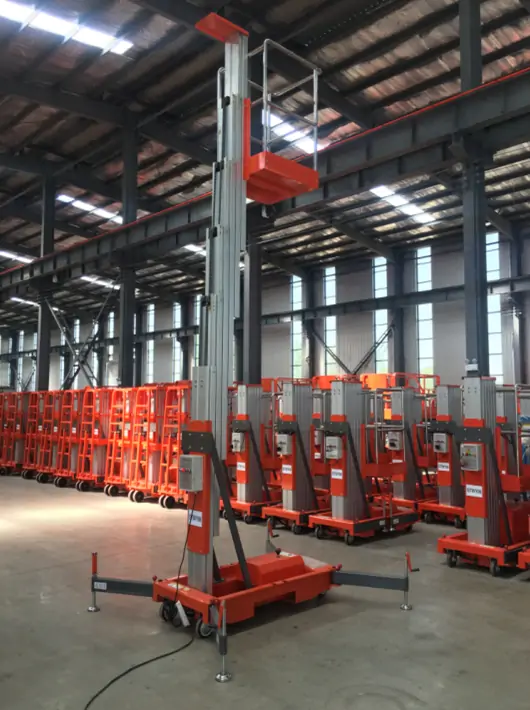
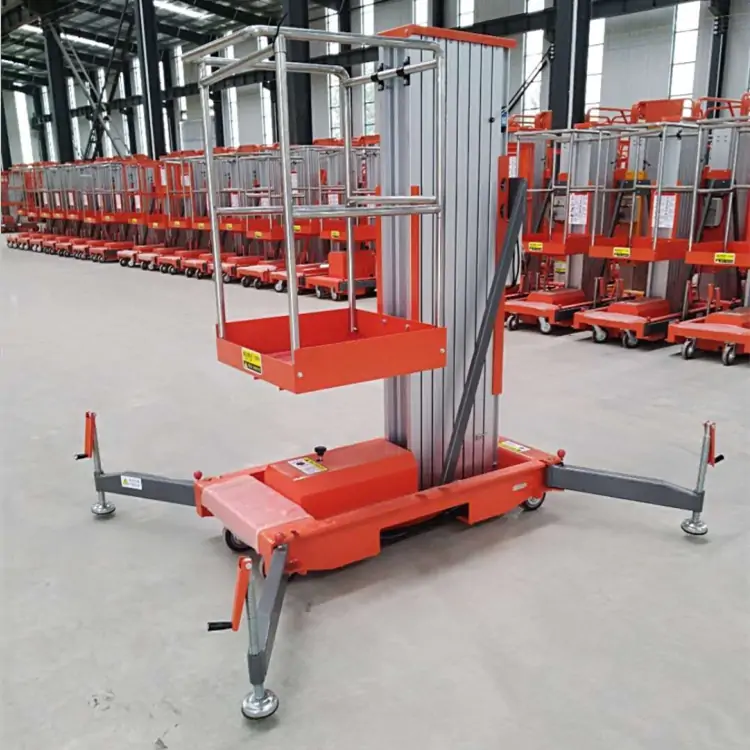
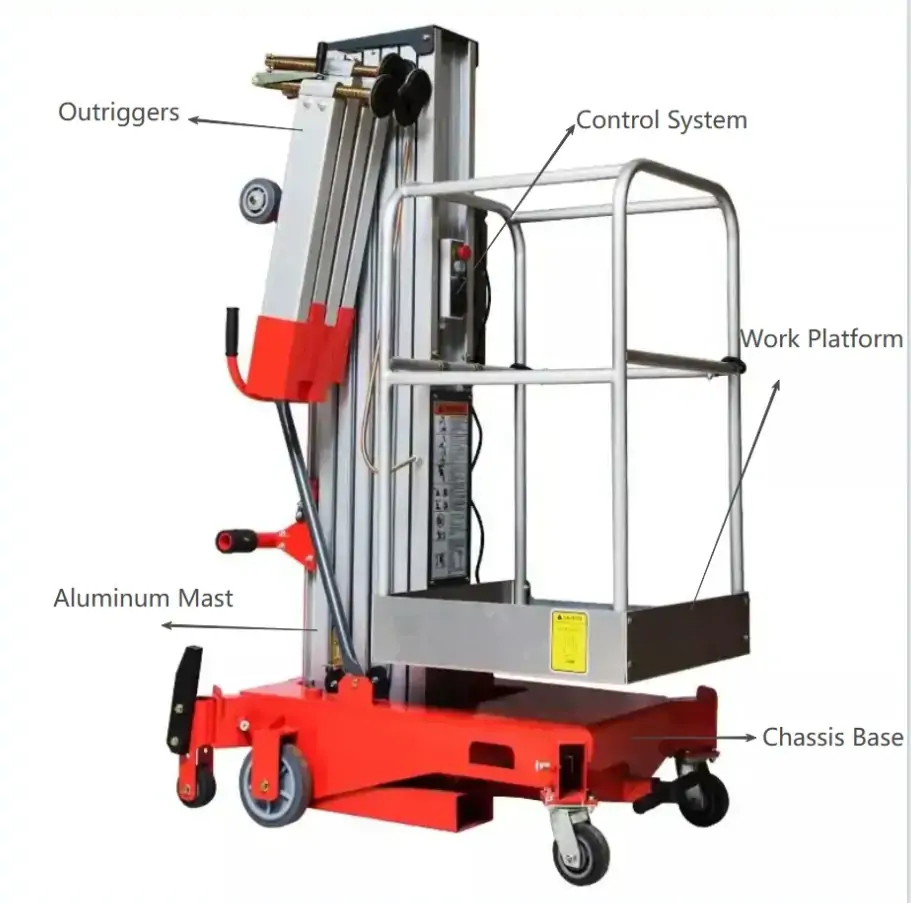
The working principle of the Single Mast Lift is the combination of a lightweight mechanical structure and precision hydraulic transmission technology, providing a safe and stable vertical lifting experience for single-person aerial work.
The Portable Aluminum Lift Platform completes aerial work positioning through electro-hydraulic drive and synchronization chain mechanisms.
| Items | Standard | Customized Range |
| Platform Height | 4m, 6m, 8m, 10m | Up to 12m (Working height 14m) |
| Load Capacity | 125 kg – 150 kg | Up to 200 kg (Reinforced Single Mast) |
| Power Supply | AC 220V / 50Hz | DC battery, AC/DC dual-use, 110V (US standard) |
| Stowed Height | 1.98 m – 2.15 m | Ultra-low design (for shorter doors or elevators) |
| Platform Size | 600 × 600 mm | Extended/widened platform (stability assessment required) |
| Color & Finish | VIOTTO Standard Blue/Orange | Specified RAL colors, anti-corrosion powder coating |
| Explosion-proof | Non-explosion proof | Optional Ex-proof control box and motor |
VIOTTO offers both single-mast and double-mast aluminum lift platforms and can customize solutions based on your specific operational needs. (Details: Aluminum Alloy Lift Platform)
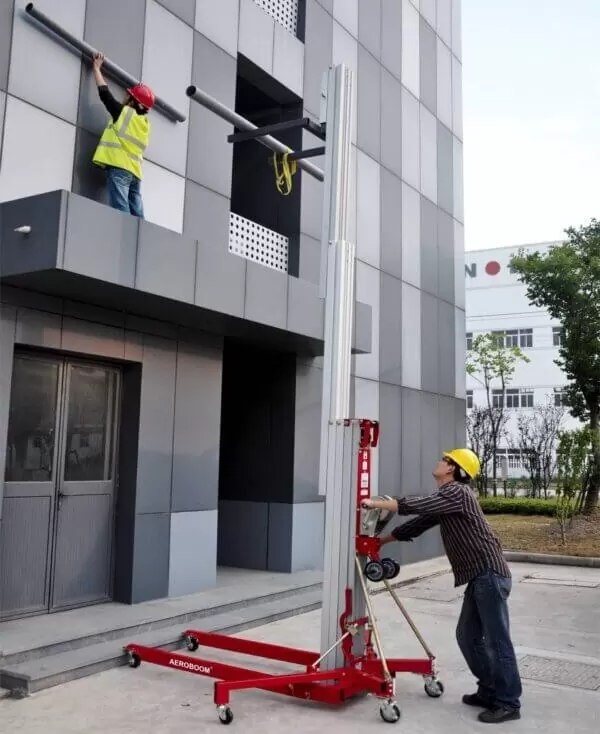
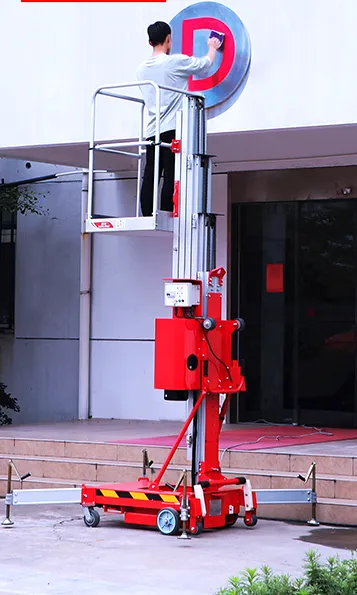
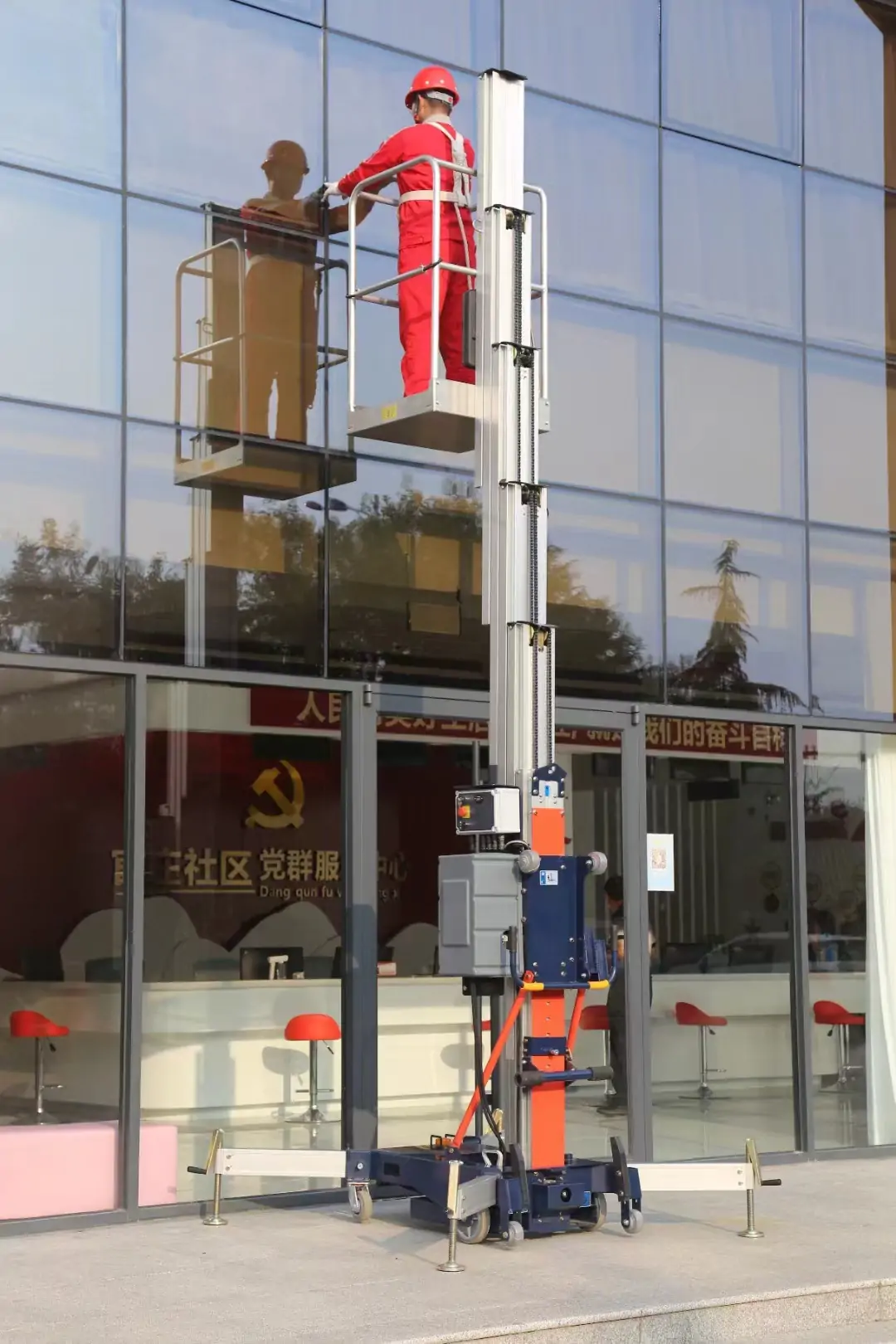
The lightweight and flexible characteristics of the Single Mast Lift make it widely applicable in scenarios with strict requirements for floor pressure and space:
VIOTTO is a professional manufacturer of the Portable Aluminum Lift Platform, dedicated to providing customers with vertical operation solutions that combine lightweight flexibility with superior safety. We provide high-quality standardized products complying with CE and ISO standards, and use our technical depth to provide you with full customization services ranging from load and special dimensions to explosion-proof systems. Contact us to obtain your customized aerial work solution and real-time quotation.

Our pre-sale team provides consultations, tailoring solutions to your needs and environment.
Offer customization options for lifting capacity, span and lifting height etc. to meet specific needs.

Real-Time Progress Updates: Weekly reports and PM communication.
Pre-Delivery Testing: 100% load & safety checks, detailed reports.

3-5 years warranty and free replacement for non-manufacturing defects.
24/7 online support and on-site assistance for crane issues.
Yes. This platform uses a compact design. The stowed width is usually within 800mm and the height is about 2m, allowing it to easily enter standard passenger elevators and pass through single office doors.
Yes. Thanks to the high-strength aluminum alloy material, the total machine weight is very light (usually 300kg-500kg). Combined with the universal non-marking casters on the base, a single operator can easily complete pushing, turning, and lifting operations.
The equipment forms a stable base through four adjustable outriggers and includes a built-in leveling sensor. The system only allows lifting when the outriggers are fully supported and the body is level, effectively eliminating tipping risks.
The maintenance volume is very low. You only need to periodically check the hydraulic oil level, clean foreign objects from the mast rails, and ensure the synchronization chains are lubricated. Aluminum alloy itself is highly corrosion-resistant with a long service life.
Yes. In addition to standard AC 220V/110V power, we provide DC battery power or AC/DC dual power customization to meet outdoor or mobile operation scenarios without external power access.


Introduction Scissor lift prices typically range from $8,000 to $50,000+, depending on lifting height, load capacity, platform size, and whether the unit is designed for indoor or rough-terrain use. In this article, we’ll explain what affects the cost, compare different lift types, and help you estimate the right budget before buying. Average Scissor Lift Price Range by Type If you are comparing the costs of scissor lifts, the quickest approach is to first understand the price ranges for different types. Based on 2026 market conditions, most buyers have budgets ranging from $4,000 to $36,000 (or even higher), depending on the lift type, working height, and drive system. Furthermore, equipment costs vary due to differences in materials and dimensions; components may be made of stainless steel, aluminum alloy die-castings, or zinc alloy die-castings. If you require aluminum alloy die-castings, you will need to commission an aluminum die casting manufacturer for production; the same applies to zinc alloy die-castings. Recommended Price Table Type Typical Working Height Load Capacity Average Price Range Mini / Manual Mobile 6–10 m 300–500 kg $4,000–$8,000 Hydraulic Mobile…
A scissor lift with extendable platform solves a common job site problem: the work area doesn’t sit directly above the machine. Overhead pipework, facade panels, and wide-span ceiling grids all demand lateral reach that a standard deck can’t provide without repositioning.The platform extension fixes this by sliding a secondary deck outward — typically 0.9 m to 1.5 m — without moving the machine. That’s a real productivity gain. But it also changes how load is distributed and where the machine’s center of gravity sits. Most incidents with scissor lift extended platforms aren’t equipment failures. They’re the result of operating outside rated parameters: wrong surface, wrong load, wrong extension angle.This guide covers what to check before purchase, how to deploy the extension safely, and which compliance standards apply in major markets. What Is a Scissor Lift Platform Extension — and How Does It Work? The Basic Mechanism A scissor lift platform extension is a secondary deck section attached to one end of the main platform, typically on a sliding rail or swing-arm mechanism. The operator deploys it manually or with a…
In many workshops and production environments, lifting tasks are frequent, space is limited, and budgets are under constant pressure. Traditional lifting systems can be costly to install and lack the flexibility needed for dynamic operations. This is where portable jib cranes offer a practical alternative. Designed for mobility and ease of use, they provide a flexible and efficient lifting solution without heavy infrastructure investment. By improving handling efficiency and reducing manual labor, they help optimize workflow while keeping costs under control. In this article, we explore the key benefits and how they can support your operations. What Is a Portable Jib Crane? A portable jib crane is a compact and movable lifting device designed for localized material handling. A typical portable jib crane combines the functionality of a small crane with the advantage of easy relocation, making it a practical flexible lifting solution for workshops, warehouses, and production lines where space and efficiency are critical. Definition and Features A portable jib crane usually consists of a freestanding base, a vertical mast, and a rotating boom arm equipped with a hoist.…
What Is Best Portable Jib Cranes for Small Workshops? A portable jib crane for small workshops is a compact and flexible lifting solution designed to handle materials, tools, molds, and machine parts in limited workspaces. Unlike fixed cranes, it can be easily moved to different workstations, making it ideal for workshops where lifting tasks occur in multiple areas. This type of jib crane is widely used in automotive repair shops, mold manufacturing, equipment maintenance, and light industrial production, helping improve handling efficiency while reducing manual labor and safety risks. For small businesses looking for a cost-effective and space-saving lifting system, a portable jib crane offers excellent flexibility, easy installation, and a strong return on investment. Components of Portable Jib Crane The key components of a portable jib crane typically include a vertical mast, which provides stable structural support, a rotating jib arm that allows smooth horizontal movement of loads, and an electric chain hoist for efficient lifting and lowering operations. Most models also feature a mobile base with heavy-duty casters, enabling easy relocation within the workshop. One of the main…
If you’ve ever tried to source a scissor lift platform without a clear framework, you know the frustration. Dozens of models, conflicting specs, and salespeople pushing inventory — it’s easy to end up with a machine that’s either underpowered for the job or far more expensive than necessary. Here’s the short answer most buyers need upfront: the right scissor lift platform depends on three variables — working height, load capacity, and ground conditions. Get those three right, and the rest of the selection process becomes straightforward. This guide breaks down the main types of scissor lift platforms, their real-world applications, and the key parameters you should evaluate before signing a purchase order. Whether you’re outfitting a warehouse, managing a construction site, or sourcing equipment for facility maintenance, the information below will give you a practical decision framework — not just a product catalog. By the end, you’ll understand why a platform scissor lift that works perfectly indoors can be a liability outdoors, and how to avoid costly mismatches between equipment and environment. What Is a Scissor Lift Platform — and…
If your lifting application meets the following criteria: a lifting capacity of less than 32 tons, a lifting height of 30 meters or less, and a duty class at or below FEM 3m (ISO M6). Then an electric wire rope hoist is almost always the ideal choice, offering greater cost-effectiveness and shorter lead times. Once these thresholds are exceeded, or when the crane is custom-designed for specific operating conditions such as those found in ports, shipyards, or the metallurgical industry, an industrial winch becomes the only viable option. When choosing between a winch vs hoist, the key to making this decision does not lie in which type of equipment is capable of lifting heavy loads (since both are equally capable), but rather depends on four key parameters that are often misunderstood during the procurement process: maximum working load rating, wire rope drum flexibility, lifting height, and the equipment’s long-term maintainability. This article will provide an in-depth analysis of the structural differences between these two drive systems, comparing them across eight key parameters critical to procurement decisions. It will also highlight…

 English English
  Español
 Português
 العربية
 Français
 Русский