In workshop production, steel mills, and material storage environments, overhead cranes are the preferred lifting equipment for many companies. They can not only greatly improve material handling efficiency, but also reduce manual labor costs. There are many types of bridge cranes, the common ones are EOT cranes and HOT cranes. Although the two have similar shapes and structures, they differ significantly in their driving methods, application scenarios, and degree of automation. Next, this article will delve into what are the EOT and HOT crane, as well as their features, advantages, and application scenarios, etc., to help you become familiar with and understand which type is best suited to your industrial needs.

EOT Crane

HOT Crane
What is an EOT Crane?
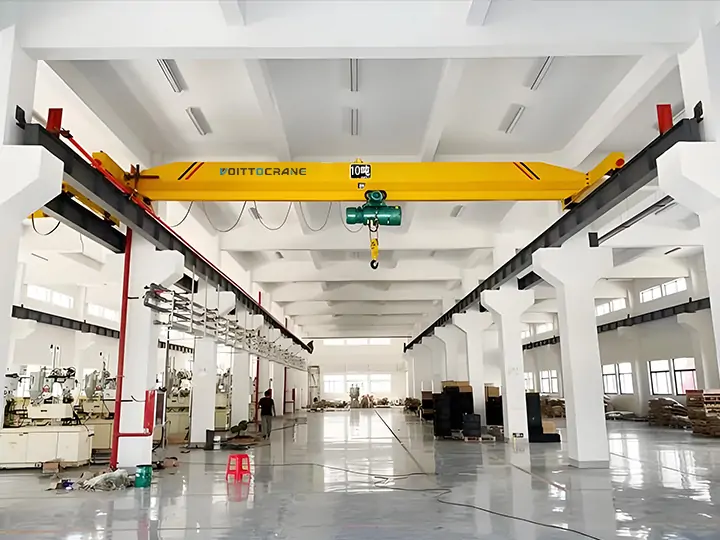
An EOT crane is also known as an Electric Overhead Travelling Crane. It is powered by electricity and spans above the factory building, enabling material handling in three dimensions of longitudinal, lateral, and vertical. The EOT crane is mainly composed of a bridge, overhead running mechanism, trolley running mechanism, and lifting mechanism.

Single Girder EOT Crane

Double Girder EOT Crane
The EOT Crane, according to the structure, can be divided into single-beam, double-beam, and suspension types. The lifting capacity ranges from 1 ton to hundreds of tons, and it is widely used in light warehousing to heavy industrial production. It has the features of high efficiency, smooth operation, and a wide application range, and is the preferred lifting solution for factories and workshops.
Application
- Manufacturing Plants: Used for handling large components and workpieces.
- Steel Mills: Used for lifting ladles, billets, and heavy raw materials.
- Machining Plants: Assist with loading and unloading machine tools and moving heavy components.
- Warehousing and Logistics Centers: Used for the storage and transfer of finished products or raw materials.
- Power and Energy Industries: Used for lifting generator sets or turbines.
- Paper Mills: Used for the movement and handling of raw materials, finished products.
- Maintenance Workshop: Assist in lifting or assembling large parts.
- Smart Manufacturing Workshop: Automated production lines and EOT cranes operate in coordination.
Advantages and Features
- Strong Load Capacity: A wide range of lifting capacities, from 1 ton to 500 tons, caters to both light and heavy-duty operations.
- High Operational Efficiency: Electric-powered, it boasts fast handling speeds and is suitable for frequent and continuous operations.
- Large Coverage: Installed above a workshop or factory to cover the entire working area.
- Flexible Operation: Operates from the cab, via ground-mounted handles, or via a wireless remote control.
- Reliable Structure: Constructed of high-strength steel, it offers a durable and robust design and easy maintenance.
- High Space Utilization: Mounted on overhead rails, it takes up no floor space, facilitating factory layout.
- Wide Application: Suitable for a variety of industries, including manufacturing, metallurgy, energy, and logistics.
- Safety: Equipped with limit switches, overload protection, and an emergency brake system.
- Automation and Intelligence: equipped with PLC control, variable frequency speed regulation, remote monitoring, and an intelligent anti-sway system.
What is a HOT Crane?
A HOT crane is also known as a Hand Operated Overhead Traveling Crane, is a manually driven bridge crane. It consists of a bridge, trolley, and lifting mechanism. The lifting mechanism usually adopts a manual chain hoist. The HOT crane operation does not rely on electricity or complex automation systems. It is lifting, traveling, and traversing the trolley are accomplished manually by pulling chains, handwheels, or ground-based levers.


HOT cranes have a simple structure and low manufacturing and maintenance costs. They are suitable for occasions with small lifting weights and low usage frequency, such as small and medium-sized factories, warehouses, maintenance workshops, etc.
Application
- Small Machinery Repair Shops: Used for lifting and moving parts.
- Warehouse Material Handling: Assists in the handling of light cargo.
- Assembly Shops: Used for moving small components during equipment or product assembly.
- Mold Storage Areas: Used for lifting molds or tools.
- Temporary Construction Sites: Used for lifting light building materials within a small area to meet temporary construction needs.
- Off-electric Locations: Suitable for material handling in environments without power.
Advantages and Features
- No Electric Drive Required: Suitable for use in environments without power or during power outages.
- Simple Structure: Compact design, easy installation, and maintenance.
- Low Cost: Manufacturing and operating costs are significantly lower than those of EOT cranes, making it economical and practical.
- Safe and Controllable Operation: Manual operation offers excellent controllability.
- Wide Application: Meets the needs of light material handling.
- Low Maintenance Requirements: No electrical system, low failure rate, and easy daily maintenance.
Difference Between EOT and HOT Cranes
| Type | EOT Crane | HOT Crane |
|---|---|---|
| Drive Method | Electric Motors Driven | Manually Operated |
| Lifting Capacity | 1-500 tons | < 5 ton |
| Working Efficiency | High-speed, Automated Lifting | Manual Operation Speed is Low |
| Positioning Accuracy | ±50mm | Depends on Manual Control |
| Cost | Higher Cost (depending on lifting capacity and span, etc.) | Low cost |
| Installation Complexity | Requires Power Source, More Complex | Easy to Install, Low Environmental Requirements |
| Maintenance | Requires Regular Servicing | Minimal Maintenance |
| Safety | Equipped with Multiple Safety Devices, High Safety | Relies Heavily on Operator Vigilance |
Conclusion
The above content introduces what are the EOT and HOT Crane, as well as their advantages and applications, etc. Although both EOT and HOT cranes are overhead cranes, their different drive systems give them distinct advantages and disadvantages in terms of application environment, operating efficiency, and load capacity. EOT cranes are more suitable for industrial applications with high lifting capacity and automation, while HOT cranes, with their low cost, simple structure, and independence from electricity, offer unique value in small and medium-sized warehouses or specialized working conditions.
VOITTO is committed to providing you with some valuable references, so that you can choose the right lifting equipment. If you have any specific requirements or need further assistance, please feel free to contact our expert team. VOITTO will provide you with custom solutions and professional support.




 English
  Español
  Português
  العربية
  Français
  Русский