
An industrial gantry crane is a self-supporting overhead lifting system carried on freestanding legs rather than building-mounted runways, typically covering 0.5 to 800 tons of capacity and spans from about 6 to 50 meters depending on structure type. Because it doesn’t rely on the building structure to carry the load, it’s the default choice for outdoor yards, precast plants, shipyards, and any site where installing overhead runway rails isn’t practical.
Most buyers start this decision by asking “what tonnage do I need?” — but tonnage is the third question, not the first. The two variables that actually determine whether a crane fits your operation are the application environment and the structural type, and getting those wrong is what turns a straightforward purchase into a re-engineering project six months later.
This guide walks through a five-step selection framework — application, structure type, capacity/span/duty class, height and ground conditions, then certification — so you can walk into a supplier conversation with a complete specification instead of a single number.
- 1 Quick Reference: Gantry Crane Types at a Glance
- 2 Step 1: Start With Your Application, Not the Tonnage
- 3 Step 2: Match the Structural Type to the Job
- 4 Step 3: Size Capacity, Span, Duty Class & Height Correctly
- 5 Step 4: Certification, Compliance & Choosing a Supplier
- 6 Selection Checklist
- 7 Conclusion
-
8
FAQ
- 8.1 Q1:What’s the difference between an industrial gantry crane and an overhead bridge crane?
- 8.2 Q2:How much does an industrial gantry crane cost?
- 8.3 Q3:What span do I actually need?
- 8.4 Q4:Do I need a rail-mounted or rubber-tyred gantry crane for a container yard?
- 8.5 Q5:What certifications should I ask a gantry crane supplier for?
Quick Reference: Gantry Crane Types at a Glance
| Structure Type | Typical Capacity | Typical Span | Best Fit |
|---|---|---|---|
| Single girder gantry | 0.5–20 t | 6–20 m | Indoor workshops, warehouses, light fabrication |
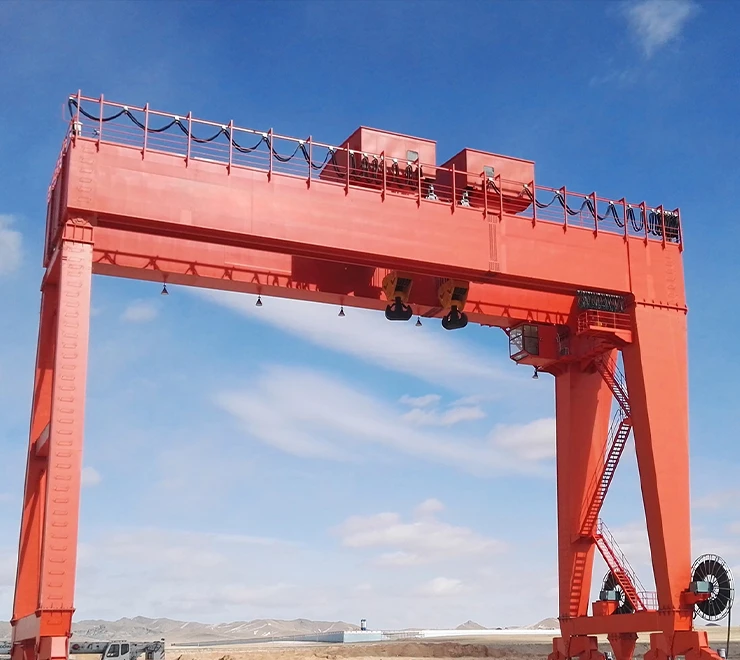
| Double girder gantry | 5–800 t | 6–40 m | Outdoor yards, precast plants, heavy fabrication |
| Semi-gantry | 5–150 t | up to 30 m | Sites where one side must stay clear (uses an existing runway on one rail) |
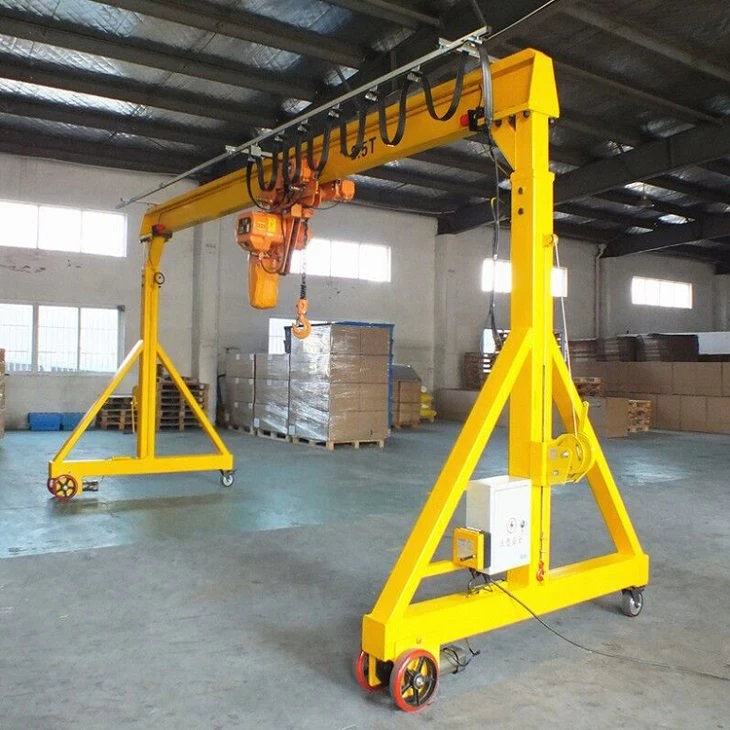
| Portable/mobile gantry | 0.5–5 t | 3–8 m | Maintenance bays, equipment service, temporary lifts |
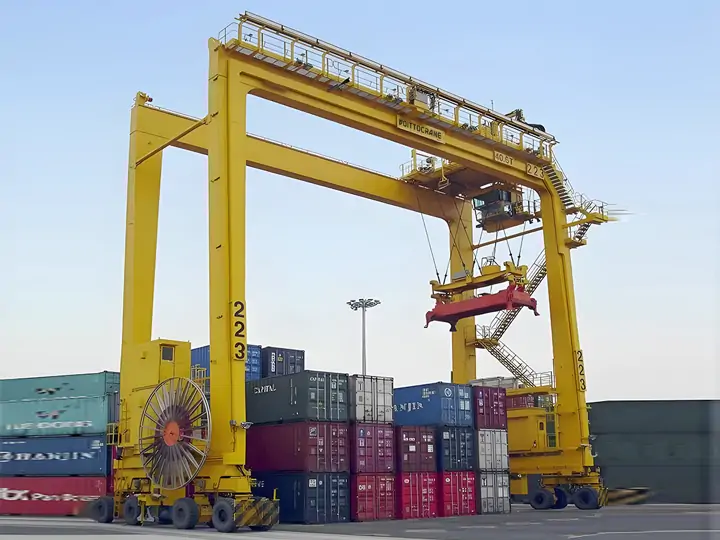
| Rail-mounted (RMG) / Rubber-tyred (RTG) | 20–70 t | up to 50 m | Container yards, ports, shipyard block assembly |
Have your application, capacity, span and duty class ready?
Get Quote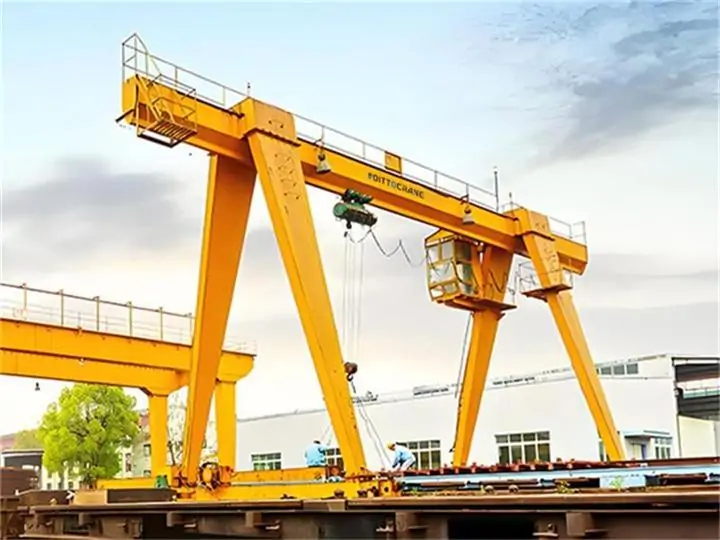


Step 1: Start With Your Application, Not the Tonnage
The application environment eliminates most structural options before you ever compare tonnage. Indoor and outdoor use, ground conditions, and how often the crane needs to move all narrow the field faster than capacity does, because they determine whether a crane can physically be installed and operated at all.
Indoor Production, Assembly & Warehousing
A workshop with a level floor and limited outdoor exposure is the natural fit for single girder or portable gantry cranes in the 0.5–20 ton range. The reason capacity stays modest here isn’t a technical ceiling — it’s that indoor floor loading and headroom constraints typically make single girder structures the more economical choice below 20 tons, while double girder designs only start paying for themselves once span or tonnage push structural requirements up. Buyers moving parts between a handful of workstations, doing mold changes, or handling maintenance loads fall into this category.
Outdoor Storage Yards & Precast Concrete
Outdoor yards handling precast beams, steel coils, or stacked components need double girder gantry cranes because the elements are heavy (commonly 20–60 tons for precast beams), awkwardly shaped, and lifted at fixed engineered points rather than balanced loads. The portal-frame structure is self-supporting, so it doesn’t require building columns to carry the runway — which is precisely why it’s the standard for yard operations above 10 tons. Span here is typically driven by the number of storage rows (most precast yards run 3–5 parallel rows) plus truck access lanes, not by maximizing yard coverage.
Shipyards, Ports & Heavy Fabrication
Shipyards and ports need gantry and rail-gantry systems specifically because overhead runway rails often can’t be installed in open block-assembly yards or dry docks. A standard double girder gantry crane covers lighter pre-assembly and storage work (5–150 tonnes, spans up to 40 m), while rail-mounted (RMG) and rubber-tyred (RTG) variants extend to 50 m span for container yard and dock coverage — the tradeoff being materially higher cost from the added travel mechanism and control system complexity.
Maintenance, Workshops & Mobile Use
Where the crane needs to move between rooms, bays, or even sites, portable gantry cranes (0.5–5 ton, 3–8 m span) trade lifting capacity for the ability to be relocated through a standard doorway. This is the category buyers most often over-tonnage on “just in case,” which adds unnecessary weight and cost without changing what the crane can actually be used for on a day-to-day basis.
Step 2: Match the Structural Type to the Job
Structural type determines cost and capability more than tonnage alone — two cranes rated for the same load can have very different price points depending on girder configuration.
Single Girder vs. Double Girder
Single girder gantry cranes use one main beam and suit lighter loads and lower-headroom settings; double girder designs add a second beam, which is what unlocks both higher capacity and longer span in the same structure. The practical dividing line: below roughly 20 tons and shorter spans, single girder is usually the more cost-effective build; above that, or where span pushes past 20–25 meters, double girder becomes necessary because a single beam can no longer resist the bending load without excessive deflection.
Full Gantry vs. Semi-Gantry
A semi-gantry runs one end on a fixed runway rail and the other on ground-level legs, which is the right call specifically when one side of the workspace has to stay clear — a loading dock, a vehicle aisle, or a confined site boundary. Full gantry structures, by contrast, are self-supporting on both sides and don’t depend on an existing runway being available, which is why they’re the default for greenfield outdoor sites with no prior crane infrastructure.
Portable/Mobile vs. Fixed-Track Systems
Portable gantry cranes run on casters or small rail sections and are built to be broken down or relocated; fixed-track systems are engineered for a specific span and foundation and aren’t designed to move. The tradeoff is straightforward: mobility costs load capacity and stiffness, so a portable unit will never match a fixed double girder crane’s tonnage-to-footprint ratio — buyers choosing portability are explicitly trading maximum capacity for flexibility.
Rail-Mounted (RMG) & Rubber-Tyred (RTG) for Yard and Port Use
RMG and RTG structures add a travel mechanism on top of the base gantry design, which is what allows them to cover container yards and dock frontage up to 50 m without repositioning between lifts.
If you would like to learn more about the differences between RTG and RMG cranes, please click here: RTG Crane vs RMG Crane: Understand the Differences Between
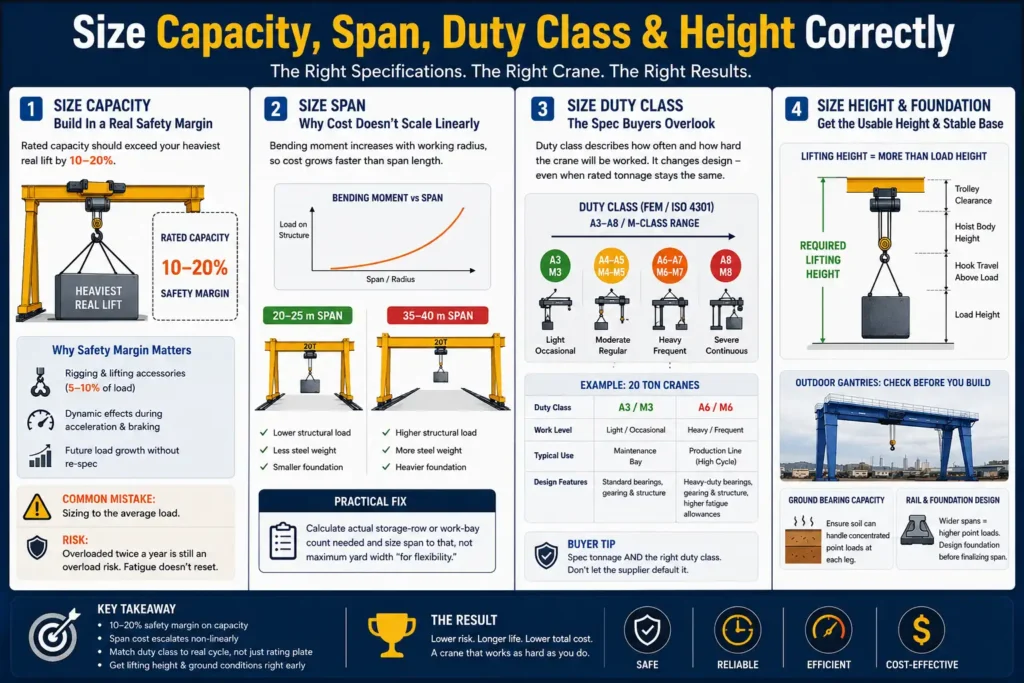
Step 3: Size Capacity, Span, Duty Class & Height Correctly
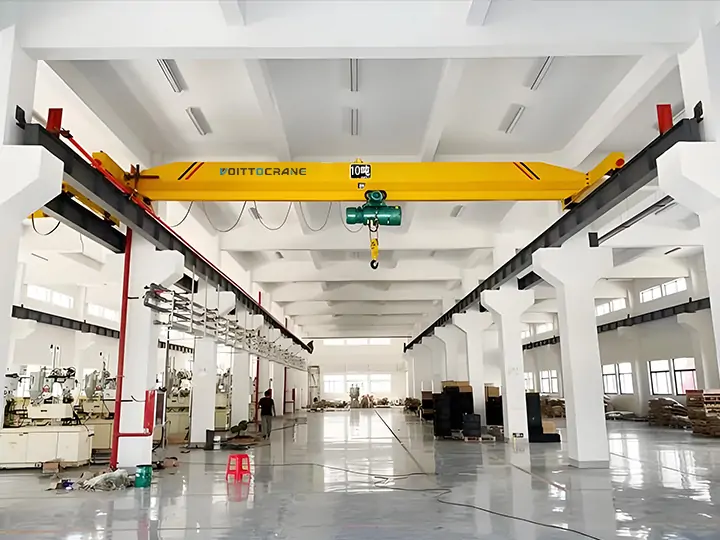
For regular production operations, choosing the right motorized gantry crane requires matching rated capacity and duty class to the actual lifting cycle.
Capacity, span, and duty class are interdependent — changing one changes what the other two need to be, so they can’t be selected in isolation.
Load Capacity: Build In a Real Safety Margin
Rated capacity should exceed your heaviest real lift by a margin, not just match it — a 10–20% safety margin is the industry-standard range because it covers rigging and lifting accessory weight (commonly 5–10% of total load on its own), dynamic effects during acceleration and braking, and future load growth without requiring a full re-spec. The common buyer mistake here is sizing to the average load rather than the heaviest anticipated one; a crane that’s “big enough” for daily use but gets overloaded twice a year on an oversized lift is still an overload risk, and duty-class fatigue doesn’t reset itself between those events.
Span: Why Cost Doesn’t Scale Linearly
Span cost grows faster than span length because bending moment on the structure increases with the working radius, not just the distance itself — increasing a boom or span by roughly two-thirds can raise structural load by well over half again, even at the same lifting weight. This is why two gantry cranes rated for identical tonnage can have meaningfully different steel weight and price once their spans diverge: a 35–40 m yard gantry carries tighter deflection tolerances and heavier foundations than a 20–25 m unit rated for the same load. The practical fix buyers often skip: calculate actual storage-row or work-bay count needed and size span to that, rather than defaulting to maximum yard width “for flexibility.”
Duty Class (FEM/ISO 4301): The Spec Buyers Overlook
Duty class — typically expressed under FEM or ISO 4301 classification systems (roughly A3 through A8, or the equivalent M-class range) — describes how often and how hard the crane will actually be worked, and it changes the structural and mechanical design even when rated tonnage stays the same. Two cranes both rated at 20 tons but built to different duty classes are different products: a higher duty class means heavier-duty bearings, gearing, and structural fatigue allowances built in from the start, because the crane is expected to cycle loads near capacity many times a day rather than occasionally. Buyers who spec tonnage alone and let the supplier default the duty class often end up with equipment matched to light, infrequent lifting — fine for a maintenance bay, inadequate for a production line cycling every few minutes.
Lifting Height & Ground/Foundation Conditions
Required lifting height isn’t just load height — it has to account for hoist body height, trolley clearance, and hook travel above the load, and insufficient height makes an otherwise correctly-sized crane unusable. For outdoor gantries specifically, ground bearing capacity and, where relevant, rail foundation design need to be confirmed before span and structure type are finalized, since a wider-span outdoor unit concentrates significant point loads at each leg — a detail that’s cheaper to correct on paper than after a foundation is poured.
Have your capacity, span, duty class and site conditions mapped out?
Get QuoteStep 4: Certification, Compliance & Choosing a Supplier
Certification isn’t paperwork you collect after the purchase decision — it’s a gate that affects customs clearance, insurance, and liability, so it belongs in the spec stage.
What to Ask For
For equipment headed to the EU, CE marking under the Machinery Directive (2006/42/EC) is the baseline requirement, and FEM design rules (FEM 1.001 for crane mechanisms) or ISO 4301 crane classification standards should be cited in the structural design documentation. The manufacturing facility itself should hold ISO 9001 quality management certification, separate from the product’s own compliance marks. For Russia, Kazakhstan, or Belarus, EAC certification is additionally required, and for US-bound equipment, compliance with relevant OSHA lifting-equipment standards falls partly on installation and operating practice, not the manufacturer alone — worth clarifying with your supplier which party is responsible for what.
How to Verify Before You Pay a Deposit
The gap between “we’re certified” and a certified product is real: ask for the actual EC Declaration of Conformity, a third-party overload test certificate (typically issued at 125% of rated capacity), and the factory’s ISO 9001 certificate as documents, not verbal assurance. Cross-check that safety devices — overload protection, anti-collision limits, and load display — are listed as standard equipment in the quotation, not optional add-ons, since these are the components inspectors and insurers look for first. Buyers who skip this step and rely on a supplier’s general reputation are the ones most likely to discover a documentation gap during customs clearance, when it’s far more expensive to fix.
Selection Checklist
Before you request a quote, have these seven items ready — it’s the difference between a quote turned around in hours and one that takes days of back-and-forth:
- Application — indoor/outdoor, industry (warehouse, precast, shipyard, port, general fabrication)
- Structure type — single girder, double girder, semi-gantry, portable, RMG/RTG
- Capacity — heaviest real load, plus a 10–20% margin
- Span — based on actual storage rows/bay width, not maximum coverage
- Duty class — expected lifts per day / cycle frequency
- Lifting height — including hoist, trolley and hook-travel clearance
- Certification requirements — CE/FEM/ISO/EAC/OSHA depending on destination market
Conclusion
Choosing the right industrial gantry crane comes down to sequencing the decision correctly: lock in the application and structure type first, then size capacity, span and duty class together rather than one at a time, and treat certification as a spec item rather than an afterthought. Buyers who follow that order end up with a crane that fits the job on day one — and one that still fits it after the duty cycle picks up.

Alan
Crane Solutions Specialist · Voitto Crane
Specialized in Overhead Crane, Gantry Crane, Jib Crane, Port Crane & EOT Crane export solutions. 10+ years helping global clients with pre-sales consultation, capacity selection and site-specific configurations.
FAQ
Q1:What’s the difference between an industrial gantry crane and an overhead bridge crane?
A gantry crane is self-supporting on freestanding legs, while an overhead bridge crane runs on runway rails mounted to the building structure. Gantry cranes suit outdoor yards and sites without existing runway infrastructure; overhead cranes suit indoor facilities where the building can carry the runway load.
Q2:How much does an industrial gantry crane cost?
Outdoor double girder gantry cranes for yard and loading operations generally run $18,000–$120,000, while heavier 50-ton-class configurations typically range from tens of thousands to over a hundred thousand US dollars depending on span, duty class, and control specification. Rail-mounted or rubber-tyred container-handling models cost significantly more due to added travel mechanism complexity.
Q3:What span do I actually need?
Span should match your actual storage rows or work-bay width plus access clearance — not the maximum available yard width. Most precast and storage yards need 3–5 parallel rows, and oversizing span raises structural steel cost and foundation requirements faster than the added coverage is usually worth.
Q4:Do I need a rail-mounted or rubber-tyred gantry crane for a container yard?
RMG and RTG structures are built for high-cycle container and yard operations where the crane needs to travel across wide coverage areas — typically 20–70 tons and spans up to 50 m. For lighter, lower-frequency yard or storage work, a standard double girder gantry crane is usually the more cost-effective choice.
Q5:What certifications should I ask a gantry crane supplier for?
Request the EC Declaration of Conformity and CE marking documentation (Machinery Directive 2006/42/EC) for EU-bound equipment, the factory’s ISO 9001 certificate, and a third-party overload test certificate — typically issued at 125% of rated capacity. Ask which party (manufacturer vs. installer) is responsible for destination-market compliance like OSHA or EAC.




 English
  Español
  Português
  العربية
  Français
  Русский