
Overhead cranes are a common lifting equipment in industrial production. They are widely used in workshops, factories, warehouses, and other places to carry out tasks such as transporting large parts or heavy goods, loading, and unloading. Mastering the correct overhead crane operating methods not only improves production efficiency but also ensures a safe working environment and avoids potential safety hazards caused by improper operation. In this article, we’ll delve into how to operate overhead crane to help operators and factories improve their skills and reduce operational risks.


What Is Overhead Crane?
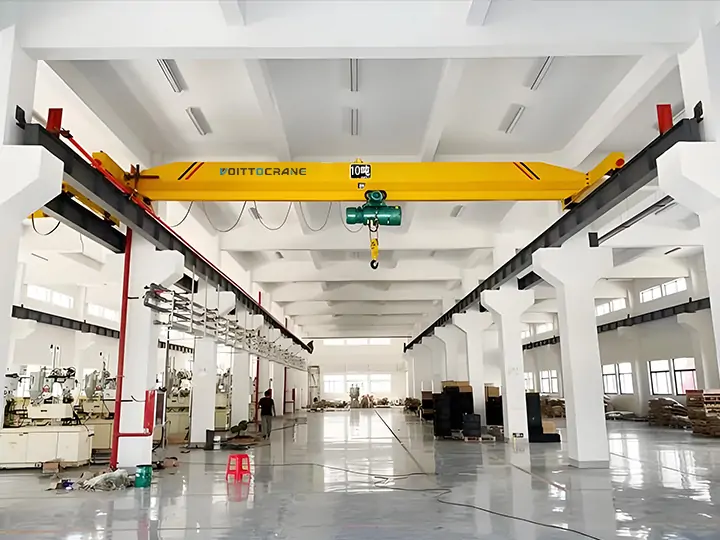
An overhead crane is a type of lifting equipment that operates above a factory building. It consists of one/two main beams, two end beams, a trolley, a lifting mechanism, a running mechanism, a Power supply system, and a control system. These components work together to move materials from point A to point B. Because its structure is like a “bridge” and can cover the entire working area, it is called an overhead crane.


How To Operate Overhead Crane?
The operators of overhead cranes must undergo professional training and hold a special equipment operator certificate before they can operate bridge cranes. The following is the Overhead Crane Operation Guide and Precautions, which is divided into four main parts pre-use inspection, operating steps, operating precautions, and post-operation requirements.
Pre-use Inspection
- Check the hook, wire rope, and pulley for cracks, wear, or deformation.
- Check the limit switches, brakes, and emergency stop buttons for sensitivity and effectiveness.
- Check the rails, hoisting equipment, controllers, and lighting for proper function.
Operating Steps
- Turn on the main power and confirm that the indicator lights are functioning normally.
- Before operating, sound the horn or signal to alert nearby personnel.
- Control the movement of the trolley, trolley, and hook using the operating handle or remote control.
- When lifting heavy objects, perform a test lift 10-20 cm off the ground to confirm that the brakes are secure and the weight is within the permitted range before continuing.
- Lifting and lowering operations must be smooth, and sudden lifting and lowering are strictly prohibited.
- Keep the load steady during lifting and avoid pulling, dragging, or jerking.
- Slow down before turning or stopping to avoid inertia shock.
Operating Precautions
- Overloading is strictly prohibited.
- Lift the load in its vertical condition, prohibit the use crane or trolley to drag the load.
- Loads are not allowed to cross the heads of people.
- Simultaneous reverse movement in two or more directions (e.g., forward and reverse) is strictly prohibited.
- Operators must obey the unified signals of the commander and suspend operations if the signals are unclear.
- Workers are not allowed to leave the cabin if there are still loads on the hook.
Post-use Requirements
- Lift the hook to a higher position and put the controller to the 0 position, cut off the main power.
- Cut off the main power and cut off the e-lock after work.
- The crane should be stopped at the designated position and be fixed when the driver leaves the crane.
- Clean and wipe the lifting equipment after work, and fill in the operation record.
How Does An Overhead Crane Work?
The operating principle of a bridge crane is that the main girder bridge serves as the integral support structure, while the end beams move longitudinally on tracks on both sides of the plant, covering the entire working area. A trolley on the main girder moves horizontally, and an electric hoist or electric winch mounted on the trolley drives the hook up and down, achieving vertical movement. The electrical control system is responsible for providing power and operating each component.
The driver coordinates the action of each organization through the linkage table control system, and cooperates with the safety components, such as limit switches and brake devices, to complete a series of operation cycles, such as lifting, panning, positioning, unloading, and releasing heavy loads. The whole system adopts a modularized design, and the electrical control realizes stepless speed regulation to ensure the smooth running of the load and meet the precise lifting requirements under different working conditions.
Overhead Crane Operation Safety Rules
Complying with the overhead crane operating procedures can effectively improve production efficiency and protect personnel safety. The following are the overhead crane operation safety rules. Please read carefully.
- The bridge crane shall be operated by personnel who meet the professional special equipment driving qualification certificate.
- The side of the equipment must be marked with the overhead crane’s maximum load, span, working level, and other information.
- No people are standing on the overhead crane except in the cabin.
- When the EOT travelling crane is undergoing routine inspection and maintenance, the entire vehicle must be powered off.
- When the bridge crane is not loaded, the hook should be at least 2.5 meters above the ground to maintain a safe distance.
- It is prohibited for bridge cranes to pass over the heads of people on the ground when transporting goods.
- For an EOT crane, the lowest point of the load shall be 0.5m higher than the highest point of obstacles.
- People transportation on a hook or a flap grab bucket is not allowed.
- Tools, spare parts, fasteners, and varia should be in special cases, they are not allowed to be placed on the overhead travelling crane to avoid dropping objects, hurting, or damaging equipment.
- When lifting an expensive load or noxious liquid, no matter how heavy it is, only after checking reliability on the position above ground 150-200mm, can the overhead bridge crane keep lifting.
- Combustibles are not allowed to be positioned on the overhead crane, fire prevention should be considered.
- Wind force is more than class 6, stop using the overhead crane outdoors.
- Give the overhead travelling crane a periodic routine inspection that includes dynamic and static load tests, and the results should be documented.
Notice: It should be noted that the specific operation details may vary according to different overhead crane types and manufacturers’ requirements. Please refer to the operation manual of the specific equipment for operation.
Overhead Crane Parts
The overhead crane consists of main girder, end girder, trolley running mechanism, Overhead Travel Mechanism, hoisting mechanism, rail, crane hook, cab, walking platform and other parts.

End Girder

Overhead Crane Cab

Overhead Crane Hook

Electric Wire Rope Hoist

Trolley Running Mechanism

Overhead Crane Main Girder
Conclusion
The above content introduces how to operate overhead crane and the rules and regulations for using overhead cranes. Mastering the art of how to operate overhead crane is the key to safe production and improving work efficiency. If you still have questions about how to operate overhead crane safely and efficiently after reading this information, please feel free to contact our professional technical team. We will provide you with timely and professional answers and guidance.
VOITTO is a professional overhead crane Customization and manufacturer, committed to providing high-performance and high-reliability lifting equipment to help you effectively improve your production efficiency. For customized overhead crane solutions, please feel free to contact us. VOITTO’s professional team will provide you with personalized advice and help you choose the most suitable equipment.




 English
  Español
  Português
  العربية
  Français
  Русский