
Indoor cranes can improve productivity and ensure operational safety in modern factories and warehouses. The right crane can reduce labor costs, improve operational accuracy, and enhance overall work efficiency.
Businesses need to consider factors such as load capacity, span and height, operating frequency, budget, and safety standards when selecting the appropriate indoor crane. This article provides a comprehensive overview of various indoor crane types, including bridge cranes, gantry cranes, cantilever cranes, monorail cranes, and low-headroom or custom-designed hybrid cranes. It will also analyze key selection criteria, compare the advantages and disadvantages of different types, and provide practical guidance on maintenance, safety, and supplier selection to help you make the best decisions.
If your focus is specifically on manufacturing environments — production lines, heavy equipment installation, and assembly operations — our factory cranes guide covers overhead, gantry, and jib crane configurations with a factory-specific selection table matching crane type to production scenario.
Types of Indoor Cranes
Choosing the right crane can improve material handling efficiency and ensure operational safety. Next, we will introduce common indoor crane types in detail, including bridge cranes, gantry cranes, cantilever cranes, monorail cranes, low-headroom cranes, and customized or hybrid solutions, to help you make the best choice based on your actual needs.
Overhead (Bridge) Cranes
The following is an introduction to common Indoor Overhead Cranes:
Single Girder Overhead Crane
Single Girder Overhead Cranes are suitable for medium to light-duty operations. Equipped with electric hoists, they can meet daily handling and assembly needs, and are simple to operate and maintain.
- Features: With only one main girder, the crane is compact and lightweight, suitable for small to medium-sized factories and light material handling.
- Applications: Factory workshops, warehouses, assembly lines.
- Advantages: Easy installation, small footprint, and low cost.

Double Girder Overhead Crane
Double Girder Overhead Cranes boast high load-bearing capacity and stability, making them ideal for heavy material handling and large equipment assembly, and suitable for high-frequency industrial production.
- Features: Two main beams structure, more suitable for heavy-duty or large-span operations.
- Applications: Steel mills, heavy machinery workshops, large storage facilities.
- Advantages: High load-bearing capacity, stable operation, suitable for long-term, high-frequency operations.

Top Running Overhead Crane
Top-rail bridge cranes are suitable for large-span factories, improving workshop logistics efficiency. Their stable structure makes them suitable for long-term continuous operation.
- Features: The main beam runs on tracks above the factory structure, which are directly fixed to the building structure.
- Applications: Workshops with large spans and few height restrictions.
- Advantages: High load-bearing capacity, suitable for heavy-duty handling and large spans.

Underhung Overhead Crane
Underslung Cranes have a compact design, allowing for flexible operation in low headroom workshops, suitable for light to medium-sized material handling, and saving factory space.
- Features: The main beam runs on a track suspended below the steel beams of the factory building, requiring minimal headroom.
- Applications: Small factories or warehouses with limited building height.
- Advantages: Space-saving, flexible installation, suitable for environments with low headroom requirements.

Light Duty / Electric Hoist Overhead Crane
Light-duty electric hoist bridge cranes are designed for light-duty operations, are easy to operate, and can be quickly installed and maintained, making them suitable for small factories and warehouses.
- Features: Used for handling light materials, typically equipped with an electric hoist.
- Applications: Light material handling in assembly workshops, laboratories, and warehouses.
- Advantages: Low cost, simple operation, and easy maintenance.
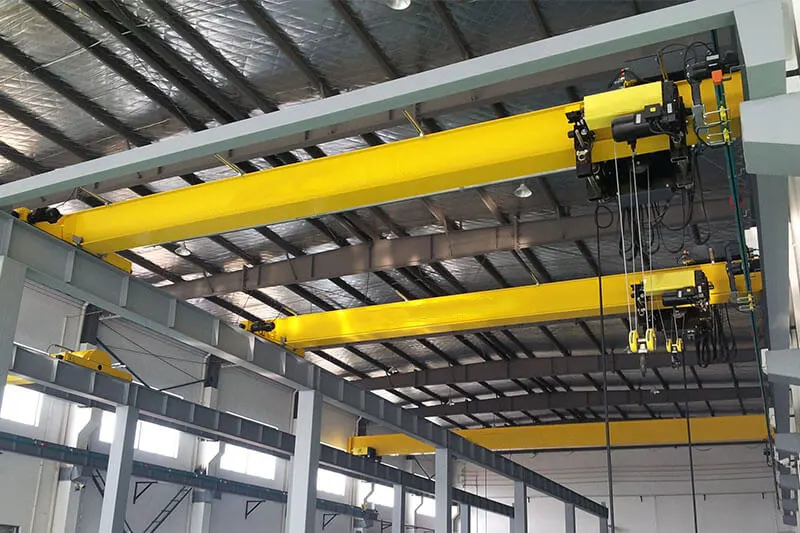
Low Headroom Cranes
Low headroom cranes are suitable for indoor environments with limited ceiling height, increasing effective lifting height while ensuring safe and stable operation, making them suitable for older factories and compact workshops.
- Features: Specifically designed for environments with limited factory height, reducing the required headroom for the crane through optimized main beam structure and lifting mechanism.
- Applications: Low-ceiling workshops, renovation projects of old factories, and space-constrained production workshops and warehouses.
- Advantages: Achieves greater lifting height under limited height conditions, improving space utilization without requiring large-scale factory renovations.

Indoor Gantry Cranes
The following is an introduction to common Indoor Gantry Cranes:
Fixed Gantry Crane
Fixed gantry cranes are used for long-term fixed workstation operations, stably completing the lifting and transfer of heavy materials, and are used for equipment assembly and mold handling.
- Features: The columns are fixed to the ground track or foundation, ensuring structural stability.
- Applications: Fixed workstations, large equipment assembly areas, mold handling areas.
- Advantages: High load-bearing capacity, smooth operation, suitable for repetitive tasks.
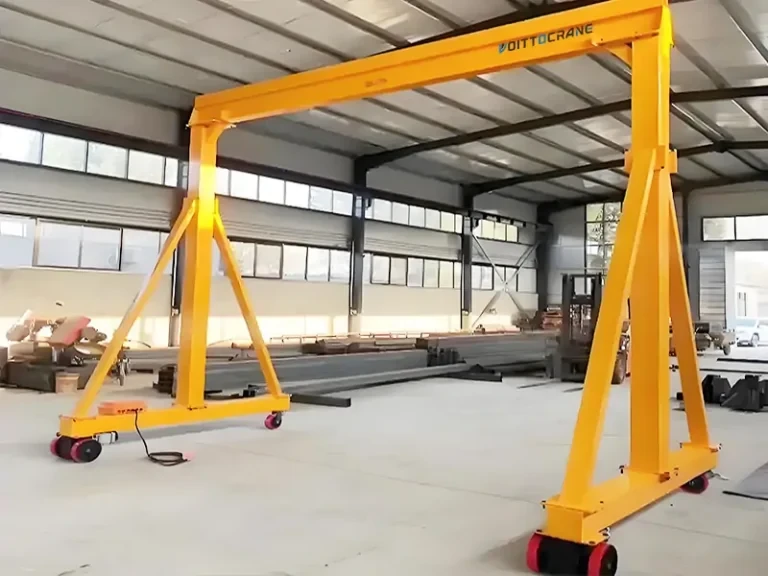
Mobile Gantry Crane
Mobile Gantry Cranes can move freely between different work areas, suitable for indoor material handling tasks requiring frequent workstation adjustments.
- Features: Equipped with casters or rails for easy movement within the workshop.
- Applications: Multi-station operations, small-batch production, repair shops.
- Advantages: No fixed foundation required, flexible installation, wide range of applications.

Adjustable Height Gantry Crane
Adjustable height gantry cranes are suitable for handling various sizes of equipment and materials, allowing the height to be adjusted according to actual operational requirements, improving space utilization.
- Features: Adjustable lifting height to adapt to different working conditions and equipment heights.
- Applications: Assembly workshops, warehouses, and scenarios requiring frequent changes of work objects.
- Advantages: High flexibility, meeting diverse operational needs.
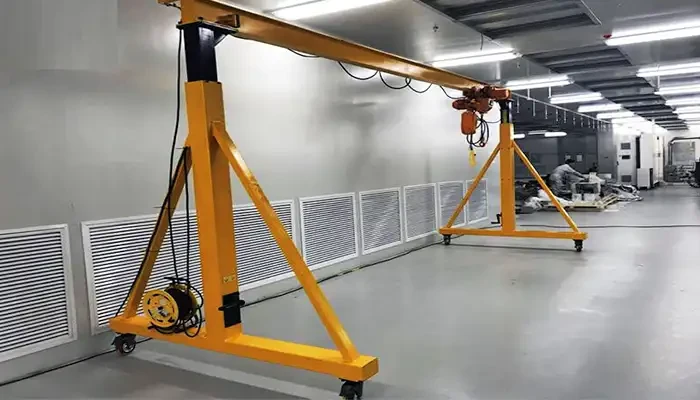
Single Girder Gantry Crane
Single Girder Gantry Cranes have a simple structure, suitable for daily light to medium load handling operations, making them an economical choice for factories and warehouses.
- Features: Lightweight structure, suitable for light to medium load indoor operations.
- Applications: Material handling in small to medium-sized factories and warehouses.
- Advantages: Lower cost, easy installation and maintenance.

Double Girder Gantry Crane
Double Girder Gantry Cranes are used for heavy-load and high-intensity operations, operate stably, and are suitable for lifting large equipment and heavy components.
- Features: Double main beam structure for enhanced load-bearing capacity.
- Applications: Heavy equipment assembly, large mold handling.
- Advantages: Suitable for high-frequency, heavy-load, and long-span operations.

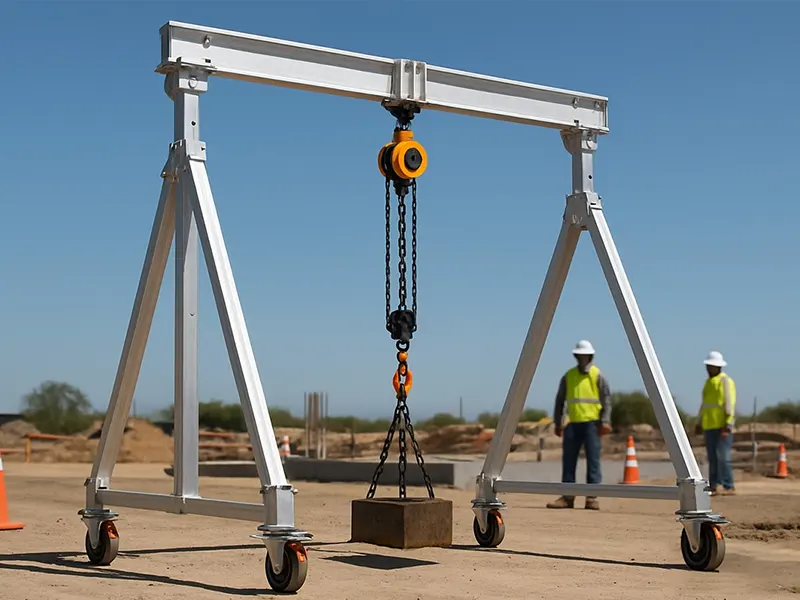
Portable Gantry Crane
Portable Gantry Cranes are suitable for temporary or flexible work scenarios, allowing for rapid deployment and disassembly, and facilitating transport and storage.
- Features: Modular design, quick assembly and disassembly.
- Applications: Temporary operations, equipment maintenance, small warehouses.
- Advantages: Easy to transport, small footprint, low investment cost.
Indoor Jib Cranes
The following is an introduction to common Indoor Jib Cranes:
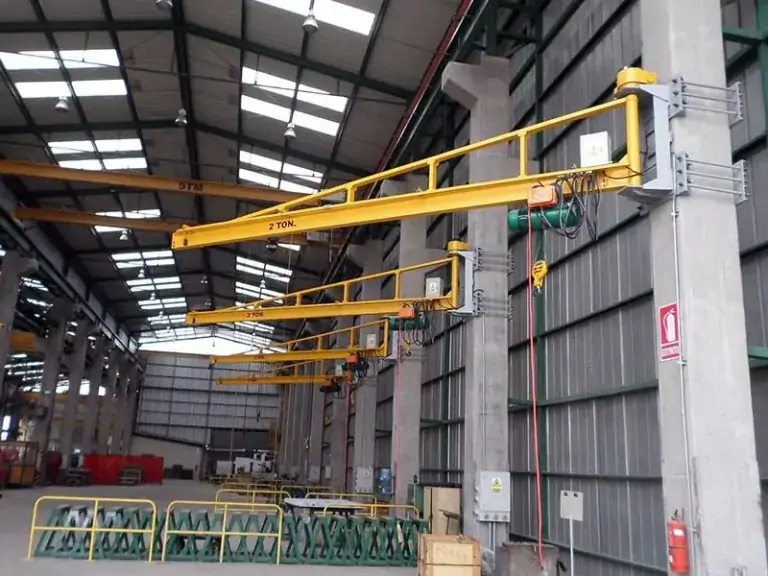
Wall-Mounted Jib Crane
Wall Mounted Cantilever Cranes are suitable for workshops with limited space, allowing material lifting to be completed within a fixed workstation.
- Features: Installed on factory columns or walls, it does not occupy floor space.
- Applications: Wall-mounted workstations, assembly lines, CNC machining, and machine tool loading and unloading areas.
- Advantages: Saves space, suitable for fixed work points.
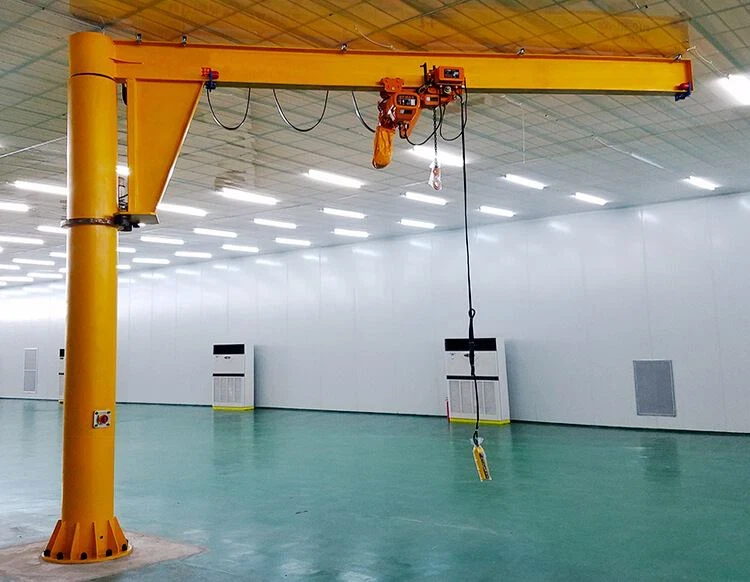
Free-Standing Pillar Jib Crane
Free-Standing Pillar Jib Cranes do not require a factory building structure, making them suitable for independent workstations and enabling multi-directional material handling.
- Features: Independent column mounting, allowing for a wide range of rotation.
- Applications: Open workshops, individual workstations, or central work areas.
- Advantages: Flexible installation location, wide coverage area.
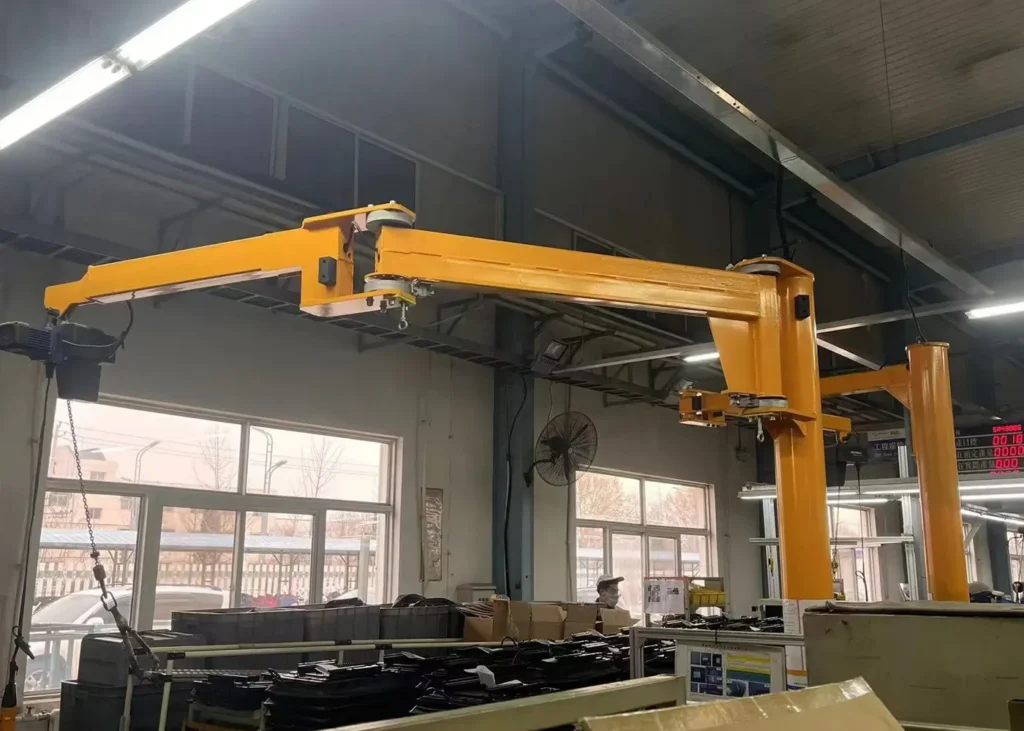
Articulating Jib Crane
Articulating Jib Cranes are suitable for workshops with complex layouts, allowing for precise positioning of lifting points and high operational flexibility.
- Features: Multi-joint arm design allows for obstacle avoidance during operation.
- Applications: Production areas with dense workstations and complex spaces.
- Advantages: Flexible operation, adaptable to complex working conditions.
Wall-Traveling Jib Crane
Wall Traveling Jib Cranes are suitable for continuous operation scenarios, capable of smooth operation between multiple workstations, improving overall material handling efficiency.
- Features: Can move horizontally along walls or tracks, expanding the work area.
- Applications: Long-distance work areas, adjacent to production lines.
- Advantages: Large coverage area, high space utilization.

Indoor Monorail Cranes
The following is an introduction to common Indoor Monorail Cranes:
Straight Monorail Crane
Linear monorail cranes are suitable for standardized production lines, enabling efficient and continuous indoor material transport and improving logistics efficiency.
- Features: The tracks are arranged in a straight line, with a simple structure and a fixed running path.
- Applications: Material transfer between assembly lines, warehouse aisles, and fixed workstations.
- Advantages: Stable operation, simple maintenance, suitable for continuous material handling operations.

Curved Monorail Crane
Curved monorail cranes are suitable for complex factory environments, can move flexibly between different workstations, and can transport goods along multiple paths.
- Features: The track can be designed with curves to adapt to complex workshop layouts.
- Applications: Production areas with limited space or where it is necessary to bypass equipment.
- Advantages: Flexible layout; can connect multiple workstations.

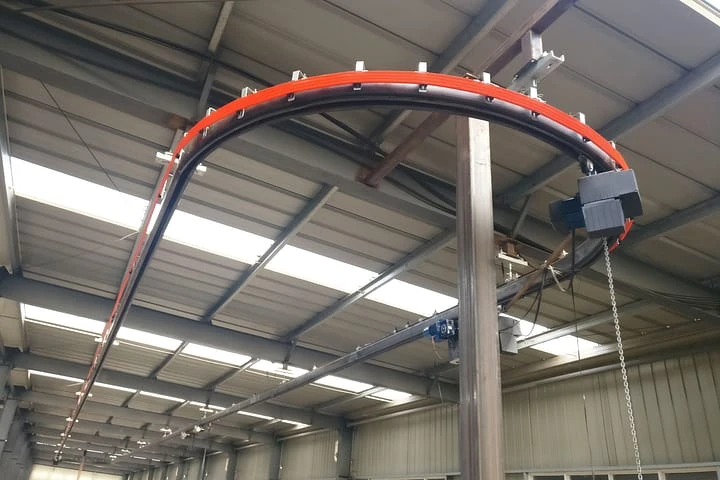
Loop Monorail Crane
Circular monorail cranes are suitable for assembly line operations, allowing for the cyclical transport of materials and improving overall production cycle time.
- Features: The track forms a closed loop, enabling cyclical operation.
- Applications: Batch production lines, continuous processing steps.
- Advantages: High continuity, suitable for high-frequency operations.
Switch Track Monorail Crane
Monorail cranes with turnouts are suitable for multi-line production environments, allowing for switching of transport routes according to process requirements, resulting in high system flexibility.
- Features: Equipped with a turnout device, allowing for switching of operating paths.
- Applications: Production workshops with multiple workstations and multiple process flows.
- Advantages: Flexible path selection, adaptable to various operational needs.
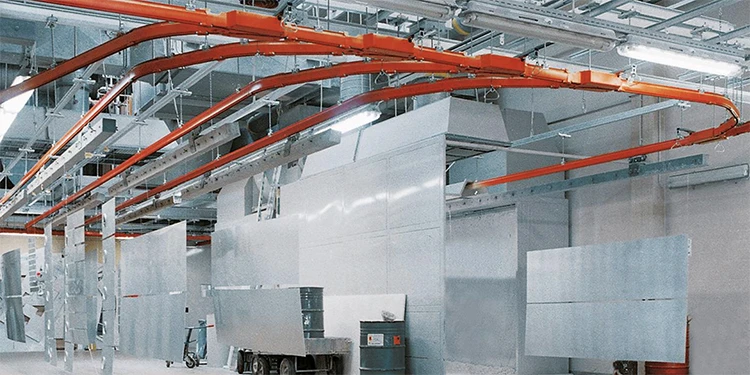
Ceiling-Mounted Monorail Crane
Roof-mounted monorail cranes are suitable for indoor environments with limited space, enabling material transport without occupying floor space.
- Features: The track is suspended from the factory roof structure, saving ground space.
- Applications: Compact workshops, locations with low footprint requirements.
- Advantages: Makes full use of upper space and does not affect ground operations.
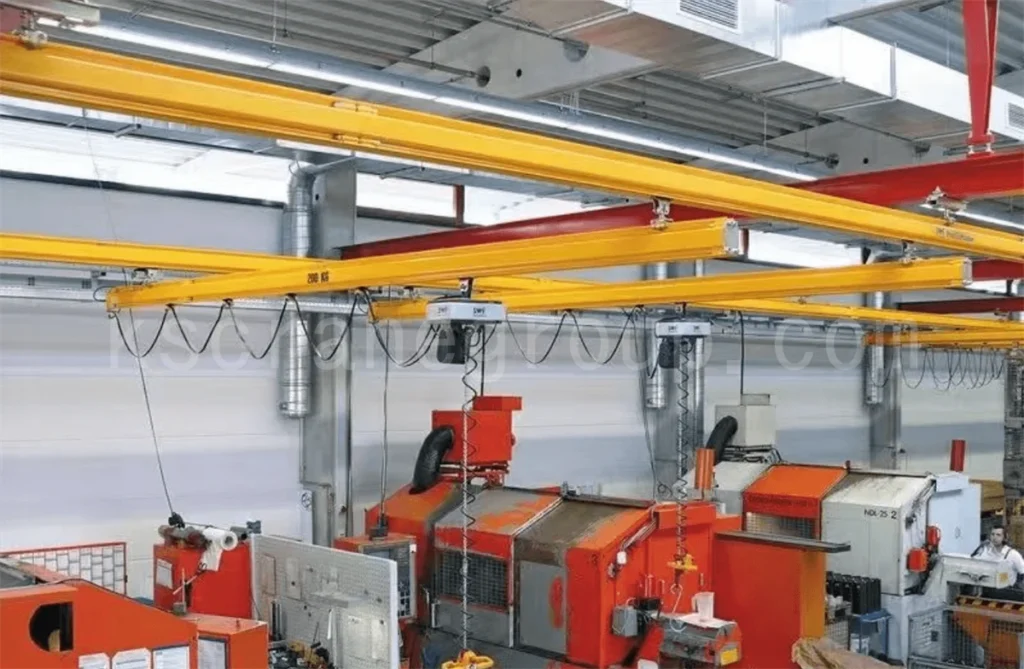
Key Factors to Consider When Choosing an Indoor Crane
When selecting an indoor crane, different factory structures and production needs necessitate different equipment configurations.The following sections outline the key factors to consider when selecting a crane, including lifting capacity, space availability, operating frequency, cost, and safety.
- Lifting Capacity and Lifting Requirements: Clearly define the maximum lifting capacity and daily operating weight. The equipment must meet actual working conditions and cannot be overloaded.
- Span, Height, and Space Limitations: Select the appropriate type based on the factory span, headroom, and layout. Low headroom or large span environments require specific design considerations based on the working conditions.
- Operating Frequency and Speed: High-frequency operations place higher demands on equipment stability and motor performance, and should be matched to the production rhythm.
- Budget and Life Cycle Costs: In addition to procurement costs, installation, maintenance, and long-term operating costs must be considered.
- Safety and Compliance Standards: The equipment should comply with local safety regulations and industry standards to ensure stable operation.
- OSHA/ISO Standards: Based on the project location, meet relevant OSHA or ISO standards.
- Maintenance and Inspection Requirements: Regularly inspect the structure, electrical systems, and safety devices to reduce the risk of failure and extend service life.
Indoor Crane Comparison Guide
Choosing the right indoor crane requires comprehensive consideration of the factory structure, lifting requirements, and production process. Different types vary in installation methods, coverage areas, and load-bearing capacities. The table below provides a brief comparison of common indoor cranes.
| Type | Installation Method | Coverage Area | Flexibility | Load Capacity | Typical Applications |
|---|---|---|---|---|---|
| Overhead Crane | Installed on runway beams attached to building structure | Covers entire workshop | Medium | Medium to Heavy Duty | Large factories, continuous production lines |
| Gantry Crane | Supported by legs, runs on floor rails or wheels | Partial or full area coverage | High | Light to Heavy Duty | Warehouses, assembly areas, multi-station operations |
| Jib Crane | Wall-mounted or floor-mounted column | Single workstation | High | Light to Medium Duty | Machine loading, localized lifting, assembly stations |
| Monorail Crane | Ceiling-mounted track system | Fixed path | Medium | Light to Medium Duty | Production lines, material transfer between stations |
Indoor Crane Manufacturers and Suppliers
Choosing the right manufacturers and suppliers not only affects equipment quality but also after-sales service and long-term operating costs. When selecting equipment, companies should comprehensively consider supply capabilities, technical support, and delivery services.
- Local Suppliers vs. International Suppliers: Local suppliers offer convenient communication and fast response times, making them suitable for projects with high installation and after-sales requirements. International suppliers generally possess extensive project experience and diverse product lines, suitable for large-scale or customized needs. Selection should be based on a comprehensive evaluation considering budget, delivery time, and technical requirements.
- Customization Capabilities and Engineering Support: Different factory structures and production processes place varying requirements on crane design. Manufacturers with engineering design capabilities can provide tailored solutions based on span, height, load, and automation needs, ensuring equipment matches site conditions.
- Global Delivery and Installation Services: Suppliers with global delivery capabilities can provide transportation, on-site installation, and commissioning support, ensuring smooth equipment deployment. Comprehensive after-sales service and technical support help guarantee long-term stable equipment operation.
Maintenance and Safety Tips
Proper maintenance and management ensure the safe and stable operation of indoor cranes. Establishing a regular inspection system and strengthening personnel training can effectively reduce failure rates and safety risks.
Daily, Weekly, and Monthly Inspection Checklists
- Daily Inspection: Check the wire rope, hook, and cable for damage; confirm the brakes, limit switches, and buttons are functioning correctly; observe for any abnormal sounds or vibrations.
- Weekly Inspection: Check the track, connecting bolts, and lubrication; test the operating status of the traveling and lifting mechanisms; clean dust and debris.
- Monthly Inspection: Conduct a comprehensive inspection of the electrical system, control cabinet, and safety protection devices; check key structural components for cracks or deformation; replace or maintain vulnerable parts.
Common Issues and How to Avoid Them
- Wire rope wear: Lubricate regularly and replace promptly when it reaches the end-of-life standard.
- Brake failure: Regularly calibrate and check brake clearance.
- Rail misalignment: Keep the track clean and correct it regularly.
- Electrical faults: Avoid damp environments and strengthen line inspection.
Training Requirements for Operators
Operators should be certified and familiar with the equipment structure and safety regulations; master emergency response procedures; regularly participate in safety training and operational skills refresher training, and operate in a standardized manner.
Conclusion
Indoor cranes directly impact production efficiency, safety levels, and operating costs. Selecting the appropriate type based on load requirements, factory structure, and operating frequency is crucial for efficient, safe, and long-term stable operation.
For specific working conditions or professional selection advice, please contact us. We can provide customized design, manufacturing, and technical support solutions based on your factory conditions and usage requirements.
FAQS
What is the maximum load for indoor cranes?
Indoor cranes typically range from 0.5 to 50+ tons. Single girder cranes handle lighter loads, while double girder models are used for heavy-duty lifting.
Can indoor cranes be customized for specific facilities?
Yes. They can be designed to match building span, height, load capacity, and workflow requirements.
How long does installation typically take?
Small cranes may take a few days to install. Larger systems generally require 1–3 weeks, depending on site conditions.
Which indoor crane is best for a warehouse vs factory?
Warehouses often use single girder or light gantry cranes. Factories typically choose double girder or heavy-duty systems. If you’re still deciding between a gantry crane and a bridge crane for your facility, our gantry crane vs bridge crane guide breaks down the structural differences, power supply trade-offs, and maintenance considerations that determine which type is the right fit for your operating environment.
Are indoor cranes suitable for low-ceiling workshops?
Yes. Underhung or low headroom designs are suitable for limited ceiling height spaces.




 English
  Español
  Português
  العربية
  Français
  Русский