
An electric overhead crane is a large lifting equipment, widely used in manufacturing, metallurgy, workshops, warehousing, and other fields. It not only lifts heavy materials to the designated location but also effectively reduces labor costs. However, operating an electric overhead crane is not an easy task. It involves many safety regulations and operating points during use. If it is not operated properly, it is very easy to cause damage to equipment or safety accidents. Therefore, mastering the electric overhead crane operation guide is crucial for operators and enterprises. The general principles behind how to operate an overhead crane — pre-use inspection, operating steps, and post-operation requirements — apply equally to electric models and are worth reviewing alongside this guide.
Next, this article will provide you with detailed standard operating procedures and key precautions for electric overhead cranes, helping operators and enterprises to master professional skills more deeply and ensure safe and efficient production.

Single Girder Electric Overhead Crane

Double Beam Electric Overhead Crane
What is an Electric Overhead Crane?
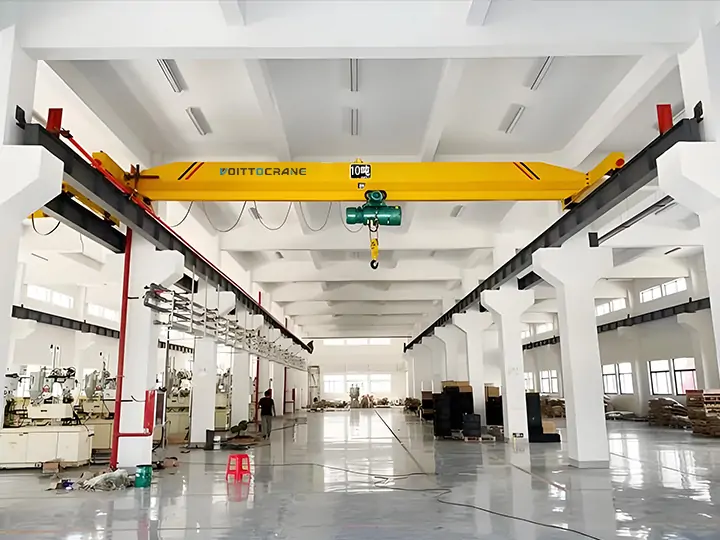
An electric overhead crane is a type of material handling equipment widely used in industrial production, warehousing and logistics, and steel mills and metallurgy. It consists of a bridge, an overhead running mechanism, a trolley travel mechanism, a lifting mechanism, and other parts. Operating on rails above a factory building, it can lift, transport, and precisely position materials over a wide area. Electric overhead cranes are typically equipped with a wire rope hoist, a European electric hoist, or a winch trolley as the lifting mechanism, enabling efficient lifting of a variety of cargoes, including metal materials, machinery, and bulk materials.

Suspension Underhung Crane

European Electric Overhead Crane
According to different structures and application scenarios, electric overhead cranes can be divided into single-girder electric EOT cranes, double-girder electric overhead travelling cranes, and suspension underhung cranes. Because its structure and appearance resemble a “bridge”, it is called an electric overhead crane.
Electric Overhead Crane Operation Guide Before Preparation
Before using the electric EOT crane, the operator should conduct a comprehensive inspection of the equipment to ensure it is in good condition. The specific inspection items are as follows:
- Structural Components Inspection: confirm that the main beam, end beam, traveling mechanism, and other metal structures are not deformed, loose, cracked, or corroded.
- Electrical System: Check the control cabinet, cables, and switches for proper function.
- Mechanical Components: Verify that the wire rope, hook, and pulleys are free of visible wear or deformation.
- Braking System: Test the brakes for sensitivity and reliability.
- Lubrication: Ensure that key components are adequately lubricated.
- Operating Environment: Check the tracks and work area for obstructions.
Electric Overhead Cranes Standard Operating Procedures

Lifting Operation
- Accurate Positioning: through the cab monitoring system or ground command, the center of the hook is aligned with the center of the cargo, and the error should be controlled within ±50mm.
- Lowering of Spreader: Slowly lower the spreader to about 1 meter above the cargo and pause to confirm that the hook is aligned with the corner pieces of the box.
- Locking Confirmation: Continue to lower the spreader until the hook is fully locked. Confirm that it is securely locked with the instructions of the ground personnel.
- Test Lift Inspection: First, lift 5–10 cm, pause to observe whether the material is balanced. After confirming that there are no abnormalities, continue lifting.
Cargo Handling
- Smooth Lifting: to raise the cargo to a safe height at an even speed (usually not lower than 2 meters).
- Horizontal Movement: first, run the bridge to the target position above, and then move the trolley to avoid the compound action at the same time.
- Precise Positioning: Switch to low-speed gear when approaching the target position, so that the placement accuracy reaches within ±25mm.
- Safe Placement: Slowly lower the cargo and release the hook after confirming that the load display returns to zero when the cargo is fully loaded.
Special Working Conditions
- Strictly adhere to hazardous material classification signs during operation.
- Maintain a smooth, impact-free lifting process.
- Reduced speed may be necessary to ensure safety.
Operator Qualification Requirements
- Must obtain a special equipment operator’s license (Q4 or Q8 program).
- Regularly attend retraining (usually every 4 years).
- For the operation of new electric overhead cranes, professional training provided by the manufacturer is required.
Safety Precautions
Operation Discipline
- It is strictly prohibited to violate the rules of command, operation, and labor discipline.
- It is prohibited to carry out maintenance on a suspended cargo.
- Do not use the emergency stop button indiscriminately.
Load Management
Strictly implement the rated load regulations, including:
- Overloading operation is not allowed.
- Pay attention to load curve changes (the larger the working range, the smaller the allowable load).
- After a sudden unloading (e.g., cargo drop), the controller should be zeroed first.
Emergency Handling
- Sudden power failure: Immediately return all the controllers to zero position, place the container safely through the backup power, or activate the manual release device.
- Equipment abnormality: If there is an abnormal sound, vibration, or electrical spark, stop the operation immediately and report for maintenance.
- Collision accidents: If a collision occurs, you must stop the machine to check the structural deformation and track condition, and shall not continue to use it without evaluation.
Daily Maintenance and Care
Electric overhead crane operators can perform maintenance and inspection according to the following procedures:


- The surface of the wire rope needs to be kept lubricated (at least once every semi).
- Check brake pad wear weekly (remaining thickness less than 50% of the original thickness must be replaced).
- Measure wheel rim wear once a month (vertical wear exceeding 15% of the original thickness should be replaced).
- Periodically, remove dust from the electrical cabinet.
- Check the working condition of the cable reel unit.
- Test the sensitivity of each safety limit switch.
- Following the manufacturer’s requirements cycle (usually every 100-200 working hours), for each lubrication point to fill the specified type of grease.
- Establish equipment operation files to record each inspection and maintenance.
Conclusion
Mastering the standardized electric overhead crane operation guide and specifications can not only improve production efficiency, but also important guarantee of safe operation. In actual use, enterprises should combine their own production needs to establish a complete electric overhead crane operation guide and training systems to achieve a safe, efficient, and sustainable production environment. VOITTO is committed to providing you with some valuable references, So that you can deal with various emergencies during use and reduce downtime.
If you have any specific requirements or need further assistance, please feel free to contact our team of experts. VOITTO will provide you with custom electric overhead crane solutions and professional support.




 English
  Español
  Português
  العربية
  Français
  Русский