
If you’ve watched an overhead crane lift a multi-tonne load across a factory bay, the motor driving that movement is doing far more than simply spinning a shaft. It’s managing torque, controlling speed, holding loads safely, and withstanding hundreds of start-stop cycles every day. Understanding how that works — at a practical level — is what separates a smart procurement decision from an expensive one.
The core answer is this: an overhead crane motor converts electrical energy into mechanical motion through electromagnetic induction. That motion drives three distinct crane functions — lifting, lowering, and horizontal travel. But the motor type, duty rating, braking system, and control method determine whether your crane runs reliably for 20 years or causes recurring problems from year two onward.
This guide walks you through the working principle, key motor types, critical specifications, and what to look for when evaluating products for your facility.
- 1 The Working Principle: How the Motor Drives Movement
- 2 Crane Motor Types: Matching the Motor to the Application
- 3 Overhead Crane Motor Specifications: What the Numbers Actually Mean
- 4 How the Motor Fits Into the Hoist System
- 5 Selecting the Right Motor Configuration for Your Environment
- 6 Summary: What to Take Away Before You Specify
-
7
FAQ
- 7.1 Q1: What is the difference between a hoist motor and a travel motor on an overhead crane?
- 7.2 Q2: Why does the duty cycle class matter more than power rating when selecting a crane motor?
- 7.3 Q3: When should I specify a European FEM standard electric hoist instead of a standard CD/MD type?
- 7.4 Q4: What protection rating should I specify for overhead crane motors in my facility?
- 7.5 Q5: Can an overhead crane motor be repaired, or is replacement usually the better option?
The Working Principle: How the Motor Drives Movement
Every electric motor for overhead crane use follows the same fundamental principle. When alternating current flows through the stator windings, it generates a rotating magnetic field. That field induces current in the rotor, which produces its own magnetic force — and the rotor spins in response. This is electromagnetic induction.
That rotational force is then transferred through a reducer (gearbox) to the mechanical system: a drum that winds wire rope for hoisting, or a drive wheel that moves the bridge or trolley along the rail.


How the Hoist Motor Lifts a Load
The hoist motor drives a drum that winds and unwinds wire rope — or in chain hoist configurations, a sprocket that moves the chain. Reversing the motor direction reverses the drum rotation, lowering the load.
What makes crane hoist motors different from general industrial motors is the integrated electromagnetic brake. This brake is built directly into the motor unit. When power is applied, the brake releases magnetically. When power is cut — by design or due to a fault — a spring clamps the brake discs instantly. The load holds in place. This is a fail-safe system, not an add-on feature, and it’s required for all hoist applications.
How Travel Motors Move the Bridge and Trolley
A bridge crane has two independent travel systems. The bridge travels longitudinally along the runway rails — end to end across the bay. The trolley travels laterally across the bridge beam. Each movement has its own dedicated motor.
Travel motors face less vertical load stress than hoist motors. However, long-span bridges — typically over 15 meters — use two motors driving simultaneously. If their output speeds drift, the bridge skews on the rails. Over time, this creates uneven rail wear and structural fatigue. Synchronization between paired travel motors is a frequently overlooked detail in procurement.
Crane Motor Types: Matching the Motor to the Application
Selecting the correct motor starts with understanding what each crane motor type is designed to do — and where it falls short.
AC Squirrel Cage Motors
These are the workhorses of standard overhead crane systems. The rotor has no external connections, brushes, or slip rings. The result is a simple, robust, low-maintenance motor suited to light and medium-duty applications.
Speed control is limited without a Variable Frequency Drive (VFD). For workshop cranes with basic on/off operation, that’s acceptable. For applications requiring smooth acceleration or precise positioning, pairing this motor with a VFD is the practical solution.
AC Wound Rotor (Slip Ring) Motors
Wound rotor motors use external resistors connected via slip rings to adjust speed and starting torque without a VFD. They handle variable, heavy loads well — which is why steel mills, foundries, and port facilities favor them.
The maintenance trade-off is real. Brushes and slip rings are wearing components that require periodic inspection. This must be factored into the total cost of ownership, especially in high-cycle applications.
Brake Motors (Integrated Brake Configuration)
This isn’t a separate motor category — it’s the standard configuration for all hoist applications. The motor and electromagnetic brake are combined in a single unit. Almost every electric hoist uses this setup.
The brake in a crane hoist motor automatically engages when power is off or operation stops, preventing heavy objects from sliding down. This is a non-negotiable safety requirement, not an optional upgrade. Any hoist motor you specify should include this as standard.
VFD-Controlled AC Motors
A Variable Frequency Drive adjusts the frequency and voltage supplied to the motor, enabling smooth speed ramp-up, variable operating speeds, and controlled deceleration. For applications requiring precise load positioning — such as assembly lines or mold handling — variable frequency drive control allows smooth speed adjustment and prevents load swing.
In modern production environments, VFD-controlled motors are increasingly the baseline expectation — not a premium tier. They extend motor life, reduce mechanical shock on the crane structure, and improve operator control.
Overhead Crane Motor Specifications: What the Numbers Actually Mean
When reviewing a motor datasheet, these are the overhead crane motor specifications that directly affect reliability and service life.
| Specification | Recommended Range | Why It Matters |
|---|---|---|
| Duty Cycle Class (IEC 60034-1) | S3, S4, or S6 for crane use | Must match actual operating intensity |
| Power Rating (kW) | Sized to crane load and speed | Right-sizing prevents overload and waste |
| Insulation Class | Class F (155°C) or H (180°C) | Determines thermal tolerance and lifespan |
| Protection Rating | IP54 minimum; IP55+ for harsh sites | Guards against dust and moisture |
| Voltage | Match facility supply (380/400/460V) | Voltage mismatch causes immediate failure |
| Integrated Brake Torque | 1.5–2× motor rated torque | Ensures safe load holding when power cuts |
The Duty Cycle Mistake That’s Easy to Make
Duty cycle class is the most commonly overlooked specification in crane motor procurement. An S1-rated motor is designed for continuous, uninterrupted operation — like a conveyor belt. An overhead crane operates in repeated start-lift-stop-travel cycles. That pattern is classified as S3 (Intermittent Periodic Duty) or S4 (Intermittent with Starting) under IEC 60034-1.
Using an S1 motor in a high-cycle crane generates heat it was never designed to dissipate. Insulation degrades. Bearings fail early. The motor needs replacement far sooner than expected. Always verify the crane’s duty class — per FEM 1.001 or ISO 4301 — before confirming the motor specification.
How the Motor Fits Into the Hoist System
The motor alone doesn’t lift anything. It works as part of a complete drive system. Understanding how the components connect helps procurement teams evaluate full packages, not just isolated components.
Motor → Reducer → Drum
The reducer is responsible for reducing the speed of the motor and increasing the torque. The drum is responsible for winding and unwinding the wire rope or chain. The gearbox ratio must match the hoist’s required lifting speed and load capacity. A mismatched ratio forces the motor to work outside its efficient operating range — causing heat buildup and early wear.
Wire Rope vs. Chain as the Lifting Medium


The choice of lifting medium affects the entire drive system specification. Compared with the chain electric hoist, the wire rope electric hoist has the advantages of fast lifting speed, higher lifting height, economy, and practicality. For loads above 5 tonnes or lifting heights above 6 meters, wire rope is typically the correct choice. Chain hoists are well suited to lighter, lower-height applications where their compact form is an advantage.
European FEM Standard Hoists: A Different Motor Architecture
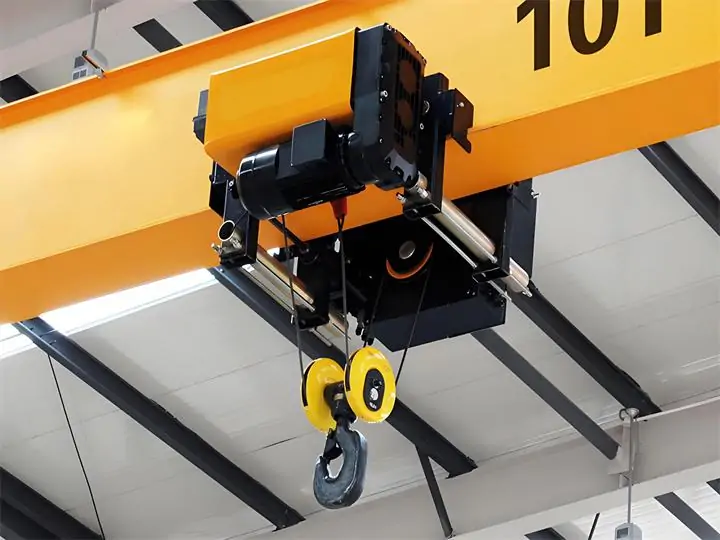

European electric hoists adopt a modular design, equipped with a high-efficiency brake motor and reducer, with a variable frequency speed regulation function and a safety protection device. This design integrates the motor, reducer, drum, and brake into a compact, pre-engineered unit. It reduces installation complexity and improves consistency across the drive system. Built to European FEM standards, capacity reaches 1 to 80 tons and is suitable for demanding duty cycles (M5–M7) and precision lifting tasks.
For procurement teams comparing standard CD/MD wire rope hoists against European FEM models, the key distinction is operational intensity. Standard hoists handle light to medium duty well. European FEM configurations are built for facilities running higher cycle counts and requiring tighter positioning accuracy.
Selecting the Right Motor Configuration for Your Environment
Application environment directly affects motor specification — often as much as load capacity does.
Standard Workshop and Manufacturing Environments
For general manufacturing facilities with cranes operating under moderate daily cycles, an AC squirrel cage brake motor with Class F insulation and IP54 protection is the practical baseline. Wire rope electric hoists are suitable for 1 to 25-ton loads with lifting heights up to 45 meters, working with overhead cranes, gantry cranes, and jib cranes.
High-Precision Production and Automotive Applications
The European electric hoist is suitable for the automobile manufacturing industry, workshop machining, warehouse logistics, and other industries, mainly used for material or cargo handling, assembly, lifting, and other work. VFD control is essential here — smooth acceleration prevents load sway and protects precision components during positioning.
Hazardous and Explosive Environments
In petrochemical, pharmaceutical, coal, or gas facilities, a standard motor is not a safe option. Explosion-proof hoists utilize special processes such as explosion-proof motors, explosion-proof electrical components, and anti-static materials during design and manufacturing, effectively preventing explosions caused by electric sparks, friction sparks, or overheating. These units comply with ATEX and IECEx standards. For classified hazardous zones, this is the only compliant choice — not an upgrade option.
Low-Headroom Facilities
Where ceiling height is limited, standard hoist motor configurations may reduce usable lift height significantly. Low-headroom type hoists have been designed specifically for applications where factory height is limited or lifting space is restricted. The motor and drive components are repositioned to minimize the distance between the hook and the rail beam, recovering vertical clearance that would otherwise be lost. How much clearance is actually recovered — and whether it’s enough for standard sling sets to work without custom rigging — depends on four specific dimensions that most supplier datasheets don’t present together. That calculation, along with the European vs standard hoist design comparison, is laid out in detail in the low headroom crane guide.
Summary: What to Take Away Before You Specify
An overhead crane motor is not a commodity item. The duty cycle class, insulation rating, brake integration, environmental protection, and control method all determine whether the system performs as expected — or becomes a maintenance burden.
Start with your crane’s duty classification. Confirm the site environment. Then match the motor configuration to both. For most standard industrial applications, an AC brake motor with VFD control provides the right balance of performance, control, and longevity. For demanding or hazardous environments, European FEM configurations and explosion-proof designs are not optional upgrades — they’re the correct baseline.
Work with a supplier who can provide complete drive system documentation — not just a motor datasheet — before confirming any purchase. The specification decision made at procurement determines the maintenance reality for the next 15 to 20 years.

Alan
Crane Solutions Specialist · Voitto Crane
Specialized in Overhead Crane, Gantry Crane, Jib Crane, Port Crane & EOT Crane export solutions. 10+ years helping global clients with pre-sales consultation, capacity selection and site-specific configurations.
FAQ
Q1: What is the difference between a hoist motor and a travel motor on an overhead crane?
A hoist motor handles vertical lifting. It must withstand high starting torque, frequent start-stop cycles, and always includes an integrated electromagnetic brake that holds the load when power is removed. A travel motor drives horizontal movement — either the bridge along the runway or the trolley across the beam. Travel motors experience less torque stress but require careful speed matching on long-span cranes with paired drives. Both motor types should be specified separately based on their individual load profiles and duty requirements, even when the crane OEM offers them as a bundled package.
Q2: Why does the duty cycle class matter more than power rating when selecting a crane motor?
Power rating tells you how much the motor can do. Duty cycle class tells you how long it can do it without overheating. A motor rated for S1 (continuous duty) running in an S3 or S4 crane application will overheat with every operating cycle because it cannot dissipate heat fast enough during the rest periods. Over time, this degrades insulation and shortens bearing life significantly. Always confirm the crane’s usage group classification per FEM 1.001 or ISO 4301 first — then select a motor whose duty class matches that intensity.
Q3: When should I specify a European FEM standard electric hoist instead of a standard CD/MD type?
Choose a European FEM standard hoist when your operation involves high duty cycles (M5 or above), requires precise load positioning, or demands low-headroom performance. The modular design, integrated VFD, and high-efficiency brake motor make it better suited to intensive production environments like automotive manufacturing, precision assembly, and aerospace facilities. Standard CD/MD hoists are cost-effective for light to medium-duty applications with lower cycle frequency. If your crane runs multiple shifts per day with consistent load demands, the FEM configuration is the more sustainable long-term choice.
Q4: What protection rating should I specify for overhead crane motors in my facility?
IP54 is the standard baseline for most indoor industrial environments — it protects against dust ingress and water splashing from any direction. For outdoor applications or high-humidity environments such as washdown areas or coastal facilities, IP55 or higher is recommended. Facilities handling chemicals or subject to condensation should request IP65. For hazardous zones with flammable gases or dust, the protection rating must be specified as part of the full ATEX or IECEx explosion-proof classification — the IP rating alone is insufficient. Always assess your worst-case environmental condition, not the average condition.
Q5: Can an overhead crane motor be repaired, or is replacement usually the better option?
Repair is reasonable when the damage is isolated — such as a bearing replacement or brake lining renewal — and the motor’s core insulation and winding condition are confirmed healthy via megger (insulation resistance) testing. Replacement is the better decision when winding insulation has degraded below acceptable levels, when repair costs exceed 50–60% of a new motor’s cost, or when the original motor was incorrectly specified for the application. In that last scenario, repairing the existing unit simply restores the same underlying mismatch. Replacement with a correctly rated motor eliminates the root cause rather than deferring it.




 English
  Español
  Português
  العربية
  Français
  Русский