
In various industries, choosing the right portable jib crane is crucial for improving lifting efficiency, ensuring workplace safety, and reducing manual handling costs. Whether in workshops, warehouses, construction sites, or maintenance operations, a well-selected portable jib crane can significantly enhance productivity and flexibility. Facing different lifting capacities, boom lengths, rotation angles, and movement methods, buyers may face challenges when selecting the most suitable model.
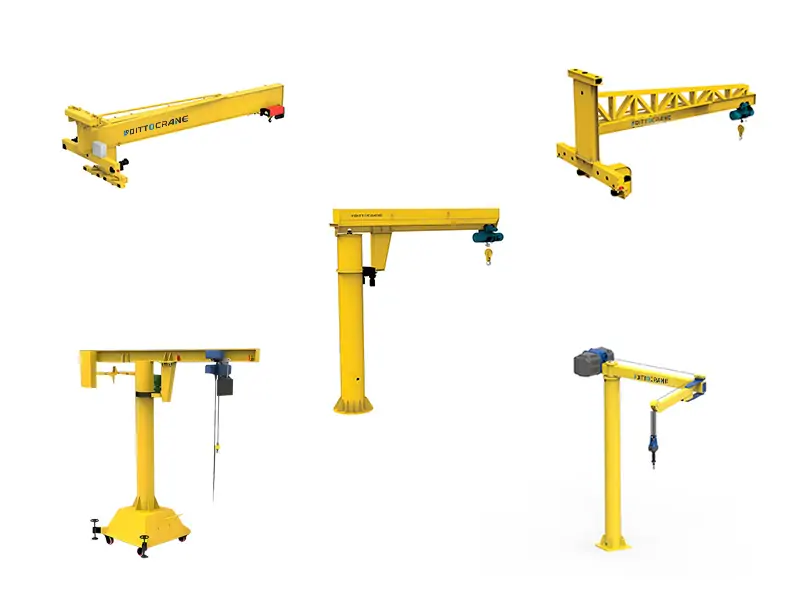
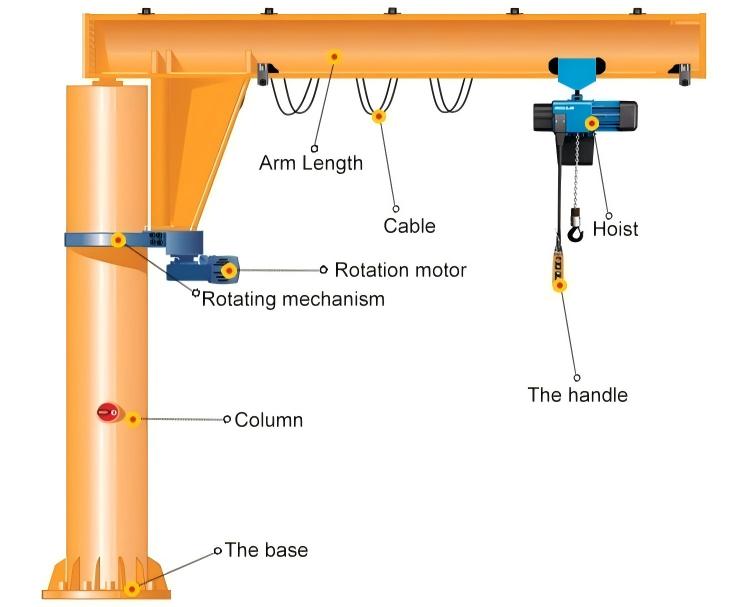
In this portable jib crane buying guide, we will explain in detail how to choose a portable jib crane based on key factors such as lifting capacity, operating radius, mobility requirements, installation conditions, and application scenarios. You will also learn about different types of portable jib cranes, common application scenarios, and practical advice to help you choose the most appropriate solution for your specific lifting needs.
What Is a Portable Jib Crane and Where Is It Used?
Portable jib crane is a movable small-scale lifting device consisting of a column, a rotating arm (jib), and a supporting electric or manual hoist. Unlike fixed jib cranes, it can be flexibly transferred between different workstations. By utilizing the rotation of the jib (generally 180° or 360°) and the lifting motion of the hoist, it enables rapid material handling and precise positioning. It is an essential piece of equipment for improving operational efficiency and reducing manual handling.
Main application scenarios include:
- Workshop Production Lines: Used for equipment loading/unloading and component transfer.
- Warehouses and Logistics Centers: Carrying out cargo loading/unloading, handling, and sorting.
- Equipment Maintenance and Repair: Lifting medium and small equipment such as motors and pumps.
- Mold and Manufacturing Industry: Mold replacement and precision positioning.
- Small Assembly Stations: Assisting manual labor in completing repetitive lifting tasks.
Overall, the portable lifting jib crane is particularly suitable for scenarios requiring flexible handling, limited space, or frequent changes in workstations, offering high practical value in the field of light to medium-duty material handling.
Types of Portable Jib Cranes
Voitto provides a range of portable jib crane solutions to meet different lifting needs in workshops, warehouses, and professional industries. From fixed floor-mounted systems to fully mobile and articulated designs, each type is carefully engineered to optimize space utilization, lifting efficiency, and operational flexibility.
Choosing the right type depends on your workspace layout, load capacity, and mobility needs. Below is an overview of the most common types of portable jib cranes and their main features.
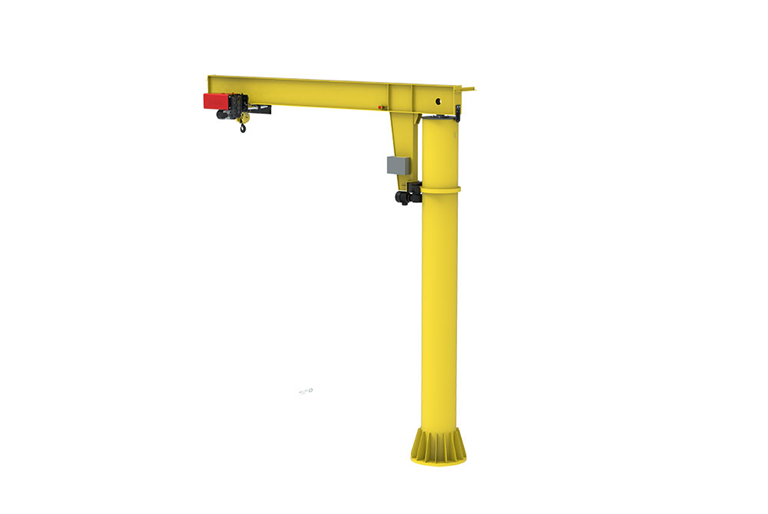
Floor Mounted Jib Crane
Definition: A floor-mounted jib crane is installed on the ground with a fixed base, providing stable and reliable lifting operations within a specified area.
Features: Due to the fixed ground installation, this type offers excellent structural stability and high load-bearing capacity, supporting continuous heavy-duty lifting operations. It features a wide rotation angle and is compatible with electric hoists.
Application Range: Widely used in manufacturing workshops, assembly lines, and heavy material handling areas.
Basic Parameters:
- Load Capacity: 0.5t – 10t
- Jib Length: 2m – 10m
- Rotation Angle: 180° / 270° / 360°
- Lifting Height: 2m – 8m
Wall Traveling Jib Crane
Definition: A wall traveling jib crane is installed on walls or columns and moves horizontally along rails, thereby expanding the operating range to cover a larger work area.
Features: Designed to move along wall-mounted rails, this crane maximizes workspace coverage without occupying floor space, making it an ideal choice for efficiently extending lifting operations across multiple workstations.
Application Range: Suitable for factories, warehouses, and production lines that require overhead coverage without obstructing ground passage.
Basic Parameters:
- Load Capacity: 0.5t – 5t
- Jib Length: 3m – 8m
- Traveling Length: Customizable
- Lifting Height: Depends on installation height

Wall Mounted Cantilever Crane
Definition: This crane is fixed to a wall or column and features a horizontally rotating jib.
Features: Utilizing a compact wall-mounted design, this crane saves floor space while providing a reliable and efficient lifting solution within a limited working range, especially suitable for localized operations.
Application Range: Very suitable for small workshops, maintenance stations, and areas with limited space.
Basic Parameters:
- Load Capacity: 0.25t – 3t
- Jib Length: 2m – 6m
- Rotation Angle: Up to 180°
- Lifting Height: Customizable

Portable Jib Crane On Wheels
Definition: A mobile jib crane equipped with wheels that can be easily moved between different locations.
Features: Equipped with a mobile base and wheels, this crane offers high flexibility and can be easily repositioned between work areas, making it ideal for dynamic environments where lifting points change frequently.
Application Range: Perfect for workshops, warehouses, and maintenance operations where lifting positions change often.
Basic Parameters:
- Load Capacity: 0.25t – 2t
- Jib Length: 2m – 5m
- Rotation Angle: 180°–360°
- Movement Method: Manual push or electric

Portable Articulated Jib Crane
Definition: An articulated jib crane utilizes a jointed arm design to flexibly bypass obstacles.
Features: Featuring a multi-jointed articulated arm, this crane offers excellent maneuverability and precise positioning capabilities, enabling it to work around obstacles and operate effectively in narrow or complex spaces.
Application Fields: Used for assembly lines, precision manufacturing, and areas with complex layouts.
Basic Parameters:
- Load Capacity: 0.125t – 1t
- Arm Length: 2m – 6m
- Rotation Angle: Up to 360°
- Joint Movement: Multi-axis

Boat Jib Crane
Definition: A boat jib crane is specifically designed for marine environments, used for lifting equipment on docks or ships.
Features: Manufactured with corrosion-resistant materials and a durable structure, this crane is specifically designed for marine environments to ensure reliable operation in outdoor, humid, and saltwater conditions.
Application Fields: Commonly used in docks, shipyards, and ship maintenance operations(This marine travel lift has a relatively low lifting capacity. For more information on marine travel lifts, please read“How to Choose the Right Marine Travel Lift Capacity for Your Boat Yard”).
Basic Parameters:
- Load Capacity: 0.25t – 3t
- Jib Length: 2m – 6m
- Rotation Angle: 180°–360°
- Surface Treatment: Anti-corrosion coating
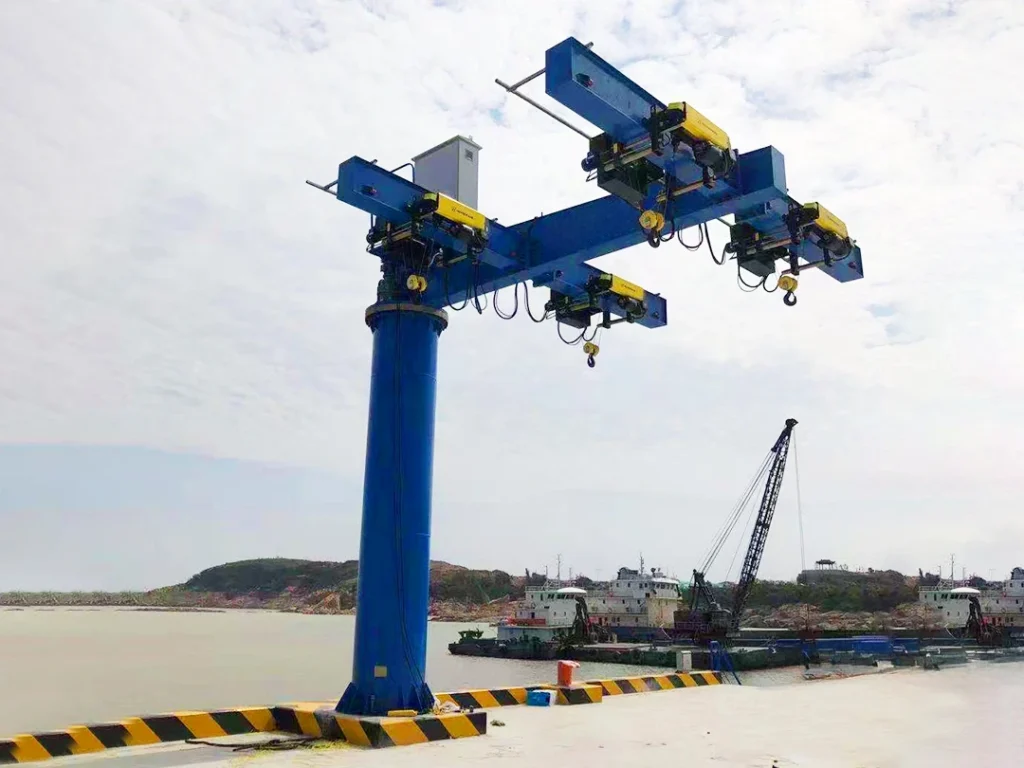
Each type of portable jib crane has its specific purpose, ranging from fixed heavy-duty lifting to flexible mobile operations and precision handling. The best choice depends on your workspace constraints, load requirements, and mobility needs. Let’s look at a real-life case to experience the impressive results brought by using the right equipment.
Case Study
The client is from the UAE, serving the oil and gas, construction engineering, and industrial equipment sectors. The workshop has multiple fixed workstations and requires frequent assembly and maintenance of materials like motors, pump sets, and valves weighing 300–1000kg. Under high-temperature, dusty environments and local standard requirements, Voitto customized and delivered 3 sets of customized pillar-mounted jib cranes. This equipment includes 360° rotation, 2–6m boom length, 2–6m lifting height, 8/0.8 m/min lifting speed, and an A4 work duty, suitable for conditions from -20°C to 42°C. Since being put into use, the equipment has operated stably and is easy to use, significantly reducing manual handling intensity and improving the efficiency and safety of multi-station operations, fully meeting the client’s high-frequency needs and receiving positive feedback.
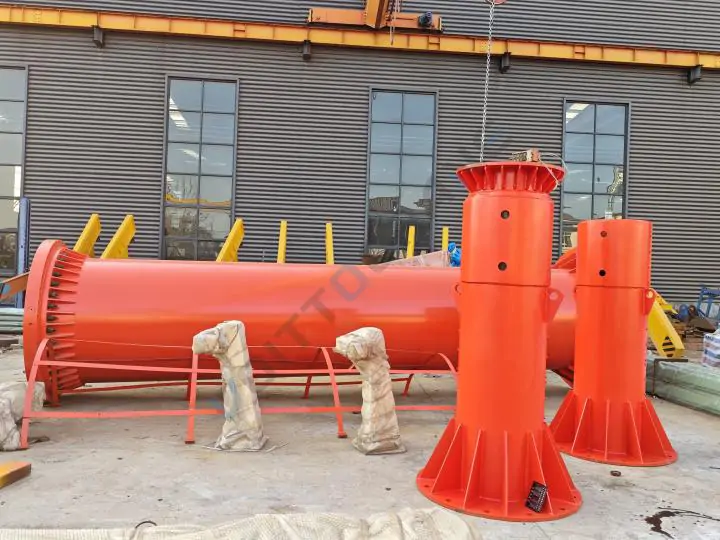
Overall, this project verified the high cost-effectiveness and practical value of pillar-mounted jib cranes in small and medium-sized workstations, making it an ideal choice for industrial assembly and maintenance scenarios in the Middle East.
Benefits of Portable Jib Cranes
The flexibility, efficiency, and cost-effectiveness of portable jib cranes make them widely used in workshops and warehouses. Key advantages include:
- High Mobility: Can be easily moved between workstations to support flexible operations.
- Easy Installation: Can be quickly installed and used without complex foundations.
- Increased Efficiency: Speeds up handling operations and reduces manual labor.
- Cost-Effective: A lower-cost alternative compared to fixed crane systems.
- Space Saving: Compact design makes it ideal for space-limited or crowded work areas.
- Enhanced Safety: Minimizes lifting risks and improves workplace safety.
- Versatile Use: Suitable for various industries and applications.
When flexibility, ease of use, and cost control are the primary considerations, portable jib cranes are the ideal lifting solution for small and medium-duty operations. Next, let’s look at how to choose the right Portable lifting Jib Crane.For a detailed breakdown of each advantage, see our guide on the benefits of portable jib cranes.
How to Choose a Portable Jib Crane?
The best way to choose a portable jib crane is to match the crane’s specifications with actual lifting tasks, workspace conditions, and operational needs, rather than just looking at price or appearance. Choosing the right crane can improve efficiency, safety, and long-term cost-effectiveness, while choosing the wrong one may lead to overload risks, limited operating range, or wasted investment.
Load Capacity:
Determine your maximum lifting weight (including tools and accessories). Choose a crane with a lifting capacity at least 10-20% higher to ensure equipment safety and durability.
Handling Range and Lifting Height:
The boom length determines horizontal coverage, while the lifting height ensures there is enough space above the equipment.
Workspace and Layout:
- Limited space → Wall-mounted or compact designs.
- Open areas → Mobile or free-standing cranes.
- Obstacles → Articulated jib cranes.
Mobility Needs:
Whether the equipment will perform fixed lifting at a single station or move flexibly between multiple areas.
Suitable Hoist and Power Supply:
- Manual hoist → Low-frequency operations, cost-focused tasks.
- Electric hoist → High efficiency, frequent lifting.
Safety and Stability:
Ensure the crane is equipped with a stable base or counterweight to prevent tipping. It should have locking wheels for safety during operation and overload protection to avoid lifting beyond the rated load, thereby reducing safety risks.
The method for choosing a portable jib crane is to evaluate these six key factors: load capacity, operating range, workspace layout, mobility needs, crane type, and safety features.
Portable Lifting Jib Crane vs. Gantry Crane
When choosing between a portable lifting jib crane and a gantry crane, the difference lies in movement method, coverage area, and application scenarios. Both have their advantages and are suitable for different material handling needs.
| Feature | Portable lifting Jib Crane | Gantry Crane |
| Structure | Vertical column + rotating arm | Bridge beam + two legs |
| Mobility | High (can be moved easily) | Medium–High (runs on wheels or rails) |
| Coverage Area | Limited (circular area) | Large (linear travel area) |
| Load Capacity | Light to medium (0.25–5t) | Medium to heavy (1–100t+) |
| Installation | No foundation needed (portable types) | Minimal or rail-based setup |
| Best For | Local lifting tasks | Moving loads across longer distances |
Portable jib cranes are ideal for flexible, localized lifting operations, while gantry cranes are more suitable for heavy-duty operations across larger areas. The best choice depends on your load requirements, workspace size, and mobility needs.
FAQS
1.What Capacity Portable Jib Crane do I Need?
The required lifting capacity depends on your maximum load, but for safety, it is recommended to choose a crane with a capacity at least 10-20% higher.
2. Can portable jib cranes be used in high-temperature environments?
Yes, with proper customization, such as using heat-resistant components and protective coatings, jib cranes can operate in such conditions.
3. What is the difference between a mobile jib crane and a fixed jib crane?
Portable jib cranes offer mobility and flexibility, whereas fixed jib cranes do not. Specialized workstations offer higher stability.
4. Is an electric hoist better than a manual hoist?
Electric hoists are better suited for frequent and heavy lifting, while manual hoists are suitable for light or occasional use.
5. How much space is needed to install a jib crane?
The space required depends on the boom length and rotation angle, but portable models are ideal for compact or limited areas.
6. Can jib cranes be customized?
Yes, jib cranes can be customized to meet the needs of steel mills, warehouses, shipyards, and other industries.
Conclusion
In conclusion, choosing the right portable jib crane requires matching it with the actual working environment, lifting frequency, and operational needs. As shown in this case study, a properly configured 1-ton jib crane can significantly improve efficiency, reduce manual handling, and ensure safety.
If you are unsure which crane is best suited for your application, our engineering team is ready to help. VOITTO is a well-known portable jib crane manufacturer in China, certified with ISO and CE, ensuring that every piece of equipment meets the highest international standards. We will provide customized solutions based on your workspace, load requirements, and industry standards. Contact us today.

Alan
Crane Solutions Specialist · Voitto Crane
Specialized in Overhead Crane, Gantry Crane, Jib Crane, Port Crane & EOT Crane export solutions. 10+ years helping global clients with pre-sales consultation, capacity selection and site-specific configurations.




 English
  Español
  Português
  العربية
  Français
  Русский